How Do Bulgarians Say "Hi"?
How people in Plovdiv greet each other: the everyday Bulgarian words for hi, hello and thank you, when formality matters, and how far English carries you in the city.
Plovdiv, Bulgaria's second-largest city and an inland city of six hills in the south of the country, is a place where greetings do real social work. The national language is Bulgarian, written in the Cyrillic alphabet, and the words people use to open a conversation depend on the hour, the setting and how well they know each other. Visitors who arrive with even two or three phrases notice the difference immediately, in cafes on the Main Street, in shops in Kapana and at the tables of the Old Town.
How Do Bulgarians Say "Hi"?
The standard everyday word is "zdravey", which works as hi or hello in most casual situations in Plovdiv, with "zdrasti" as a shorter, looser version used between friends and younger speakers. For a more formal or polite register, Bulgarians use "dobur den", good day, during daytime hours. The words stay the same whether you are in Plovdiv, Sofia or a village in the Rhodopes, because Bulgarian is the single state language of the country.
That is the short version. The longer version is that Bulgarian, like most Slavic languages, keeps a firm line between the informal "ti" and the formal "vi", the equivalent of tu and vous in French. The greeting you choose signals which register you are choosing. "Zdrasti" to a stranger of an older generation can read as breezy; "dobur den" to a group of teenagers in Kapana reads as stiff but never rude. Visitors are cut a great deal of slack, and a friendly attempt at any of these words is generally met with warmth rather than correction.
There is also the physical layer. In Bulgaria the customary greeting between acquaintances is a handshake, and close friends and family often kiss cheeks, but the head shake that accompanies yes and no is famously reversed from Western expectation: a nod can mean no and a head shake can mean yes. This trips up newcomers more than any vocabulary item. Watch the words and the eyebrows, not just the head movement, and the meaning becomes clear quickly.
What Do The Everyday Greetings Sound Like In Plovdiv?
The core set is small: "zdravey" and "zdrasti" for hi, "dobur den" for good day, "dobro utro" for good morning, "dobar vecher" for good evening, and "blagodarya" for thank you. Two parting phrases, "dovizhdane" for goodbye and "chao" for the casual bye, complete the visitor's toolkit. All of them are standard Bulgarian, spoken in Plovdiv exactly as elsewhere in the country, and none of them changes by region.
Pronunciation is friendlier than the Cyrillic script suggests. Stress in Bulgarian is mobile and not marked, which is why listening beats reading for these phrases. "Dobur den" carries its stress on the second syllable of each word, "blagodarya" on the "da". Say them roughly as written in Latin letters and a Plovdiv shopkeeper or waiter will understand the intent even when the accent slides.
The table below collects the phrases a visitor to Plovdiv is most likely to use in a single weekend.
| Bulgarian | What it means | Where it fits in Plovdiv |
|---|---|---|
| Zdravey | Hi, hello | General casual greeting, any time of day |
| Zdrasti | Hi (loose) | Friends, younger speakers, informal settings |
| Dobur den | Good day | Polite daytime greeting, shops, older people |
| Dobro utro | Good morning | Mornings, cafes, hotel staff |
| Dobar vecher | Good evening | Evenings, restaurants, events |
| Blagodarya | Thank you | Everywhere, any register |
| Dovizhdane | Goodbye | Neutral parting phrase |
| Chao | Bye | Casual, friends and peers |
One practical note for Plovdiv specifically: the Main Street, the Old Town and Kapana are walkable and dense with small shops, galleries and cafes, so the number of brief daily greetings a visitor exchanges is high. A "dobur den" on entering a small shop in Kapana is normal local behaviour rather than an overture. The district's name, "The Trap", comes from the tangle of its narrow streets, and its creative-quarter character means the atmosphere is relaxed and the greetings are low-key.
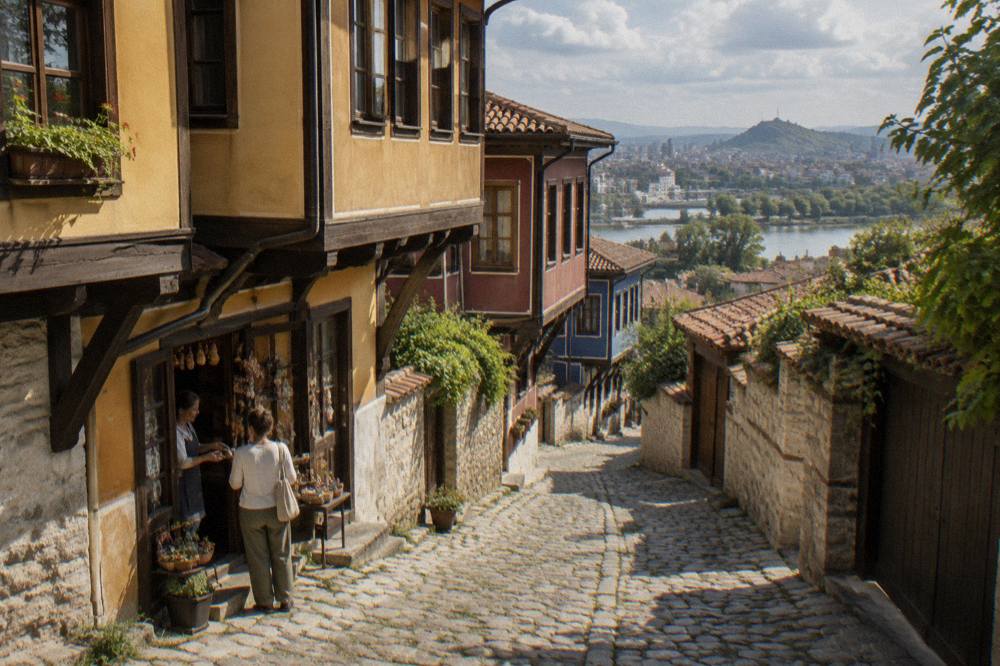
A guided walk is one of the more efficient ways to hear these words spoken at natural speed, because a local guide repeats place names, greetings and phrases in context all morning. The Old Town walk with rakia tasting pairs the route through Plovdiv's historic core with a tasting of rakia, the traditional fruit brandy, and rakia itself is a word worth learning before the first toast. If the timing of your visit is still open, the question of how many days to spend in Plovdiv shapes how much of the Old Town and the wider city you can cover on foot.
When Does Formality Matter In Plovdiv Greetings?
Formality matters on first contact and with older people: "dobur den" and the formal "vi" address are the safe defaults when entering shops, addressing staff or meeting someone older, while "zdrasti" belongs to friends, peers and clearly informal settings like bars in Kapana. Bulgarian keeps the informal and formal you distinct, and the greeting is where the choice becomes audible.
In practice the rules feel lighter than in some neighbouring countries. Plovdiv is a student city with a large creative scene, and younger people switch to the informal register quickly, sometimes immediately with visitors of a similar age. Service interactions stay politely formal on the staff side regardless. A visitor who uses the formal register a beat too long is never penalised; a visitor who drops to "zdrasti" with a stranger in their seventies may get a raised eyebrow, though directed at themselves rather than at a foreigner making the attempt.
The transition itself has a small ceremony attached. When two people agree to move to first names and the informal "ti", Bulgarians often say "haidede da se tukavame", roughly "come on, let's be informal", or simply announce the switch. It is a deliberate step, not a drift. Among friends, "chao" does service for both hello and goodbye, as it does across the Balkans, and "zdrasti" carries the same dual use in casual speech.
Three situations in Plovdiv where the register choice is most visible:
| Situation | Safer register | Why |
|---|---|---|
| Entering a small shop or gallery | Dobur den | Standard polite opener with strangers |
| Ordering in a cafe or restaurant | Dobur den or dobro utro | Neutral, works with any server |
| Meeting travellers or students | Zdravey or zdrasti | Informal is expected and welcomed |
Wine and rakia add their own vocabulary, and tastings are a setting where the greetings flow freely. The sunset wine tasting city tour combines a guided walk with local wine, and the Thracian Kings small group day trip takes the same hospitality out to the archaeological sites of the region. A toast in Bulgaria is "nazdrave", a word that doubles as a wish for health and appears early in any evening that involves a glass.
Do You Need Bulgarian At All In Plovdiv?
No, and yes: English carries a visitor through hotels, the Main Street, museums and younger service staff in Plovdiv without difficulty, but Bulgarian greetings open a noticeably warmer reception in small shops, markets and the Old Town, and Cyrillic signage makes a few learned phrases genuinely useful. Bulgarian remains the only official language, written in Cyrillic.
The English question has its own full treatment on this site, and the short answer for Plovdiv is that central areas are comfortable for English speakers while a handful of phrases extends the reach. Reading Cyrillic is a separate, smaller skill than speaking: transliterating street signs and menu boards takes an evening of practice and pays off constantly, because signage in Plovdiv is predominantly in Cyrillic even where staff speak English.
Where the phrases earn their keep:
- Small shops and studios in Kapana, where a greeting precedes browsing.
- Markets and stalls, where prices and small talk run in Bulgarian.
- The Old Town's house museums, where ticket staff greet every visitor.
- Any toast, where "nazdrave" is the word that starts it.
For readers planning the wider trip, the questions of whether Plovdiv is worth visiting and whether Bulgarians eat dinner late both touch the same daily rhythms the greetings live inside. The site's Plovdiv Travel Guide hub covers the rest of the practical picture, from the euro changeover of 1 January 2026 to getting in from Sofia.
Where To Practise Greetings Around Plovdiv?
The best practice grounds are Kapana's craft shops and cafes, the Sunday flow of the Main Street, and the ticket desks and courtyards of the Old Town houses, all places where short, repeated exchanges in Bulgarian are the norm. Guided walks add a fluent speaker to the loop, and the city's market stalls and bakery counters reward "dobur den" with immediate, patient response.
The logic is repetition. A visitor who buys coffee, a banitsa and a postcard in three separate small shops has used the same two-word greeting three times before noon, which is more reinforcement than any phrasebook session gives. The Old Town's museum houses, with their compact rooms and unhurried ticket staff, are similar low-stakes environments. Plovdiv's identity as a 2019 European Capital of Culture, shared with Matera, left the city with a well-developed habit of engaging foreign visitors patiently.
Food settings are the friendliest of all. The question of what a typical Bulgarian breakfast is usually resolves at a bakery counter, and the food and drink options around Plovdiv put a visitor in front of waiters who hear accented Bulgarian constantly and respond to it with visible good humour. "Blagodarya" at the end of a meal is the phrase that gets the most practice of any on the list.
Common Questions About Greetings In Plovdiv
How Do Bulgarians Say "Hi"?
With "zdravey" in everyday situations and "zdrasti" between friends, with "dobur den" as the polite daytime alternative. All three are standard Bulgarian, used in Plovdiv exactly as in the rest of the country.
Is "chao" used in Plovdiv?
Yes, "chao" is common as a casual hello and goodbye, especially among younger speakers and in informal settings such as bars and cafes in Kapana.
What does "nazdrave" mean?
It is the toast, equivalent to cheers, and it doubles as a wish for health. It is the single most useful word at any table in Plovdiv where a glass is raised.
Do Bulgarians shake hands or kiss cheeks?
Handshakes are the standard greeting between acquaintances, and close friends and family often kiss cheeks. A first meeting calls for a handshake and a verbal greeting.
Will anyone in Plovdiv speak English?
Yes, in hotels, central restaurants, museums and among younger staff, English is widely enough available that a visitor can manage comfortably, while a few Bulgarian phrases widen the welcome.
Is Bulgarian written in Cyrillic?
Yes, Bulgarian uses the Cyrillic alphabet, and signage in Plovdiv, from street names to menus, is predominantly in Cyrillic even where English is spoken inside.