Is It Okay To Travel To Sofia, Bulgaria As An American For Fun?
Yes, Americans travel to Sofia and Plovdiv for fun routinely: Bulgaria is in Schengen, uses the euro, and pairs the capital with Plovdiv, the country's second city, about three hours away by train.
Bulgaria has been a full Schengen member since 1 January 2025 and has used the euro since 1 January 2026, so an American visiting Sofia for fun faces far less friction than guidebooks written a few years ago suggest. The natural shape of the trip is a pair: the capital for a day or two, then the train south to Plovdiv, Bulgaria's second-largest city, an inland place built around six hills and often described as one of the oldest continuously inhabited cities in Europe. The BDZ timetable shows direct trains covering the run in about 2 hours 40 minutes to 3 hours 05, which makes the two-city holiday an easy one. This page walks through entry, money, safety, the rail link and what a first fun trip actually looks like when you build it around both cities.
Is It Okay To Travel To Sofia, Bulgaria As An American For Fun?
Yes, it is entirely ordinary for Americans to travel to Sofia, and to Bulgaria generally, purely for leisure. Bulgaria is a full member of the Schengen area since 1 January 2025, United States citizens are reported to enter visa-free for up to 90 days in any 180, and the country has used the euro since 1 January 2026. There is no fun-specific restriction, no special permit and no unusual paperwork beyond a passport.
The question usually hides two smaller worries. The first is whether entry will be smooth. Since 31 March 2024 air border checks with the rest of Schengen have been lifted, and since 1 January 2025 the land borders opened too, so a flight from another Schengen country lands like a domestic one. The Entry/Exit System, deployed at all Schengen external borders as of 10 April 2026, replaces passport stamps with biometric registration at first entry, a step that takes seconds at the booth. ETIAS, the planned electronic travel authorisation, is not operational, and no start date should be relied on until an official announcement exists.
The second worry is whether there is enough to justify the flight. Sofia answers that on its own, with a compact centre where Roman ruins sit below the street level and Vitosha mountain rises at the edge of town. Plovdiv, three hours south by direct train, is the reason to extend the trip rather than treat the capital as a city break. The city was European Capital of Culture in 2019, shared with Matera in Italy, and the legacy of that year shows in the festival calendar and the restored Old Town houses. For a fuller comparison, read whether Plovdiv is a nicer city than Sofia, which breaks down what each city does better.
A third worry, quieter than the other two, is simply whether Bulgaria is "set up" for tourists. It is. The tourist infrastructure runs from airport shuttles to guided walks in English, hotel booking works like anywhere in the European Union, and card payment is standard in cities. The country's own tourism pages publish hours and ticket prices in English for every major sight in Plovdiv, which is more than many better-known destinations manage.
Is Bulgaria Safe And Practical For American Travellers?
Bulgaria is a European Union member with the standard European emergency number, 112, free from any phone. Reported guidance for United States, United Kingdom, Canadian and Australian citizens is visa-free entry for 90 days in any 180-day period under the Schengen rule. No credible advisory singles out leisure travel to Sofia or Plovdiv as anything other than a normal European destination.
Practicalities are simpler than they were. The language is Bulgarian, written in Cyrillic, but signage at stations and airports carries Latin transliteration, and English is common in tourism settings. Plugs are type C and F at 230 volts, so American travellers need an adapter rather than a converter for dual-voltage devices.
The depth on safety lives in two dedicated pages: is it safe for Americans to travel to Bulgaria right now covers entry, health and street-level safety, and how safe is Plovdiv does the same for the second city. A tourist tax may be charged by accommodation, but its 2026 euro rate is not confirmed on the municipal pages, so confirm the amount at booking rather than expecting a fixed figure. In restaurants, tipping around a tenth of the bill for good service is the reported local norm, though it is a custom rather than an obligation.
| What Americans Ask | The Situation In 2026 |
|---|---|
| Visa needed? | No, reported visa-free for 90 days in any 180 for US citizens |
| Border process | EES biometric registration at first Schengen entry, in force since 10 April 2026 |
| Schengen status | Full member since 1 January 2025 |
| Emergency number | 112, free |
| ETIAS | Not operational, no reliable start date |
How Do Americans Get From Sofia To Plovdiv?
The BDZ timetable shows direct trains from Sofia to Plovdiv taking about 2 hours 40 minutes to 3 hours 05, with several departures across the day from 06:30 to late evening. Buses run the same corridor in a reported 1 hour 45 to 2 hours 20. Trains routed via Karlovo take far longer, roughly 4 hours 50 to 5 hours 50, so the direct services are the ones to pick.
If you would rather ride the coach, book a Sofia to Plovdiv bus ticket here.
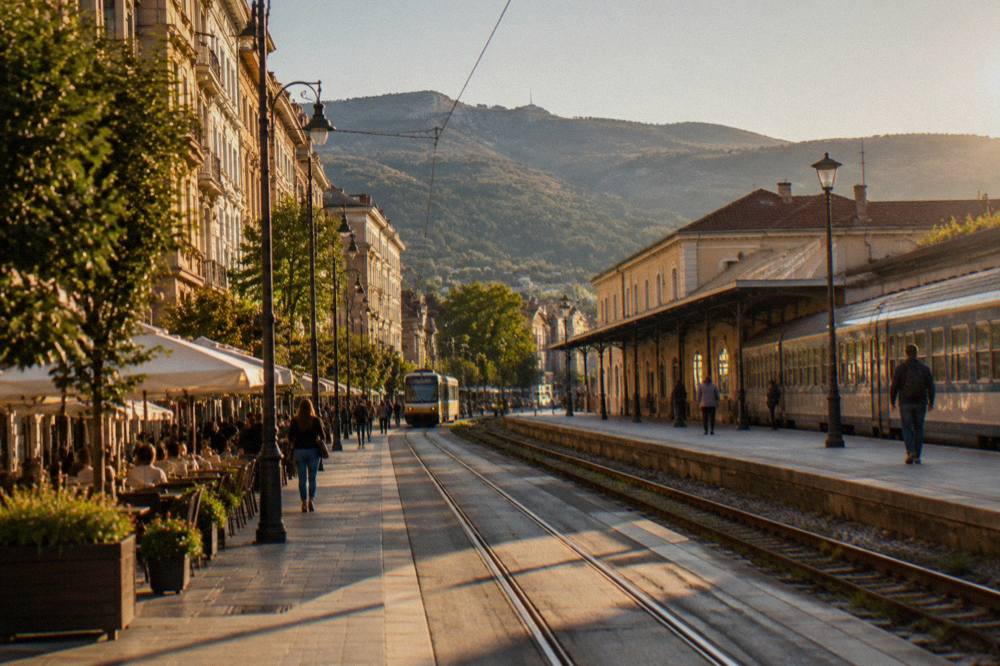
The rail pairing is the part worth knowing before you book a hotel. Sofia Central Station and Plovdiv's central station sit on the same corridor, and Plovdiv's station shares a street, Hristo Botev Boulevard, with the Yug bus station for southbound routes. One caveat: the Plovdiv railway junction has been under modernisation, reported 85 percent complete in November 2025 with completion due in 2026, so expect some access changes around the station itself while the works finish. The project includes a new underpass and rebuilt platforms, which means the station you arrive at may differ from the one older trip reports describe.
For Americans flying in, Sofia is the larger airport and the usual entry point; Plovdiv Airport at Krumovo has a small route list of its own, with its flight search listing Belfast, Birmingham, Bratislava, London, Manchester, Milan and Tel Aviv. Ryanair to Milan Malpensa and Wizz Air to Bratislava were announced by the airport, but seasonal schedules shift, so check with the airline before planning around a single route. The step-by-step rail guide, including which departures are fastest, is on the Sofia to Plovdiv page, and the guide to Plovdiv Airport covers the Krumovo option for anyone weighing a regional arrival.
If the return leg to Sofia can spare half a day, the revived town of Koprivshtitsa sits on the route between the two cities, and this half-day tour from Plovdiv covers it with a guide and transport. The six house museums there take a combined ticket of about 10 euro, per secondary sources. Check availability
Travellers who would rather drive the corridor should read whether an American can rent a car in Bulgaria before committing, and the multi-stop version of the same route is mapped in the Sofia, Plovdiv and Rila itinerary. The car-free alternative works well: trains and buses between the two cities run daily, and once in Plovdiv the core sights sit within walking distance of each other, with a city bus e-ticket at 0.50 euro for longer hops.
What Does A Fun Sofia And Plovdiv Trip Actually Look Like?
A fun first trip runs two cities in four to seven days: one to two days in Sofia, then the direct train to Plovdiv for two to four days built around the Old Town, the Ancient Theatre of Philippopolis, the Kapana creative district and a Rhodope day trip. ERA5 reanalysis for the region, 1991 to 2020, puts the July mean daily high at 28.2 C and the January mean daily low at minus 2.6 C, so spring through early autumn suits walking cities.
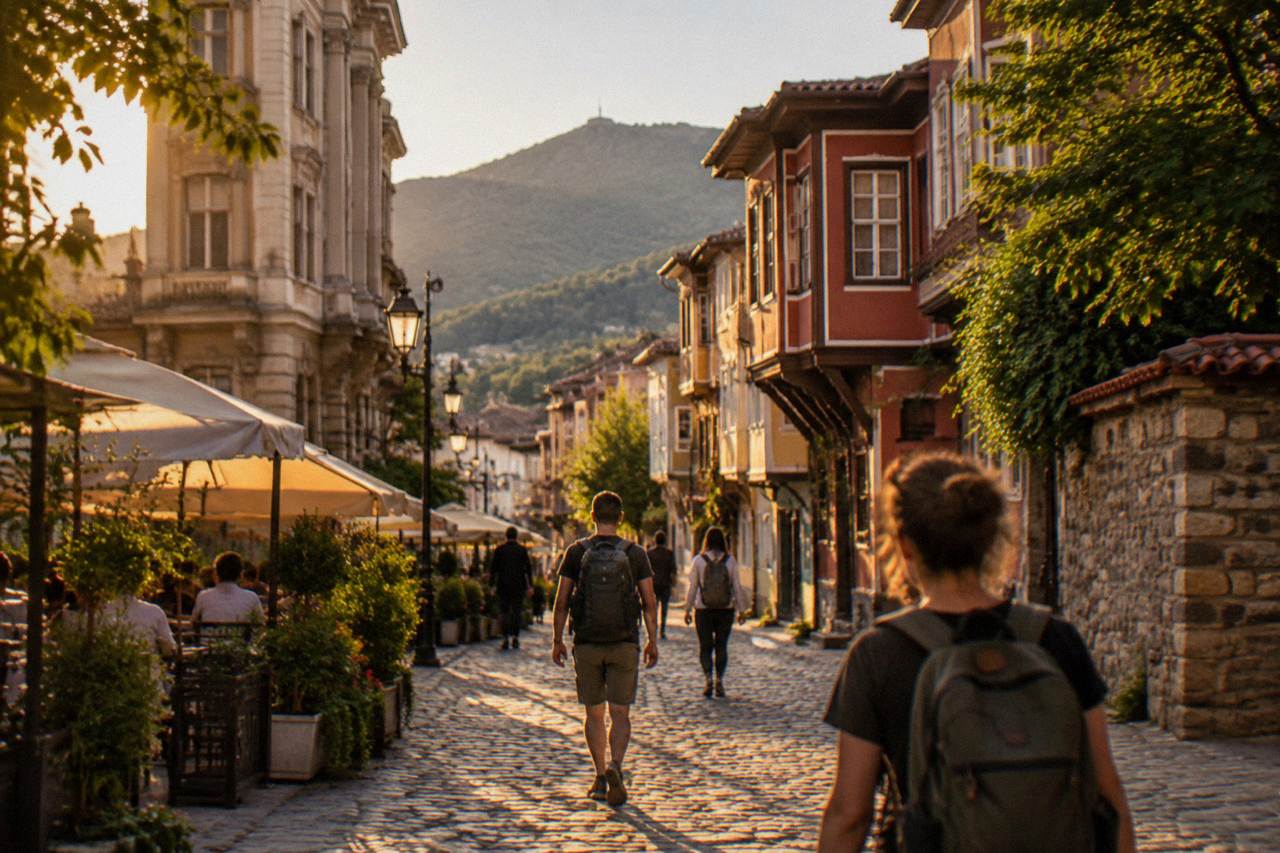
Plovdiv rewards the bigger share of the trip. The Old Town's revival houses, the Roman Stadium's exposed sphendone under the Main Street, and Nebet Tepe's hilltop excavation are all within a walkable core. The Old Plovdiv ticket page lists any single site at 3.58 euro for adults, with a combined ticket covering up to five sites at 10.74 euro. The Bishop's Basilica is priced separately at 7.57 euro, and its floor mosaics cover over 2,000 square metres, the largest such spread in Bulgaria from the 4th to 6th centuries. Kapana, whose name means "The Trap", is a free maze of streets with cafes and galleries, and the whole planning frame is laid out in how many days to spend in Plovdiv.
Beyond the city itself, day trips fan out in every direction. Bachkovo Monastery, a working monastery about 30 km away with free entry, is reachable by minibus from the Rodopi station in 35 to 45 minutes. The Rhodope mountains stretch south, and the Rhodopes day tour from Plovdiv pages map the wider region. For stretching the trip, the Bulgaria itinerary strings the capital, Plovdiv and the mountains together, and the question of whether Sofia itself is worth visiting is answered separately with the capital's own sights.
Festival dates can anchor a trip too. Opera Open ran 23 June to 9 September in 2026 at the Ancient Theatre, Kapana Fest's autumn edition ran two weekends in early October, and the Plovdiv Jazz Fest fall edition runs 6 to 8 November 2026. The Christmas market edition that followed ran from 28 November 2025 into early January. No 2027 dates for these had been announced, so treat each as a pattern to watch rather than a fixture.
| Trip Shape | Days | What It Covers |
|---|---|---|
| City pair, short | 3 to 4 | One to two days Sofia, direct train, two days Plovdiv core |
| City pair, relaxed | 5 to 7 | Adds a Rhodope day trip and Koprivshtitsa from Plovdiv |
| Triangle | 7 to 10 | Sofia, Plovdiv, Rila Monastery loop by train and tour |
| Winter version | 3 to 5 | Christmas market season, museums, the 2026/27 edition runs 1 December to 7 January |
Common Questions About Americans Travelling To Sofia
Is It Okay To Travel To Sofia, Bulgaria As An American For Fun?
Yes. Bulgaria is a full Schengen member since 1 January 2025, uses the euro since 1 January 2026, and US citizens are reported to enter visa-free for 90 days in any 180. Leisure travel is completely normal.
Do Americans need a visa for Bulgaria?
No, not for stays within the reported 90 days in any 180-day Schengen allowance. Confirm current rules with official sources before travel.
Is Bulgaria cheap for Americans?
Crowd-reported data puts an espresso or a half-litre of beer at around 2 euro each, but the honest answer depends on the dollar to euro rate. The dedicated page on costs covers it in detail.
Can Americans drink the tap water in Bulgaria?
Plovdiv's tap water question is covered on its own page; in general, confirm locally, as with any new destination.
How far is Plovdiv from Sofia?
Direct trains take about 2 hours 40 minutes to 3 hours 05 per the BDZ timetable, and buses a reported 1 hour 45 to 2 hours 20.
What currency should Americans bring to Bulgaria?
Cards are widely accepted in both cities.
The short version: plan the fun around two cities, book the direct train, and let Plovdiv Travel Guide handle the southern half of the route.