Is It Safe For Americans To Travel To Bulgaria Right Now?
Yes, Bulgaria is open and calm for American travellers, and Plovdiv is a relaxed inland base. Entry rules, safety, money and language basics for US visitors, reported from official sources.
Yes. Bulgaria is a calm, open destination for American travellers, and Plovdiv, the country's second-largest city, sits inland in the south of the country, built around six hills, with no sea coast. The European Commission lists Bulgaria as a full Schengen member since 1 January 2025, and the country has used the euro since 1 January 2026, so the two logistical frictions Americans worried about for years, border checks and an unfamiliar currency, have both disappeared. There is no official travel warning against visiting, no unrest specific to Plovdiv, and no special requirement aimed at US citizens. The single European emergency number, 112, works everywhere in the country, as this Plovdiv Travel Guide page sets out in detail below.
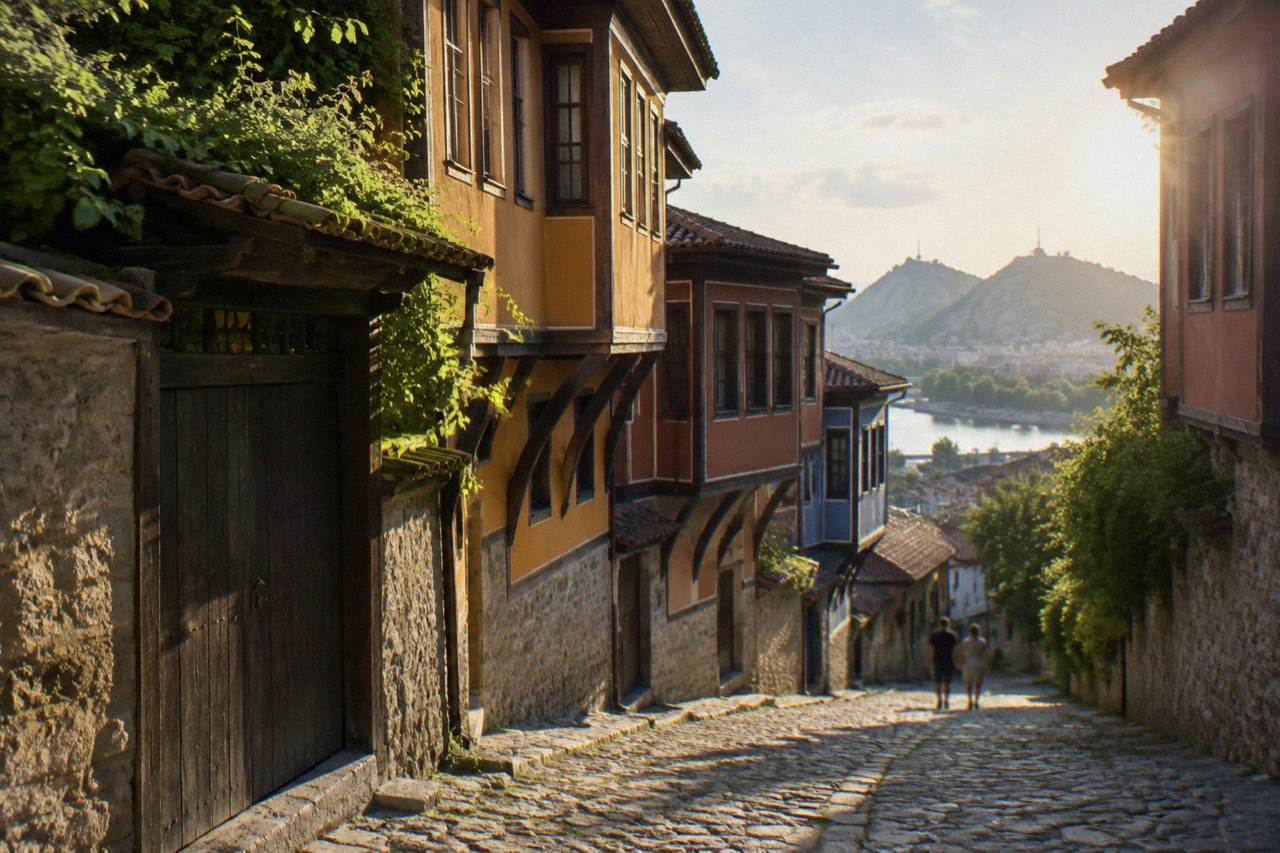
Is It Safe For Americans To Travel To Bulgaria Right Now?
Yes, Americans can travel to Bulgaria safely right now, and Plovdiv specifically is a low-drama inland city where the realistic concerns are pickpocketing in crowded spots and ordinary tourist mishaps, not violence or unrest. Bulgaria has been a full Schengen member since 1 January 2025 and uses the euro since 1 January 2026, so entry and payment are straightforward. Nothing in the official entry rules or city conditions singles Bulgaria out as risky.
That answer deserves unpacking, because "safe" bundles several separate questions: border formalities, street-level crime, health care access, money and language. Bulgaria does well on the first and last two. On street crime, the sensible reading is the same one that applies to any mid-sized European city: keep an eye on belongings on the Main Street and at the bus station, and the practical risk drops sharply. Plovdiv's centre is compact, walkable and busy until late, and the Old Town, Kapana and the area around the Ancient Theatre are public streets without gates, tickets or checkpoints.
For depth on the city itself, read how safe Plovdiv is for visitors, which covers neighbourhoods, night walking and transport specifics. The short version for an American planning a first trip: Plovdiv is the kind of city where the evening problem is finding a table in Kapana, not avoiding one.
How Does Entry To Bulgaria Work For Americans In 2026?
Americans enter Bulgaria visa-free, with stays counted under the Schengen rule of 90 days in any 180-day period, a limit reported for US, UK, Canadian and Australian citizens alike, and confirmed against official sources before travel. Since 10 April 2026 the Entry/Exit System registers biometrics at Schengen external borders instead of passport stamps. ETIAS, the planned electronic travel authorisation, is not operational and no start date may be printed, so Americans currently need only a valid passport.
The mechanics at the airport are now familiar to anyone who has flown into the euro area. Bulgaria joined Schengen fully on 1 January 2025, with air and sea internal border checks lifted from 31 March 2024, so a flight from another Schengen country arrives as a domestic-style transfer. On a direct arrival from outside Schengen, the border officer scans the passport and registers fingerprints and a face image under the Entry/Exit System, deployed at all Schengen external borders as of 10 April 2026 according to eu-LISA. No form, no fee, no pre-authorisation exists for Americans at this point.
Money changed too.
| Entry question | The answer for US citizens |
|---|---|
| Visa needed? | No, visa-free, reported at 90 days in any 180 |
| Travel authorisation? | ETIAS not operational, no start date announced, only a passport needed |
| Border registration | Entry/Exit System biometrics, in force at all external borders since 10 April 2026 |
| Schengen status | Full member since 1 January 2025, air and sea checks lifted 31 March 2024 |
| Emergency number | 112, EU-wide and free |
Getting to Plovdiv usually means flying into Sofia and taking a direct train, about 2 h 40 to 3 h 05 by the fastest services per the BDZ timetable, or a bus. Plovdiv Airport at Krumovo has a small route list, London, Milan, Bratislava among the destinations named in its own flight search, so it works mainly for travellers already in Europe. There is no US-bound flight, and nobody should plan around one.
Is Plovdiv Safe To Walk Around As An American?
Yes, Plovdiv is safe to walk around, including in the evening, and being American draws no special attention on the street. The city centre, the Old Town, Kapana and the Main Street form a continuous pedestrian zone, and the walkable core is lit and busy year round. The municipal sites, the free open-air Nebet Tepe complex, Hisar Kapia and Kapana's maze of streets, are public spaces open at all hours, with no ticket gates or restricted zones.
Orientation is the main value of a guided start, and the city has a strong one. The private city walking tour of Plovdiv covers Old Town, the Roman landmarks and the creative district with a local guide, which suits a first-day arrival perfectly: it settles the geography, the ticketed sites and the restaurant streets in one loop. For travellers who prefer tip-based walks, these run locally as well, and the arrangement, pay what you choose at the end, should be confirmed directly with the guide.
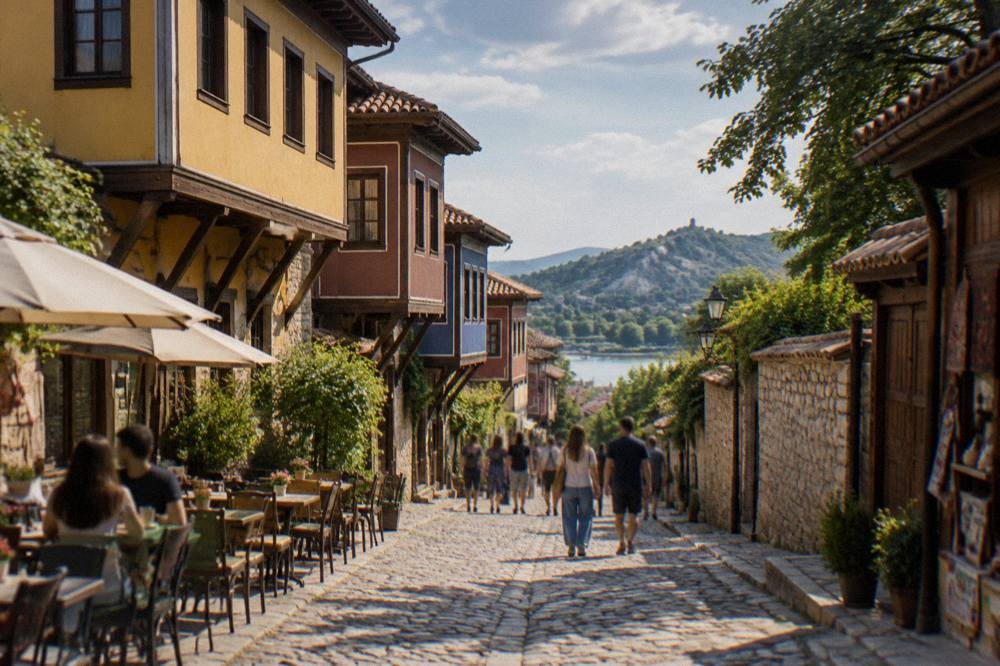
Solo travellers and older visitors manage Plovdiv easily. The centre is flat along the Main Street, with the hills only rising where the Old Town begins, and English is common in tourist-facing businesses, a point this page on speaking English in Bulgaria covers in full. The realistic annoyances are the ones of any city: keep a bag zipped in crowds, agree a taxi fare or check the meter, and treat any street game or petition-signing approach with the wariness it deserves anywhere in Europe.
What Should Americans Be Careful Of In Plovdiv And Bulgaria?
The honest list is short: pickpocketing on crowded transport and busy pedestrian streets, un-metered taxi overcharges, and general small-target scams like rigged street games, the same set an American would watch for in any European city. The guidance stays at the level of ordinary urban caution rather than alarm. None of it is Bulgaria-specific and none of it centres on Plovdiv.
A fuller rundown of cautions, from taxi habits to mountain driving, sits in what to be careful of in Bulgaria. The Plovdiv-specific additions are mild. The city bus e-ticket costs 0.50 euro, and contactless options are expanding, so exact change arguments are avoidable. The train junction outside the central station has been under modernisation due to finish in 2026, which can mean rerouted walkways around the station rather than any danger. And the Dzhumaya Mosque is a working mosque: visits are free, shoulders and knees covered, shoes off, and Friday midday prayer is the time to stand aside.
Two money notes finish the picture. A tourist tax may be charged per night by the accommodation, so confirm the rate at booking. And tipping runs around 10 percent in restaurants for good service, or a rounded-up bill, common but not compulsory, which matches what Americans do at home anyway.
How Are Americans Treated In Plovdiv?
Warmly and without ceremony. Bulgaria is a country where Americans are ordinary visitors, welcomed in hotels, restaurants and shops without any political undertone, and Plovdiv, a university city and a former European Capital of Culture in 2019, is used to foreign guests. There is no anti-American sentiment pattern, and none of the everyday frictions reported by travellers involve nationality at all: they are the universal ones of language, queues and opening hours.
The welcome question has its own detailed treatment in whether Americans are welcome in Bulgaria, and the answer there matches what the practical picture here shows. English is widespread among younger staff in the centre, Bulgarian is written in Cyrillic which makes signage a puzzle for exactly one afternoon, and gestures go further than grammar. Locals in Kapana's cafes and the Main Street's shops deal with English, German and Russian speakers daily.
For context on the city's character, what Plovdiv is famous for covers the Roman heritage, the six hills and the Old Town revival architecture that draw visitors in the first place. The Kapana district, whose name means "The Trap" for its maze of narrow streets, is free and open, an artisan quarter where the evening crowd is a mix of students, families and travellers.
What Practical Facts Should Americans Know Before Visiting Plovdiv?
Bulgaria uses the euro, sits one hour ahead of Greenwich Mean Time in winter and two in summer, runs 230-volt type C and F power sockets, and answers emergencies on 112. Tap water quality is covered separately, and none of these basics poses a barrier to an American visitor.
The climate figures deserve their label: ERA5 reanalysis, 1991-2020, is a modelled grid cell near the Old Town, not a weather station record, and reanalysis smooths urban heat. Even so, the shape is clear, hot July and August afternoons, January nights below freezing, and rain spread fairly evenly through the year with a modelled annual total around 536.6 mm.
| Month | Mean daily high | Mean daily low | Rain |
|---|---|---|---|
| January | 5.9 C | -2.6 C | 41.0 mm |
| April | 17.1 C | 6.4 C | 47.7 mm |
| July | 28.2 C | 17.9 C | 45.6 mm |
| October | 18.1 C | 8.8 C | 44.1 mm |
Beyond climate, the everyday numbers an American asks about are modest. Crowd-sourced price trackers put an espresso or a half-litre of draught beer at around 2 euro each, figures to read as approximations rather than official prices, and the broader cost question has its own page on whether Bulgaria is cheap for Americans. Planning how long to stay, how many days to spend in Plovdiv suggests enough time for the Old Town, the museums and one day trip into the Rhodopes.
For final pre-trip reading, the Plovdiv travel tips guide collects the practical details in one place, from tickets to transport.
Common Questions About Traveling To Bulgaria As An American
Is It Safe For Americans To Travel To Bulgaria Right Now?
Yes. Bulgaria is a full Schengen member, uses the euro since 1 January 2026, and Plovdiv is a calm inland city where ordinary city caution, not special measures, is the whole of the safety story. The emergency number is 112.
Do Americans Need A Visa For Bulgaria?
No. US citizens are reported to enter visa-free for 90 days in any 180-day period under the Schengen rule, and ETIAS is not operational, so only a valid passport is required.
Is Plovdiv Safe At Night?
The central pedestrian zone, the Main Street, Kapana and the Old Town approach stay busy into the evening, and the same ordinary precautions as in any European city apply. No incident statistic may be printed here, so judge it as you would any unfamiliar city centre.
Can Americans Drink The Tap Water In Plovdiv?
The tap water question has its own page on this site, and the practical answer there covers the city supply in detail. Bottled water is cheap and everywhere if you prefer it.
What Number Do Americans Call In An Emergency In Bulgaria?
112, the single European emergency number, free from any phone, handles police, fire and medical calls across Bulgaria including Plovdiv.
