Nebet Tepe: The Thracian Fortress Hill
Nebet Tepe is the hill where Plovdiv started: a free, always-open archaeological complex of Thracian fortress walls and Roman foundations standing 207 m above the Old Town, and the widest viewpoint in the city.
Short answer
Nebet Tepe is the 207 m hill at the heart of Plovdiv's Three Hills, the site of the first settlement dated by the city's tourism site to the 4th millennium BC. It is free to enter, open at all hours, and was fully restored in a project officially opened in March 2025.
Nebet Tepe is the hill where Plovdiv, in southern Bulgaria, began. It stands 207 m high at the northern edge of the Three Hills, the compact ridge of Nebet Tepe, Dzhambaz Tepe and Taksim Tepe around which the ancient city grew, and the city's tourism site dates the first settlement on its plateau to the 4th millennium BC. Today it is a free, open-air archaeological complex of fortress walls, foundations and cisterns, restored in an EU-funded project officially opened in March 2025, and it gives the widest single view over the Old Town, the Thracian plain and the Rhodopes on the horizon. For the Plovdiv Travel Guide desk it is the one sight in the city that explains all the others, because everything from the Ancient Theatre of Philippopolis to the Roman Stadium grew outward from this fortified plateau.
What Is Nebet Tepe In Plovdiv?
Nebet Tepe is the northernmost of Plovdiv's Three Hills, a 207 m limestone plateau where the city's tourism site dates the first settlement to the 4th millennium BC, and where a fortified Thracian town later named Evmolpias stood. The site is now a free, open-air archaeological complex with no ticket and no closing time. Its name ties it to that Thracian past: the hill was the acropolis of Evmolpias, the settlement the Odrysian kingdom held before Philip II of Macedon took it and gave the city the name Philippopolis. When the Romans came they called the whole settlement Trimontium, the Three Hills, and kept the fortress as the citadel of their colony.
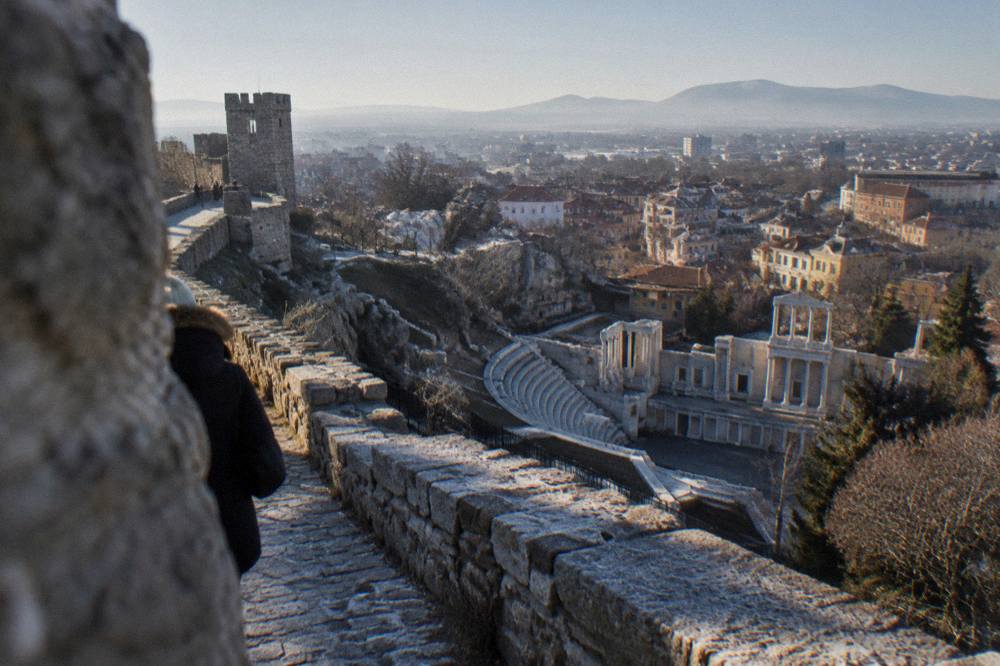
The hill is not a single monument but a layered one. Excavation has exposed sections of defensive wall from several eras, a deep rock-cut water reservoir, building foundations and the base of a medieval tower, all arranged along a walkable plateau. The restoration project that finished with the official opening in March 2025, funded under the EU programme "Along the Fortress Walls of Philippopolis", added walkways, lighting and interpretation, so the circuit is now safe to follow after dark as well as by day.
One caution belongs in any honest description. Plovdiv is often described as one of the oldest continuously inhabited cities in Europe, and Nebet Tepe is the evidence behind that description, but the claim is a description, not a ranking. The 4th millennium BC date is the one the official city tourism site prints, and it is the only date this page will stand behind.
What Can You See On Nebet Tepe Today?
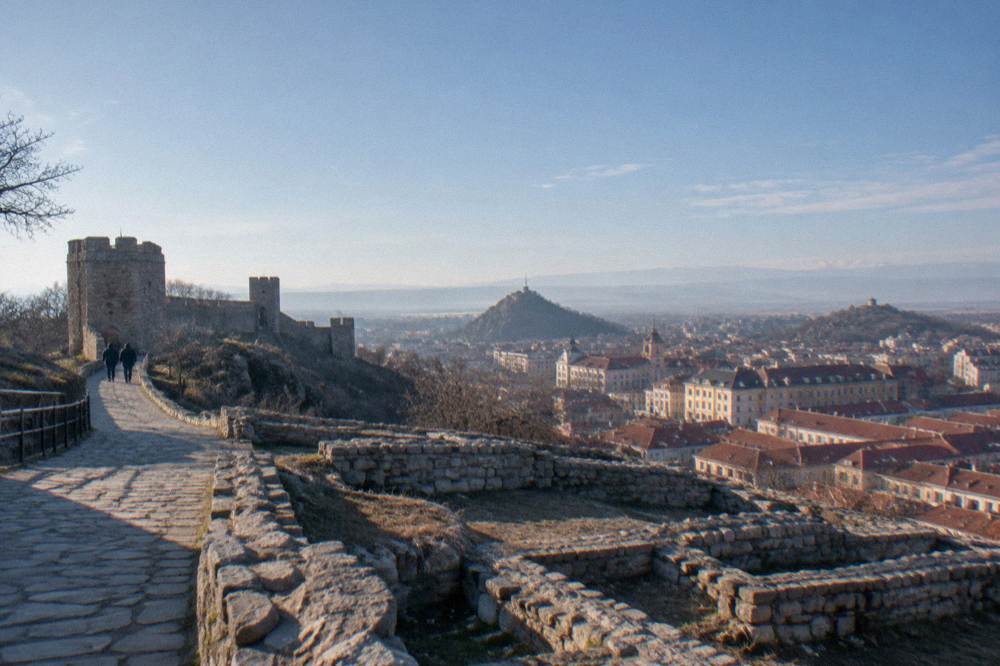
The visible remains on Nebet Tepe include a massive Thracian fortress wall of large dressed blocks, later Byzantine and medieval rebuilding on top of it, a rock-cut reservoir for rainwater, foundations of buildings inside the citadel, and the base of a lookout tower, all spread along a plateau you can walk end to end. The strongest wall faces north, the direction of attack, and you can see clearly where different periods stacked their masonry: huge ashlar blocks below, smaller medieval courses above. The reservoir, cut straight into the rock, is the feature archaeologists point to when explaining how a citadel survived a siege.
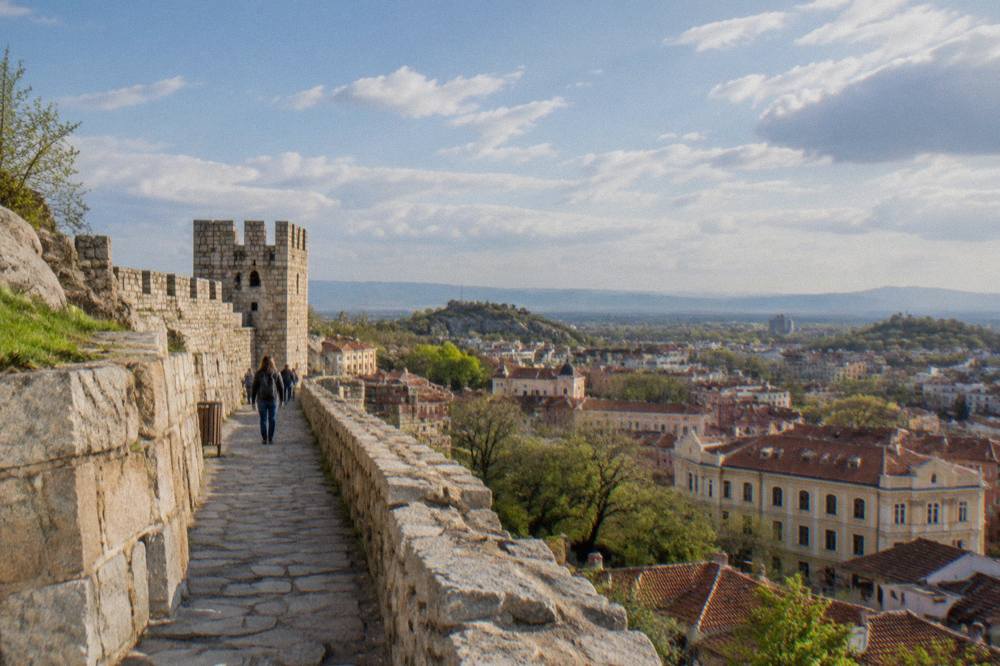
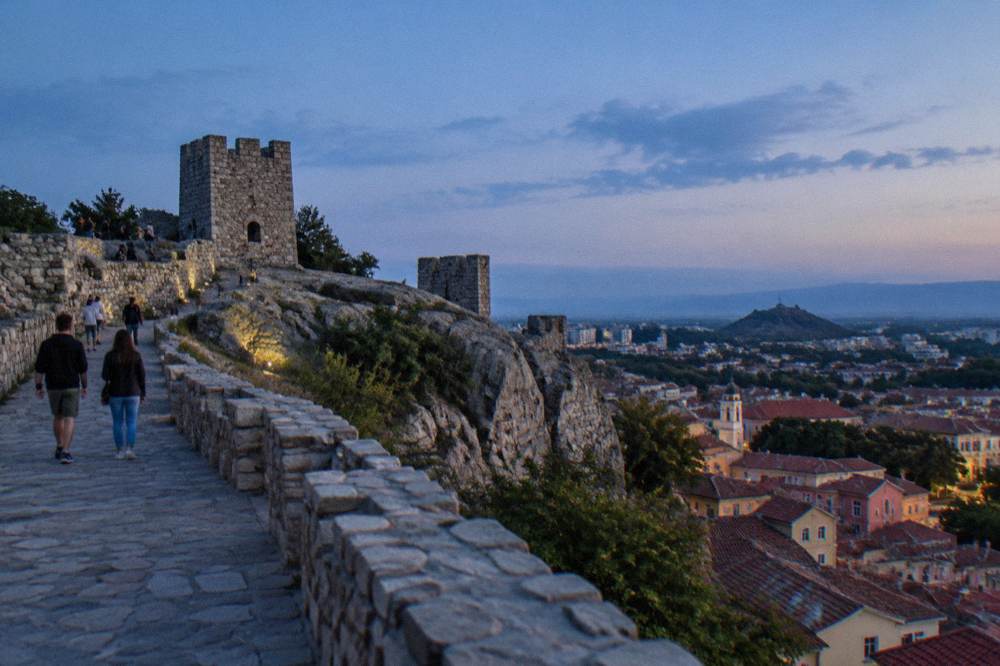
The plateau's other half is the view, and it is the reason many people climb. From the northern edge you look down on the Old Town's rooftops, the Dzhumaya Mosque dome and the flat plain beyond. To the south the Rhodopes sit on the horizon, and on clear evenings the sunset side of the hill fills with photographers. The site is free, has no gate and no attendant, and is genuinely open at all hours; the March 2025 restoration was designed with exactly that unrestricted public access in mind, as local reporting on the project noted.
Reading the stones takes a small amount of preparation to pay off. The interpretation added in 2025 explains which wall belongs to which era, but the masonry itself does the teaching if you know what to look for: the lowest courses, of enormous blocks laid without mortar, are the oldest work on the hill, while the narrower, mortared courses stacked above them come from the Byzantine and medieval rebuilds. Visitors who spend twenty minutes with the boards usually leave with the sequence clear; visitors who rush straight to the viewpoint miss the reason the viewpoint exists.
A guided walk adds the layer the stones do not explain on their own. The site's featured Plovdiv guided walking tour covers Nebet Tepe inside its Old Town route, and Check availability if you want the Thracian, Roman and Ottoman story told in place rather than read off a board.
How Old Is Nebet Tepe, Really?
The official city tourism site dates the first settlement on Nebet Tepe to the 4th millennium BC, which is why Plovdiv is often described as one of the oldest continuously inhabited cities in Europe. What the archaeology on the hill itself supports is a sequence: a Thracian settlement fortified in antiquity, a Hellenistic and Roman citadel, a Byzantine garrison point and a medieval stronghold, each leaving masonry the next generation reused.
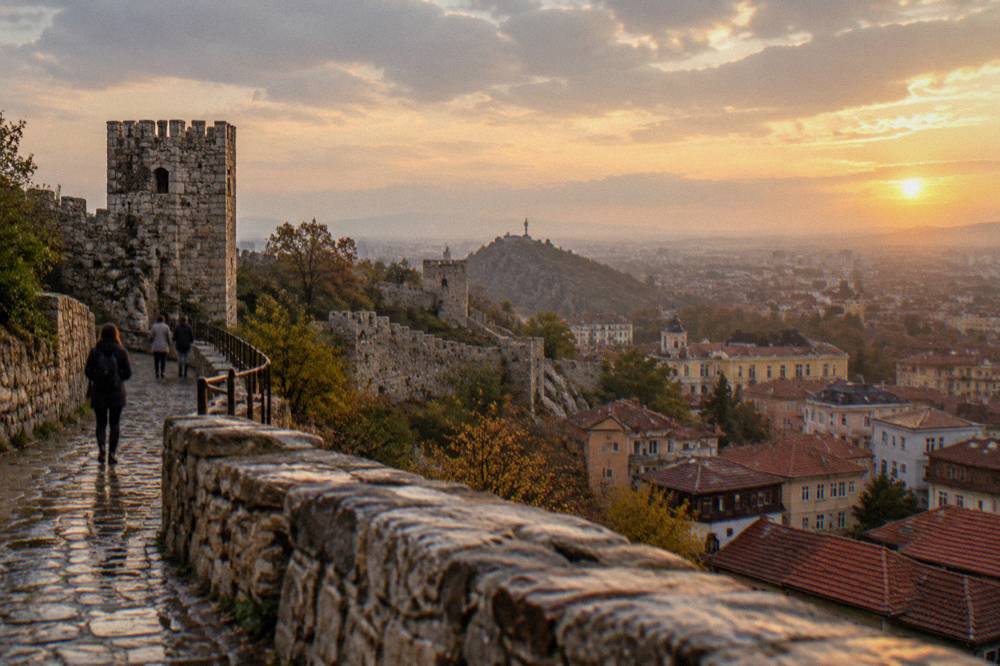
The sequence matters more than the headline number. When the restoration project opened in March 2025, the site's interpreters laid out the hill's story in that layered order, from the earliest settlement traces through the fortress of Evmolpias to the medieval tower base. The Regional Archaeological Museum, which renewed its permanent exhibition with about 150 new exhibits in 2025, holds the finds that fill in the picture, and it sits a short walk north of the hill across the central square.
The city's long list of historical names tells the same story from another angle. The official city tourism site lists Kendrissos, Evmolpias, Philippopolis, Pulpudeva, Trimontium, Ulpia, Flavia Julia, Plapdiv, Puldin, Ploudin and Filibe among the names Plovdiv has carried, and each name marks a chapter that touched this hill: Thracian, Macedonian, Roman, Byzantine, Bulgarian, Ottoman. Standing on the plateau you are standing inside every one of those chapters at once.
Is Nebet Tepe Free To Visit?
Yes, Nebet Tepe is free: it is an open-air archaeological complex with unrestricted public access, no ticket office and no closing time, a status local reporting says the 2025 restoration project was required to keep. There is nothing to book and nothing to pay at the hill itself. That puts it in a small group of Plovdiv's major sights that cost nothing, alongside the Roman Stadium sphendone, Hisar Kapia and the streets of Kapana.
The contrast is with the Old Town houses and the basilicas, which are municipal museums with ticketed entry. The Old Plovdiv price list prints a one-site adult ticket at 3.58 euro for houses such as Balabanov House, while the Bishop's Basilica is priced separately. The table below sorts the central sights by what, if anything, they cost.
| Sight | Entry cost | Ticketed? |
|---|---|---|
| Nebet Tepe | Free | No |
| Roman Stadium sphendone | Free | No |
| Hisar Kapia gate | Free | No |
| Kapana district streets | Free | No |
| Alyosha monument hill | Free | No |
| Any one Old Plovdiv house | 3.58 euro adult | Yes |
| Bishop's Basilica of Philippopolis | 7.57 euro adult | Yes |
| Old Plovdiv combined ticket, up to 5 sites | 10.74 euro adult | Yes |
Free does not mean unguarded by rules of respect. The walls are ancient and the lighting makes evenings tempting, but the plateau's edges are unfenced in places and the stone is worn. Sensible shoes, a bottle of water in July, and daylight or the installed lighting after dark are the whole of the practical advice the site needs.
The pricing structure rewards a little arithmetic, too. A visitor who plans to see several Old Plovdiv houses should compare single tickets against the combined ticket before buying, because the combined option covers up to five sites while excluding the Small Basilica and the Bishop's Basilica, which are priced on their own lines. The validity period of the combined ticket is not stated on the ticket page, so confirm it at the counter before relying on it for a second day.
What Are The Best Times To Climb Nebet Tepe?
The site never closes, so the timing question is about light and heat: the ERA5 reanalysis, 1991-2020, puts Plovdiv's mean daily high at 28.2 C in July and 5.9 C in January, which makes early morning and the hour before sunset the comfortable climbing windows in summer and midday the pleasant one in winter. May is the wettest month in the modelled normals at 56.8 mm of rain, and August the driest at 25.2 mm, so spring visits carry a small umbrella chance and late summer almost none.
The two moments locals and photographers single out are worth planning around. Late afternoon sun comes from behind the hill and lights the plain and the Rhodopes, which is the classic wide-shot hour. Early morning, by contrast, gives low light across the Old Town rooftops to the north and an empty plateau, because the site has no gate to open and nobody arrives early. Winter visits are quiet and cold, with mean daily lows around -2.6 C in January, and the walls take frost, so care on the paths matters then.
The site also earns its place in the city's event calendar. During the Opera Open season the Ancient Theatre below the hill hosts performances from late June into September, and an evening performance followed by a climb to the plateau, with the theatre lights still glowing below, is one of the distinctive ways the hill gets used without ever being booked or gated. The same plateau hosts occasional open-air events tied to the Old Town festival days, which ran 16 to 23 September in their 2026 edition.
A monthly shape of the climb, drawn from the modelled normals:
| Month | Mean daily high | Mean daily low | Rain |
|---|---|---|---|
| Jan | 5.9 C | -2.6 C | 41.0 mm |
| Mar | 12.1 C | 2.1 C | 55.0 mm |
| May | 21.9 C | 11.5 C | 56.8 mm |
| Jul | 28.2 C | 17.9 C | 45.6 mm |
| Sep | 23.8 C | 13.8 C | 42.8 mm |
| Nov | 12.3 C | 3.8 C | 39.7 mm |
How Do You Get To Nebet Tepe?
Nebet Tepe sits at the southern top of Plovdiv's Old Town, reached on foot from the city centre up the cobbled streets past Hisar Kapia and the Old Town houses; there is no vehicle access to the plateau itself, and the whole climb from the Central Square side is a short, steep walk of a few hundred metres. The nearest landmark gate is Hisar Kapia, the Ottoman-era gate at the Old Town's southern edge, from where signposted lanes rise to the site entrance.
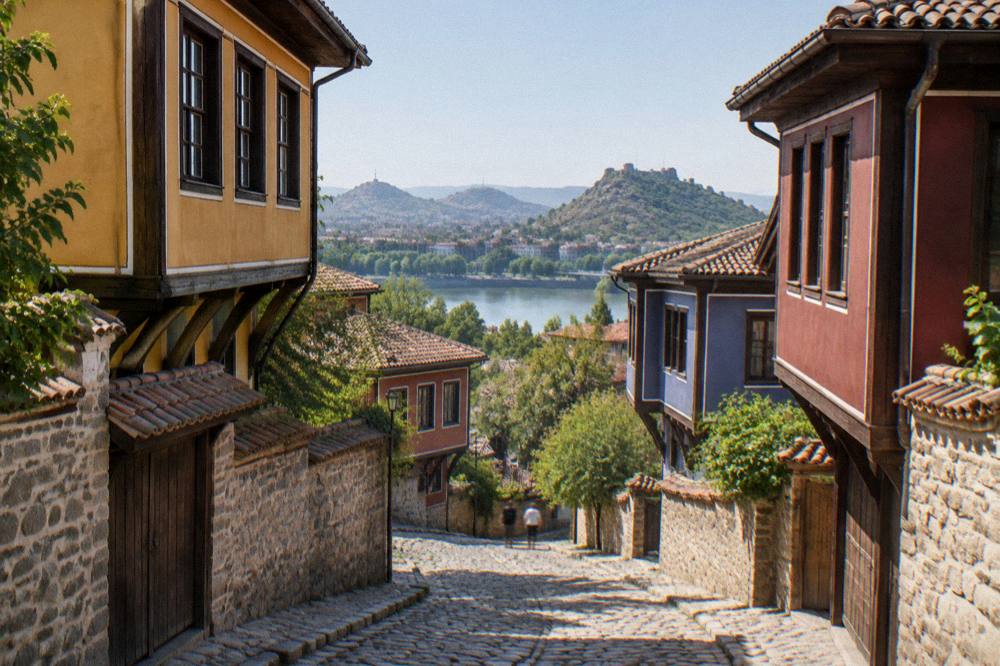
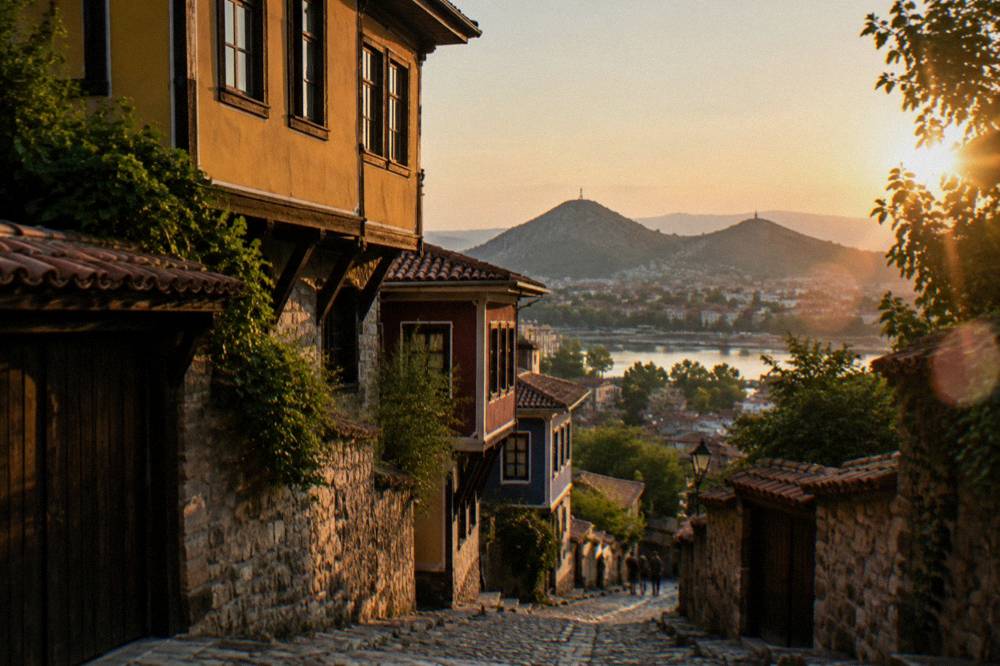
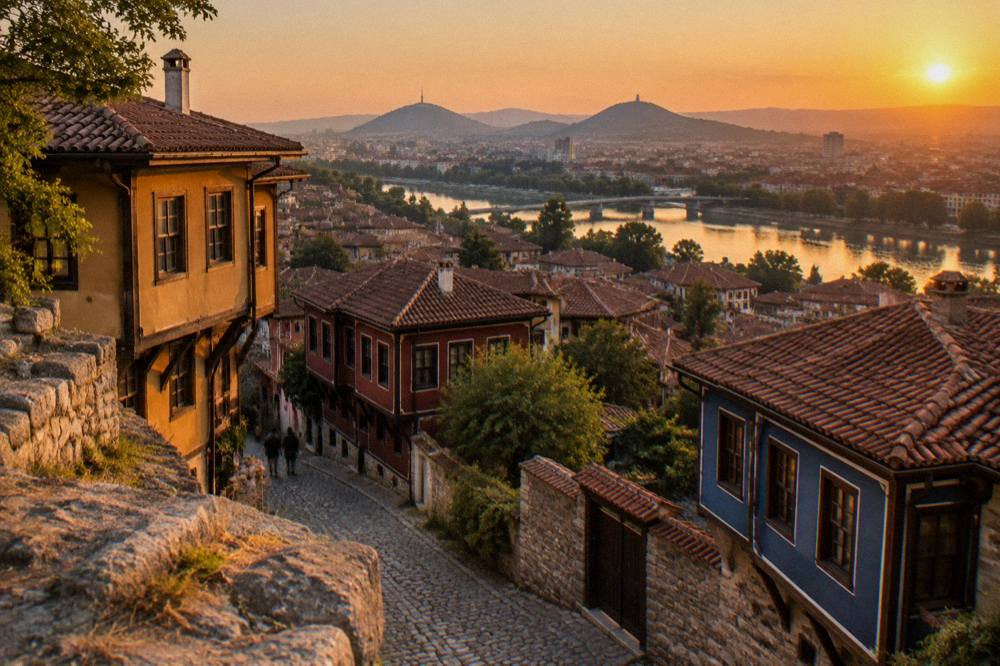
The approach is part of the experience, because the lanes pass Hindliyan House and its neighbours and the terraces of the revival-era houses the Old Town is famous for. Coming from the north, the Ethnographic Museum is the usual starting landmark; coming from Kapana, you enter through the southern lanes below the hill. Cobbles and worn stone make the last stretch slippery in rain, and the site is an open hilltop, so wheelchair access to the plateau is limited by terrain rather than by any barrier or ticket.
If you would rather not get around the lanes alone, a guided walk solves it: the featured Plovdiv guided walking tour route runs through the Old Town and up to the hill, and solo options for going deeper follow.
How Does Nebet Tepe Compare With Plovdiv's Other Hills?
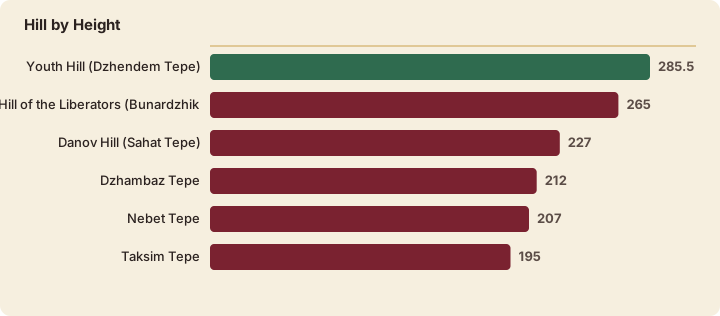
Plovdiv has six hills today: there were seven until Markovo Tepe was partly destroyed by quarrying in the 1930s, and Nebet Tepe, at 207 m, is neither the highest nor a standalone peak but the northern point of the Three Hills ridge, standing between Dzhambaz Tepe at 212 m and Taksim Tepe at 195 m. The highest of the six is Youth Hill (Dzhendem Tepe) at 285.5 m, and the most visited after Nebet Tepe is Bunardzhika, the Hill of the Liberators, crowned by the Alyosha monument unveiled in 1957.
| Hill | Height | What sits on it |
|---|---|---|
| Youth Hill (Dzhendem Tepe) | 285.5 m | Open parkland |
| Hill of the Liberators (Bunardzhika) | 265 m | Alyosha monument, unveiled 1957 |
| Danov Hill (Sahat Tepe) | 227 m | Clock tower hill |
| Dzhambaz Tepe | 212 m | Part of the Three Hills, Old Town houses |
| Nebet Tepe | 207 m | Thracian fortress archaeological site |
| Taksim Tepe | 195 m | Part of the Three Hills, Roman Odeon side |
The comparison matters for planning. Nebet Tepe is the hill with the archaeology and the Old Town view; Sahat Tepe and Danov Hill and Youth Hill are greener, quieter walks; Bunardzhika, with the Alyosha monument, gives the long panorama that includes Nebet Tepe itself. Visitors with a full day can link several, and the three-day Plovdiv itinerary shows how.
What Should You Combine With Nebet Tepe?
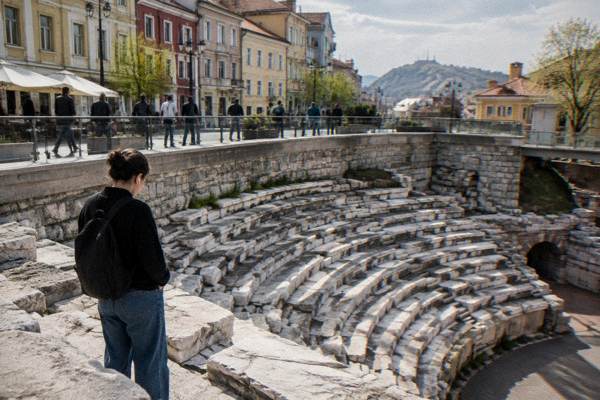
The natural combination is the whole Old Town circuit: Nebet Tepe at one end, the Ancient Theatre of Philippopolis, built in the 90s AD with 28 concentric rows of marble seats, at the other, and the revival-era houses and Hisar Kapia in between, all walkable within an hour or two at a relaxed pace. The hill is small as a standalone stop; the genius of Plovdiv is that the citadel, the theatre, the stadium and the basilicas all sit within a compact quarter.
A day built around the hill takes shape like this:
| Stop | What it is | Cost |
|---|---|---|
| Nebet Tepe | Thracian fortress hill, viewpoint | Free |
| Hisar Kapia | Ottoman-era gate in the Old Town walls | Free |
| Ancient Theatre of Philippopolis | Roman theatre, 28 rows of marble seats | 3.58 euro adult |
| Roman Stadium sphendone | Northern curve of the 2nd century AD stadium | Free to view |
| Bishop's Basilica | Mosaics over 2,000 sq m, 83 m long | 7.57 euro adult |
| Kapana | "The Trap", the maze of narrow creative streets | Free |
Two practical notes make the circuit run smoothly. First, the ticketed Old Town sites close on varying days: the Ethnographic Museum closes on Monday, as does the Regional Archaeological Museum, while the Ancient Theatre is listed as open daily, so a Monday visit still gives you the hill, the theatre and the free open-air sights even when the houses are shut. Second, lunch belongs in Kapana, the creative district whose name means "The Trap", where the narrow streets hold the cafés and workshops that make the quarter what it is; it sits directly south of the hill, so it lands naturally at the middle of the loop rather than requiring a detour.
Beyond the city, the hill's story continues outward. Nebet Tepe was the fortress of a Thracian world whose tombs and sanctuaries surround Plovdiv, and day trips to the Starosel Thracian complex and the Kazanlak region and the Rose Valley carry that same story to its tombs. Two options that pair a Plovdiv base with that wider country:
Is Nebet Tepe Worth Visiting From Sofia?
Yes, if the day trip is built around the Old Town: direct trains from Sofia take about 2 h 40 to 3 h 05, the hill is free and central, and a day visitor can climb it, see the theatre and still walk Kapana before the evening train. Trains via Karlovo take far longer, so the direct services are the ones to pick, and the railway junction modernisation due to finish in 2026 means access around the station can change during works.
The shape of a day visit is easy to draw. A morning arrival by train puts you at the central station, from the station the walk to the Old Town is straightforward along the main pedestrian street, and the hill can be the first stop, the last stop or the midday viewpoint depending on how the day is built. Because the site is free and ungated, it imposes no schedule of its own, which is exactly what a day visitor needs when the return train is fixed. Organised day tours from Sofia remove the timetable question entirely. A day trip that links Plovdiv with the Thracian valley beyond it is one way to use the time:
For anyone spending a night rather than a day, the hill at dusk and again at dawn is the quietest, most atmospheric version of Plovdiv, and the whole central quarter, from the Church of Saint Marina to the Eirene mosaic and Episcopal Basilica, sits within the same walkable bowl beneath the plateau.
Common Questions About Nebet Tepe In Plovdiv
Is Nebet Tepe free?
Yes. It is an open-air archaeological complex with no ticket, no gate and unrestricted public access, a status local reporting ties to the conditions of the 2025 restoration project.
What are Nebet Tepe's opening hours?
There are none. The site is open at all hours, day and night. Organised guided tours of the fortress run limited hours, but general access is unrestricted.
How old is the settlement on Nebet Tepe?
The official city tourism site dates the first settlement on the hill to the 4th millennium BC. Plovdiv is often described as one of the oldest continuously inhabited cities in Europe on that basis; no single "oldest city" ranking is claimed here.
Is Nebet Tepe part of Plovdiv's UNESCO listing?
No. "The Ancient Plovdiv" sits on Bulgaria's UNESCO Tentative List, submitted in 2004, and is not an inscribed World Heritage Site.
How high is Nebet Tepe?
The hill rises to 207 m, making it the second lowest of Plovdiv's six surviving hills, though its position on the edge of the Three Hills ridge above the Old Town makes it feel like the city's rooftop.
Can you see the whole city from Nebet Tepe?
You can see the Old Town, the central plain and the Rhodopes on the horizon from the plateau. For the panorama that includes Nebet Tepe itself, climb Bunardzhika, the Hill of the Liberators, where the Alyosha monument stands.