Are Americans Welcome In Bulgaria?
Americans are welcome in Plovdiv and across Bulgaria, with visa-free entry, euro pricing and English in the tourist areas. Here is what the entry rules, costs and local reception look like.
Plovdiv, Bulgaria's second-largest city and an inland city built around six hills in the south of the country, is a place where the practical answer to the welcome question is a plain yes, and the paperwork now backs it up. Bulgaria has been a full Schengen member since 1 January 2025 and has used the euro since 1 January 2026, which removes the two frictions Americans used to cite when comparing Bulgaria with the rest of the European Union. This page reports what official sources and published listings say about entry, money, language and the day-to-day reception an American visitor can expect in Plovdiv.
Are Americans Welcome In Bulgaria?
Yes, Americans are welcome in Bulgaria, and Plovdiv in particular receives them without any special formalities: United States citizens are reported visa-free for 90 days in any 180-day period under the Schengen rule, Bulgaria has used the euro since 1 January 2026, and the city's tourism economy treats American visitors as ordinary short-stay European travellers. No registration beyond normal hotel check-in applies, and the single European emergency number, 112, works exactly as it does elsewhere in the Union.
The welcome is not just formal. Plovdiv was European Capital of Culture in 2019, shared with Matera in Italy, and that year left the city with an arts infrastructure, galleries and festival venues that were built with international audiences in mind. The city's own tourism site publishes in English, the Old Plovdiv institute that runs the Ancient Theatre and the revival-era houses prints its ticket page in English with euro prices alongside, and the tour roster covering the city includes English-language walking tours, food walks and day trips. A country does not build that apparatus for visitors it does not want.
One caveat belongs here rather than further down. Bulgaria's language is Bulgarian, written in Cyrillic, and a first-time visitor from the United States will meet the alphabet on street signs, menus and bus stops on day one. That is a reading problem, not a hostility problem. The deeper entry, safety and cost questions have their own pages: is it safe for Americans to travel to Bulgaria right now and is Bulgaria cheap for Americans cover both in detail.
How Does Plovdiv Treat American Visitors Day To Day?
In everyday terms, Plovdiv treats an American visitor as an unremarkable foreign tourist: English is used in the Old Town, in Kapana and on the main tourist listings, the city's sights publish euro prices openly, and no local rule, dress code or custom singles out US citizens for different treatment. The reception is the same mix of indifference and friendliness any mid-sized European cultural city shows, with the difference that Americans remain a less common sight than Germans, Britons or Romanians, which tends to draw curiosity rather than friction.
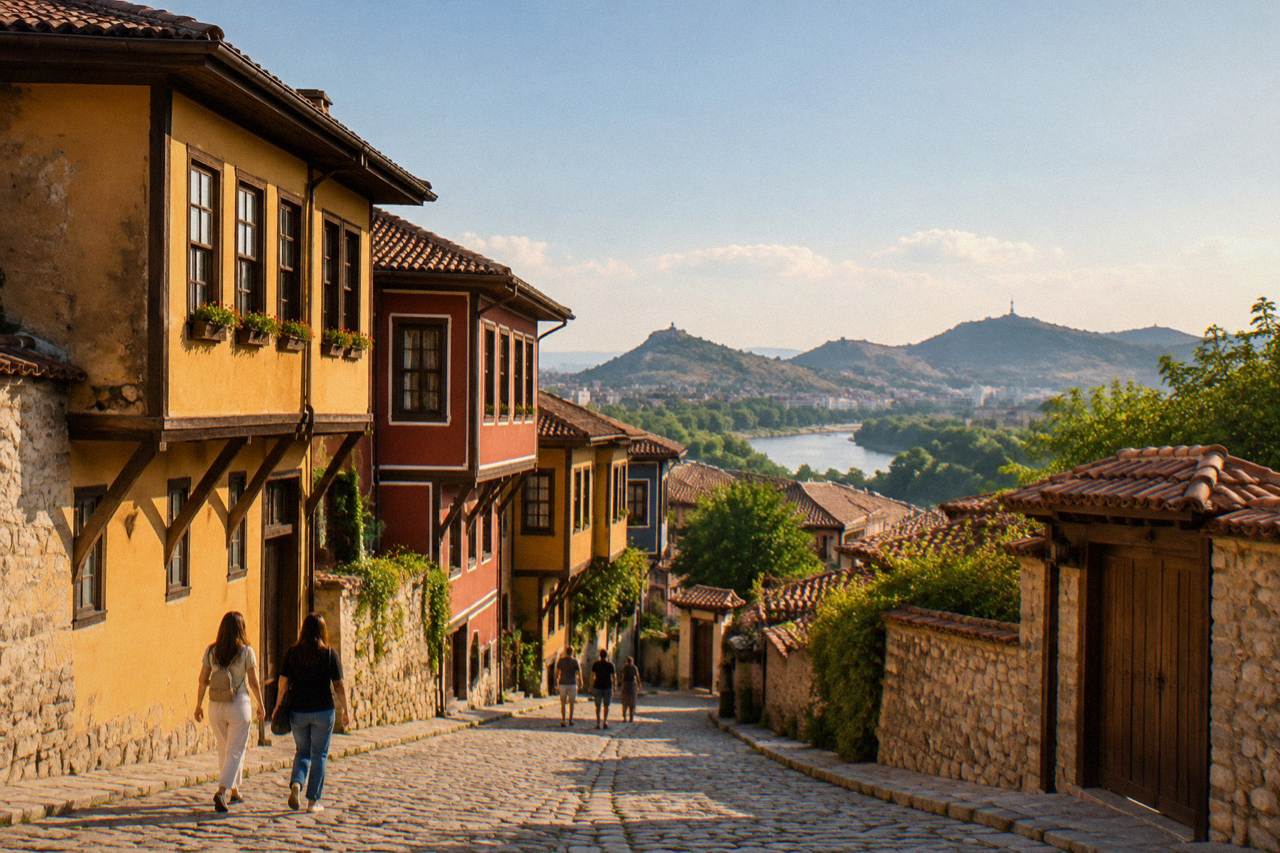
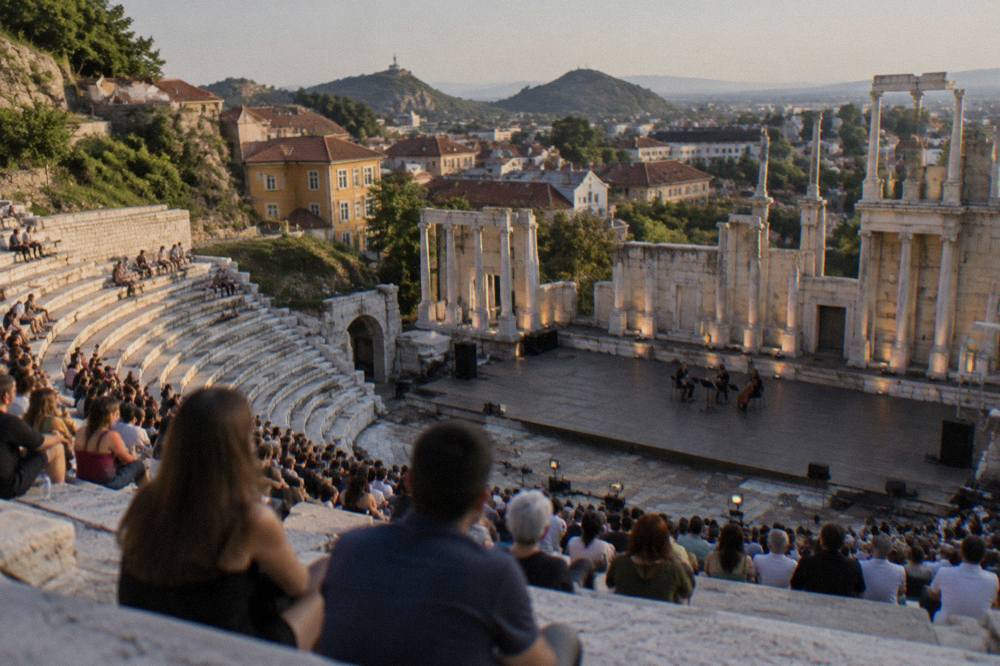
The parts of the city an American visitor will actually spend time in are built for foreign guests. The Old Town's cobbled lanes hold the Ancient Theatre of Philippopolis, a Roman theatre built in the 90s of the 1st century AD with 28 concentric rows of marble seats, plus house museums such as Balabanov House and Hindliyan House. Kapana, whose name means "The Trap" in a nod to its maze of narrow streets, is a free, open creative district of studios, bars and small venues. Nebet Tepe, the hill where the city's tourism site dates the first settlement to the 4th millennium BC, is also free and open at all hours after a restoration completed and officially opened in March 2025.
English coverage in the tourist economy is real but uneven outside the centre, which is the honest way to state it. The question can I speak English in Bulgaria deals with it fully; the short version for Plovdiv is that hotel desks, ticket desks and the listings for guided walks operate in English, while a suburban bakery may not. Phrase-book patience covers the gap.
A good way to anchor a first day is a guided walk. The Old Town guided walk with rakia tasting covers the revival houses and Roman landmarks and finishes with a tasting of Bulgaria's fruit brandy, which is as close to a local handshake as the city offers. If the budget is the question rather than the welcome, the companion page on how expensive Plovdiv is puts euro figures on coffee, beer and meals.
Do Americans Need A Visa For Plovdiv, Bulgaria?
No visa is reported for American citizens: the United States is visa-exempt for Bulgaria, allowing 90 days in any 180-day period under the standard Schengen stay rule, and since Bulgaria became a full Schengen member on 1 January 2025 a US passport holder enters through the same channels as in France or Italy. The Entry/Exit System, deployed at all Schengen external borders as of 10 April 2026, replaces passport stamps with biometric registration at first entry. ETIAS, the planned electronic travel authorisation, is not operational and no start date may be relied on.
That is a large change from the situation a few years ago, when Bulgaria sat outside Schengen and outside the euro, and American forum threads were full of confusion about both. The current position, reported from official European Commission and eu-LISA announcements, is simpler:
| Question | Answer for a US citizen |
|---|---|
| Visa needed? | No, reported visa-free, 90 days in any 180 |
| Border system | Full Schengen member since 1 January 2025 |
| Entry checks | EES biometric registration, in force since 10 April 2026 |
| ETIAS | Not operational, no start date announced |
| Emergency number | 112 |
Two practical notes follow from the table. First, the 90-in-180 rule counts the whole Schengen area, so days in Plovdiv and days elsewhere in Europe share one allowance. Second, a tourist tax may be charged by the accommodation; its 2026 euro rate is not published in one place, so confirm at booking rather than budgeting a number from memory.
Most Americans reach Plovdiv through Sofia, with direct trains taking about 2 h 40 to 3 h 05 according to the BDZ timetable, while Plovdiv's own airport at Krumovo keeps a small route list that includes London, Milan and Bratislava connections. The page on direct flights from Plovdiv lists what the airport's own flight search shows.
Is Plovdiv Safe For American Travellers?
Plovdiv is reported as a safe city for tourists by the standard travel advisories, with no Bulgaria-specific restriction aimed at Americans, no pattern of incidents targeting US citizens, and the same ordinary city caution any visitor applies: watch belongings in crowds, use metered taxis, and call 112 in an emergency, the free EU-wide number. No crime statistic, safety ranking or threat level belongs on this page because none was reported from an official source.
The day-to-day texture of safety in Plovdiv is a mid-sized, walkable city whose tourist core, from the Roman Stadium sphendone under Main Street to the Three Hills, stays busy into the evening. The Roman Stadium itself is worth a sentence here because it surprises people: only the northern part, the sphendone, is accessible, unearthed in the 1970s, while the rest of the 2nd-century structure still lies beneath the pedestrian street. That is the scale of the city, antiquity folded into ordinary life rather than fenced off from it.
The fuller treatment of the question lives at how safe is Plovdiv, and the country-level version at the safety page linked above. Neither carries a statistic; what they carry is the entry framework, the emergency number and the practical cautions.
For travellers who judge welcome by what they can book, the city's experiences run from the ground-level to the peculiar. The Buzludzha monument day trip takes visitors to the abandoned flying-saucer monument in the Balkan Mountains together with an aviation museum, a distinctly Bulgarian slice of 20th-century history, and a wine tasting with cheese and cured meats introduces the Thracian Valley wines poured in the centre of Plovdiv. All three appear in the listing band above with live prices and ratings rendered from the operators' own data.
What Should Americans Know About Money And Language In Plovdiv?
Americans should know three money facts about Plovdiv: Bulgaria has used the euro since 1 January 2026 at a fixed rate of 1.95583 lev per euro, so no exchange calculation is needed; card payment is normal in the centre; and the Old Plovdiv ticket page prints its prices in euro directly, with a single adult site ticket at 3.58 euro and the Bishop's Basilica at 7.57 euro.
Here is what the main sights cost, straight from the Old Plovdiv price list:
| Site | Adult price | Notes |
|---|---|---|
| Any one Old Plovdiv site | 3.58 euro | Ancient Theatre, Small Basilica, house museums |
| Combined ticket, up to 5 sites | 10.74 euro | Excludes the two basilicas |
| Bishop's Basilica | 7.57 euro | Priced separately, daily 9:00 to 18:00 |
| Roman Stadium sphendone | Free | Open-air viewing |
| Nebet Tepe, Kapana, Hisar Kapia | Free | Public spaces, open at all hours |
Crowd-reported price levels for daily life, which are approximate, put an espresso around 2 euro and a half-litre of draught beer around 2 euro, with a mid-range three-course dinner for two in the 30 to 40 euro range. Whether that reads as cheap depends on where the traveller is comparing from, which is exactly the argument of the is Bulgaria cheap for Americans page.
Language deserves one honest paragraph. Bulgarian is written in Cyrillic, and menus, signage and tickets in the tourist core carry English translations, but the visitor who leaves the centre will meet Cyrillic alone. Learning to read the alphabet, which takes an evening, converts street signs from noise into information. A greeting in Bulgarian, covered on the page about how Bulgarians say hi, is received the way any effort at the local language is received in a small country: warmly.
Which Plovdiv Plans Suit A First American Visit?
A first American visit to Plovdiv suits a two- or three-night plan: one day for the Old Town, the Ancient Theatre and Kapana, one for a day trip into the Rhodopes or to Bachkovo Monastery, and an evening for a food walk or wine tasting, all booked or walked without any formalities beyond a passport and a card. The debate about length has its own page at how many days in Plovdiv, Bulgaria, and the answer there leans longer than one night for good reason.
The city's calendar rewards timing. Opera Open ran 23 June to 9 September 2026 in the Ancient Theatre, an experience that puts opera on 1st-century marble under the open sky. Kapana Fest held its autumn edition over the first two weekends of October 2026, and the Christmas market filled Central Square and Kapana from 1 December 2026 to 7 January 2027 under the name "Soul of Christmas". None of these needs a local contact to attend, and tickets for the theatre season go on sale through ordinary channels Americans already use.
For depth, the surrounding region is part of the welcome. Bachkovo Monastery, about 30 km south, is a working monastery reported free to enter, reached by minibus from the Rodopi bus station in 35 to 45 minutes. Asen's Fortress sits above Asenovgrad on the same road, and the Wonderful Bridges and the wine villages of the Thracian Valley fill out the Rhodopes day trips from Plovdiv. A visitor based in the city for three nights can see Roman Plovdiv on foot and mountain Bulgaria by minibus without ever changing hotels, which is the practical case this site makes throughout its Plovdiv Travel Guide pages.
Common Questions About Americans Visiting Plovdiv
Are Americans Welcome In Bulgaria?
Yes. Americans enter Bulgaria visa-free under the reported Schengen 90-in-180 rule, pay in euro like everyone else since 1 January 2026, and are received in Plovdiv as ordinary short-stay tourists, with English used across the Old Town and the tourism listings.
Do Americans need a visa for Plovdiv, Bulgaria?
No visa is reported for US citizens: 90 days in any 180-day period are allowed under the Schengen rule, with EES biometric registration at the border since 10 April 2026. ETIAS is not operational and no start date should be relied on.
Is Plovdiv safe for American tourists?
Plovdiv is reported as safe for tourists by the standard advisories, with no restriction aimed at Americans. Apply ordinary city caution and call 112, the free EU-wide emergency number, if needed.
Can Americans pay by card in Plovdiv?
Carry some cash: it still helps in markets and on minibuses, and confirm card acceptance locally.
Do Plovdiv locals speak English?
English is used in hotels, ticket desks, tour listings and the tourist core of the Old Town and Kapana. Outside the centre, Bulgarian in Cyrillic predominates, so learning to read the alphabet pays off.
The short version of this whole page: the welcome question in Bulgaria has quietly resolved itself into a paperwork question, and the paperwork now says yes. An American with a passport, a card and two or three nights lands in a euro-country, Schengen city of Roman theatres and revival houses where the reception is curious, relaxed and entirely ordinary, which is the best kind of welcome a traveller can ask for.
