Can I Speak English In Bulgaria?
English in Bulgaria and Plovdiv: where it works, where Cyrillic slows you down, and how guided tours and simple phrases cover the gaps.
Bulgaria's official language is Bulgarian, written in the Cyrillic alphabet, and nobody on this site will tell you that English replaces it. The practical question is narrower: in Plovdiv, the country's second-largest city and its 2019 European Capital of Culture, does a visitor who speaks only English get through the day? The short answer is yes, with preparation. Museum ticket pages, the municipal tourism infrastructure and the city's paid tour offer all operate in English, while restaurants, shops and transport demand a little more patience and a transliterated phrase or two. This page lays out where English reliably works, where Cyrillic matters, and what to do about the gap.
Can I Speak English In Bulgaria?
Yes, you can get by in English in Bulgaria, especially in Plovdiv, though Bulgarian is the official language and is written in Cyrillic. The city's key visitor services, including the Old Plovdiv ticket pages, the municipal tourism site and paid guided tours, publish English versions, and younger Bulgarians commonly learn English at school. Menus, street signs and bus stops are another matter.
The distinction that matters is between the visitor economy and everyday life. Plovdiv's museum infrastructure is genuinely bilingual: the Old Plovdiv institute that runs the Ancient Theatre, the Roman Stadium sites and the Old Town houses maintains an English ticket page with prices in euro, and the Regional History Museum publishes its admission page in English too. The city tourism site, visitplovdiv.com, carries full English listings for sights, events and transport. If your day consists of the Old Town, things to do in Plovdiv around the centre and a guided walk, English covers nearly everything.
Step outside that layer and Bulgarian takes over. Restaurant menus in neighbourhood restaurants may be Bulgarian-only, market stalls certainly are, and bus destination boards use Cyrillic. None of this blocks a trip. It just means that a translation app, a short phrase list and a willingness to point at what you want are part of the kit, the same as in much of Central and Eastern Europe. For the broader case for the city, see is Plovdiv Bulgaria worth visiting.
Where English Works Well In Plovdiv
English works well in Plovdiv's visitor-facing layer: museum ticket desks and websites, the official tourism site, hotels and paid tours, all of which publish English versions. School-era English is common among Bulgarians born in recent decades, so cafes, ticket offices and shops in the centre generally manage. Outside the centre, in markets and on local buses, Bulgarian in Cyrillic is the norm and English support thins out.
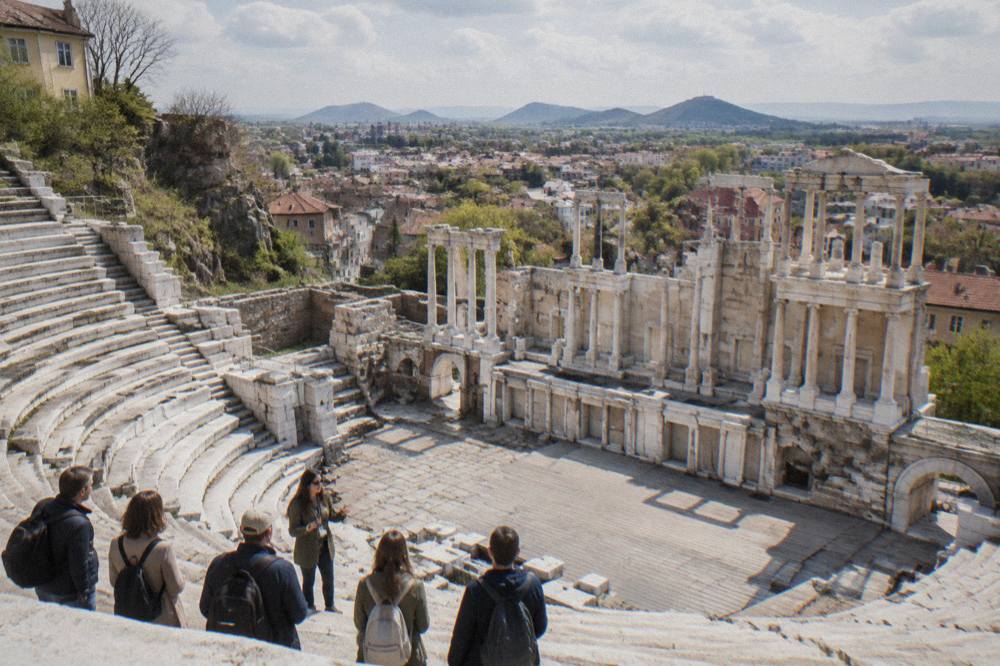
The reliable zone is easy to map because it follows the sights. The Ancient Theatre, the Roman Stadium's 3D hall and visitor centre, the Bishop's Basilica and the Old Town revival houses all sit under the Old Plovdiv institute, whose English pages state prices, hours and lunch breaks plainly. The Regional Archaeological Museum renewed its permanent exhibition in 2025 with a bilingual audio guide, a small but telling sign of how the city presents itself to foreign visitors. At the other end of the scale, the Dzhumaya Mosque is a working mosque with free entry and no ticket bureaucracy at all: dress modestly, avoid Friday midday prayer, and language is barely an issue.
Restaurants in the centre and in Kapana, the creative district whose name means "The Trap", usually have English menus or staff who can talk you through the dishes. Traditional food helps here: what to eat and drink in Plovdiv runs to shopska salad, kebapche and kavarma, dishes that survive translation by pointing.
| Situation | English support | What helps |
|---|---|---|
| Museum ticket desks (Old Plovdiv sites) | English pages and posted prices | Ticket page lists hours, lunch breaks, family rates |
| Guided tours in Plovdiv | Tours sold to international visitors run in English | Read the listing's language line before booking |
| Centre restaurants and Kapana | English menus common | A food name or photo bridges gaps |
| City buses | Cyrillic destination boards | Match your stop's name letter by letter |
| Neighbourhood markets | Bulgarian only | Point, nod, and have small euro coins |
| Taxis | Driver English varies | Apps or a written address |
How To Handle Cyrillic Signs In Plovdiv
Cyrillic in Plovdiv is manageable because many letters map directly onto Latin sounds, and the alphabet can be decoded in an afternoon. Bulgarian signs for centre, street, old town and bus stop repeat constantly, so a short list of transliterations covers a large share of what a visitor actually reads. Street names in the Old Town and Main Street also carry history, and reading them becomes part of the visit rather than an obstacle.
A few equivalences unlock a surprising amount: П is R, Н is N, В is V, С is S, Р is R's neighbour P, and У is U. With those six plus a handful of others, Център resolves into "centar", the Bulgarian for centre, and Пловдив is recognisably Plovdiv on every road sign in the country. The frustration is real for about a day, then it fades. The Old Town's museum houses, Balabanov, Hindliyan, Nedkovich and Lamartine among them, carry Latin-script nameplates anyway because the institute markets them internationally. The rest of the planning pages sit on Plovdiv Travel Guide.
Transport is where Cyrillic bites hardest. City bus destination boards and stop names are in Bulgarian, and the practical method is to write down your stop's name in Cyrillic, from a mapping app, and match it on the board. The single e-ticket costs 0.50 euro, paid electronically, so the transaction itself needs no words. For arrivals and departures, the BDZ rail timetable site has an English interface for the Sofia to Plovdiv line, where direct trains take about 2 h 40 to 3 h 05, and the main stations sit side by side on Hristo Botev Boulevard, which helps when signs switch scripts mid-journey.
Do Plovdiv Tours Run In English?
Yes, Plovdiv's paid tours sold to international visitors run in English, and a tour is the most language-proof way to see the city's layered history, since the guide or audio commentary carries the translation for you. The city's walking tours cover the Old Town, the Roman landmarks and the food of the centre, while day trips reach Bachkovo Monastery, Asen's Fortress and the Thracian valley sites beyond the city.
The site's own featured pick here is the AudioGuide walking tour of Old Town and the Roman landmarks, an English-language audio walk that suits travellers who want commentary without a group's schedule, with live availability at Check availability. Human-guided options exist across the roster, from classic city walks to food walks through Kapana. Every listing states its language and what the price covers, so the language question is answered before you pay, not after.
Guides also bridge the language gap on day trips, where public transport gets thin and signage gets more purely Bulgarian. Bachkovo Monastery, about 30 km from Plovdiv and free to enter as a working monastery, Asen's Fortress above Asenovgrad and the Thracian complexes in the Rose Valley all sit in countryside where English is thin on the ground. A guided small-group trip converts that into a day without translation worries, and the Rhodopes to the south, reachable on a Rhodopes day tour from Plovdiv, reward the approach even more.
Useful Bulgarian Phrases For Plovdiv
A dozen Bulgarian phrases carry a visitor through Plovdiv's markets, cafes and taxis, and locals respond warmly to any attempt at the language, however brief. The essentials are hello, thank you, please, yes, no, the bill and do you speak English, all of which transliterate cleanly into Latin script. Bulgarian uses the same nod-and-shake logic as anywhere in the Balkans for basic courtesy, so the effort is small and the payoff in service and goodwill is immediate.
| English | Bulgarian (Cyrillic) | Say it |
|---|---|---|
| Hello | Здравей / Здравейте | zdra-vey (formal: zdra-vey-te) |
| Thank you | Благодаря | bla-go-da-rya |
| Please | Моля | mo-lya |
| Yes / No | Да / Не | da / ne |
| The bill, please | Сметката, моля | smet-ka-ta, mo-lya |
| Do you speak English? | Говорите ли английски? | go-vo-ri-te li an-gliy-ski |
| How much? | Колко струва? | kol-ko stru-va |
| Good morning / Good evening | Добро утро / Добър вечер | do-bro u-tro / do-bar ve-cher |
| Goodbye | Довиждане | do-vizh-da-ne |
Two habits make the list work. First, pair any phrase with the English question that follows it, because speakers who know some English will switch rather than leave you stranded. Second, carry your accommodation's address in Cyrillic on paper or offline on your phone for taxis, a trick that matters more than grammar. The deeper cultural layer, when Bulgarians eat, what breakfast looks like, how coffee is taken, has its own pages: what time Bulgarians eat dinner and a typical Bulgarian breakfast cover the table side of the language question.
Does Anyone Speak English Outside Plovdiv?
Outside Plovdiv, English support depends on the setting rather than the region: Sofia's airports, stations and visitor services work in English much as Plovdiv's do, while villages, monasteries and rural bus routes run in Bulgarian alone. Day-trip destinations from Plovdiv such as Bachkovo, Koprivshtitsa and the Rhodope towns are perfectly visitable without Bulgarian, but a tour or a prepared itinerary removes nearly all the language friction.
The reason is structural. Bulgaria's tourism economy concentrates its English in the places tourists actually reach, and the farther you go from a ticket office, the more the language reverts to Cyrillic. That is an argument for planning rather than for staying home: the Sofia to Plovdiv rail link is bookable with an English timetable, day trips in the site's roster list their language, and the country's essentials, the euro since 1 January 2026, Schengen membership since 1 January 2025 and the 112 emergency number, all work identically regardless of what language you speak. Sizing the city against the capital is covered in how many days to spend in Plovdiv, a planning question that matters more than vocabulary.
Common Questions About Speaking English In Plovdiv
Can I Speak English In Bulgaria?
Yes, in the visitor-facing parts of the country, and Plovdiv is one of the easiest places to do it: museum ticketing, the tourism site and paid tours all operate in English. Everyday life runs in Bulgarian, written in Cyrillic, so a translation app and a few phrases smooth the edges.
Is English widely spoken in Plovdiv?
English is common in Plovdiv's centre among people of school and working age, and universal across the museum and tour infrastructure. Markets, local buses and neighbourhood shops outside the centre are Bulgarian-speaking, and pointing plus a smile handles those.
Do Plovdiv museum tickets require Bulgarian?
No. The Old Plovdiv ticket page publishes its prices in euro with English descriptions, and the city's other state museums maintain English pages. Ticket desks handle English transactions routinely.
Can I get by in Plovdiv without reading Cyrillic?
Largely yes, and the alphabet decodes quickly because many letters map onto Latin sounds. Learning to recognise Plovdiv, centre, street and your bus stop's name in Cyrillic covers the majority of signs a visitor actually needs.
Are Plovdiv walking tours available in English?
Yes. Tours sold to international visitors list English as their language, including audio-guided walks of the Old Town and Roman landmarks. Tip-based walks also run locally; agree the arrangement with the guide directly.
What language is spoken in Bulgaria besides Bulgarian?
Bulgarian, a Slavic language written in Cyrillic, is official and dominant. English is the most useful foreign language for visitors in cities like Plovdiv, and Turkish and Romani are also spoken in communities across the country.