Regional Archaeological Museum: Thracian And Roman Finds Near The Center
The Regional Archaeological Museum in Plovdiv holds the city's deepest past in one building: Thracian metalwork, Roman inscriptions from Philippopolis, and a permanent exhibition renewed in November 2025. It stands on Saedinenie Square, a short walk from the Old Town.
Short answer
The Regional Archaeological Museum in Plovdiv is at Saedinenie Square 1, open Tuesday to Sunday 10:00 to 18:00 and closed on Mondays. Its permanent exhibition was renewed in November 2025 with about 150 new exhibits and a bilingual audio guide. Ticket prices are not published on a confirmed list, so confirm at the desk.
The Regional Archaeological Museum in Plovdiv, in southern Bulgaria, is where the city's six hills and the plains around them turn into display cases. The building faces Saedinenie Square 1, close to the central grid of the modern city, and it collects the archaeological record of a place often described as one of the oldest continuously inhabited cities in Europe. The official city tourism site dates the first settlement on Nebet Tepe, one of those hills, to the 4th millennium BC. What that long story looks like in physical objects, from Thracian metalwork to inscriptions carved for Roman Philippopolis, is the museum's whole reason for existing. The permanent exhibition was renewed in November 2025 with about 150 new exhibits and a bilingual audio guide, according to the Bulgarian News Agency, which reported the completion of the renewal project.
This page from the Plovdiv Travel Guide covers what the museum holds, when it opens, how the ticket situation works, and how to fold it into a day that also takes in the Ancient Theatre of Philippopolis and the Roman Stadium.
What Is The Regional Archaeological Museum In Plovdiv?
The Regional Archaeological Museum in Plovdiv is the main museum institution collecting and displaying the archaeological material of the city and its region, from prehistoric settlement finds through Thracian metalwork to the sculpture and inscriptions of Roman Philippopolis. It occupies a dedicated museum building on Saedinenie Square 1 in the city center. The museum's own site lists it as the body managing several of the city's ancient monuments, including the Roman Stadium and the Ancient Theatre.
The museum's role is broader than a single gallery. Its site menu connects it to the standing ancient monuments scattered through the center, which matters for a visitor planning a route: the museum is the indoor counterpart to a city that is, in large part, an open-air site. Plovdiv's Roman layer includes the Roman Odeon and the Roman Forum, both within the central area, and objects recovered from excavations around these monuments end up in the museum's collections.
The renewal completed in November 2025 reshaped the permanent exhibition. The Bulgarian News Agency reported about 150 new exhibits added and a bilingual audio guide introduced as part of the same project. For a returning visitor who last saw the galleries years ago, that is a reason to treat the museum as effectively a new presentation rather than a static cabinet of old stones.
Where Is The Museum In Plovdiv And How Do You Reach It?
The Regional Archaeological Museum stands on Saedinenie Square 1 in central Plovdiv, at the western edge of the pedestrian core, a few blocks from the Central Square and the start of the Main Street. Saedinenie Square is also a public transport hub, with city buses stopping around it, and the single city bus e-ticket costs 0.50 euro. The museum is therefore reachable on foot or by a single short bus ride from nearly anywhere in the center.
Plovdiv's geography makes this simple. The city's center is compact, and the museum sits at the point where the central square area meets the wider grid of the modern city. Walking is the usual way to move through the center. The Old Town begins a short distance uphill to the east, and the route from the museum to Hisar Kapia, the old gate at the edge of the Old Town, runs along the Main Street, the long pedestrian axis of the city.
For travellers arriving by rail, the guide to the Plovdiv train station covers the station's position on Hristo Botev Boulevard and the ongoing junction modernization works, which the transport ministry reported 85 percent complete in November 2025 with completion targeted for 2026. Expect some access changes around the station during the works.
| Starting point | How to reach the museum | What to know |
|---|---|---|
| Central Square / Main Street | Walk west along the pedestrian axis | Central and flat, no climb involved |
| Old Town / Hisar Kapia | Walk down to the Main Street, then west | Downhill; allow time for the return climb |
| Plovdiv Central railway station | City bus toward the center, or a walk along Hristo Botev Blvd | E-ticket 0.50 euro per ride |
| Kapana Creative District | Walk north across the central area | Kapana's streets are free and open at all hours |
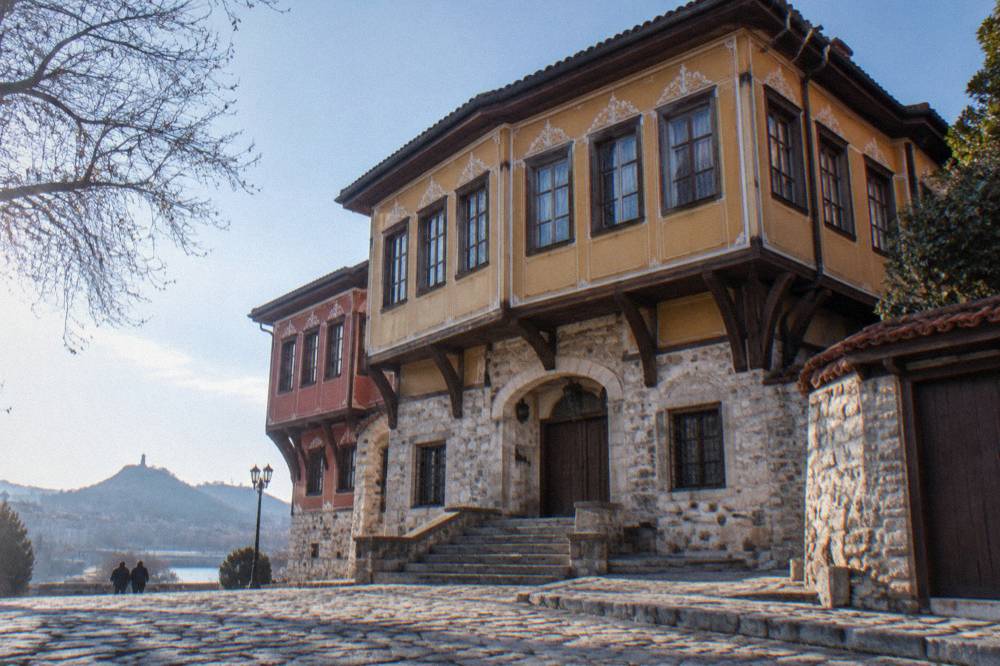
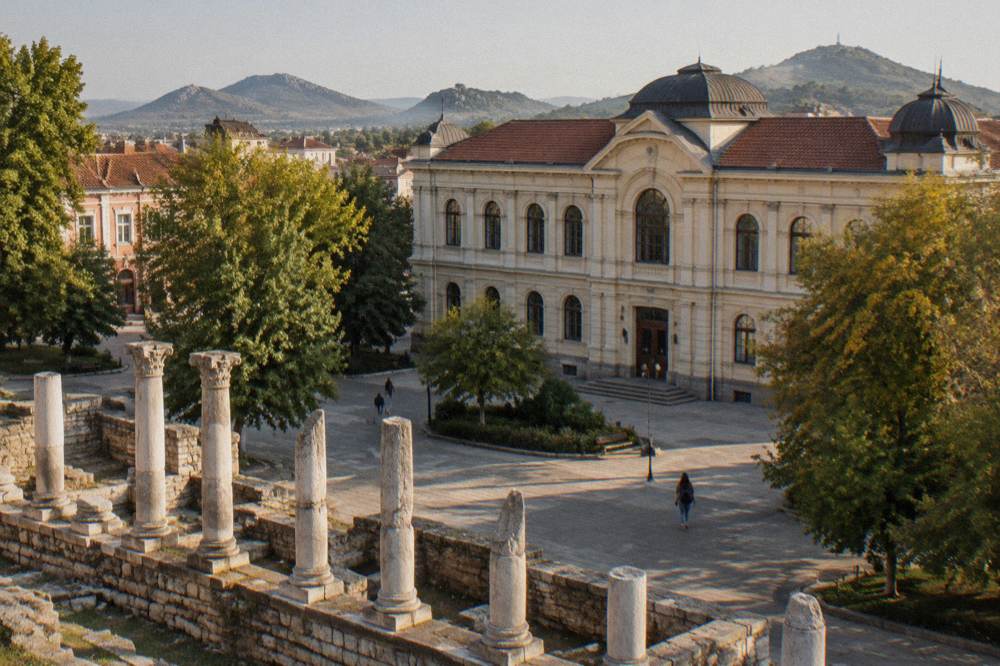
A practical note on the museum's own footprint: the building fronts the square directly, so the entrance is visible from the open space rather than hidden in a courtyard. The square itself is one of the city's main public spaces and holds its own monuments, which makes the arrival part of the visit rather than a detour.
If a structured introduction appeals before you go it alone, an audio-guided walk of the Old Town and the Roman landmarks pairs naturally with a museum visit, since the walk covers the outdoor monuments and the museum holds the finds. Check availability.
What Can You See Inside The Plovdiv Archaeological Museum?
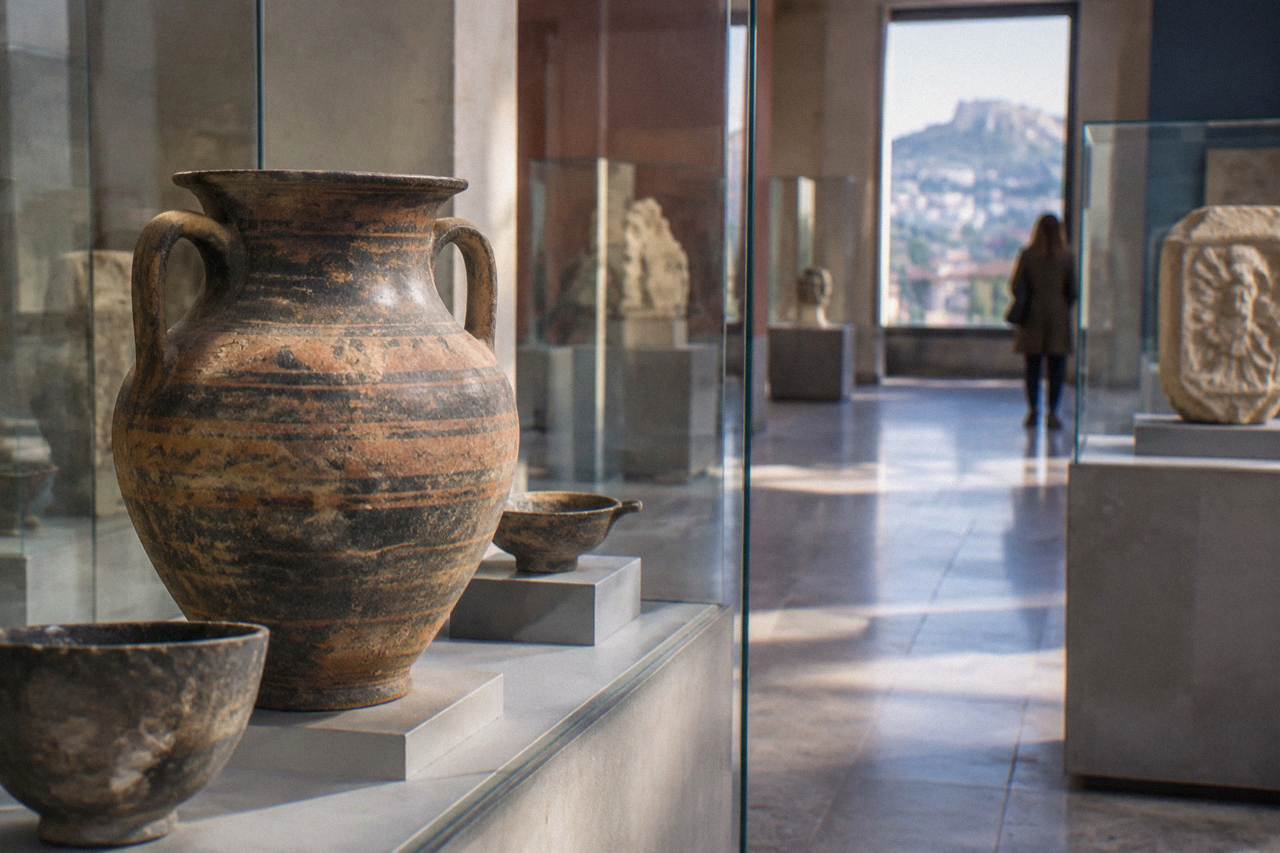
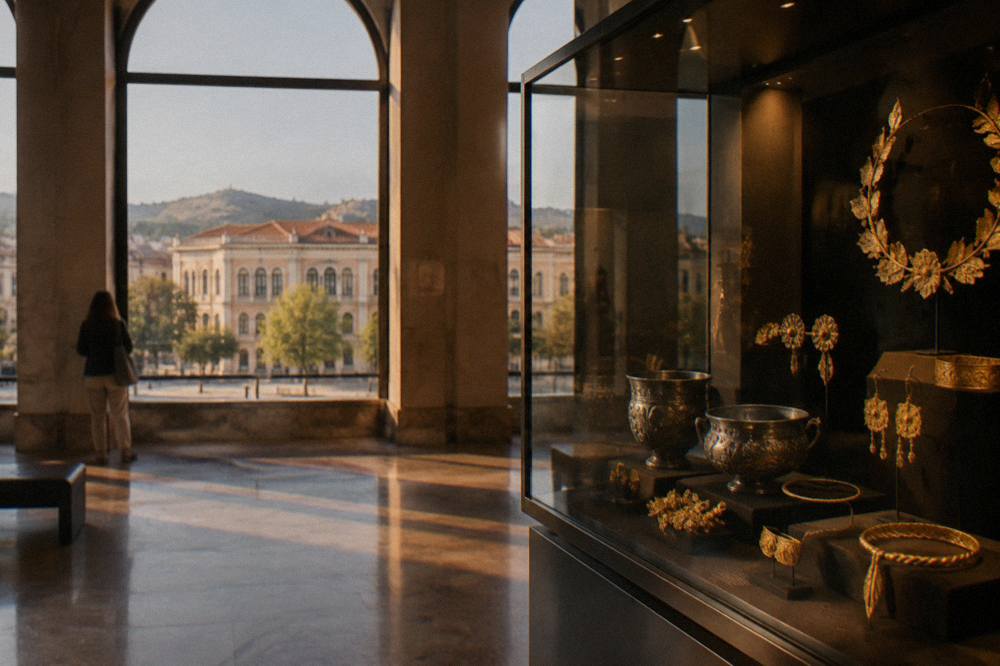
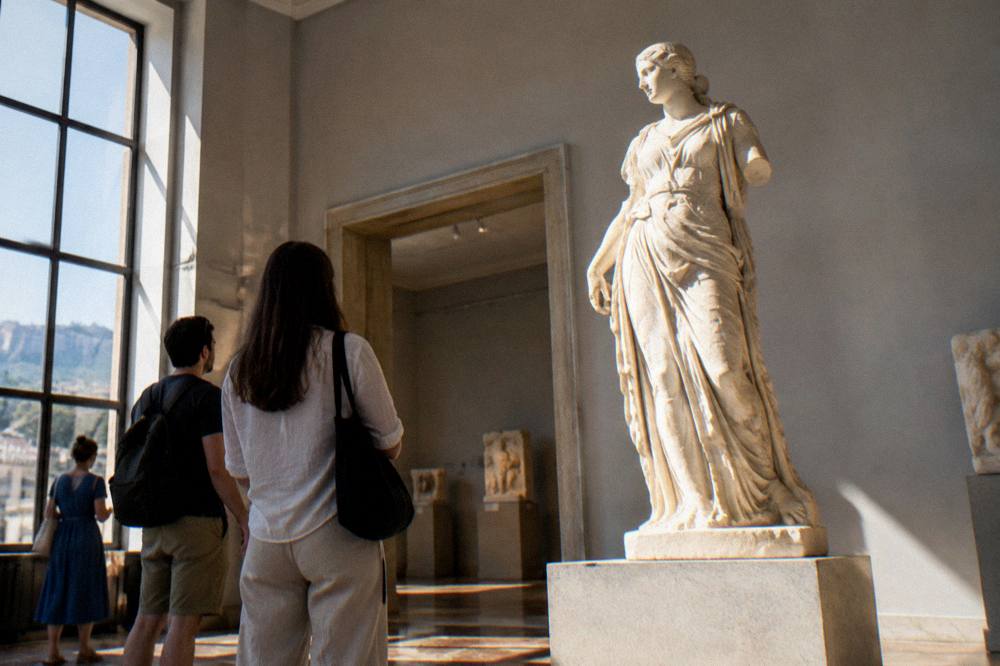
The permanent exhibition of the Regional Archaeological Museum in Plovdiv spans the archaeological sequence of the region: prehistoric settlement material, Thracian artefacts including metalwork, and the sculpture, inscriptions and everyday objects of Roman Philippopolis. The renewal completed in November 2025 added about 150 new exhibits to the permanent display and introduced a bilingual audio guide, per the Bulgarian News Agency's report on the project.
The Thracian material is the part that draws researchers. Plovdiv sits at the northern edge of the Rhodope region and the Thracian plain, a landscape dense with burial mounds and sanctuaries described on this site's day-trip pages for Starosel and Kazanlak and the Rose Valley. Objects from that world, and from the settlement layers of the city itself before the Romans, form the earlier galleries.
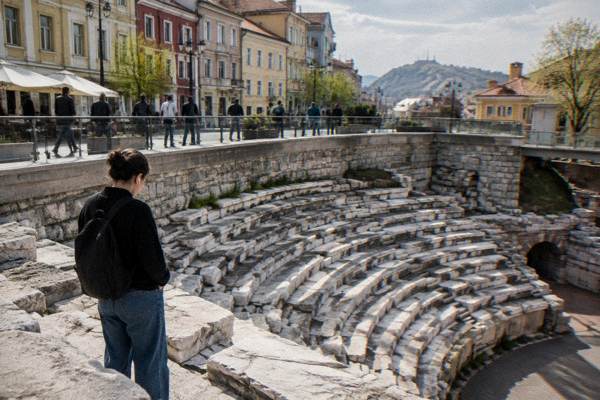
The Roman galleries carry the city's imperial name, Philippopolis, and the inscriptions and sculpture recovered from the urban core. The standing monuments are the visible half of this story: the Ancient Theatre, built in the 90s AD with 28 concentric rows of marble seats; the Roman Stadium, built in the 2nd century AD on the model of the stadium at Delphi, which held up to 30,000 spectators and of which only the northern part, the sphendone, is accessible today because the rest lies beneath the Main Street. The museum holds the portable evidence of the same city, and reading the two halves together is what a visit to Plovdiv does best.
| Collection area | Period covered | Typical objects on display |
|---|---|---|
| Prehistory | Neolithic onward, first settlement on Nebet Tepe dated to the 4th millennium BC | Settlement finds from the hills, early tools and pottery |
| Thracian | First millennium BC | Metalwork, ornaments, burial material from the region |
| Hellenistic | Era of Evmolpias and early Philippopolis | Coins, ceramics, imported goods |
| Roman Philippopolis | Roman era, city named Philippopolis | Inscriptions, sculpture, everyday urban objects |
| Late antique and medieval | After the Roman era | Material from the layered medieval city known as Puldin and Filibe |
The November 2025 renewal is worth flagging for anyone whose image of the museum is a decade old. The renewed exhibition added about 150 exhibits and a bilingual audio guide, changes reported by the Bulgarian News Agency when the project was presented. Galleries that were previously dense without much interpretation gained a layer of explanation aimed at visitors reading in two languages.
What Are The Opening Hours And Ticket Prices?
The Regional Archaeological Museum in Plovdiv is open Tuesday to Sunday from 10:00 to 18:00 and is closed on Mondays, per the museum's own site. A confirmed ticket price is not published on the museum's current page, so the desk is the authority: confirm the fare when you arrive. The Old Plovdiv sites nearby follow a different price list entirely, with a single site ticket reported at 3.58 euro for adults.
The Monday closure is the single most important planning fact. Plovdiv's museum calendar shares this pattern: the Ethnographic Museum in the Old Town is also closed on Mondays, with winter hours 9:00 to 17:00 and summer hours 9:00 to 18:00. A Monday in Plovdiv is therefore better spent outdoors, at free sites such as Nebet Tepe, the open-air archaeological complex on one of the three central hills, or in the Kapana Creative District, whose narrow streets, whose name means "The Trap", are open public space at all hours.
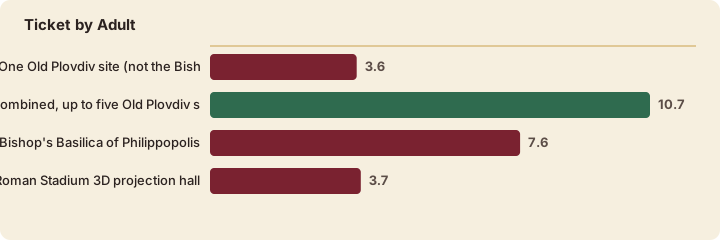
The prices below are the reported list; check at the gate, since offers and seasonal adjustments are the museum institutes' own to change.
| Ticket | Adult | Student | Family |
|---|---|---|---|
| One Old Plovdiv site (not the Bishop's Basilica) | 3.58 euro | 1.53 euro | 7.16 euro |
| Combined, up to five Old Plovdiv sites | 10.74 euro | 4.09 euro | 21.47 euro |
| Bishop's Basilica of Philippopolis, separate list | 7.57 euro | 3.58 euro | 15.34 euro |
| Roman Stadium 3D projection hall | 3.68 euro | 1.23 euro | not listed |
| Regional Archaeological Museum | confirm at the desk | confirm at the desk | confirm at the desk |
Two traps in that table deserve their own sentences. First, the Regional History Museum, a different institution with several sites around the city, publishes its own list, 5 euro for one site and 8, 10 and 12 euro for two, three and four sites, with free entry the first Thursday of the month, and this list has nothing to do with the Archaeological Museum despite the similar names. Second, the combined Old Plovdiv ticket excludes the Small Basilica and the Bishop's Basilica, which are priced separately, and the combined ticket's validity period is not stated on the confirmed list, so do not plan around an assumed duration.
A comparison of the city's main museums helps when a short visit forces a choice:
| Museum | Closed | Hours | Ticket status |
|---|---|---|---|
| Regional Archaeological Museum | Monday | Tue to Sun 10:00 to 18:00 | Not on a confirmed list; confirm at the desk |
| Regional Ethnographic Museum (Kuyumdzhiev House) | Monday | Winter 9:00 to 17:00, summer 9:00 to 18:00 | Reported around 3.07 euro adult |
| Regional History Museum (multi-site) | varies by site | varies by site | 5 euro one site, adult, published list |
| Old Plovdiv houses (Balabanov, Nedkovich, others) | some close Monday | roughly 9:00 to 18:00 summer | 3.58 euro single site, reported |
How Does The Museum Connect To Plovdiv's Other Roman Sites?
The Regional Archaeological Museum in Plovdiv is listed on its own site as managing several of the city's ancient monuments, including the Roman Stadium and the Ancient Theatre of Philippopolis, which makes it the institutional thread running through Roman Plovdiv. A visit works best as a loop: the museum's galleries first for context, then the standing monuments themselves, with the full set of sites mapped on this site's Roman Plovdiv guide.
The order can go either way. Seeing the Ancient Theatre first, 28 concentric rows of marble seats built in the 90s AD, gives the museum's sculpture a place to belong; seeing the museum first turns every footing along the Main Street into something with a label. The Roman Stadium's visible sphendone is free to view in the open air, and its paid 3D projection hall, reported at 3.68 euro for adults, reconstructs the parts still buried under the Main Street, a useful pairing with the museum's urban material.
The Roman layer extends past the headline monuments. The Odeon, the small theatre of the city council, and the Forum sit within the central area, and the Bishop's Basilica, about 83 m long and 36 m wide, the largest basilica of its era in Bulgaria, with two layers of floor mosaics covering over 2,000 sq m, adds the late Roman Christian city to the sequence. All of these are described in the guide to Roman Plovdiv, and the museum's late antique cases close the same story indoors.
For travellers who want the connective tissue explained aloud rather than read from labels, the museum pairs well with a guided format:
Want the whole Roman story walked through with a guide? Book a guided walking tour here.
The audio guide format suits this particular city because the sites are scattered along a walkable axis rather than gathered in one compound, and a commentary that moves with you covers the ground between monuments as well as the monuments themselves.
Is The Museum Worth It On A Short Plovdiv Visit?
On a stay of one or two days, the Regional Archaeological Museum in Plovdiv earns its slot for the Thracian galleries and the renewed Roman display, provided the day is not a Monday, when it is closed. A two-day itinerary has comfortable room for the museum plus the Old Town, the Ancient Theatre and the free sphendone. On a single day, the standing monuments come first and the museum becomes the rainy-day or late-afternoon option.
The judgment depends on what draws you to Plovdiv. If the pull is the Roman city, the museum is not optional: it holds the inscriptions and the small finds that the open-air sites cannot show. If the pull is atmosphere, the Old Town houses such as Balabanov House and the Ethnographic Museum carry the National Revival era story instead, and that is a different afternoon. For a paced plan that includes both, the site's Plovdiv In Two Days itinerary slots the museum in alongside the monuments.
Weather is a legitimate input. Plovdiv's climate is continental: the ERA5 reanalysis, 1991-2020, puts the mean daily high at 5.9 C in January and 28.2 C in July, with rainfall peaking in May at 56.8 mm on the monthly totals and August the driest month at 25.2 mm. A January afternoon or a wet spring day is museum weather; an August morning belongs on Nebet Tepe early, before the heat.
| If you have | Museum fits how | Suggested order |
|---|---|---|
| Half a day | Yes, one gallery pass | Museum, then the free sphendone on the walk back |
| One day | Choose museums or monuments | Ancient Theatre and Old Town first; museum if time and open |
| Two days | Comfortably, unhurried | Day one monuments, day two museums and Kapana |
| A rainy day | Centerpiece of the day | Museum, then coffee in Kapana's covered corners |
Families should weigh attention spans honestly. Sculpture and inscriptions reward readers; the audio guide introduced in 2025 helps, and the building is compact enough that a short visit is a real option rather than a failed long one. For a wider set of options with children in tow, the site's coverage of things to do in Plovdiv lists the outdoor alternatives.
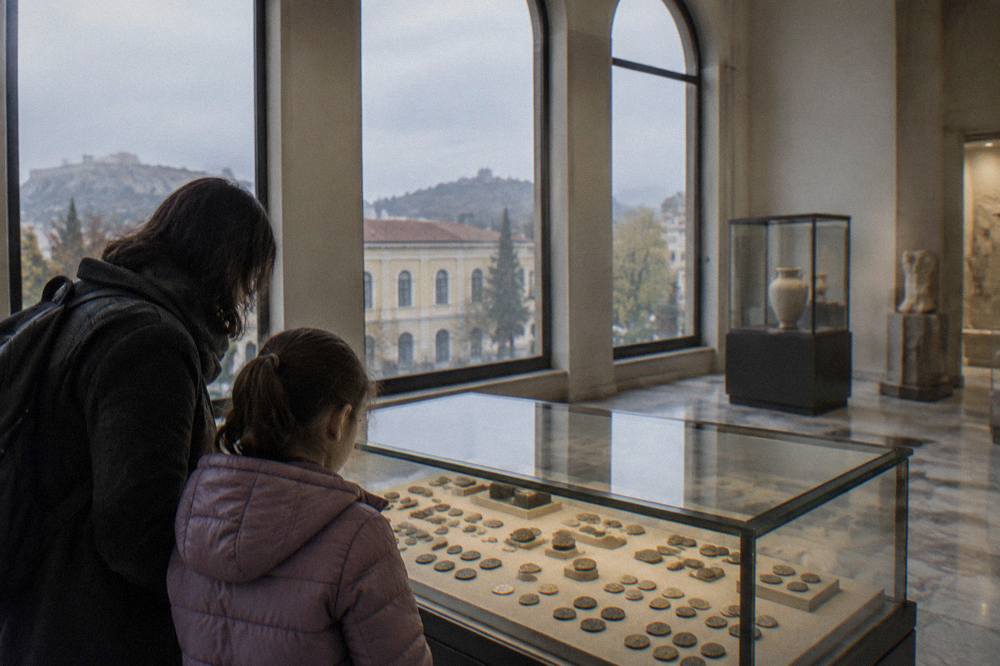
For a shorter guided taste of the city center that still touches the Roman layer:
What Else Sits Near The Museum For The Rest Of The Day?
Around the Regional Archaeological Museum in Plovdiv sit Saedinenie Square itself, the Main Street pedestrian axis running east, the Kapana Creative District just north of the Old Town, and the Old Town's gates and houses uphill. The museum is therefore not an outlying trip but a single stop inside a walkable circuit that can end with dinner, an evening drink, or the nighttime version of the same streets.
Working outward: the square holds its own monuments and open space. East runs the Main Street, the long pedestrian spine, passing the Dzhumaya Mosque, a working mosque and the second-largest in Bulgaria by built area at about 1,500 sq m, free to visit outside prayer times with modest dress. Further east lie the Roman Stadium sphendone under the street level, then Hisar Kapia and the climb into the Old Town toward Nebet Tepe, free and open at all hours.
North of that axis is Kapana, "The Trap", the creative district of narrow streets, galleries and bars, free and open as public space. A museum-to-Kapana route takes in the whole central band of the city without transport, and the guide to Plovdiv at night covers how those streets change after dark. The evening options in that district are covered on this site, and a walk with a tasting stop is one way to end the loop:
For a second day or a wider arc, the day-trip pages on Hisarya, the Roman town with surviving walls in the plain north of the city, and on the Thracian complexes of Starosel extend the same archaeological story beyond the city limits. Where to base for any of this is covered in the guide to where to stay in Plovdiv, which maps the center, Kapana and the hillside quarters.
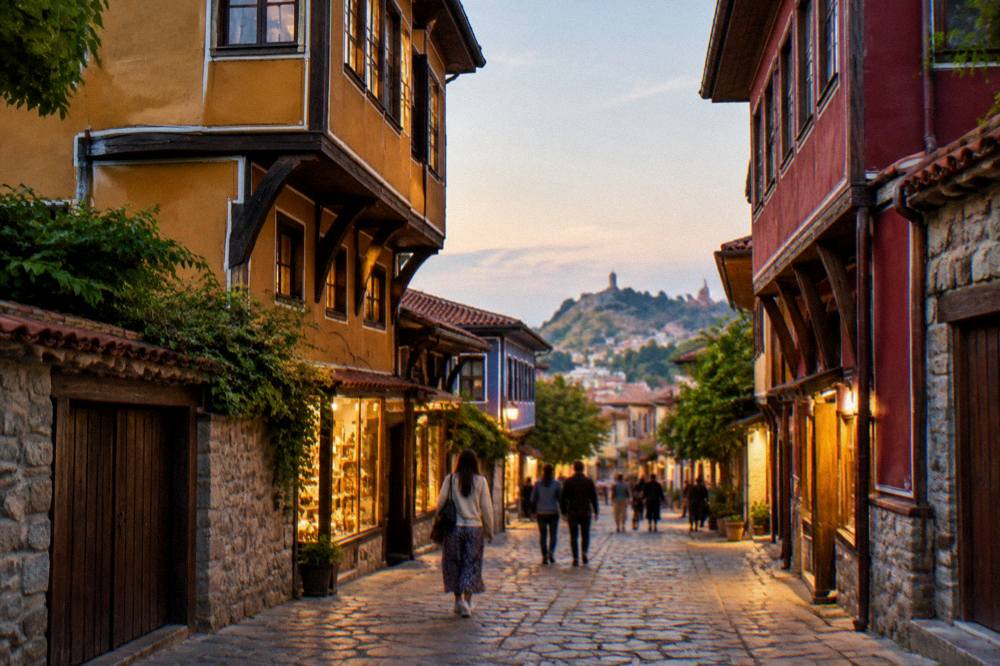
One last pairing worth naming: the Ethnographic Museum in the Kuyumdzhiev House covers the folk and Revival-era culture the Archaeological Museum does not, and the two together give a visitor both ends of the city's timeline, hill settlement to the merchant city of the National Revival, inside two buildings and one afternoon's walk.
Common Questions About The Regional Archaeological Museum In Plovdiv
Is The Regional Archaeological Museum In Plovdiv Open On Mondays?
No. The museum is closed on Mondays and open Tuesday to Sunday from 10:00 to 18:00, per the museum's own site. The Ethnographic Museum in the Old Town follows the same Monday closure, so plan Mondays for outdoor sites such as Nebet Tepe or Kapana instead.
How Much Does The Plovdiv Archaeological Museum Cost?
A confirmed ticket price is not published on the museum's current page, so no figure can be printed here. Confirm the fare at the desk when you arrive. The nearby Old Plovdiv sites follow the municipal institute list, reported at 3.58 euro for a single-site adult ticket.
What Is Inside The Regional Archaeological Museum Plovdiv?
The permanent exhibition covers the region's archaeological sequence: prehistoric settlement finds, Thracian metalwork and burial material, and the inscriptions, sculpture and objects of Roman Philippopolis. The renewal completed in November 2025 added about 150 new exhibits and a bilingual audio guide.
Where Is The Archaeological Museum In Plovdiv Located?
At Saedinenie Square 1, on the western edge of the central pedestrian area, close to the Main Street and a few minutes' walk from the Central Square. City buses serve the square, and the single e-ticket costs 0.50 euro.
Can You Visit The Museum And The Ancient Theatre On The Same Day?
Yes, easily. Both sit inside the walkable center: the museum on Saedinenie Square, the Ancient Theatre uphill in the Old Town, open April to October 9:30 to 18:00 and November to March 9:00 to 17:30, with a lunch break at 12:30. The museum is closed Mondays, so the pairing works Tuesday to Sunday.
Is The Museum Managed By The Same Body As The Roman Sites?
The museum's own site menu lists the Roman Stadium and the Ancient Theatre of Philippopolis among the monuments it covers, while the Old Plovdiv municipal institute still sells those sites' tickets on its own price list. Treat the archaeology as one story told by two institutions, and buy tickets at the gate of each site.