Is Plovdiv The Oldest City In Bulgaria?
The age claim on Plovdiv, in southern Bulgaria, examined against the archaeology of Nebet Tepe and the verifiable dates of its Roman layers.
Plovdiv, in southern Bulgaria, is an inland city built around six hills, and the claim attached to it is a big one: often described as one of the oldest continuously inhabited cities in Europe. The phrase turns up in tourism brochures, on the city's own marketing and in nearly every guidebook summary. But the question of whether Plovdiv is the oldest city in Bulgaria is a different matter from the European superlative, and it deserves a careful answer. The verifiable evidence centres on one hill, Nebet Tepe, where the city's official tourism site dates the first settlement to the 4th millennium BC.
This page lays out what the dated archaeology shows, why the "oldest" label is hard to award to any single city, and which parts of Plovdiv you can actually stand in today when you want to feel that depth of time. The short version: the settlement evidence is real and genuinely ancient, but the city's own materials stop short of a ranking, and so does the archaeology that has been published. Anyone who tells you Plovdiv is definitively number one, in Bulgaria or in Europe, is going further than the published archaeology allows.
Is Plovdiv The Oldest City In Bulgaria?
Plovdiv is the strongest candidate in Bulgaria for continuous inhabitation, because its own tourism site dates the first settlement on Nebet Tepe to the 4th millennium BC, but no official source prints a ranking of Bulgarian cities by age, and the claim that survives scrutiny is narrower: one of the oldest continuously inhabited cities in Europe, described as such, not crowned as number one.
That distinction is the whole answer in miniature. The two things being claimed are different. A city can have very ancient traces of human presence without having been continuously inhabited, and it can have a long recorded history without archaeological layers going back millennia. Plovdiv's strength is the combination: a settlement on Nebet Tepe dated by the municipal tourism site to the 4th millennium BC, followed by an unbroken chain of occupation through Thracian, Hellenistic, Roman, Byzantine, Ottoman and modern Bulgarian periods.
The city's historical names trace that chain in a single list. The official city site records Kendrissos, Evmolpias, Philippopolis, Pulpudeva, Trimontsium, Ulpia, Flavia Julia, Plapdiv, Puldin, Ploudin and Filibe among the names Plovdiv has carried, each one marking a different people and era occupying the same ground between the hills. A place does not collect eleven names by being abandoned.
Comparison is not attempted here. No ranking against other candidate cities is offered here, and none should be trusted from a poster. The broader case for visiting Plovdiv does not depend on winning an age contest anyway; the layers themselves are the attraction.
What Do The Dated Layers Under Plovdiv Actually Show?
The anchor date is the 4th millennium BC, which the city's official tourism site attaches to the first settlement on Nebet Tepe, the northernmost of the three hills of the old town. From there the record runs forward without a break: Thracian Evmolpias, Hellenistic Philippopolis, Roman Trimontsium, and every later era layered on the same streets.
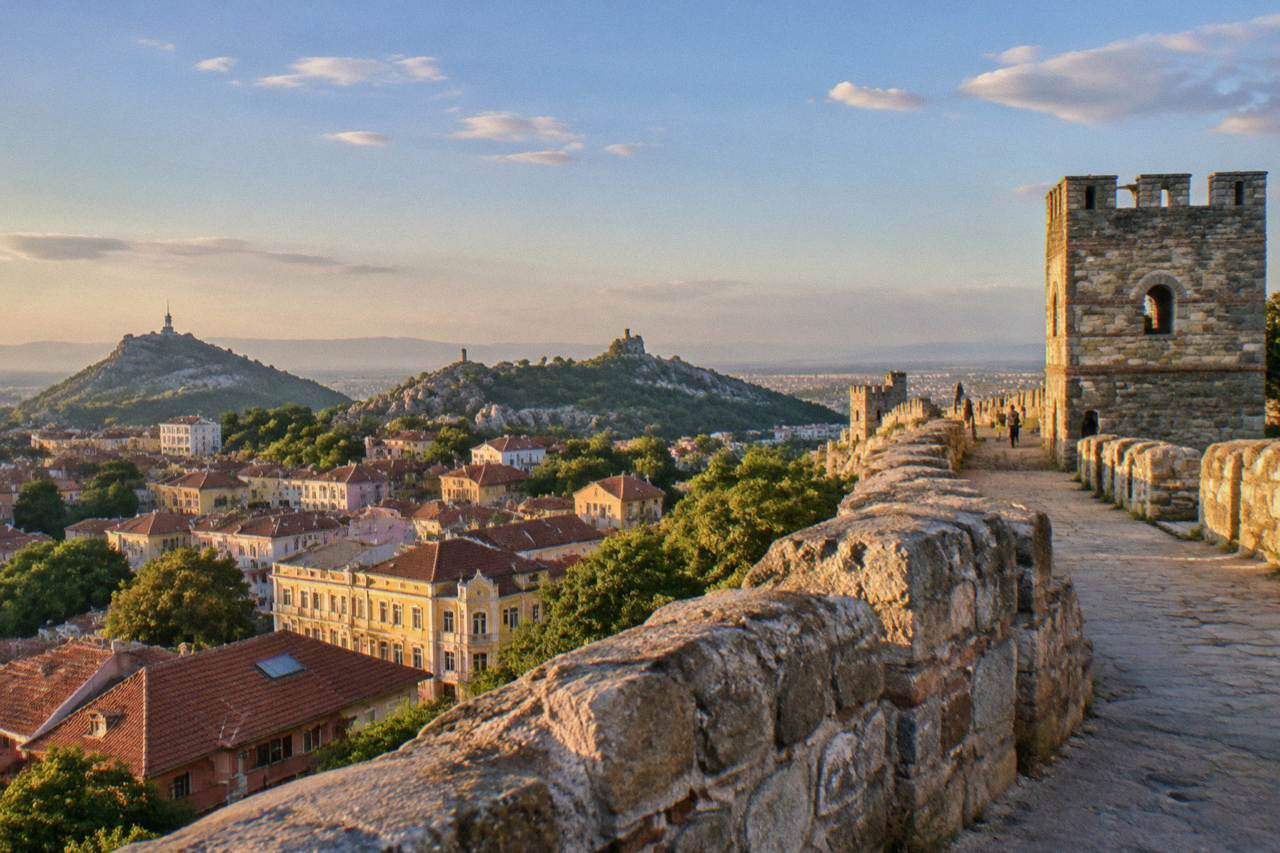
Nebet Tepe is the place to start, and it is free to visit. The hill carries the remains of the earliest fortified settlement and the thick walls of every period that reused the site, and a major restoration project finished there in March 2025, reopening the whole complex with public access and no ticket. Standing on the terrace, you look across the bend of the old town toward the plain of the Maritsa river, the same view that made the hill worth fortifying six thousand years ago.
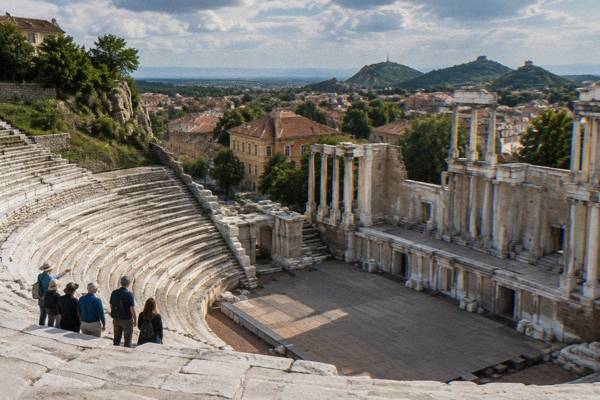
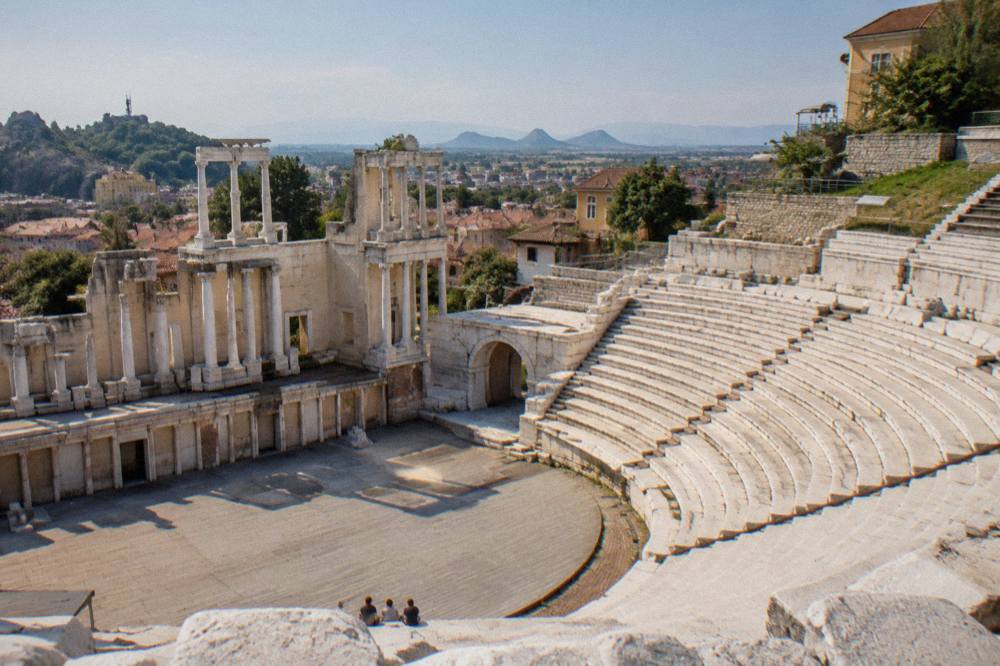
Below the hills, the Roman layers are where the dating becomes precise and publicly documented. The Ancient Theatre of Philippopolis was built in the 90s of the 1st century AD, per the city tourism site, and retains 28 concentric rows of marble seats. The Roman Stadium followed in the 2nd century AD on the model of the Stadium at Delphi, seating up to 30,000 spectators; only its northern end, the sphendone, is visible today, because the rest still lies beneath the modern Main Street. The early Christian basilicas close the ancient sequence: the Small Basilica and the great Episcopal Basilica, the latter about 83 m long and 36 m wide with over 2,000 sq m of floor mosaics, belong to the late antique era of the city's history as the municipal site presents it.
| Layer | Period or date | What you can see today |
|---|---|---|
| First settlement, Nebet Tepe | 4th millennium BC | Open-air site on the hill, free entry |
| Thracian and Hellenistic city | Evmolpias, then Philippopolis | Fortification walls reused on Nebet Tepe |
| Ancient Theatre | 90s of the 1st century AD | Full theatre, 28 rows of marble seats |
| Roman Stadium | 2nd century AD | Sphendone end under the Main Street |
| Small Basilica | Late antique era | Mosaic floors in situ |
| Bishop's Basilica | Late antique era, about 83 m long | Visitor centre over two mosaic floors |
A guided walk ties those layers together in a way that signage alone does not, and the Old Town guided walk with rakia tasting is the site's featured option for exactly this route, Check availability if you want a guide to connect the eras.
Why No City Can Honestly Claim The "Oldest" Crown?
The "oldest city" question has no referee. Age claims measure different things, presence versus continuous inhabitation versus documented urban life, and cities from Matera to Athens market themselves with the same phrase, so Plovdiv's tourism materials stick to "described as one of the oldest continuously inhabited cities in Europe" rather than a ranking, which is also what the evidence supports.
Consider what each contender is actually claiming. A Neolithic settlement mound, a continuously occupied town and a city with an unbroken written record are three different kinds of age, and they rarely line up neatly in one place. Archaeology also keeps moving: a new dig can push any city's dates back, which is why serious sources hedge. The claim that survives for Plovdiv is the hedged one, and the hedged one is still remarkable.
The comparison people ask about most often is with Matera in Italy, and there is a whole page on this site devoted to which is older, Plovdiv or Matera, because the two cities share a European Capital of Culture year, 2019, and a reputation for deep time. Within Bulgaria, other cities have long histories too, but no verdict is offered and none is needed.
What can be said without qualification is what Plovdiv's own materials say: the municipal tourism site dates the first settlement on Nebet Tepe to the 4th millennium BC, and the city is often described as one of the oldest continuously inhabited cities in Europe. That is the sentence to trust. Notice it does not need to say "8,000 years" or claim a number one spot; the date itself does the work.
Where In Plovdiv Can You Feel The Age Today?
Four free or nearly free places carry the deepest layers: Nebet Tepe for the original settlement, Hisar Kapia for gates that have been rebuilt across eras, the Roman Stadium sphendone for the imperial city, and the Ancient Theatre, where a one-site ticket costs 3.58 euro on the Old Plovdiv price list and puts you inside a structure from the 90s of the 1st century AD.
Nebet Tepe comes first for a reason. It is the oldest thing in the city, it is free, and after the 2025 reopening you can walk the whole conserved complex. Hisar Kapia, the old gate at the edge of the Old Town, is a public landmark you pass through without a ticket, its stones a patchwork of Roman and medieval rebuilding. Kapana, the creative quarter whose name means "The Trap", sits just beyond, its tangled street plan itself a relic of the Ottoman-era town.
The Ancient Theatre is the emotional centre of the age claim for a different reason: it still works. Opera Open ran from 23 June to 9 September in 2026 on the same marble rows audiences used in the 1st century, and the venue hosts concerts through the warmer months. Sitting where a Roman crowd sat, under the same sky, communicates continuous inhabitation better than any date on a plaque.
| Site | Why it matters for the age story | Entry |
|---|---|---|
| Nebet Tepe | First settlement, 4th millennium BC | Free, open access |
| Hisar Kapia | Gate rebuilt across successive eras | Free public landmark |
| Kapana quarter | Street plan of the pre-modern town | Free public streets |
| Ancient Theatre | In use since the 1st century AD | 3.58 euro one-site ticket |
| Roman Stadium sphendone | 2nd century AD, under the Main Street | Sphendone free, 3D hall 3.68 euro |
| Bishop's Basilica | Late antique mosaics, over 2,000 sq m | 7.57 euro |
Tickets are bought at the sites themselves, and hours shift between summer and winter seasons, so confirm on the day for anything timed.
Does The Age Claim Change How You Should Visit Plovdiv?
It should change the pace, not the itinerary. A city with six thousand years of layers rewards walking slowly between the hills rather than racing between sights, and two days is the comfortable minimum the site's planning pages recommend, because the Old Town, the Roman sites and the museums each take half a day on their own.
The practical payoff of the age question is sequencing. Start high on Nebet Tepe in the morning light, come down through Hisar Kapia into the Old Town houses, cross to the Stadium sphendone under the Main Street, and finish at the Ancient Theatre or the basilicas. That single walking line takes you forward through time, from the 4th millennium BC to the late antique basilicas, without ever needing transport. The how many days in Plovdiv question gets a fuller answer elsewhere on this site, but the age layers are the reason the answer is rarely one day.
Guides earn their fee on exactly this kind of route, because the visible fragments mean little without the narrative that connects them. The site's featured Old Town walk with rakia tasting covers the historic core, and themed options dig further: the Thracian Kings small-group day tour reaches the tombs of the culture that preceded Roman Philippopolis, while a wine tasting with cheese and cured meats in the centre pairs the local Thracian valley vines with the food traditions layered on top.
A place can be undeniably old and still resist a precise birthday, and Plovdiv is full of such places, as the Dzhumaya Mosque guide explains.
Common Questions About Plovdiv's Age
Is Plovdiv The Oldest City In Bulgaria?
Plovdiv is the strongest documented candidate for continuous inhabitation in Bulgaria, with the city's official tourism site dating the first settlement on Nebet Tepe to the 4th millennium BC. No official source prints a ranking of Bulgarian cities by age, so the defensible claim is that Plovdiv is often described as one of the oldest continuously inhabited cities in Europe.
How old is Plovdiv exactly?
The anchor figure is the 4th millennium BC for the first settlement on Nebet Tepe, published by the municipal tourism site. The city avoids a single round number, and any figure beyond that date, such as "8,000 years", is not what the official sources print.
Is Plovdiv older than Sofia?
Both cities have deep histories, but no comparison is offered. What is documented is Plovdiv's settlement date on Nebet Tepe and its unbroken chain of historical names from Evmolpias onward.
Where can I see the oldest part of Plovdiv?
Nebet Tepe, the hill that carries the earliest fortified settlement. It is free, open at all hours, and was fully restored in a project that opened in March 2025.
Why do some guides say Plovdiv has 8,000 years of history?
Rounded marketing numbers travel faster than precise dates. The city's own tourism site gives the 4th millennium BC as the date of the first settlement, and the responsible phrasing is that Plovdiv is often described as one of the oldest continuously inhabited cities in Europe, without a crowned ranking.
The age of Plovdiv is not a slogan to accept or reject but a chain of evidence to walk, from the walls of Nebet Tepe down to the marble rows of a theatre that still holds concerts, and that chain, per the city's own published dates, runs from the 4th millennium BC to the present without a missing link. For more on what the city is known for beyond its age, see what Plovdiv is famous for, or start planning with the Plovdiv Travel Guide homepage.