Dzhumaya Mosque: The Oldest Surviving Ottoman Building In Plovdiv
The Dzhumaya Mosque stands beside the Roman Stadium in the centre of Plovdiv, a working mosque that is open to visits from 6:00 to 23:00 and free to enter. The city's own page gives no single construction year: sources place it between the 14th and 16th centuries.
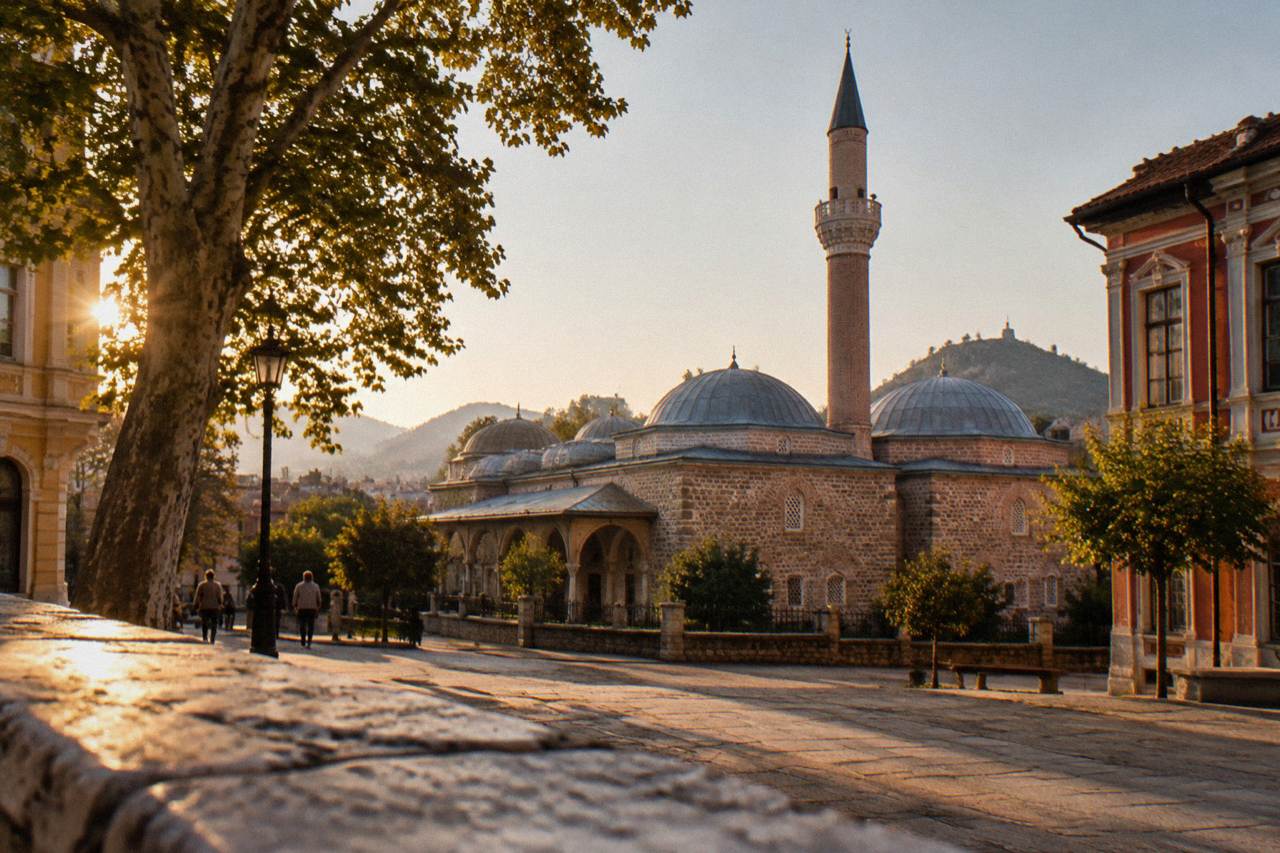
Short answer
The Dzhumaya Mosque in Plovdiv, southern Bulgaria, is a working mosque open to visitors from 6:00 to 23:00, free of charge, at 2 Zhelezarska Street beside the Roman Stadium. Modest dress is required and prayer times should be avoided. It is described as the second-largest mosque in Bulgaria by built area, at about 1,500 square metres.
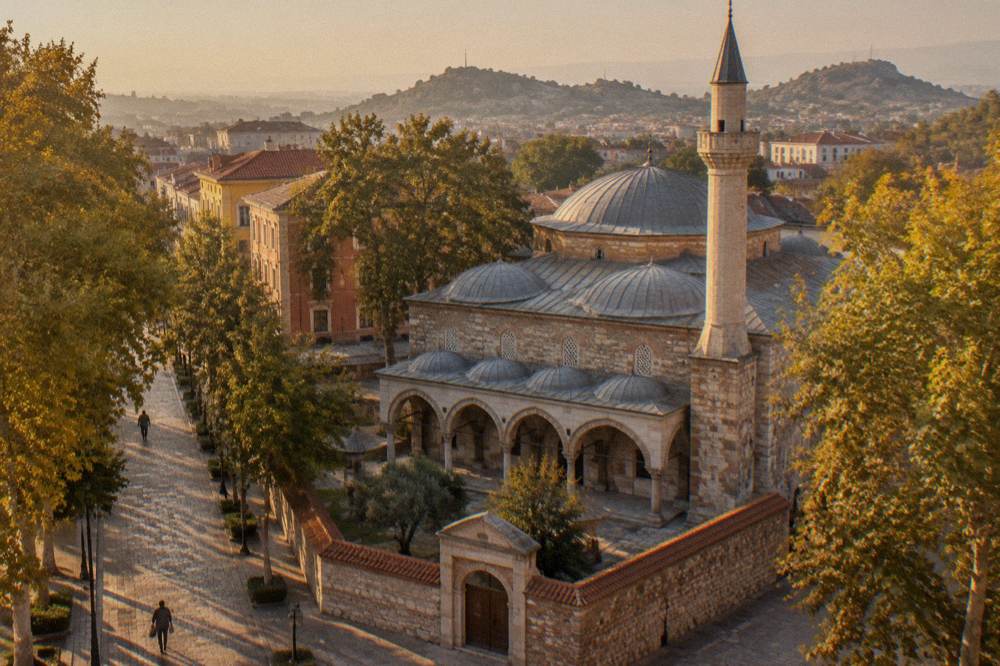
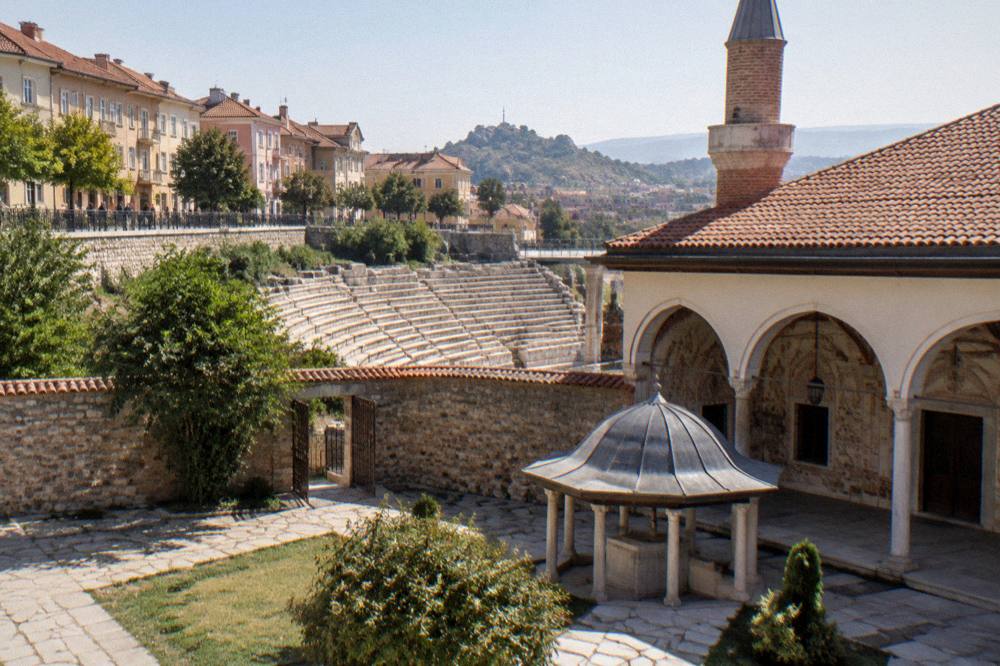
The Dzhumaya Mosque stands at 2 Zhelezarska Street in the middle of Plovdiv, Bulgaria's second-largest city, its minaret rising directly beside the excavated northern end of the Roman Stadium on the city's Main Street. It is a working mosque, and the municipal page for the building records that it is open to visits from 6:00 to 23:00, free to enter, and the second-largest mosque in Bulgaria by built area, at about 1,500 square metres.
What Is The Dzhumaya Mosque In Plovdiv?
The Dzhumaya Mosque is a functioning Ottoman-era mosque at 2 Zhelezarska Street in central Plovdiv, southern Bulgaria, standing beside the Roman Stadium on the Main Street. The city's own listing records visiting access from 6:00 to 23:00, free entry, and a built area of about 1,500 square metres, which makes it the second-largest mosque in Bulgaria by that measure. It is billed as the oldest surviving Ottoman building in Plovdiv, and it remains in daily religious use.
That last point shapes everything about a visit. This is not a museum with a ticket desk and a fixed route; it is a place of worship where visitors are welcomed outside prayer times, and where the rules of a working mosque apply. The municipal tourism page asks for modest dress and for visitors to avoid prayer times, and it gives no ticket price because there is none.
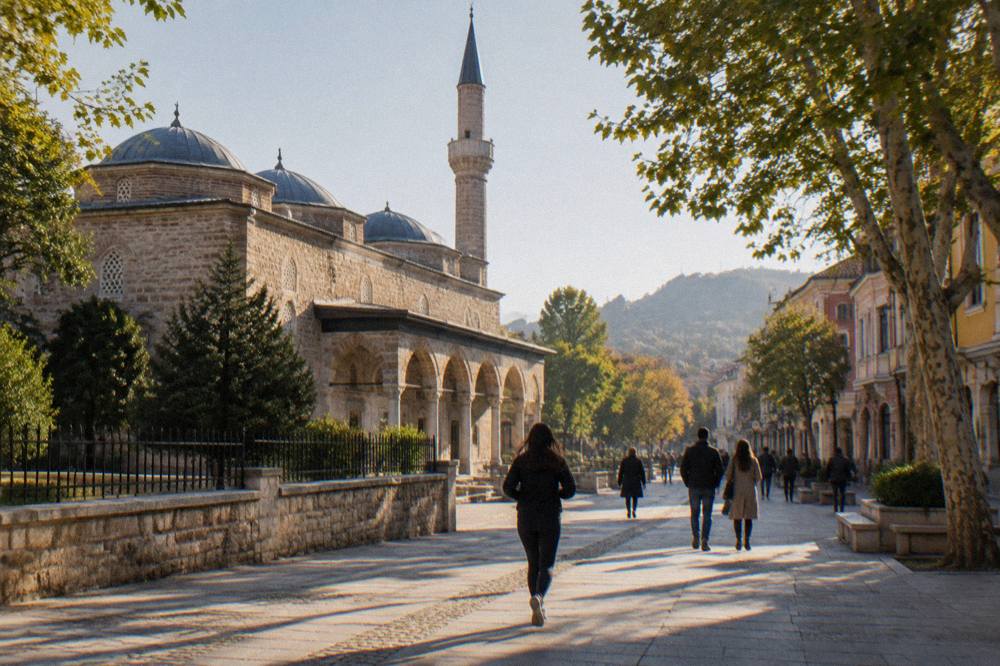
The building sits on one of the busiest pedestrian axes in the city. Step out of the courtyard and you are on the Main Street, with the sphendone of the Roman Stadium, the free open-air section of the ancient arena, only metres away. The 28 concentric rows of marble seats of the Ancient Theatre of Philippopolis and the pastel houses of the Old Town are a short uphill walk, as is the creative district of Kapana, whose name means "The Trap". The mosque is therefore less a destination in itself than a landmark that sits naturally on the route between them, and a full rundown of the surrounding options is on the things to do in Plovdiv page.
| Detail | Notes |
|---|---|
| Address | 2 Zhelezarska Street, Plovdiv |
| Visiting access | 6:00 to 23:00 |
| Entry fee | Free |
| Built area | About 1,500 sq m |
| Rank | Second-largest mosque in Bulgaria by built area |
| Status | Working mosque, active religious use |
| Construction date | No single year; sources give years between the 14th and 16th centuries |
Where Is The Dzhumaya Mosque And When Should You Visit?
The mosque stands beside the Roman Stadium on Plovdiv's Main Street, at 2 Zhelezarska Street, within a five-minute walk of the Central Square, Kapana and the lower gates of the Old Town. Access runs from 6:00 to 23:00, and the practical timing advice from the city's page is simple: go outside prayer times, and expect the building to be busiest with worshippers on Fridays around midday.
The position is the reason the mosque appears on so many itineraries. The Main Street is the pedestrian spine of the modern city, and the mosque's courtyard opens directly onto the section where the northern curve of the Roman Stadium has been excavated. Only that northern part, the sphendone, is accessible: the rest of the 2nd century AD arena, which held up to 30,000 spectators, still lies beneath the modern street, as the Old Plovdiv institute's page for the Roman Stadium explains. Visitors move between the two without needing to plan a detour.
Timing within the year matters less than timing within the day. The mosque is an indoor space in a continental climate: ERA5 reanalysis, 1991-2020, puts the modelled mean daily high at 28.6 C in August and 5.9 C in January, with May the rainiest month at 56.8 mm. In the summer heat the courtyard and the shaded interior offer a natural pause on a walk between the Ancient Theatre of Philippopolis and Kapana, and in winter the free entry makes it an easy indoor stop.
| Month | Mean daily high (C) | Mean daily low (C) | Rain (mm) |
|---|---|---|---|
| January | 5.9 | -2.6 | 41.0 |
| April | 17.1 | 6.4 | 47.7 |
| July | 28.2 | 17.9 | 45.6 |
| August | 28.6 | 18.1 | 25.2 |
| October | 18.1 | 8.8 | 44.1 |
ERA5 reanalysis, 1991-2020, grid cell near the Old Town; a modelled value, not a station record.
A guided walk is one way to see the mosque in its context, since a guide will time the stop around prayer hours and explain the building's place in the Ottoman city. The site's featured walk for this page is the Jewish heritage walking tour of Plovdiv, which traces the minority histories layered around the same streets; Check availability if that angle appeals.
What Does It Cost To Visit The Dzhumaya Mosque In Plovdiv?
Entry to the Dzhumaya Mosque is free, with no ticket, no desk and no charge for the courtyard, according to the city's own page for the building. The nearby paid sights are separate: the Old Plovdiv institute lists a single-site ticket at 3.58 euro for adults and 1.53 euro for students, and the Bishop's Basilica is priced separately at 7.57 euro for adults. A visit to the mosque itself costs nothing but respect for the house rules.
The free entry is worth stating plainly because the surrounding cluster is a mix of free and ticketed sites, and a day's budget depends on which combination you choose. The sphendone of the Roman Stadium is free to view; its 3D projection hall is 3.68 euro for adults, and a combined Eastern sector plus 3D hall ticket is 5.11 euro. Nebet Tepe, the hill where the first settlement traces on the site date to the 4th millennium BC, is free. Kapana and Hisar Kapia are open public spaces.
| Site | Adult entry | Notes |
|---|---|---|
| Dzhumaya Mosque | Free | Working mosque, 6:00 to 23:00 |
| Roman Stadium sphendone | Free | Open-air northern curve |
| Roman Stadium 3D hall | 3.68 euro | Student 1.23 euro |
| One Old Plovdiv site | 3.58 euro | Student 1.53 euro, family 7.16 euro |
| Old Plovdiv combined, up to 5 sites | 10.74 euro | Student 4.09 euro, family 21.47 euro |
| Bishop's Basilica | 7.57 euro | Student 3.58 euro, family 15.34 euro |
| Nebet Tepe | Free | Open-air archaeological complex |
The validity period of the combined ticket is not published, so confirm it at the desk if you plan to split it across two days. First Thursday of the month brings free entry for students and seniors at Old Plovdiv sites.
If a guided format suits you better than self-directing, several Plovdiv walks pass the mosque:
How Old Is The Dzhumaya Mosque In Plovdiv?
No single construction year can be printed for the Dzhumaya Mosque, because the city of Plovdiv's own page for the building states that sources give years between the 14th and 16th centuries. It is described as the oldest surviving Ottoman building in Plovdiv, a description that reflects its early place in the Ottoman city rather than a dated foundation stone.
That range is unusual for a European landmark of this prominence, and the honest handling is to keep the range. Guides and older texts sometimes print a single year; the municipal page, which is the source this site follows, declines to.
The building's continuing religious life is part of the history. It survived the end of Ottoman rule, the 20th century and the communist period as an active mosque, and it serves Plovdiv's Muslim community today. That continuity is why the visiting rules matter as much as the architecture: the building has been in uninterrupted use for worship across its whole documented life.
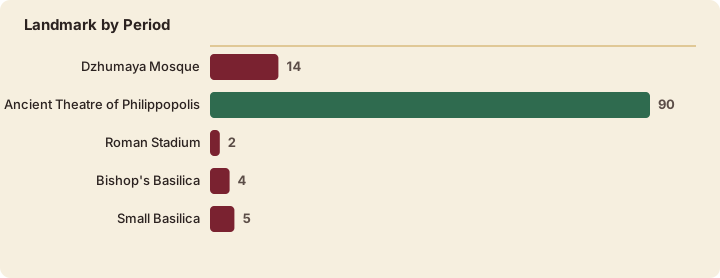
| Landmark | Period | Key figure |
|---|---|---|
| Dzhumaya Mosque | Ottoman, years given between the 14th and 16th centuries | About 1,500 sq m built area |
| Ancient Theatre of Philippopolis | 90s AD, 1st century | 28 concentric rows of marble seats |
| Roman Stadium | 2nd century AD | Up to 30,000 spectators |
| Bishop's Basilica | 4th to 6th century | About 83 m long, 36 m wide |
| Small Basilica | 5th to 6th century | Three naves, mosaic floors |
For readers weighing the city's age claims more broadly, the oldest city in Bulgaria question is answered separately, with the same discipline about what can and cannot be stated.
What Will You See At The Dzhumaya Mosque In Plovdiv?
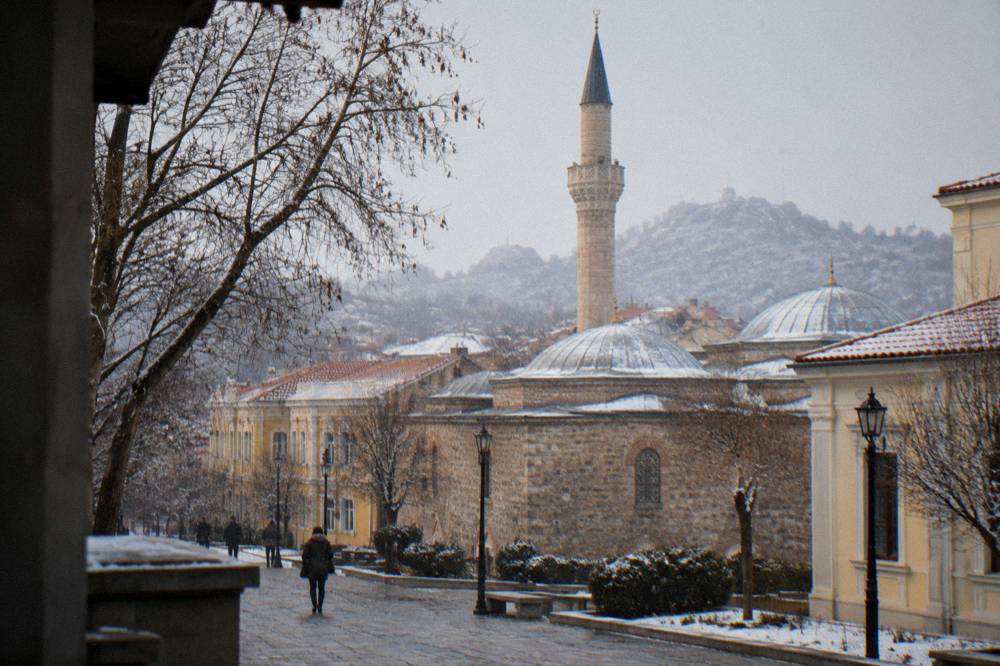
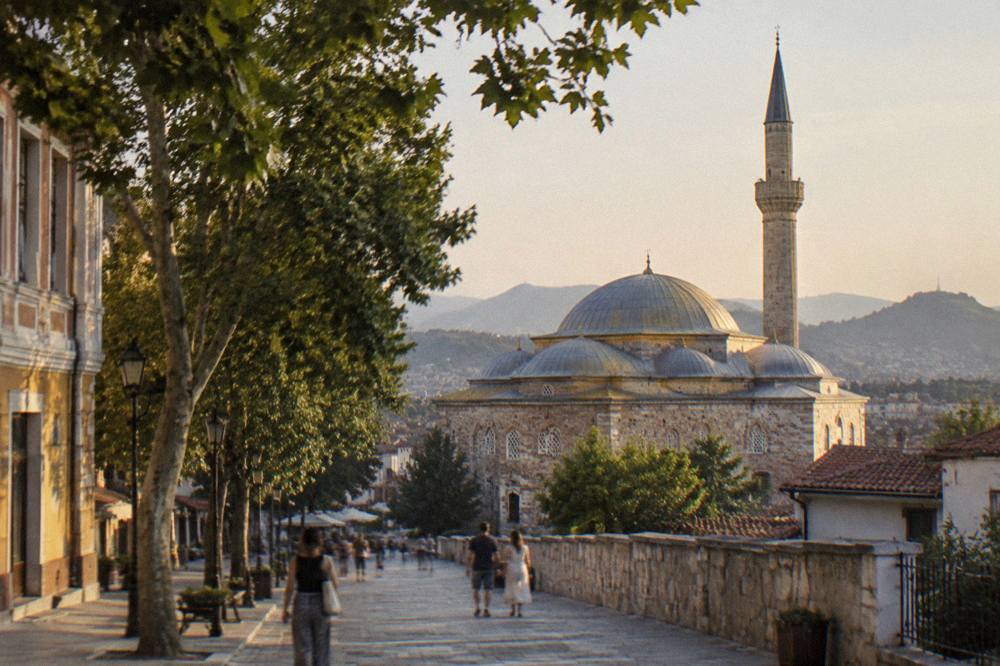
The mosque's exterior is what a visitor registers first: the minaret above the courtyard, the lead-covered domes, and the arcaded entrance facing the Roman Stadium, all within a built area of about 1,500 square metres that the municipal page records as the second-largest of any mosque in Bulgaria. Inside, the prayer hall carries the painted decoration of an Ottoman mosque in continuous use. Photography is possible, but the working-mosque rules govern everything.
The exterior rewards a slow circuit. The minaret is the mosque's most photographed element, typically framed from the sphendone side, and the photography angle from the stadium steps is the one local guides point to.
Inside, the decoration follows the Ottoman tradition: painted surfaces, calligraphy and geometric ornament rather than figurative work. The municipal page gives no inventory of interior features, so the simple description is that it is an active prayer hall whose furnishings serve worship, and a short, quiet visit is the expected pattern. The wider set of guides lives on Plovdiv Travel Guide.
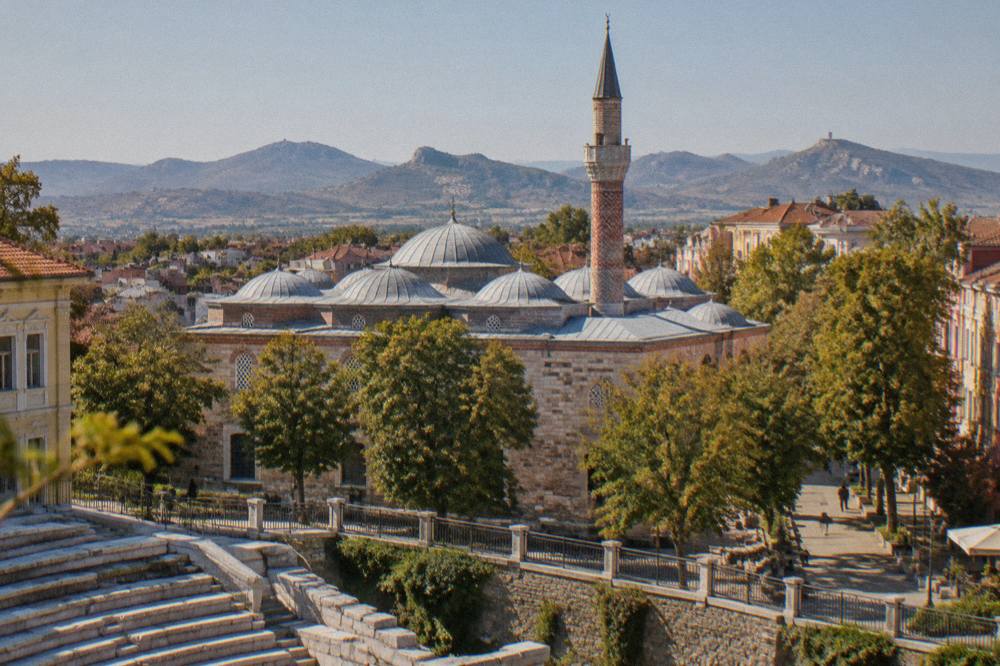
Around the mosque, the immediate cluster of sights can fill several hours:
| Nearby sight | Direction | Entry |
|---|---|---|
| Roman Stadium sphendone | Beside the mosque | Free |
| Central Square and Main Street | North, along the pedestrian axis | Free |
| Kapana creative district | South-west of the mosque | Free, open streets |
| Hisar Kapia gate | Uphill towards the Old Town | Free |
| Nebet Tepe | Uphill, Three Hills group | Free |
| Old Town revival houses | Uphill from Hisar Kapia | 3.58 euro per site |
The Old Town houses, among them Balabanov House and Hindliyan House, sit at the top of the slope, and the Ethnographic Museum rounds out the domestic side of the city's past. A walk that connects them all is outlined on the Plovdiv walking tour itinerary page.
How Does The Mosque Fit Into A Day Around Plovdiv?
A natural day puts the Dzhumaya Mosque at the centre of the route rather than at either end: start on the Main Street, see the Roman Stadium sphendone beside the mosque, visit the mosque late morning or mid-afternoon outside prayer times, then climb through Hisar Kapia to the Old Town and the Ancient Theatre. Because the mosque is free and open until 23:00, it can absorb schedule slips that ticketed sites cannot.
To base yourself within walking distance of this route, book a hotel here.
| Time | Stop | Cost |
|---|---|---|
| Morning | Main Street, Central Square, Roman Stadium sphendone | Free |
| Late morning | Dzhumaya Mosque, outside prayer times | Free |
| Midday | Kapana for lunch, open streets | Food at your own cost |
| Afternoon | Hisar Kapia, Old Town houses, Ancient Theatre | 3.58 euro per site |
| Late afternoon | Nebet Tepe for the sunset view | Free |
| Evening | Dinner back in Kapana | Food at your own cost |
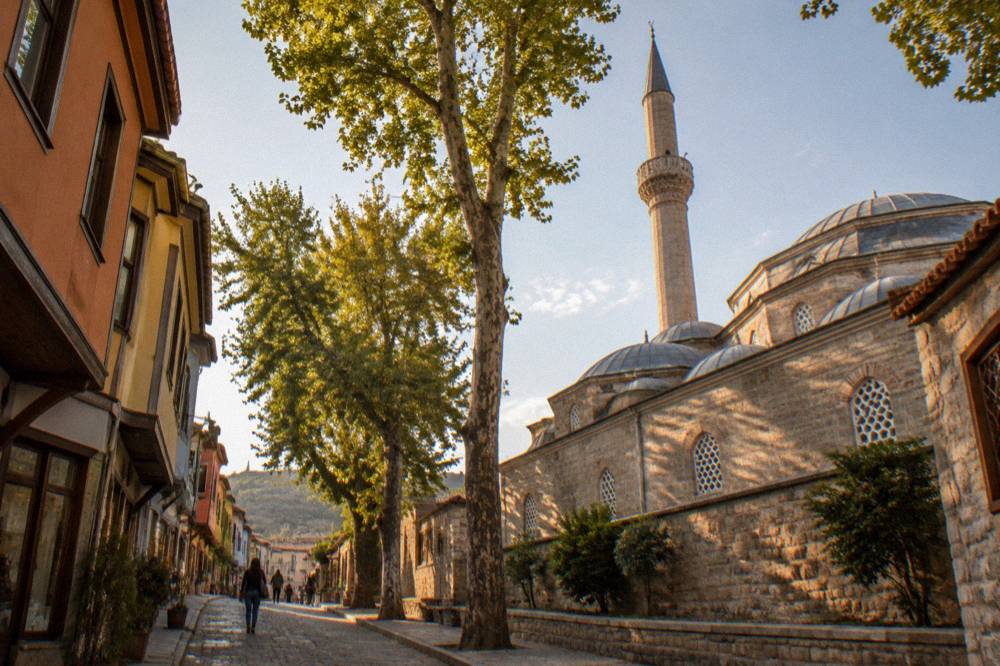
The order can be reversed in summer, when ERA5 reanalysis, 1991-2020, puts the modelled mean daily high at 28.6 C in August and the shaded mosque interior and the evening hours are the comfortable ones.
Guided formats cover this same ground with the timings handled for you. The classic city walk and the Old Town and Roman Theatre walk both pass the mosque:
For a fuller sample of how the pieces fit, the site's one-day Plovdiv itinerary and the guide to Nebet Tepe cover the hilltop end of the walk in detail.
What Should Visitors Know About Dress And Etiquette?
The rules at the Dzhumaya Mosque are the standard rules of a working mosque: shoulders and knees covered for all visitors, shoes removed at the entrance, women's heads covered, quiet voices, and no interruption of prayer. The city's page asks visitors to avoid prayer times, and Friday around midday is the main weekly congregation. There is no charge, no booking and no guided obligation; entry is simply conditioned on respect.
A short checklist, built only from what the municipal page states:
- Cover shoulders and knees; long trousers or a long skirt.
- Remove shoes before entering the prayer hall.
- Avoid prayer times, especially the Friday midday prayer.
- Do not walk directly in front of someone at prayer.
None of this is onerous, and the mosque's long visiting window, 6:00 to 23:00, means a visitor who arrives during prayer can simply return an hour later. That is harder at the ticketed sites, where the winter hours at the Ancient Theatre run 9:00 to 17:30 with a lunch break from 12:30 to 13:00, so the mosque is the flexible block in any day plan.
How Does The Dzhumaya Mosque Compare With Plovdiv's Other Landmarks?
The mosque's distinctiveness is its living continuity: unlike the Roman Stadium and the Ancient Theatre, which are monuments to visit, the Dzhumaya Mosque is a religious building in daily use, free to enter and open across a 17-hour daily window. It is described as the oldest surviving Ottoman building in Plovdiv and the second-largest mosque in Bulgaria by built area, about 1,500 square metres, which places it among the city's most significant non-antique structures.
Every other landmark in the immediate cluster answers a different question. The Roman Stadium and the Ancient Theatre answer the question of what Philippopolis looked like under Rome; the Bishop's Basilica mosaics answer it for the early Christian city; the Old Town houses answer it for the Bulgarian National Revival. The mosque answers it for the Ottoman centuries, when the city was Filibe, and unlike the others it answers it without a ticket desk.
| Landmark | Period it represents | Entry | Open access |
|---|---|---|---|
| Dzhumaya Mosque | Ottoman, years given between the 14th and 16th centuries | Free | 6:00 to 23:00 |
| Ancient Theatre | Roman, 90s AD, 1st century | 3.58 euro | 9:30 to 18:00 Apr to Oct, 9:00 to 17:30 Nov to Mar |
| Roman Stadium sphendone | Roman, 2nd century AD | Free | Open-air public view |
| Bishop's Basilica | Early Christian, 4th to 6th century | 7.57 euro | 9:00 to 18:00 daily |
| Ethnographic Museum | Bulgarian National Revival | About 3.07 euro | Closed Monday |
The mosque also anchors the city's layered story in a way few single buildings do. A walk that starts at the stadium, pauses at the mosque and climbs to Nebet Tepe covers the Roman era, the Ottoman period and the 4th millennium BC in under an hour of moving time, and the history of Plovdiv is best understood as exactly that sequence of layers. The Alyosha monument, unveiled in 1957 on Bunardzhik hill, adds the most recent layer and a free panorama over the whole ensemble.
A guided version of this comparison, with the mosque set in the story of Plovdiv's minority communities and trading past, is available as an Old Town and Roman Theatre walk:
For evening plans, the sunset wine tasting walk pairs the same city-centre landmarks with a tasting stop, a format that suits a first evening in the city.
Common Questions About The Dzhumaya Mosque
Is the Dzhumaya Mosque in Plovdiv free to visit?
Yes. The city's own page for the building lists free entry, with visiting access from 6:00 to 23:00. There is no ticket desk; the conditions of entry are the standard ones for a working mosque, namely modest dress and avoidance of prayer times.
When was the Dzhumaya Mosque built?
No single year can be stated. The city of Plovdiv's page says sources give years between the 14th and 16th centuries.
What are the opening hours of the Dzhumaya Mosque?
Visiting access runs from 6:00 to 23:00, according to the municipal listing. Because it is a working mosque, access for sightseeing pauses during prayer times, and the Friday midday prayer is the main weekly congregation to plan around.
What should I wear to visit the Dzhumaya Mosque?
Shoulders and knees covered for all visitors, shoes removed before entering the prayer hall, and women's heads covered.
Can you photograph inside the Dzhumaya Mosque?
The municipal page sets no photography policy, so ask on site before photographing, and never photograph worshippers without permission. The exterior, with the minaret framed against the Roman Stadium, is the standard shot and needs no permission.
How big is the Dzhumaya Mosque?
The building's built area is about 1,500 square metres, which the city's page records as the second-largest of any mosque in Bulgaria.
The Dzhumaya Mosque is the clearest single reminder that Plovdiv's story did not stop with the Romans, and its free, long opening window makes it the easiest major landmark in the city centre to visit on any schedule: arrive outside prayer times, dress modestly, and the Ottoman centuries of Filibe are open to you until 23:00.
