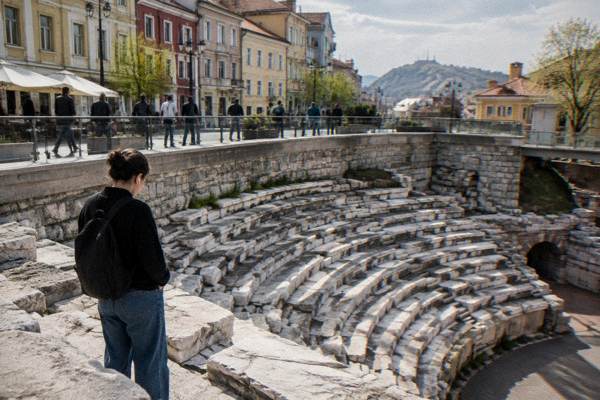
Hisar Kapia: The Old Eastern Gate
Hisar Kapia is the eastern gate of Plovdiv's Old Town, a free public landmark where the fortified hill town once opened onto the plain below. This guide covers what it is, how to reach it, what it costs, and what to see within a short walk.
Short answer
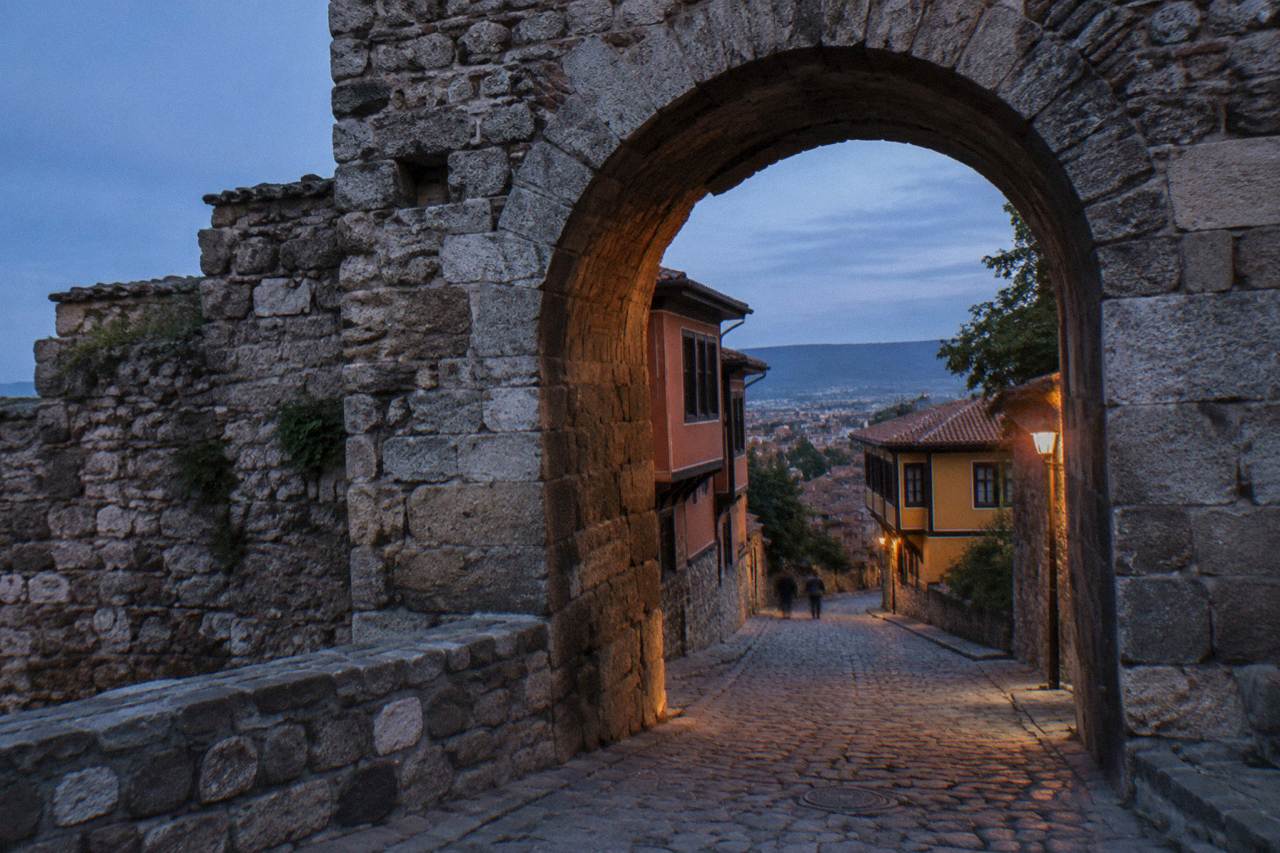
Hisar Kapia is a free public gate in Plovdiv, Bulgaria, open at all hours, standing at the eastern edge of the Old Town. No ticket, no closing time, and no fence: the arch is a street-level landmark you walk through, with the Old Town's houses on one side and Kapana's creative district on the other.
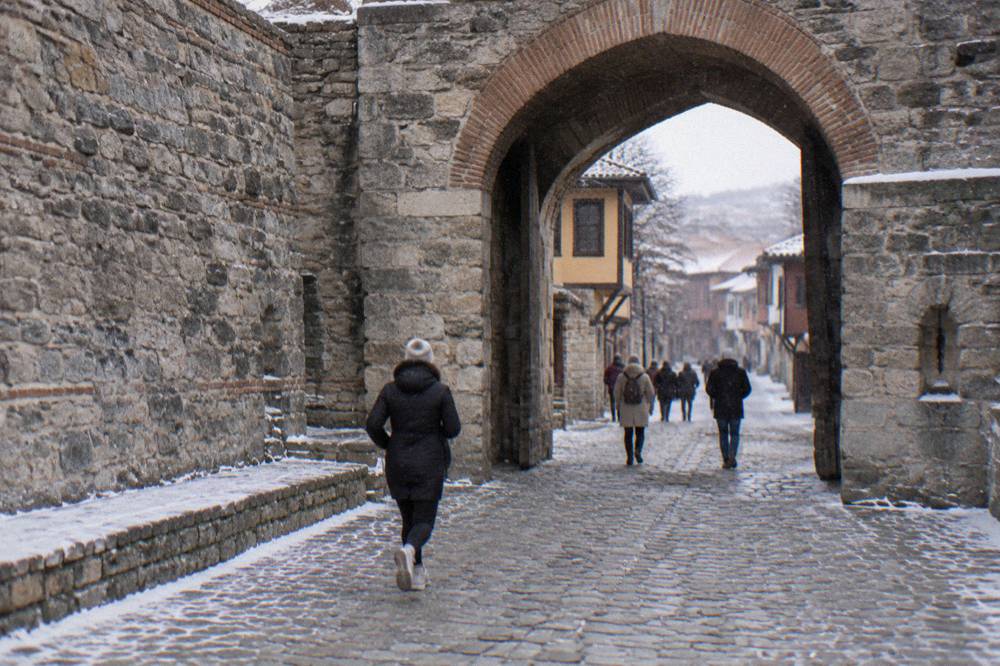
Hisar Kapia stands at the eastern edge of Plovdiv's Old Town, a stone arch that once served as a gate through the fortified walls of the ancient city. The gate is a public landmark with no ticket and no closing time: you walk under it, you look up, and you keep going. Around it sit the cobbled lanes of the Old Town on the hillside above, and below it the ground falls away toward the Dzhumaya Mosque, the Roman Stadium sphendone and the narrow streets of Kapana. Plovdiv, in southern Bulgaria, is an inland city built around six hills, and Hisar Kapia is one of the places where the layers of that city meet in a single frame.
What Is Hisar Kapia In Plovdiv?
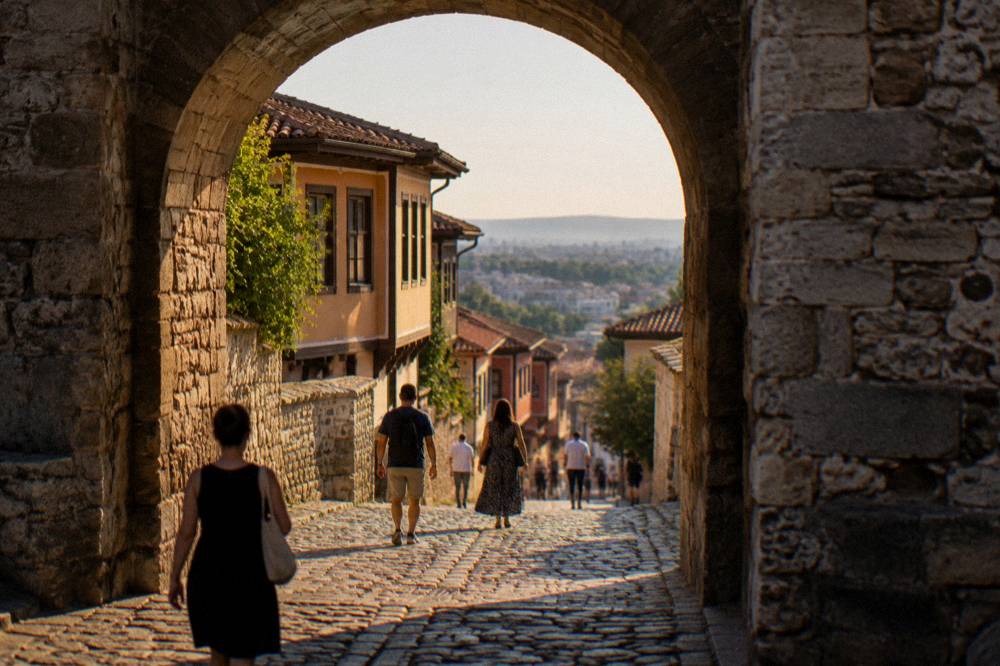
Hisar Kapia is a surviving city gate at the eastern edge of Plovdiv's Old Town, listed by the Old Plovdiv institute among the public landmarks of the historic core. It is free to see and open at all hours, because it is not a museum: it is a street. The arch marks the point where the walled town of Philippopolis opened toward the low ground to the east, and today it frames one of the classic views of the old quarter.
The name follows a pattern anyone who has travelled in the Balkans will recognise. "Kapia" is the local word for a gate, and "Hisar" relates to fortress or walls, so the name says plainly what the place is: the fortress gate. The gate is not a ticketed attraction in the way the Ancient Theatre of Philippopolis is. There is no counter, no turnstile and no rope. The arch belongs to the street network, and that is exactly what makes it easy to miss if you are walking fast and looking at your map.
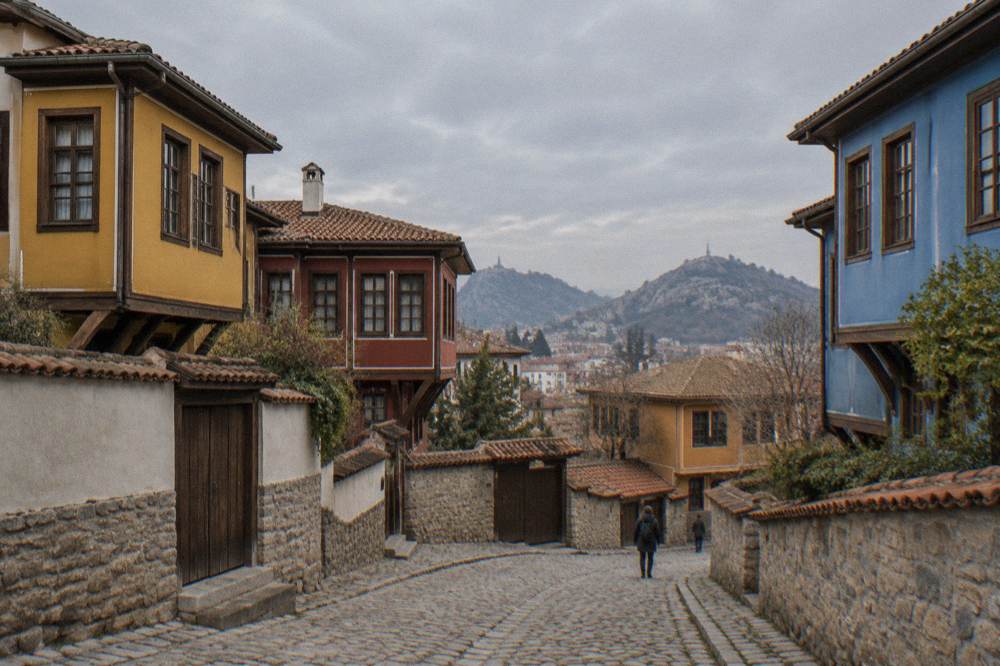
What surprises many first-time visitors is how small the moment is and how large the frame. You step through a gap in old masonry, the noise of the modern city drops a little, and the cobbles take over. On the Old Town side the streets climb toward the balconied revival houses. On the downhill side the ground slopes toward the mosque and the main pedestrian street. The gate works as a hinge between two halves of the city that feel nothing alike.
The Old Town as a whole is often described as one of the oldest continuously inhabited urban cores in Europe, and the city's tourism site dates the first settlement on nearby Nebet Tepe to the 4th millennium BC. "The Ancient Plovdiv" sits on Bulgaria's UNESCO Tentative List, submitted in 2004, which is a waiting list rather than an inscription. The gate is a good place to keep that distinction in mind, because the walls you are standing beside carry several thousand years of rebuilding, and the arch you see today is the survivor of that process rather than a single moment in it.
Where Is Hisar Kapia And How Do You Reach It?
Hisar Kapia sits at the eastern rim of Plovdiv's Old Town, roughly between the Dzhumaya Mosque and the top of the old quarter's cobbled lanes. On foot from the main pedestrian street you climb gently uphill from the mosque area and the gate appears within a few minutes. There is no dedicated parking, no metro and no cable car: the Old Town is a walking district, and the gate rewards exactly that.
The practical approach is simple. From the central square area, walk toward the Dzhumaya Mosque, which is itself free to visit outside prayer times, and continue uphill past the mosque's garden. The lane narrows, the cobbles begin, and the arch arrives. Coming the other way, from the top of the Old Town near Nebet Tepe or the revival houses, you descend through the lanes and the gate marks the exit toward the modern city. Either direction works, and the two directions give you two different views of the arch.
If you are staying outside the centre, the city bus network uses an e-ticket priced at 0.50 euro, and the central railway station and the Yug bus station stand side by side on Hristo Botev Boulevard, from where the Old Town is a manageable walk uphill. The municipal transport app covers routes and stops. Once you are in the Old Town itself, everything is pedestrian: narrow lanes, steps, and surfaces that reward solid shoes over thin soles.
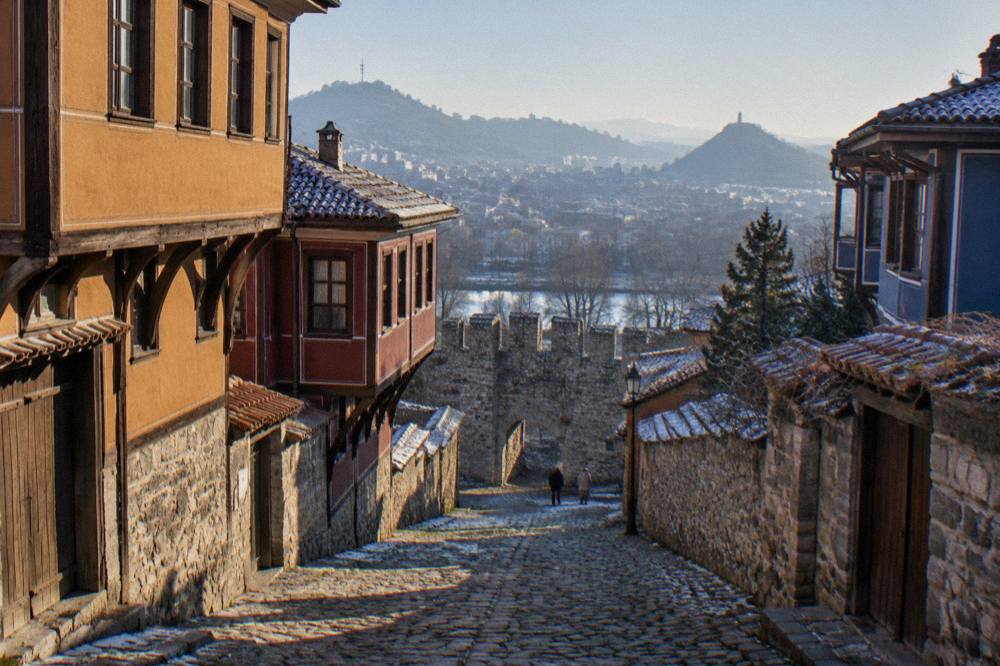
For anyone planning the wider picture, the site's overview of things to do in Plovdiv places the gate among the free landmarks of the old quarter, and the Old Town area guide covers the streets on the hillside above it in detail. A guided walk is another way in, and the trio below collects the walking options that include the Old Town's gates and lanes.
What Does It Cost To Visit Hisar Kapia?
Visiting Hisar Kapia costs nothing: the gate is a free public landmark, open at all hours, with no ticket office and no fence. What you pay for is everything around it. The Old Plovdiv ticket list prices a single site at 3.58 euro for adults, and a combined ticket covering up to five sites costs 10.74 euro, but the gate itself is not one of those sites and never appears on the list.
This is worth stating clearly, because the ticket structure of the Old Town confuses people. The Old Plovdiv municipal institute sells tickets for the buildings it runs: the Ancient Theatre, the Small Basilica, the revival houses such as Balabanov and Nedkovich, and others. The Bishop's Basilica is priced separately. The open-air landmarks, the gate, Nebet Tepe, the lanes of Kapana, the sphendone of the Roman Stadium seen from the open street, are free public space.
| Item | Adult price | Notes |
|---|---|---|
| Hisar Kapia gate | Free | Public landmark, open at all hours |
| One Old Plovdiv site (except Bishop's Basilica) | 3.58 euro | Covers one ticketed site such as a house or the Ancient Theatre |
| Old Plovdiv combined ticket, up to 5 sites | 10.74 euro | Excludes the Small Basilica and the Bishop's Basilica |
| Bishop's Basilica of Philippopolis | 7.57 euro | Priced separately from the combined ticket |
| Roman Stadium 3D hall | 3.68 euro | The sphendone itself is free to see in the open air |
| Dzhumaya Mosque | Free | Working mosque, modest dress, avoid prayer times |
Two practical notes from the ticket list. Students pay 1.53 euro for a single Old Plovdiv site, and a family ticket for parents with children aged 7 to 16 costs 7.16 euro. Children under 7 enter free, as do visitors with more than 50 percent disability. The first Thursday of the month brings free entry for students and seniors at Old Plovdiv sites, and the Regional History Museum is free for everyone on first Thursdays. The validity period of the combined ticket is not stated on the official page, so confirm at the counter before you buy.
What Can You See Within A Short Walk Of The Gate?
Within a short walk of Hisar Kapia you reach the Dzhumaya Mosque, the Roman Stadium sphendone, the Kapana creative district, the revival houses of the Old Town and the Nebet Tepe archaeological complex, all free or covered by the Old Plovdiv ticket list. The gate is effectively the middle of a dense cluster: uphill lies the historic core, downhill lies the modern pedestrian city, and nothing on the list below is more than a modest stroll away.
Start downhill. The Dzhumaya Mosque stands a few minutes below the gate, a working mosque with free entry, open to visits from 6:00 to 23:00 according to the city's own page. Dress modestly, cover shoulders and knees, take your shoes off inside, and avoid the main prayer time around midday on Friday. The city's page gives no single construction year, because sources place it between the 14th and 16th centuries, and it is described as the second-largest mosque in Bulgaria by built area, about 1,500 square metres.
From the mosque, the main pedestrian street carries you to the Roman Stadium. Only the northern part, the curved sphendone, is accessible, unearthed in the 1970s; the rest of the stadium lies beneath the modern street. The sphendone is free to see in the open air, with 13 rows of seats visible, and the 3D projection hall beside it is the paid part. The stadium was built in the 2nd century AD on the model of the Stadium at Delphi and held up to 30,000 spectators, figures the city's tourism site states plainly.
Then go uphill through the gate. The Old Town lanes climb past the revival houses, and the standouts on the ticket list include Balabanov House and Hindliyan House, each covered by the 3.58 euro single ticket. The Church of Saints Constantine and Helena sits close by, and the Ethnographic Museum in the Kuyumdzhiev House holds the collection of traditional dress and interiors, closed on Mondays. At the top of the hill, Nebet Tepe is the open-air archaeological complex where the settlement story begins, free to enter after a restoration project that officially opened in March 2025.
| Sight | Direction from the gate | Cost | Open |
|---|---|---|---|
| Dzhumaya Mosque | Downhill | Free | 6:00 to 23:00, avoid prayer times |
| Roman Stadium sphendone | Downhill, then along Main Street | Free in the open air | Public street, always |
| Kapana district | Downhill, east of the mosque | Free | Public streets, always |
| Balabanov and Hindliyan houses | Uphill through the gate | 3.58 euro each | Tue to Sun, summer hours 9:00 to 18:00 |
| Nebet Tepe | Uphill, top of the Three Hills | Free | Open-air complex, unrestricted access |
| Bishop's Basilica | Downhill, toward the central square | 7.57 euro | Daily 9:00 to 18:00 |
A guided walk strings these together efficiently, and the Old Town walk with a rakia tasting is the one that fits the gate's location best, since it covers the lanes above and the streets below with a local guide and a tasting stop built in.
When Is The Best Time To Visit Hisar Kapia?
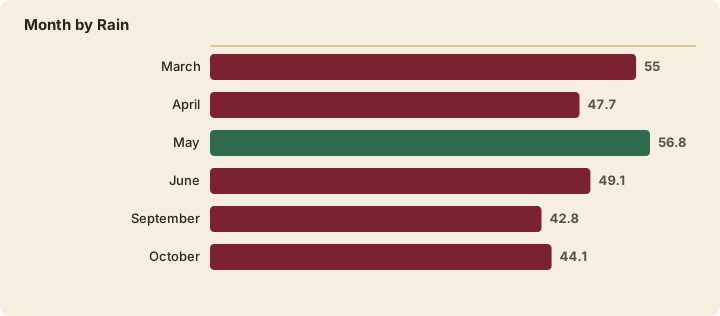
Any time works, because Hisar Kapia never closes: it is a public street-level landmark with no hours at all. What changes is the light and the crowd around it. The ERA5 reanalysis for Plovdiv, 1991 to 2020, puts the mean daily high at 28.6 C in August and 5.9 C in January, so late spring and early autumn give the most comfortable walking weather for the climb through the Old Town lanes.
The seasonal numbers are worth reading closely before you pick a month, because the Old Town is an outdoor experience with a lot of cobbles and steps, and the gate sits on a slope. The wider set of guides lives on Plovdiv Travel Guide.
| Month | Mean daily high | Mean daily low | Rain |
|---|---|---|---|
| March | 12.1 C | 2.1 C | 55.0 mm |
| April | 17.1 C | 6.4 C | 47.7 mm |
| May | 21.9 C | 11.5 C | 56.8 mm |
| June | 25.9 C | 15.4 C | 49.1 mm |
| September | 23.8 C | 13.8 C | 42.8 mm |
| October | 18.1 C | 8.8 C | 44.1 mm |
These are ERA5 reanalysis figures, 1991 to 2020, modelled for a grid cell near the Old Town, not a station record, and reanalysis smooths urban heat. May carries the highest monthly rain total in the table at 56.8 mm, and August the lowest at 25.2 mm, so summer is the dry window even with the heat. Within a day, early morning and the hour before sunset give the arch its best light: the stone warms up late in the day, and the lanes above are quieter before the ticketed houses open at 9:00 or 9:30.
The event calendar matters too. The Opera Open festival ran at the Ancient Theatre from 23 June to 9 September in 2026, and the autumn Kapana Fest ran over two weekends, 2 to 4 and 9 to 11 October 2026, at the bridge over Gladstone Street and the central square, which puts festival traffic within easy reach of the gate. The Christmas edition of the city's market programme ran from late November into early January in the 2025/26 season, and the 2026/27 edition was announced for 1 December 2026 to 7 January 2027 in Kapana and the central square areas. None of these events closes the gate, but they change what the streets around it feel like.
How Does Hisar Kapia Fit Into A Day In Plovdiv?
Hisar Kapia works best as the hinge of a one-day Plovdiv plan: start downhill at the Roman Stadium and the Dzhumaya Mosque, pass through the gate mid-morning, spend the middle of the day in the Old Town houses and on Nebet Tepe, then come back down through the gate into Kapana for the afternoon and evening. The gate sits at the natural midpoint of that loop, which is why so many walking routes use it as a landmark.
The site's one-day itinerary follows this shape, and the gate is the transition in the middle of it. A realistic morning: the pedestrian street and the stadium sphendone first, when the light is flat and the streets are quiet, then the mosque, then the climb through the arch. The ticketed houses open around 9:00 or 9:30 with a lunch break at 12:30, so the Old Town fills the late morning cleanly. Nebet Tepe at the top is free and open, and the view over the plain toward the Rhodopes explains why the city grew on these hills in the first place.
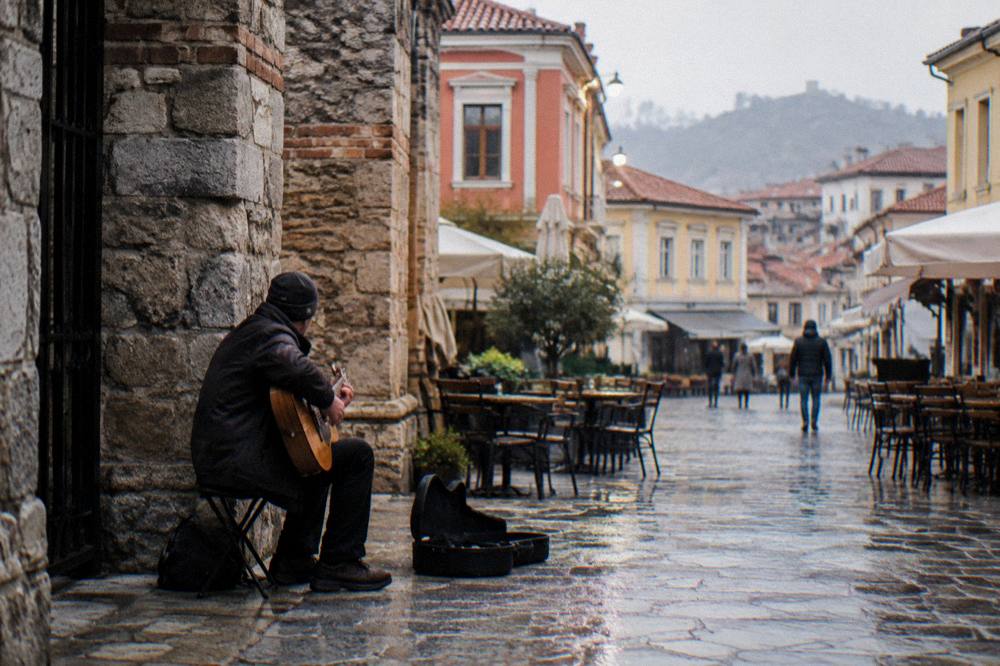
Afternoon is Kapana, the creative district whose name means "The Trap", a maze of narrow streets where visitors genuinely do lose their bearings, and that is part of the design. The district is free, open and full of small studios, bars and food spots. The site's guide to Plovdiv at night picks up the story from there, because the area around the gate changes character completely after dark, when the arch is lit and the lanes above empty out.
Families can run the same loop in a shorter form. The Tsar Simeon Garden with its singing fountains sits downhill toward the central square, and the fountains run on a seasonal schedule with routine maintenance through the year.
What Is The History Behind The Gate?
Hisar Kapia is the surviving eastern gate of the fortified core of ancient Philippopolis, one of the historical names the city carried alongside Pulpudeva, Trimontium and Filibe. The city's tourism site traces settlement on Nebet Tepe to the 4th millennium BC, and the walls the gate belonged to were rebuilt repeatedly across that long span, so the arch you see today is a composite survivor rather than a single-era monument. No ticket list assigns it a construction date, and the honest answer is that it accumulated.
The city's long list of names tells the story in shorthand. Kendrissos, Evmolpias, Philippopolis, Trimontium, Pulpudeva, Puldin, Filibe: each name belongs to a period, Thracian, Hellenistic, Roman, Byzantine, Ottoman, and each period left its mark on the walls and gates of the hill town. The gate's position is not decorative. The Three Hills, the Nebet, Dzhambaz and Taksim group, form the ancient acropolis, and a gate on the eastern side controlled the route down toward the plain and the river, which is where the modern city's commercial streets now run.
Plovdiv is often described as one of the oldest continuously inhabited cities in Europe. There were seven hills until the 20th century, when Markovo Tepe was partly quarried away in the 1930s, leaving six. "The Ancient Plovdiv" joined Bulgaria's UNESCO Tentative List in 2004, which is a nomination on a waiting list, not a World Heritage inscription. The gate belongs to that tentative-listed old core, and walking through it is the most direct way to understand why the nomination exists: the layers are physically stacked on a single hillside.
| Historical name | Period association | What it refers to |
|---|---|---|
| Evmolpias | Thracian | Early name of the settlement on the hills |
| Philippopolis | Hellenistic and Roman | "City of Philip", the name behind the Roman sites |
| Trimontium | Roman | "Three Hills", the acropolis group |
| Pulpudeva | Thracian | Local form of the city's name |
| Puldin and Ploudin | Medieval | Bulgarian-era forms |
| Filibe | Ottoman | The name used through the Ottoman period |
The Roman monuments nearby give the gate its ancient context, and the site's Roman Plovdiv coverage, along with the pages on the Ancient Theatre and the Roman Stadium, fill in the era when the walled city was at its most built-up. The theatre, built in the 90s of the 1st century AD, keeps 28 concentric rows of marble seats, and the stadium's sphendone survives under the modern street. The gate was the everyday piece of that infrastructure: not a monument but a working opening in the wall, which is why it never became a ticketed site.
Where Should You Eat And Drink Near Hisar Kapia?
Kapana, the district a few minutes downhill from Hisar Kapia, is the eating and drinking quarter, a maze of narrow streets whose name literally means "The Trap". The district is free to wander and open at all hours, with small kitchens, bars and coffee spots along the lanes. The advice is to wander, read the boards and confirm opening days locally.
The food culture around the gate is the reason the area feels alive rather than museum-like. Bulgarian breakfast means banitsa, cheese filo pastry, often with boza or ayran. The midday and evening table runs through shopska salad with its sirene cheese, kavarma from the clay pot, grilled kebapche and kyufte, and tarator, the cold yogurt and cucumber soup, in summer. The site's guide to what to eat in Plovdiv covers the dishes properly, and the Bulgarian food page gives the national context.
Wine belongs on the same walk. The Thracian Valley around Plovdiv grows Mavrud and Rubin, among other local varieties, and estates within a short drive of the city offer tastings. In the centre, wine tasting experiences run as bookable sessions, and rakia, the fruit brandy, is the local digestif that several Old Town walks build a tasting around. Coffee culture is strong too, and the site's cafes guide covers the specialty end of it.
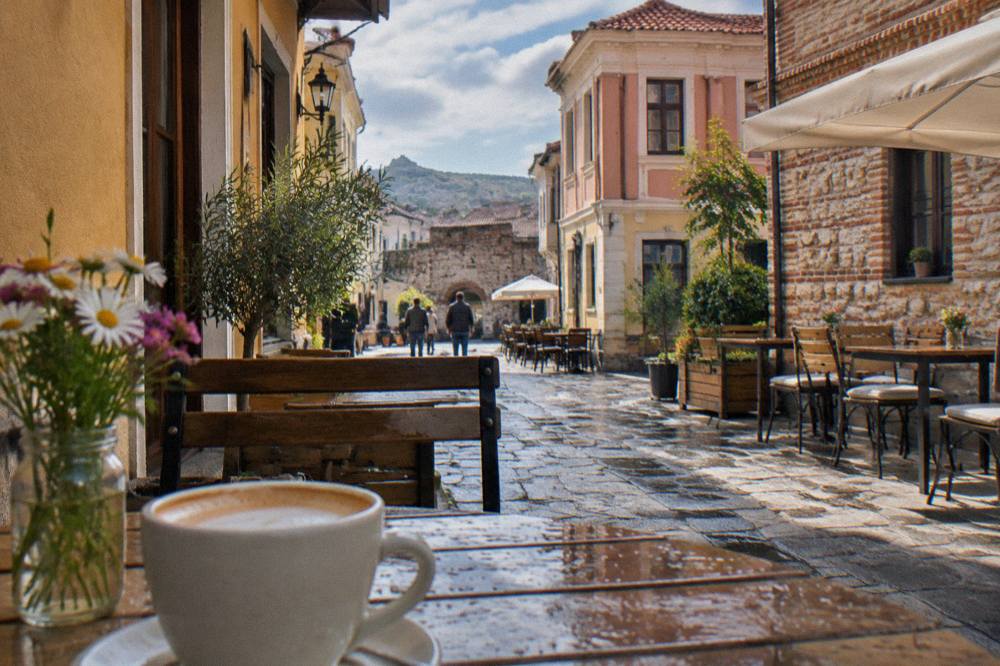
Budget planning is easy here. Crowd data for 2026 puts an espresso in Plovdiv around 2 euro and a half-litre of draught beer around 2 euro, and a mid-range three-course meal for two in the 30 to 40 euro range, figures to treat as approximations rather than official prices. A tasting fee at a wine venue varies by what is poured, so check the room before you sit down.
What Should You Know Before You Go?
Bring comfortable shoes, water in summer and a light layer for the evenings, plan around Monday closures at two museums, and carry small euro notes for any ticket counters. Hisar Kapia itself asks nothing of you: no ticket, no dress code, no hours. The Old Town around it is a hillside of cobbles and steps, the ERA5 reanalysis puts August mean highs at 28.6 C, and the ticketed houses close for lunch at 12:30, so a little timing saves a lot of retracing.
The details that catch people out are few but real. The Regional Ethnographic Museum and the Regional Archaeological Museum are closed on Mondays, the Archaeological Museum running Tuesday to Sunday from 10:00 to 18:00, and the Ethnographic Museum opening 9:00 to 18:00 in summer and 9:00 to 17:00 in winter. The Archaeological Museum renewed its permanent exhibition in November 2025 with around 150 new exhibits and a bilingual audio guide, so it is worth more time than its modest footprint suggests. Ticket prices for the Archaeological Museum are not published on its own page, so confirm at the desk.
| Practical point | Detail |
|---|---|
| Gate access | Free, public street, no hours |
| Old Town surface | Cobbles and steps, solid shoes advised |
| Summer heat | ERA5 mean daily high 28.6 C in August, carry water |
| Monday closures | Ethnographic Museum and Archaeological Museum |
| Lunch break | Old Plovdiv sites pause 12:30 to 13:00 |
| Emergency number | 112, free EU-wide |
A few wider facts make the trip smoother. Bulgaria has been a full Schengen member since 1 January 2025, so border checks with Romania, Greece and the other Schengen states are a thing of the past on land. Citizens of the United States, United Kingdom, Canada and Australia enter visa-free for 90 days in any 180, and the EU's Entry/Exit System has been fully deployed since 10 April 2026, replacing passport stamps with biometric registration at external borders. A tourist tax may be charged by your accommodation, but its 2026 euro rate is not published as a single figure, so confirm at booking rather than budgeting a guess.
Getting to the city is covered in detail elsewhere on the site: direct trains from Sofia run about 2 h 40 to 3 h 05, buses take about 1 h 45 to 2 h 20, and Plovdiv Airport at Krumovo keeps a small, seasonal route list. The central station area has been under a long modernisation programme due to finish in 2026, so expect some access changes around the railway approaches. The Sofia to Plovdiv and getting around guides carry the full picture, and the site's travel tips page collects the rest.
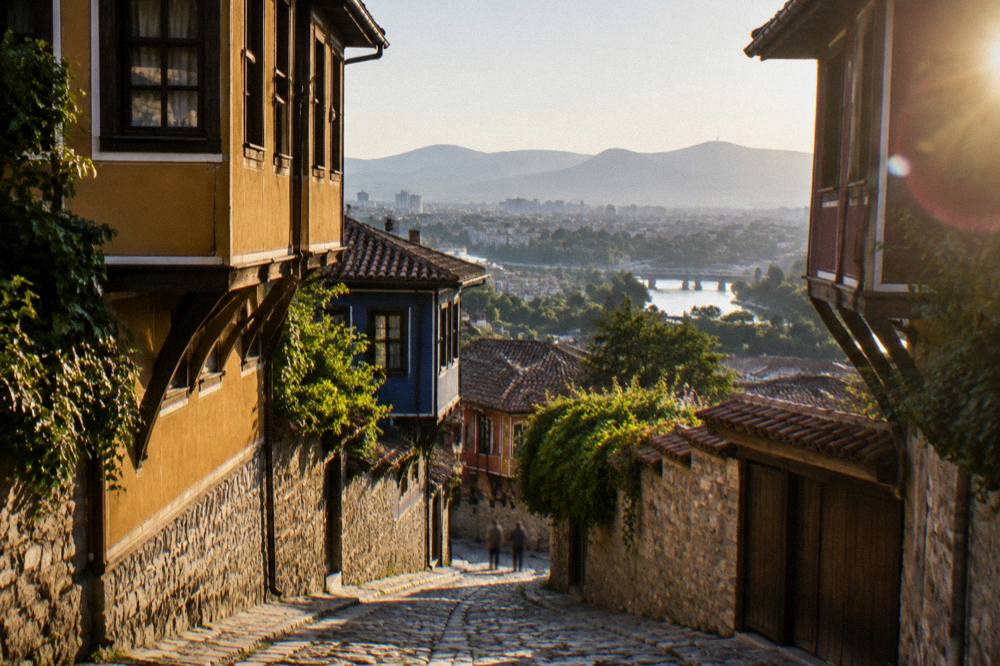
For anyone who wants the gate explained rather than just walked through, a private walking tour is the deepest option, and it pairs naturally with a day spent in the lanes above the arch.
Common Questions About Hisar Kapia
Is Hisar Kapia free to visit?
Yes. The gate is a public landmark with no ticket, no fence and no opening hours. It is a street-level arch you walk through at any time of day or night, and the Old Plovdiv ticket list does not include it among its paid sites.
What does the name Hisar Kapia mean?
The name describes the place plainly: "kapia" is the local word for a gate and "hisar" relates to fortress walls, so Hisar Kapia is the fortress gate. It stands at the eastern edge of the Old Town, where the walled city once opened onto the lower ground.
Can you see Hisar Kapia outside daylight hours?
Yes, the gate is public space with no closing time, and the area is lit at night. The lanes around it are quieter after dark, and the Kapana district downhill stays lively into the evening.
How long should you spend at Hisar Kapia?
The arch itself is a brief stop, a few minutes to look up and take in the frame. The value is in what surrounds it: allow a half day for the loop through the Old Town houses, Nebet Tepe and Kapana, and a full day if you add the Roman sites and museums.
Is Hisar Kapia part of the Old Plovdiv ticket?
No. The gate is free public space. The Old Plovdiv tickets, 3.58 euro for a single site and 10.74 euro for a combined ticket covering up to five sites, apply to the ticketed houses, the Ancient Theatre and the Small Basilica, not to the gate itself.
Is Plovdiv Old Town a UNESCO World Heritage Site?
No. "The Ancient Plovdiv" is on Bulgaria's UNESCO Tentative List, submitted in 2004, which is a waiting list rather than an inscription. The Old Town is fully visitable regardless, and the gate is one of its free landmarks.
Hisar Kapia asks nothing of you and gives you the Old Town's whole frame in exchange: walk through it once in the morning light and once after dark, and you will have seen Plovdiv from both of its sides.