What Is Plovdiv Famous For?
Plovdiv is famous for its Roman theatre, its Old Town revival houses, the Kapana creative district and its six hills. Here is what the city is known for, with ticket prices and event dates.
Plovdiv, in southern Bulgaria, is famous for four things above all: a Roman theatre still used for open-air opera, an Old Town of National Revival houses, the Kapana creative district, and a hilltop cityscape built around six hills. The city was European Capital of Culture in 2019, shared with Matera, and its history runs from a settlement on Nebet Tepe dated by the city's tourism site to the 4th millennium BC, through Philippopolis and Trimontium under Rome, to the present day. This page lays out each of those claims as the primary sources state them, with the 2026 ticket prices from the Old Plovdiv ticket page and the dates that matter for a visit.
What Is Plovdiv Famous For?
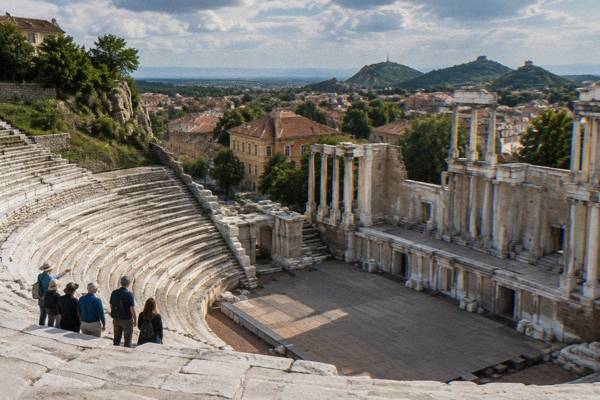
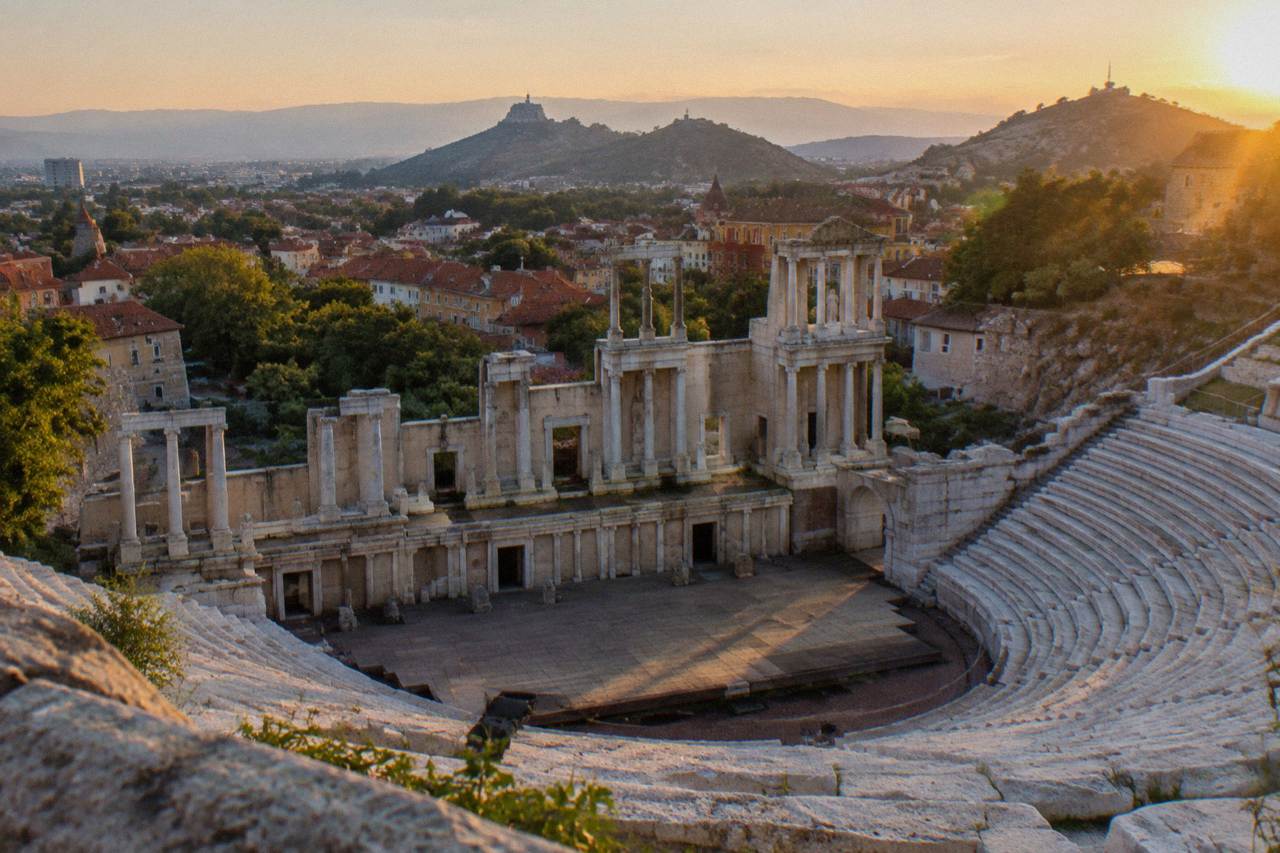
Plovdiv is famous for the Ancient Theatre of Philippopolis, a 1st-century Roman theatre with 28 concentric rows of marble seats that still hosts opera each summer, for the Old Town's revival houses and Nebet Tepe, for the Kapana creative district whose name means "The Trap", and for being a city of six hills. It carries the historical names Philippopolis, Trimontium, Pulpudeva and Filibe, was European Capital of Culture in 2019 together with Matera, and holds a place on Bulgaria's UNESCO Tentative List, submitted on 14 September 2004, as "The Ancient Plovdiv". It is not an inscribed World Heritage Site.
That cluster is unusually dense for a city of 333,994 residents, the National Statistical Institute estimate for Plovdiv Municipality on 31 December 2025. The Roman theatre sits at the foot of the Old Town, the Roman Stadium runs beneath the modern Main Street, and the whole ensemble is walkable in a loop of a couple of kilometres. The municipal tourism site frames the city as one of Europe's longest continuously inhabited places, and the archaeological record behind that claim is visible without a museum ticket: Nebet Tepe is a free open-air complex, and the stadium's northern curve can be viewed at no charge.
A note on the famous hill count. There were seven hills until Markovo Tepe was partly quarried away; six remain, and the Three Hills, Nebet, Dzhambaz and Taksim Tepe, form the heart of the old city. Any guide that promises seven is working from an old map. For the full spread of sights, the site's everything there is to do in Plovdiv page carries the complete rundown, and for placement on the map, where Plovdiv sits in Bulgaria explains the inland, southern setting.
The Roman Landmarks That Made Plovdiv's Name
Plovdiv's Roman fame rests on three monuments: the Ancient Theatre of Philippopolis, built in the 90s of the 1st century AD with 28 concentric rows of marble seats; the Roman Stadium of Philippopolis, a 2nd-century structure on the model of the stadium at Delphi that held up to 30,000 spectators; and the Bishop's Basilica, a 4th-to-6th-century building about 83 m long with over 2,000 sq m of floor mosaics. The Old Plovdiv ticket page prices a single adult site at €3.58, the Bishop's Basilica at €7.57, and a combined ticket covering up to five sites at €10.74.
The theatre is the one people photograph, and for good reason. Standing on the top row, the modern city appears below the stage: rooftops, minarets and hills, with a performance schedule listed on the municipal events pages.
The stadium is the stranger story. Built in the 2nd century AD, only its northern part, the sphendone, is accessible, unearthed in the 1970s; the rest lies beneath the pedestrian Main Street. The Old Plovdiv site says so plainly, and the free sphendone viewing plus a paid 3D projection hall, adult €3.68, let a reader reconstruct the rest. The basilica belongs to a later layer: the oldplovdiv.bg page records a two-layer mosaic floor of over 2,000 square metres, reopened after a long restoration that finished before 2021.
| Roman monument | When built | What you can see | Adult entry 2026 |
|---|---|---|---|
| Ancient Theatre of Philippopolis | 90s of the 1st century AD | 28 concentric rows of marble seats, stage, city view | €3.58 |
| Roman Stadium of Philippopolis | 2nd century AD | Northern sphendone, 13 rows of seats, part of the track | Sphendone free; 3D hall €3.68 |
| Bishop's Basilica of Philippopolis | 4th to 6th century | Two mosaic floor layers, over 2,000 sq m | €7.57 |
| Small Basilica | 5th to 6th century | Three-nave early Christian church with mosaics | €3.58 |
| Nebet Tepe | Settlement from the 4th millennium BC | Fortified hilltop complex, city panorama | Free |
Hours follow a seasonal rhythm: the theatre runs 9:30 to 18:00 from April to October and 9:00 to 17:30 from November to March, with a lunch break at 12:30. To walk these layers with commentary rather than a paper map, the Old Town audio-guide walk covers the Old Town and the Roman landmarks in one guided loop, or see live dates through the operator's listing: Check availability.
The Old Town, Kapana And The Six Hills
The Old Town of Plovdiv is famous for its National Revival houses, colour-washed mansions such as Balabanov, Hindliyan and Nedkovich houses, priced at €3.58 for any single site, while Kapana, whose name means "The Trap", is a maze of narrow streets turned into a creative district of studios, galleries and street art, free and open at all hours. Hisar Kapia, a medieval gate, and the Dzhumaya Mosque, a working mosque of about 1,500 sq m and the second-largest in Bulgaria by built area, anchor the edges of both quarters.
The revival houses are the architectural signature. The visitplovdiv.com and oldplovdiv.bg listings describe them as merchant homes with overhanging upper floors and painted interiors; Hindliyan House moved to daily opening in a September 2026 report. The Old Plovdiv combined ticket covers up to five sites for €10.74 for adults, and the price list on that page is the authority for every euro figure in this paragraph. Students pay reduced rates and children under 7 enter free.
Kapana is the modern half of the fame. The municipal tourism site explains the name, "The Trap", from streets tangled enough to lose a stranger, and the district now hosts Kapana Fest, whose autumn 2026 edition ran across two weekends, 2 to 4 and 9 to 11 October. Street art covers gable walls, and the district's artisan market runs at weekends. The Dzhumaya Mosque, on the edge of the quarter, is free to visit outside prayer times, with modest dress expected; the city's own page prints no construction date, and sources disagree on when it was built.
Is a sunset walk with a glass of Bulgarian wine the right closing move for a first day in Plovdiv?
Plovdiv As European Capital Of Culture 2019
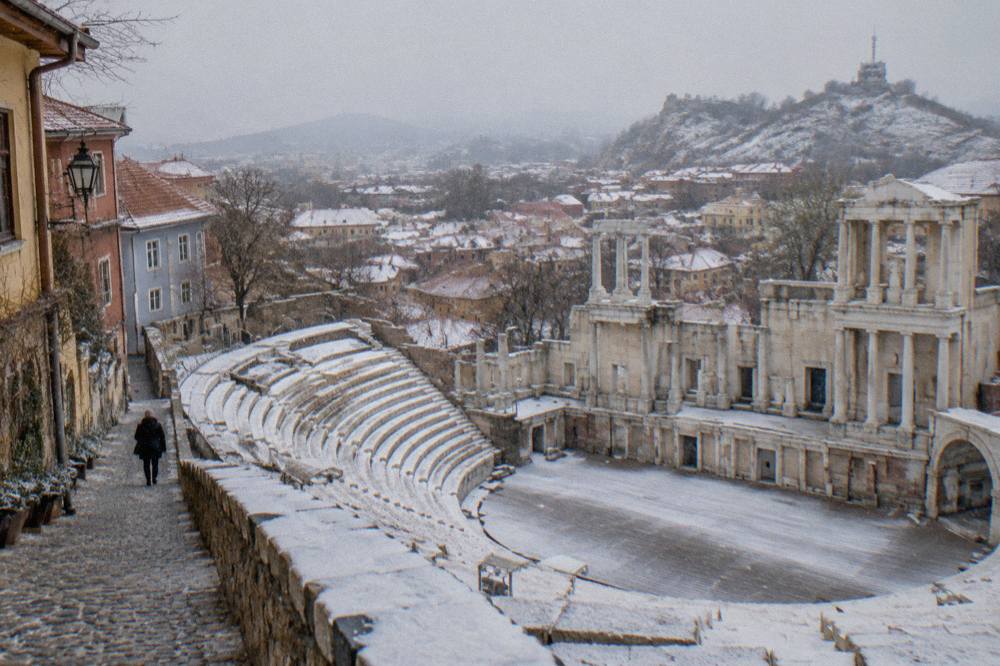
Plovdiv was European Capital of Culture in 2019, the first Bulgarian city to hold the title, shared with Matera in Italy, and the designation transformed the Kapana district, the tobacco warehouse quarter and the basilica projects, leaving a legacy of festivals that still runs today: Opera Open at the Ancient Theatre, Plovdiv Jazz Fest and Kapana Fest among them. The 2019 foundation, "Plovdiv 2019", is named on the municipal tourism site's own history page.
The legacy is measurable in the calendar. Opera Open ran 23 June to 9 September 2026 at the Ancient Theatre, with performances from Carmina Burana to Nabucco on the bill. The Plovdiv Jazz Fest fall edition runs 6 to 8 November 2026 at the Boris Hristov House of Culture. Kapana Fest held its autumn edition over the first two weekends of October. Christmas in Plovdiv, the 2026/27 edition titled "Soul of Christmas", is scheduled for 1 December 2026 to 7 January 2027 across Kapana and Central Square.
The title also matters for what Plovdiv is not. "The Ancient Plovdiv" sits on Bulgaria's UNESCO Tentative List, submitted 14 September 2004, and a tentative listing is a waiting list rather than an inscription, so the city is not a World Heritage Site. The 2019 year, not a UNESCO badge, is what put the city on the international cultural map. For the direct comparison with its co-title city, see which city is older, Plovdiv or Matera, and for the country-wide picture, what Bulgaria is famous for covers monasteries, roses and the Rhodopes beyond this city.
| Signature event | 2026 dates | Venue |
|---|---|---|
| Opera Open | 23 June to 9 September | Ancient Theatre of Philippopolis |
| Old Town "Revived Heritage" festival days | 16 to 23 September | Old Town houses and squares |
| Kapana Fest, autumn edition | 2 to 4 and 9 to 11 October | Bridge over Gladstone Street, Central Square |
| Plovdiv Jazz Fest, fall edition | 6 to 8 November | Boris Hristov House of Culture |
| Christmas in Plovdiv, "Soul of Christmas" | 1 December 2026 to 7 January 2027 | Kapana and Central Square |
Wine, Food And The Road To The Rhodopes
Plovdiv is also famous as a base for the Thracian Valley wine region and the Rhodope mountains: Bachkovo Monastery, about 30 km away and free to enter, Asen's Fortress above Asenovgrad, and the Wonderful Bridges rock arches in the Rhodopes, with local food and wine traditions, Mavrud and Rubin reds, shopska salad, kavarma and kebapche, anchoring the table. Kapana and the Old Town hold the tables; the hills and vineyards hold the day trips.
The food vocabulary is worth learning before arrival. Shopska salad is tomatoes, cucumbers, peppers and sirene cheese; banitsa is the cheese filo pastry sold for breakfast; kavarma is a clay-pot stew; kebapche and kyufte are grilled minced meat. The local pour is Bulgarian wine from the Thracian Valley or rakia, the fruit brandy that opens a meal. A guided Old Town walk with a rakia tasting pairs the revival houses with the local spirit, and the Wonderful Bridges and Rhodope cuisine small-group day below takes the mountain table as its theme.
If you would rather taste those dishes than memorise them, book a Bulgarian food tour here.
South of the city the road climbs. Buses for the Rhodope villages leave from the Rodopi bus station, and the minibuses toward Bachkovo stop at the monastery approach after 35 to 45 minutes. Entry to the monastery is free; the fortress and the Thracian temple at Starosel carry small local fees that are best confirmed on arrival, since the figures in circulation predate the euro changeover.
When To Visit, What It Costs, And How To Judge It
The best window for Plovdiv is May to September: the ERA5 reanalysis for 1991-2020 puts the mean daily high at 21.9 C in May, 28.6 C in August and 23.8 C in September, against 5.9 C in January, and the summer theatre season peaks in July. A one-site Old Town ticket costs €3.58, the combined five-site ticket €10.74, coffee and beer each run about €2 by crowd-reported data, and the city bus e-ticket is €0.50, with Bulgaria a full Schengen member since 1 January 2025 and the euro in force since 1 January 2026.
Rain is modest and evenly spread; May carries the highest monthly total at 56.8 mm and August the lowest at 25.2 mm in the modelled normals, and reanalysis smooths urban heat, so a July afternoon in the stone theatre can run warmer than the 28.2 C mean high. Spring and autumn trade a few degrees for thinner crowds at the theatre and the houses. Winter has its own draw in the Christmas market, and the singing fountains in Tsar Simeon's Garden freeze over quietly until spring.
Budgeting is straightforward. The sightseeing layer, theatre, basilica, two houses, runs under €20 with the combined ticket. The eating layer depends on appetite: crowd data puts a mid-range three-course meal for two around €30 to €40. A tourist tax may be charged by the accommodation, and its 2026 euro rate is unconfirmed, so ask at booking. For the practical decisions, how many days to spend in Plovdiv and the Plovdiv Travel Guide planning pages carry the detail, and for the national comparison travellers often make, whether Plovdiv is a nicer city than Sofia weighs the two honestly.
Common Questions About What Plovdiv Is Famous For
What Is Plovdiv Famous For?
Plovdiv is famous for the Ancient Theatre of Philippopolis, the Old Town's National Revival houses, the Kapana creative district, its six hills and its 2019 year as European Capital of Culture, shared with Matera.
Is Plovdiv Old Town a UNESCO World Heritage Site?
No. "The Ancient Plovdiv" is on Bulgaria's Tentative List, submitted on 14 September 2004, which is a waiting list and not an inscription.
Why does Plovdiv have six hills, not seven?
There were seven hills until Markovo Tepe was partly quarried away; six remain, with the Three Hills, Nebet, Dzhambaz and Taksim Tepe, at the historic core.
Can you attend a performance at the Roman theatre?
Yes. Opera Open ran 23 June to 9 September 2026 at the Ancient Theatre, and the municipal events pages list concerts and operas each summer season.
What food is Plovdiv known for?
The regional table centres on shopska salad, banitsa, kavarma, kebapche and kyufte, with Thracian Valley reds such as Mavrud and Rubin, and rakia as the opening pour.
How much do the famous sights cost?
A single Old Plovdiv site is €3.58 for adults, the Bishop's Basilica is €7.57, the combined ticket covering up to five sites is €10.74, and Nebet Tepe, Kapana and the Roman Stadium sphendone are free.