Is Plovdiv Bigger Than Varna?
Is Plovdiv bigger than Varna? A clear answer from Bulgaria's own population statistics, plus what Plovdiv's size means for a visit: hills, Old Town, day trips and how the two cities suit different trips.
Plovdiv is Bulgaria's second-largest city, an inland city in southern Bulgaria built around six hills with no sea coast, and on the population measures that decide city rankings it sits ahead of Varna. The gap is not enormous, which is partly why the question gets asked so often, but the order is stable: Plovdiv holds second place, and the National Statistical Institute's own estimate for the end of 2025 gives Plovdiv Municipality 333,994 residents. Varna, on the Black Sea coast, is the country's principal port and its summer seaside capital, and that maritime role shapes it far more than raw population does. The two cities are close enough in size that the more useful question for a traveller is not which is bigger but which kind of trip each one serves, and this page answers both.
Is Plovdiv Bigger Than Varna?
Yes, on the standard measures Plovdiv is bigger than Varna. Plovdiv is Bulgaria's second-largest city, and the National Statistical Institute's estimate for 31 December 2025 puts Plovdiv Municipality at 333,994 residents, with 319,612 recorded at the 2021 census. Varna follows as the smaller of the two on the same national ranking, though the margin between them is narrow rather than decisive.
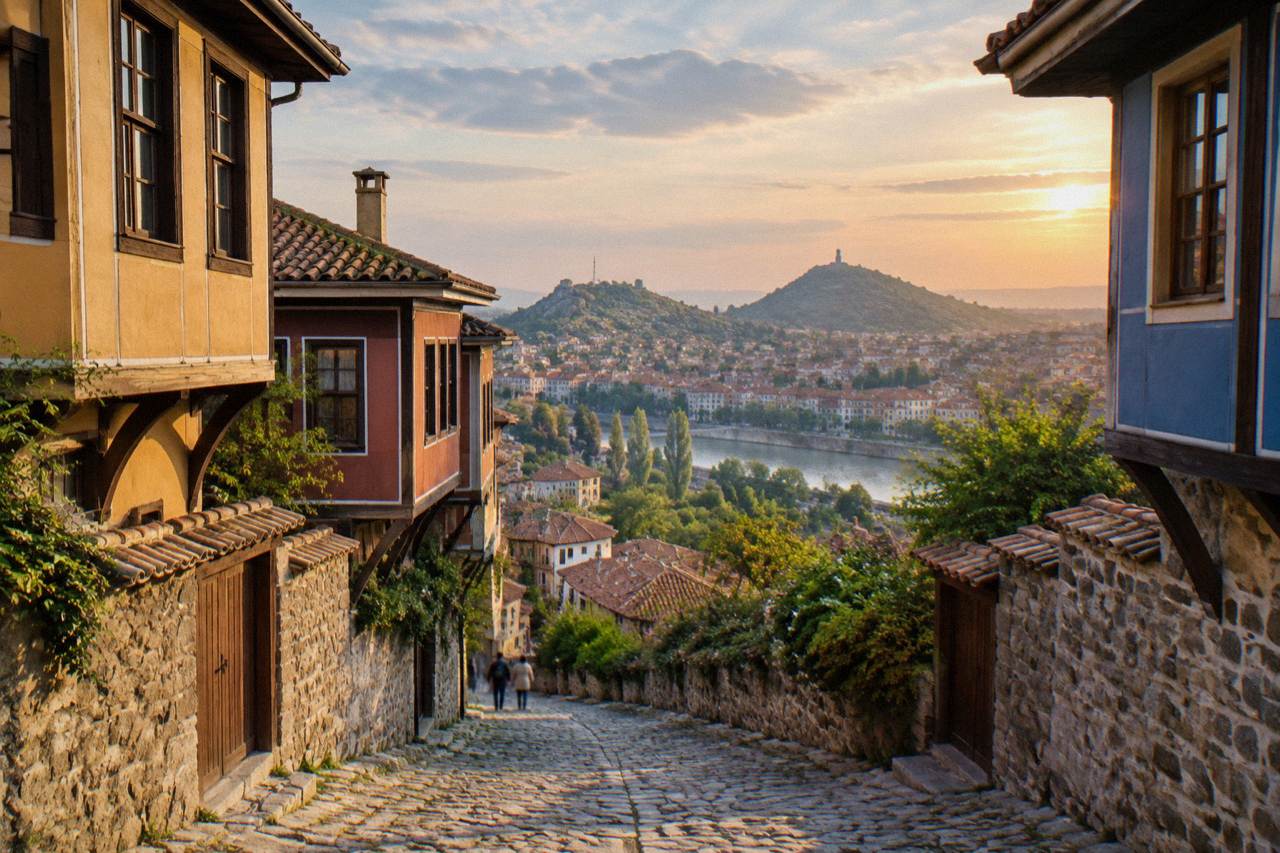
The rank itself is worth pausing on, because "second-largest city" is a phrase Plovdiv carries in nearly every description of it, from the municipal tourism site to the country's own promotional material. Rank and feel are different things, though. Plovdiv's population is spread across a city that climbs and dips over six hills, three of which, Nebet Tepe, Dzhambaz Tepe and Taksim Tepe, form the historic core the Romans knew as Trimontium, the Three Hills. There were seven hills until Markovo Tepe was partly quarried away in the 1930s; six remain, and the city's shape still bends around them.
Varna's identity, by contrast, is bound to the coast: it is the city Bulgarians associate with the sea, and its population swells each summer with the seaside season. Neither fact changes the ranking, but both explain why the question feels live. Two cities of similar administrative size can read as completely different places once you arrive, and Plovdiv reads as a layered inland capital of history rather than a beach destination. For a wider sense of what that layering amounts to, see what Plovdiv is famous for.
How Many People Live In Plovdiv?
Plovdiv Municipality had an estimated 333,994 residents on 31 December 2025, according to the National Statistical Institute estimate, and 319,612 at the 2021 national census. Those are the two figures that anchor Plovdiv's place in Bulgaria's city ranking, and both are published measures rather than estimates from travel writing. The 2025 figure represents growth against the census count five years earlier.
The census-to-estimate movement matters more than it might seem. A city that added population between 2021 and the end of 2025 is one where the second-place rank is not merely inherited but sustained, and Plovdiv's role as the economic and cultural centre of southern Bulgaria is part of that. The city was European Capital of Culture in 2019, shared with Matera in Italy, and the institutions built around that year, from the restored Bishop's Basilica to the festival calendar, serve a resident population of this scale year-round, not just a summer influx.
For a traveller, a population in the low hundreds of thousands lands in a sweet spot. Plovdiv is large enough to sustain an opera programme, a jazz festival and a full museum roster, yet small enough that the whole historic core, from the Ancient Theatre of Philippopolis down through Kapana to the Maritsa river, can be crossed on foot. The question of how long that walk needs is answered in detail in how many days to spend in Plovdiv, and the honest answer is that two days cover the core comfortably.
| Measure | Figure | What it is |
|---|---|---|
| Plovdiv Municipality, 31 Dec 2025 | 333,994 | NSI estimate, current headline figure |
| Plovdiv Municipality, 2021 census | 319,612 | National census count |
| National rank | Second-largest city in Bulgaria | Standing description across official sources |
| Hills in the city | Six | Seven until Markovo Tepe was partly quarried away |
| Time zone | EET, UTC+2 (UTC+3 in summer) | Same zone as the whole country |
The table above keeps to figures attached to Plovdiv itself, because those are the ones the national statistics carry directly. The comparison with Varna resolves on rank: Plovdiv is the larger of the two on the measures Bulgaria's statistical office publishes, and the rest of this page is about what that size actually buys a visitor.
Population is one axis; the shape of the city is another. If you are weighing Plovdiv against the capital rather than the coast, the same reasoning applies in whether Plovdiv is a nicer city than Sofia.
Does A Bigger City Mean A Bigger Visit?
No, and in Plovdiv's case the reverse is closer to the truth: the city's size is concentrated into a walkable historic core that sits within twenty minutes on foot of the modern centre. The Ancient Theatre, the Roman Stadium's sphendone, Nebet Tepe, Hisar Kapia and the Kapana creative district all lie inside that compact zone, so a bigger population does not translate into longer distances between the sights a visitor actually comes to see.
The Ancient Theatre of Philippopolis, built in the 90s of the 1st century AD with 28 concentric rows of marble seats, stands at the top of that slope and still hosts an opera season each summer. Below it, the Roman Stadium of Philippopolis, built in the 2nd century AD on the model of the stadium at Delphi, survives in its northern part, the sphendone, visible free of charge at street level, with the rest lying under the modern Main Street. Other pages covering the same trip are gathered on Plovdiv Travel Guide.
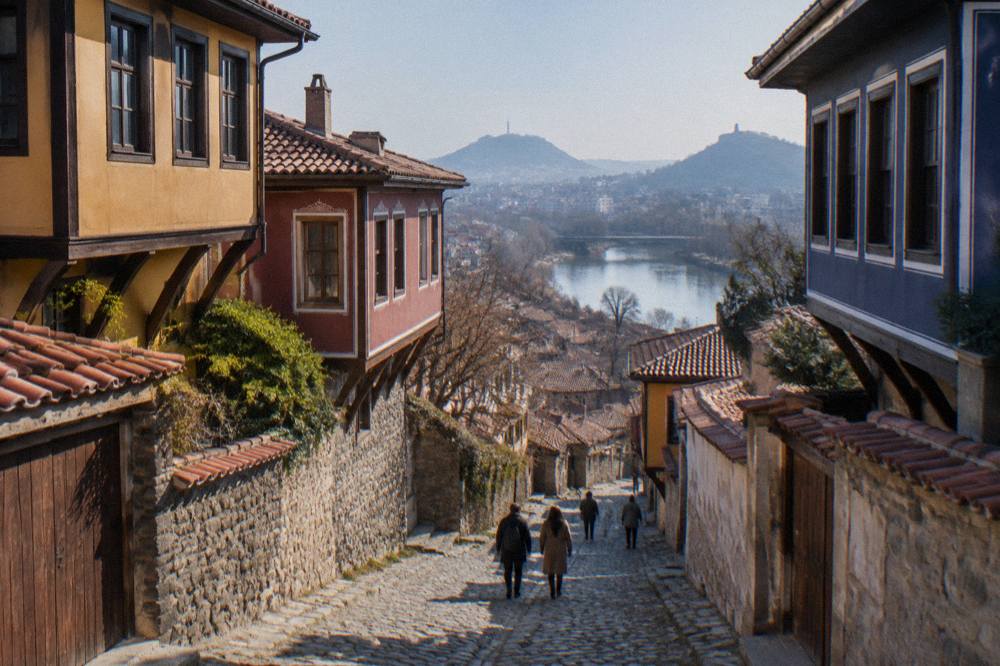
What Plovdiv's scale does buy is depth rather than sprawl. This is a city often described as one of the oldest continuously inhabited cities in Europe, with the first settlement on Nebet Tepe dated to the 4th millennium BC by the city's tourism site, and the layers sit almost vertically on top of one another: Thracian walls, Roman staging, Ottoman mosques including the Dzhumaya Mosque with its construction dated by the city's own page to between the 14th and 16th centuries, and the Bulgarian revival houses above them all. A guided walk is the efficient way to read those layers, and one of the distinctive options is the Jewish Walking Tour of Plovdiv, which traces a heritage quarter that fewer visitors encounter on their own. The fuller sight list is in things to do in Plovdiv.
How Does Plovdiv Use Its Inland Position?
Plovdiv's inland position in the Thracian plain makes it a hub for day trips rather than a base for the beach, and that is the clearest practical difference from a coastal city of similar size. Bachkovo Monastery lies about 30 km away, the Rhodope mountains begin at the city's southern edge, and the Thracian valley wine region sits within easy reach, so the day-trip roster runs to monasteries, fortresses, gorges and wineries.
Bachkovo Monastery, a working monastery with free entry, is reachable by minibus from Plovdiv's Rodopi bus station in roughly 35 to 45 minutes, and it pairs naturally with Asen's Fortress above Asenovgrad on the same road south. The Rhodopes beyond hold the Wonderful Bridges, the Trigrad gorge and the Devil's Throat cave, all covered on established small-group day tours from the city. North and east, the Valley of the Thracian Kings and the Rose Valley around Kazanlak carry the ancient tomb country Bulgaria is known for, and westward the road leads to Koprivshtitsa and on to Sofia, about 2 h 40 to 3 h 05 from Plovdiv by direct train on the BDZ timetable.
A coastal city answers a different question. Varna's pull is the Black Sea shoreline and everything that comes with it, which makes it a summer trip in a way Plovdiv never is. Plovdiv's calendar instead runs through cultural events: Opera Open at the Ancient Theatre ran 23 June to 9 September in 2026, the autumn Kapana Fest took place over the first two weekends of October, and the Plovdiv Jazz Fest fall edition runs 6 to 8 November at the Boris Hristov House of Culture. Where to place Plovdiv on the map, and how its southern position shapes arrival planning, is covered in where Plovdiv is located in Bulgaria.
| Day trip from Plovdiv | What it is | Getting there |
|---|---|---|
| Bachkovo Monastery | Working monastery, free entry, about 30 km | Minibus from Rodopi station, 35 to 45 min |
| Asen's Fortress | Medieval fortress above Asenovgrad | Same southern road, past Asenovgrad |
| Wonderful Bridges | Rock arches in the Rhodopes | Small-group day tours from the city |
| Kazanlak and the Rose Valley | Thracian tombs and rose country | Day tours, or road trip east |
| Sofia | The capital, museums and Rila Monastery beyond | Direct train, about 2 h 40 to 3 h 05 |
Which City Suits Which Trip?
Plovdiv suits a trip built around history, walking and inland day trips, while a seaside holiday is the trip Varna exists for, and no population figure changes that division of labour. Choose Plovdiv for the Roman sites, the Old Town, the Rhodopes and the wine valley; choose the coast when the purpose of the journey is the sea itself, and treat the size question as a footnote to that decision.
That is the honest framing, because the ranking is settled but narrow. Plovdiv's 333,994 municipal residents give it second place, and its cultural infrastructure, a year-round city of museums, galleries and festival stages rather than a resort economy, reflects a city that works in every season. The climate underwrites that: ERA5 reanalysis for 1991-2020 shows a mean daily high of 28.2 C in July and 5.9 C in January, a continental pattern with hot summers and cold winters, so the city's indoor life, its museums, its Kapana cafes and its concert halls, carries the winter months the way the shoreline carries a coastal city's summer.
Practicalities also lean Plovdiv's way for an inland itinerary. Bulgaria has used the euro since 1 January 2026 and has been a full Schengen member since 1 January 2025, city buses run on a 0.50 euro e-ticket, and the city's single e-ticket fare makes the hills and the centre easy to connect. Most international visitors still arrive through Sofia and take the direct train down; Plovdiv Airport at Krumovo keeps a small, seasonal route list of its own.
For travellers piecing together a first Bulgaria itinerary, the usual pairing is Sofia for two or three nights, Plovdiv for two, and then a choice: the mountains and monasteries inland, or the coast east. Both are legitimate answers, and the country is compact enough that Plovdiv to the sea and Plovdiv to the Rhodopes are same-day distances. The size question that opened this page settles in a sentence, Plovdiv is the larger city by population and rank, and the itinerary question is the one that actually deserves your evening of planning.
Common Questions About Plovdiv And Varna
Is Plovdiv Bigger Than Varna?
Yes. Plovdiv is Bulgaria's second-largest city, with the National Statistical Institute estimating 333,994 residents for Plovdiv Municipality on 31 December 2025, against 319,612 at the 2021 census. Varna ranks behind it on the same national measures, though the margin is narrow.
Is Plovdiv The Second-Largest City In Bulgaria?
Yes, that is its standing description across official and tourism sources, and the population figures support it: 333,994 residents estimated for the end of 2025, up from 319,612 at the 2021 census.
Does Plovdiv Have A Sea Coast?
No. Plovdiv is an inland city in southern Bulgaria, built around six hills in the Thracian plain, with the Rhodope mountains to the south. The nearest sea is the Black Sea coast, where Varna sits.
Which City Is Better For History, Plovdiv Or Varna?
For a trip organised around ancient and revival-era history, Plovdiv is the stronger fit: the Ancient Theatre of Philippopolis, the Roman Stadium sphendone, Nebet Tepe and the Old Town revival houses are all within one walkable core, and the city is often described as one of the oldest continuously inhabited cities in Europe.
How Far Is Plovdiv From Sofia?
Direct BDZ trains cover Sofia to Plovdiv in about 2 h 40 to 3 h 05, with several departures a day; trains routed via Karlovo take considerably longer, so check the timetable when booking.
Is Plovdiv Easy To Visit Without A Car?
Yes. The historic core is compact and walkable, city buses use a 0.50 euro e-ticket, and the principal day trips, including Bachkovo Monastery about 30 km away, run on scheduled minibuses and small-group tours from the city.
