Alyosha Monument On Bunardzhik Hill
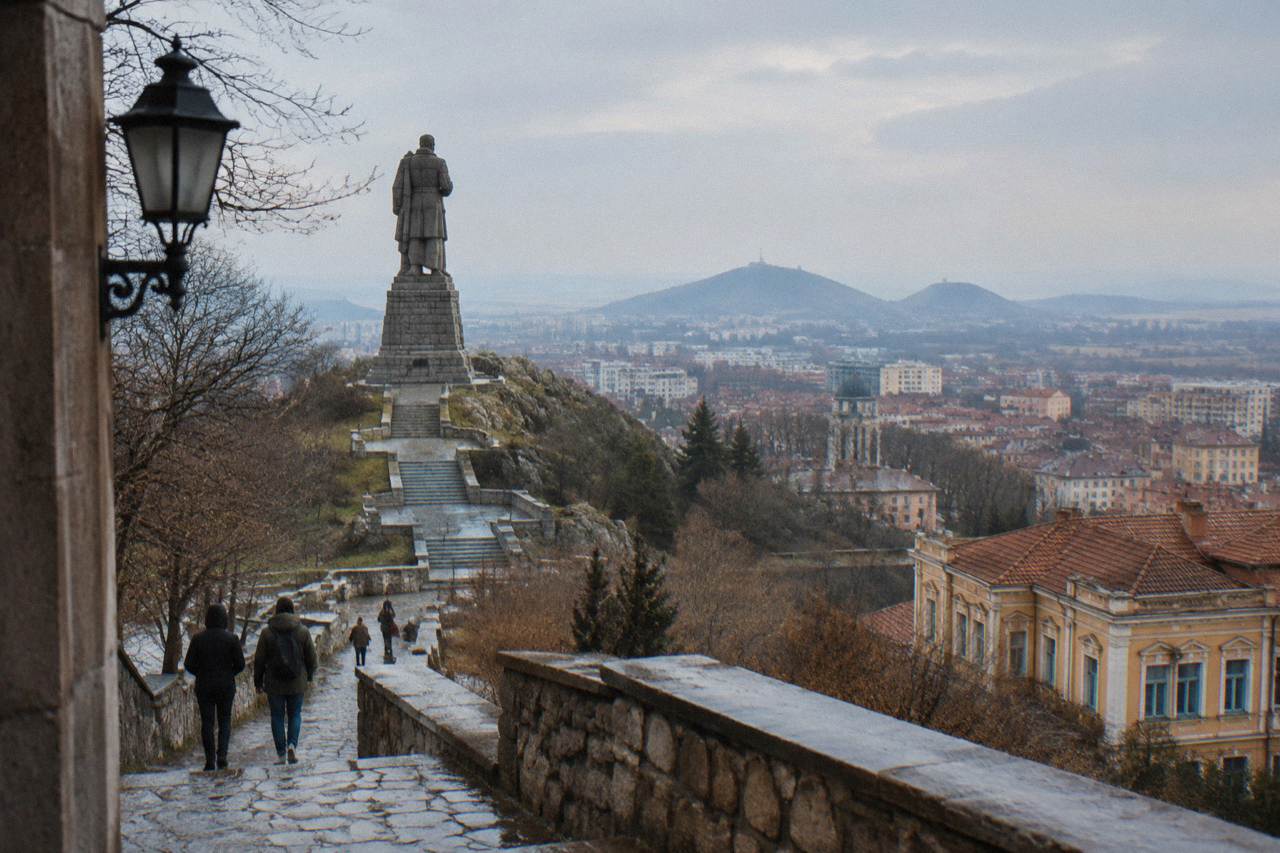
The Alyosha Monument is the giant concrete soldier who has watched over Plovdiv from Bunardzhik Hill since 1957, and the climb to his pedestal is one of the best free walks in the city.
Short answer
The Alyosha Monument in Plovdiv is a Soviet Army memorial unveiled in 1957 on Bunardzhik Hill, the Hill of the Liberators, 265 m above the city. The hill is a free public park, open at all hours, with no ticket, and the monument is the single best known viewpoint over Plovdiv's six hills and the plain beyond.
The Alyosha Monument in Plovdiv, in southern Bulgaria, is the concrete Soviet Army soldier who has stood on the top of Bunardzhik Hill since 1957, gazing north across the city with his back to the Rhodope mountains. Locals call him Alyosha, an affectionate diminutive of Aleksei, and the name has long since replaced the official one in everyday speech. The hill he stands on, also called the Hill of the Liberators, rises 265 m above the city, which makes the monument the single most visible landmark on Plovdiv's skyline after the hills themselves. Access is free, there is no ticket, no gate and no closing hour, and the climb from the city center takes a matter of minutes on foot, which is why the hill doubles as a park, a running route and a viewpoint rolled into one. This guide covers what the monument is, how to reach it, what the climb gives you, why the statue is controversial, and how to fit Bunardzhik into a wider day in Plovdiv.
What Is The Alyosha Monument In Plovdiv?
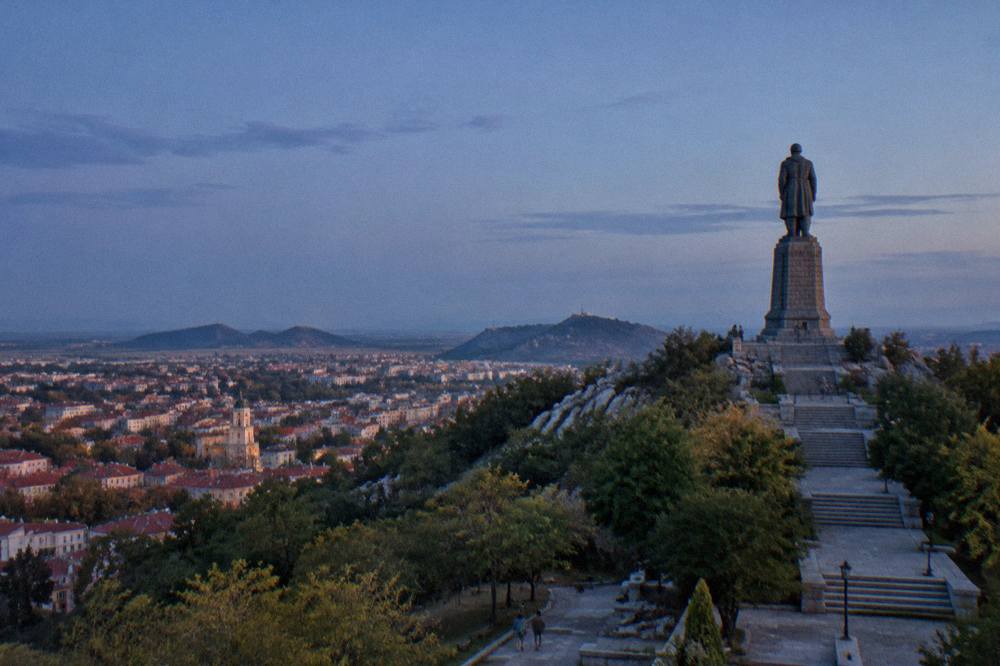
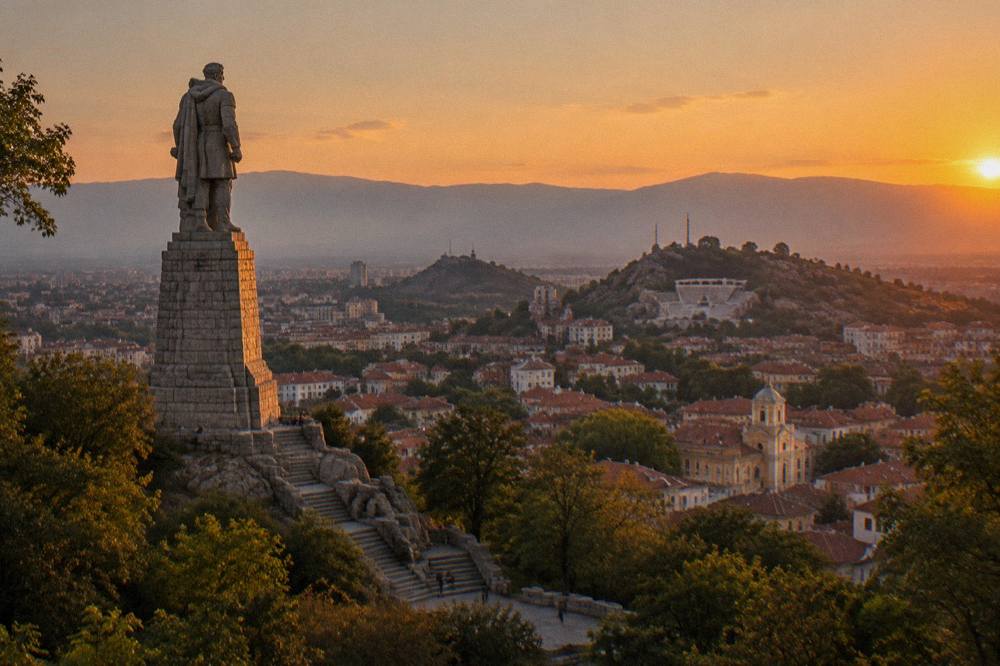
The Alyosha Monument is a memorial to the Soviet Army of the Second World War, a reinforced concrete figure of a soldier unveiled in 1957 on the top of Bunardzhik Hill in Plovdiv, the Hill of the Liberators, 265 m above the city. The statue is reported at about 11 m tall on a pedestal of about 6 m. It is a free public space with no ticket and no closing hour, and the hill around it is a park.
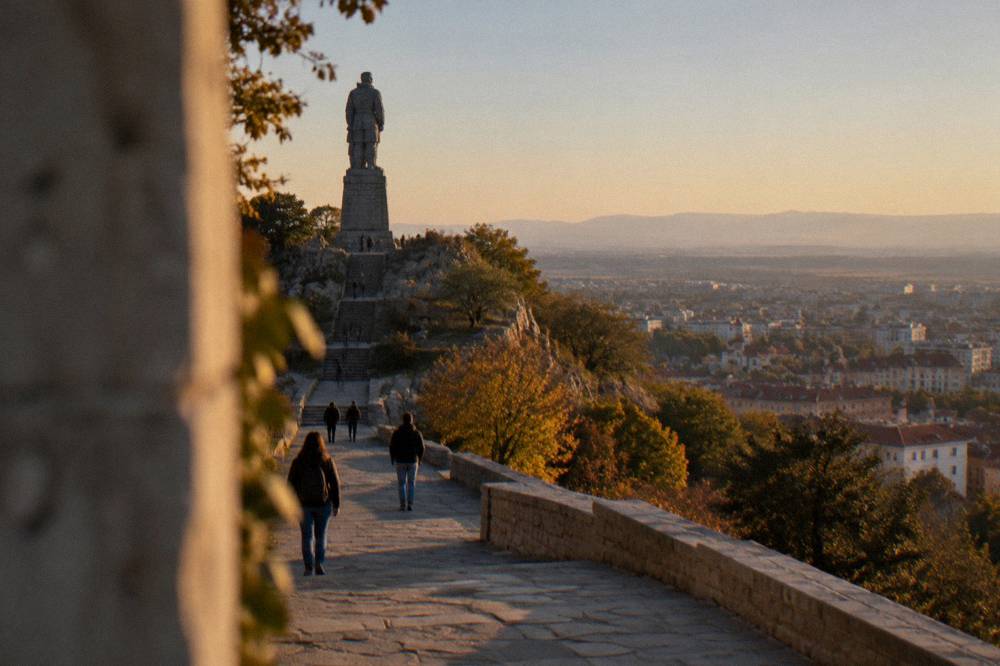
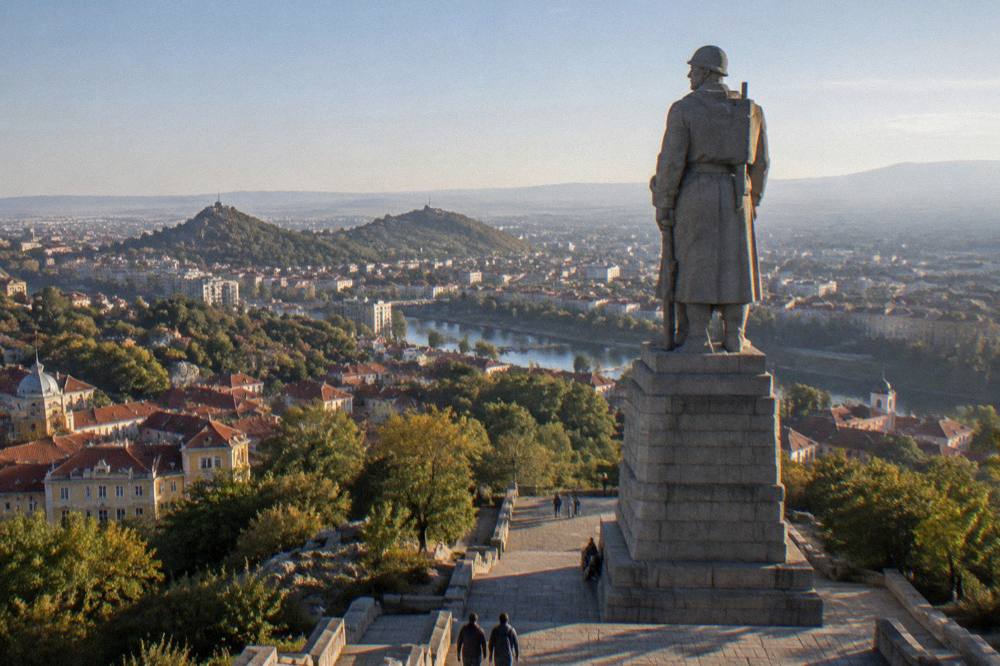
The figure is a Soviet soldier in a greatcoat, holding a submachine gun slung across his chest, his face turned north. The nickname, Alyosha, comes from the Russian diminutive of Aleksei and refers to a fictional soldier from a Soviet-era poem and song; the name stuck in Plovdiv speech and now appears on maps, bus stop names and even a beer brewed in the city's Kapana district.
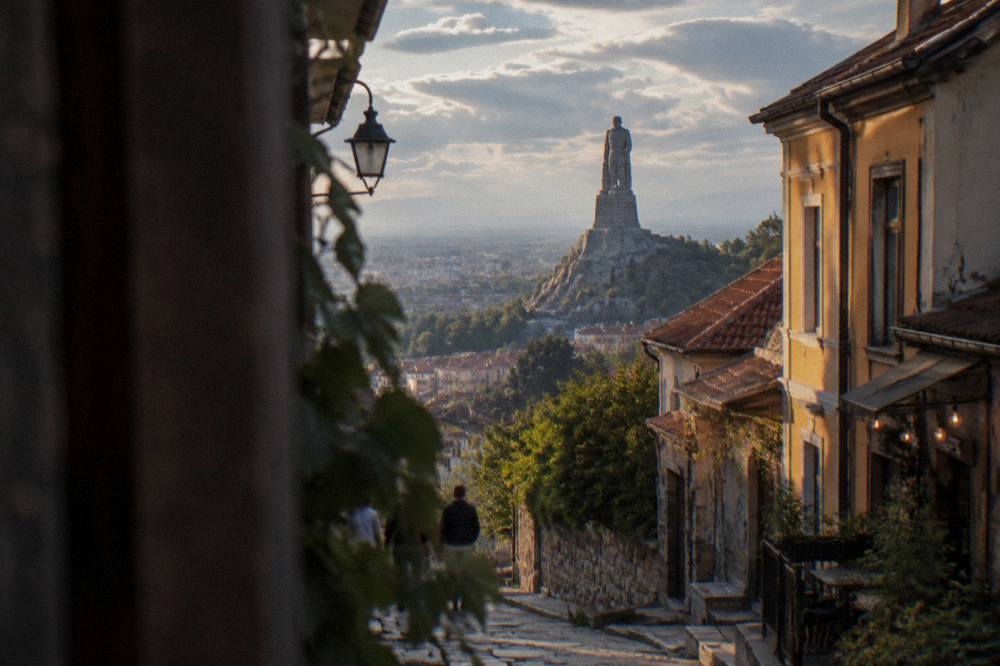
The statue's scale is what registers first. Reported at about 11 m for the figure alone, standing on a reported 6 m pedestal, it is visible from the plain south of the city and from the Old Town's upper streets, a fixed point by which the whole city orients itself. The reported heights come from secondary references rather than an official plaque, so treat the numbers as approximate. What no source disputes is the effect: a single human silhouette, monumental and simplified, readable from kilometers away.
The setting matters as much as the statue. Bunardzhik is one of Plovdiv's six hills, and unlike Nebet Tepe or the Three Hills cluster in the Old Town, it carries almost no archaeology open to the public. Instead it is a green park of pine trees, gravel paths and lawns, one of the largest open green spaces within walking distance of the center. The monument sits at the summit, with open ground around it and a panorama that takes in the rest of the city.
Where Is The Alyosha Monument In Plovdiv And How Do You Get There?
The Alyosha Monument stands on the summit of Bunardzhik Hill, the Hill of the Liberators, on the south side of central Plovdiv, a short walk uphill from the area around the Central Railway Station and Tsar Simeon Garden. There is no ticket, no gate and no closing time, and the city bus network serves the streets at the hill's foot with a single e-ticket fare of 0.50 euro.
Bunardzhik is the hill immediately south of the city center, between the wide boulevards that run toward the railway station and the leafier residential slopes beyond. The standard approach on foot starts from the bottom of the hill near the western end of the center, where a stepped path climbs through pine trees to the summit. The climb is short but steady, and the path network means you can make a loop of it, ascending one side and descending another into a different neighborhood. There are benches at intervals, and the lower slopes are popular with runners and dog walkers at all hours.
By public transport, the city's buses serve the avenues around the hill's base. The hill is close enough to the center that many visitors never bother with a bus at all: from the Central Railway Station area the walk to the summit path is a matter of minutes, and from Tsar Simeon Garden and the Singing Fountains it is only a little further.
| Approach | Where it starts | What the climb is like | Ticket needed |
|---|---|---|---|
| Western stepped path | Near the boulevard below the summit | Steady stone steps through pines, the classic route | No, free |
| Eastern park path | Residential streets east of the hill | Gentler gravel paths, longer loop | No, free |
| Southern slope | Streets above the Youth Hill side | Quieter, more residential, fewer steps | No, free |
| By city bus | Stops around the hill's foot | Bus to the base, then a short walk up | 0.50 euro e-ticket |
The hill's position is its main practical advantage. It sits between the railway and bus stations and the Old Town, so it slots naturally into an arrival day: leave a bag, walk up for the view, and come down straight into the center.
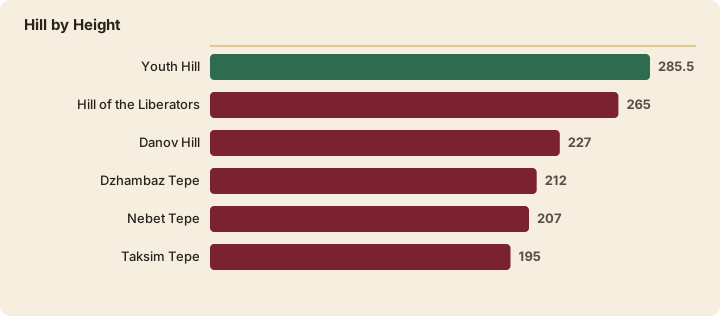
| Hill | Bulgarian name | Height | What sits on it |
|---|---|---|---|
| Youth Hill | Dzhendem Tepe | 285.5 m | Open parkland on the southwest side |
| Hill of the Liberators | Bunardzhika | 265 m | The Alyosha Monument and park |
| Danov Hill | Sahat Tepe | 227 m | Clock tower and old town views |
| Dzhambaz Tepe | Dzhambaz Tepe | 212 m | Old Town houses and terraces |
| Nebet Tepe | Nebet Tepe | 207 m | Walled archaeological complex, free |
| Taksim Tepe | Taksim Tepe | 195 m | Residential slopes near the Old Town |
There were seven hills until quarrying partly destroyed Markovo Tepe in the 1930s, so six remain, a correction worth making because half the guidebooks still say seven. Bunardzhik is the second highest of the six and the only one whose summit is a flat, open park rather than a built-up street or a fenced archaeological site, which is exactly why the view from the top is unobstructed in every direction.
A guided walk is a good way to anchor the hill in the wider city, and the Old Town and Roman Theatre tour covers the streets and the theatre that the Bunardzhik panorama looks down on.
What Can You See From The Alyosha Monument In Plovdiv?
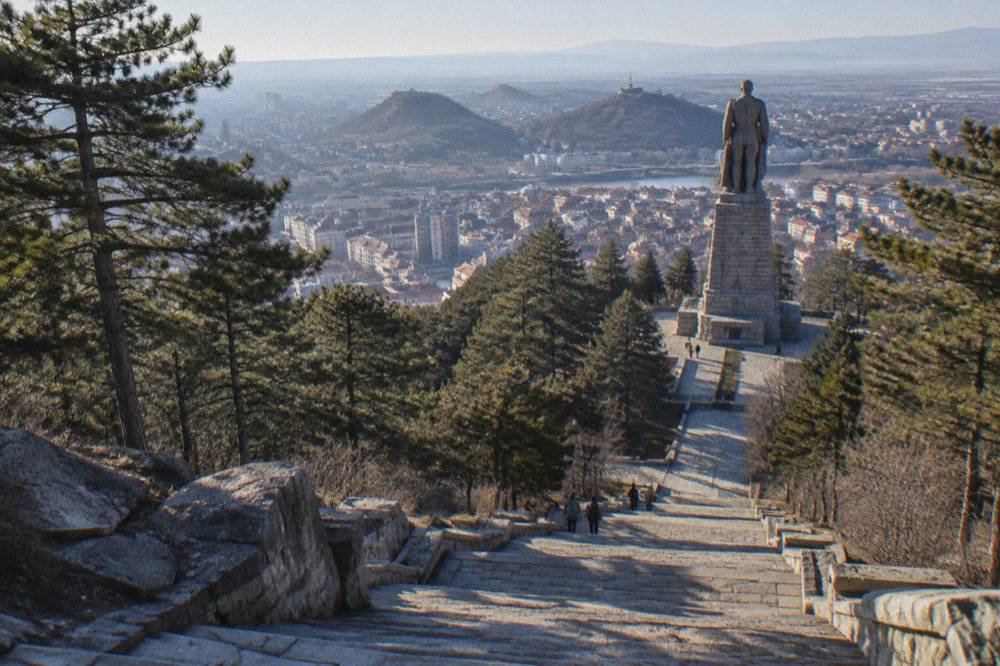
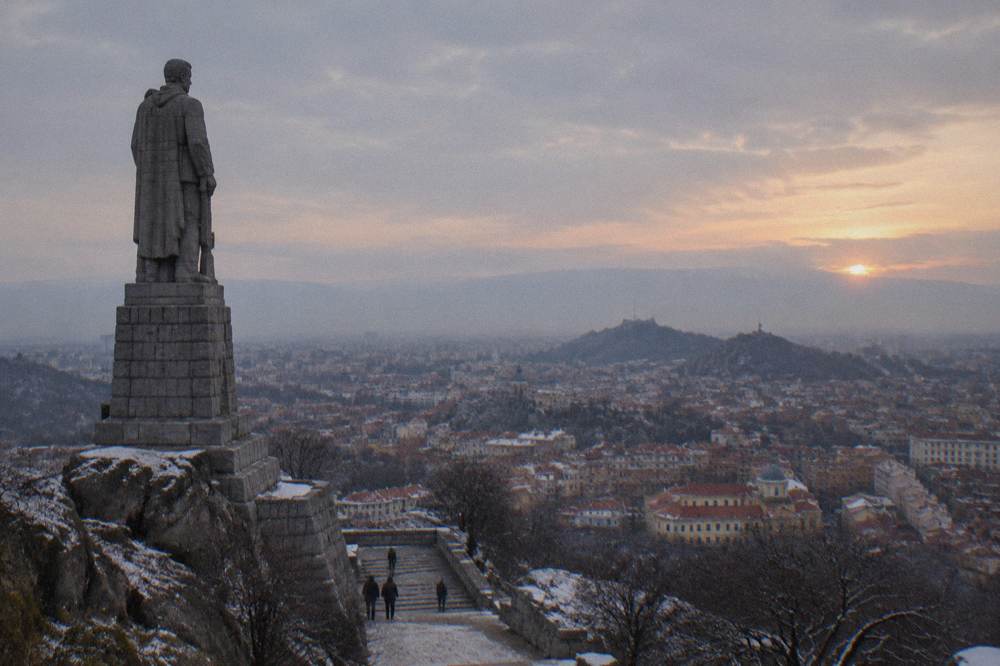
From the base of the Alyosha Monument on Bunardzhik Hill you can see the whole of central Plovdiv laid out below: the Three Hills and the Old Town, the Ancient Theatre's marble curve, the Dzhumaya Mosque minaret, the Central Square and the Roman Stadium beneath it, the Rhodope mountains to the south and the flat Thracian plain stretching north. The viewpoint is free and open at all hours.
The panorama is the reason to come, more even than the statue itself. Looking north, the whole city grid reads at a glance. The Three Hills cluster, Nebet Tepe, Dzhambaz Tepe and Taksim Tepe, is unmistakable, with the Old Town's red roofs and the restored walls of the Nebet Tepe complex, which reopened after conservation in March 2025 and remains free to enter. On the far side of the Old Town the Ancient Theatre of Philippopolis shows as a pale crescent of 28 concentric rows of marble seats built into the hillside in the 90s of the 1st century AD. Closer in, the minaret of the Dzhumaya Mosque rises above the Main Street, and the flat roofline of Central Square hides the Roman Stadium, only the northern sphendone of which is excavated, the rest still lying under the modern street.
To the south the ground climbs again into the Rhodope mountains, the range that gives Plovdiv its day-trip hinterland: Bachkovo Monastery, Asen's Fortress, the Wonderful Bridges and the gorge country around Trigrad. On a clear day the hills read as a wall across the southern horizon. To the north and east the view runs out across the Thracian plain toward the Sredna Gora and the Balkan range, the farm flatness that explains why Plovdiv grew where it did, on hills above a river crossing on the road between the mountains.
Sunset is the hour the hill earns its reputation. The statue silhouettes against the western sky, the Old Town's warm roof tiles catch the low light, and the theatre and mosque turn gold. The park stays open and busy into the evening in summer, and the free access means there is no timing pressure: come up for an hour, come up with a drink from a shop below, or come up twice, once in daylight to read the map of the city and once at dusk.
| Direction | What you see | Landmark to look for |
|---|---|---|
| North | Central Plovdiv and the plain beyond | Central Square and the Dzhumaya Mosque minaret |
| Northeast | The Old Town and Three Hills | The Ancient Theatre's marble seating crescent |
| East | Residential slopes and the Sredna Gora | The flat line of the Thracian plain |
| South | The Rhodope mountains | The wall of hills above the city |
| West | Station district and Youth Hill | The railway junction and Dzhendem Tepe |
For visitors who want the city explained rather than just seen, a guided Old Town walk pairs well with the hill, since the tour covers the Ancient Theatre and the Old Town lanes that the panorama frames.
When Is The Best Time To Visit The Alyosha Monument In Plovdiv?
The Alyosha Monument and Bunardzhik Hill in Plovdiv are free and open at all hours year round, so the best time is a matter of light and heat rather than opening hours. The ERA5 reanalysis for Plovdiv, 1991 to 2020, puts the mean daily high at 28.6 C in August and 5.9 C in January, so the climb is at its kindest in spring and autumn, and sunset is the best hour on any day.
Because the hill is a public park with no gate, there is no schedule to plan around and no ticket to buy in advance. That freedom shifts the planning question entirely to weather and light. Summer afternoons in Plovdiv are hot: the modelled mean daily high reaches 28.2 C in July and 28.6 C in August, and the stepped western path is exposed for long stretches, so the early morning and the hour before sunset are the comfortable windows. Winter is a different walk: January's mean daily low sits at minus 2.6 C, snow does fall in Plovdiv, and the bare trees of the cold months open views that summer foliage partly closes.
| Month | Mean daily high (C) | Mean daily low (C) | Rain (mm) | Hill conditions |
|---|---|---|---|---|
| January | 5.9 | -2.6 | 41.0 | Cold, possible snow, bare trees |
| March | 12.1 | 2.1 | 55.0 | Warming, changeable |
| May | 21.9 | 11.5 | 56.8 | Green, mild, the rain peak of 56.8 mm |
| July | 28.2 | 17.9 | 45.6 | Hot, go early or at sunset |
| August | 28.6 | 18.1 | 25.2 | The highest mean high and the lowest rain |
| October | 18.1 | 8.8 | 44.1 | Mild, clear, autumn light |
The figures come from the ERA5 reanalysis for 1991 to 2020, a modelled grid cell over the city rather than a station record, so they describe the climate pattern rather than any single day. The pattern they describe is continental: hot summers, cold winters, a modest and fairly even spread of rain through the year with May the wettest month at 56.8 mm and August the driest at 25.2 mm.
Two seasonal notes are worth adding. First, the hill is a working park for locals, so weekday mornings belong to runners and dog walkers, while weekends bring families and picnics; neither interferes with the view, but the summit is livelier at some hours than others. Second, the monument faces north, so the statue itself photographs best in the middle of the day, while the view over the city photographs best at the golden hour, a small logistical conflict that two short visits solve.
Why Is The Alyosha Monument In Plovdiv Controversial?
The Alyosha Monument in Plovdiv is controversial because it is a Soviet Army memorial from the communist period, and since Bulgaria's political turn away from communism there have been repeated public calls to remove it, alongside equally strong campaigns to keep it as a war memorial and a landmark. No removal decision has been taken, and as of the latest reports the statue stands on Bunardzhik Hill unchanged, with the debate ongoing rather than resolved.
The argument runs along familiar lines for Soviet memorials across Eastern Europe. One side sees the statue as a symbol of the Soviet occupation and the communist regime that followed, a figure holding a weapon over the capital of an independent country, and argues it belongs in a museum rather than on the city's second-highest hill. The other side sees a memorial to soldiers who died in the Second World War, a monument that has outgrown its politics to become a landmark, a meeting point and a name that the whole city uses with affection. Municipal debates over the statue's future have surfaced repeatedly, and the reports available describe political argument and public petitions, but no decision to dismantle, relocate or alter the monument.
For a visitor, the practical outcome of all this is simple: the statue stands, the hill is open, and the only visible trace of the controversy is the occasional graffiti at the base and the periodic newspaper story. The monument has no visitor center, no ticket office and no interpretation, which is itself a fact worth noticing. What you see is a concrete soldier, a pedestal, a park and a view, with the meaning left to the visitor to assemble.
The hill's older name softens the argument for many locals. The 1957 statue was deliberately placed on that hill to weld the two eras together, one liberation stacked on another, and the naming is part of why the site carries more weight than a single statue would on its own.
What Else Can You Do Around Bunardzhik Hill In Plovdiv?
Around Bunardzhik Hill in Plovdiv you can walk to Tsar Simeon Garden and the Singing Fountains at the hill's foot, cross the center to the free Nebet Tepe complex and the Old Town, visit the Ancient Theatre for a 3.58 euro one-site ticket, or ride the city buses onward to the Youth Hill parkland, all within a single afternoon, since the hill sits between the station district and the Old Town.
Bunardzhik's position makes it a hinge rather than a detour. Descending north from the summit puts you within walking distance of Tsar Simeon Garden, the city's central park, where the lake with the Singing Fountains anchors the green space and the municipality reports routine year-round maintenance of the garden. From there the Main Street, the pedestrian spine of the modern city, runs straight to Central Square and the buried Roman Stadium, whose open-air sphendone is free to view and whose 3D projection hall costs 3.68 euro for an adult ticket.
The Old Town climbs immediately east of the center. The one-site Old Plovdiv ticket costs 3.58 euro for an adult and covers the Ancient Theatre, the Small Basilica and the revival-era houses such as Balabanov House and Hindliyan House, with a combined ticket for up to five sites at 10.74 euro excluding the basilicas. The Bishop's Basilica, with its more than 2,000 sq m of floor mosaics, is priced separately at 7.57 euro. All of this sits within a fifteen-minute walk of the base of Bunardzhik, which is why the hill works so well as the first stop of a walking day: climb, read the city from above, then descend into the streets you just identified.
| Sight near Bunardzhik | Distance from the hill | Ticket | Hours note |
|---|---|---|---|
| Tsar Simeon Garden and Singing Fountains | Short walk downhill | Free | Public park, open access |
| Nebet Tepe archaeological complex | Walk across the center | Free | Open-air, free access since the 2025 reopening |
| Ancient Theatre of Philippopolis | Walk through the Old Town | 3.58 euro one-site | Daily, lunch break 12:30 to 13:00 |
| Roman Stadium sphendone | On Central Square | Free to view | Open-air, always visible |
| Dzhumaya Mosque | On the Main Street | Free | Working mosque, modest dress, avoid prayer times |
| Regional Ethnographic Museum | Old Town edge | About 3.07 euro | Closed Monday |
For a fuller account of the city's attractions, the things to do in Plovdiv roundup covers the whole center, and the Nebet Tepe and Danov Hill and Youth Hill pages cover the other hill walks that pair naturally with Bunardzhik. The Sahat Tepe page covers the clock tower hill, the third of the walkable central hills.
Food is the other thing the hill's foot does well. The descent on the western side lands close to the Kapana creative district, whose name means The Trap, a maze of narrow streets of studios, bars and kitchens, free and open at all hours. A Bulgarian food walk is the efficient way to eat your way through it, and the Plovdiv food tour route across the garden makes an easy pre-dinner walk.
How Do You Fit The Alyosha Monument Into A Day In Plovdiv?
The Alyosha Monument fits into a Plovdiv day as either the first stop of the morning, when the light is flat and the climb is cool, or the last stop before dinner, when the sunset over the Old Town pays for the steps, because the hill sits directly between the station district and the center, costs nothing, and takes well under an hour to climb, linger at and descend.
A practical morning version runs like this. Start at the base of the western stepped path, climb to the statue, and spend twenty minutes reading the skyline: find the Ancient Theatre, the Three Hills, the mosque minaret and the Rhodope wall to the south, in that order, because each one anchors a district you will walk through later. Descend toward the garden and the Main Street, cross to Central Square for the free sphendone of the Roman Stadium, and continue into the Old Town for the theatre and the revival houses. The afternoon then belongs to the museums or to Kapana, and the evening to the Main Street.
The evening version reverses the logic. Spend the day in the Old Town and the center, then climb Bunardzhik in the last hour of daylight, watch the sunset from the summit, and descend into Kapana for dinner. The advantage of this order is that by the time you reach the top you recognize what you are looking at, which turns the panorama from a view into a recap of the day.
For visitors with more than a day, the hill also works as a morning running route, and the park's loop paths make it the city's default hill workout. For those who want a guide for the city portion of the day, the Old Town and Roman Theatre walk is the natural pairing, and a food walk covers the Kapana end of the evening.
The pairing works because the walk and the hill cover the two halves of the same picture: the tour explains the streets and the theatre, and the hill shows you where all of it sits. For travelers planning a longer stay that includes the Rhodopes, a Rila Monastery day trip from Sofia is another option that starts from the capital and can be combined with a Plovdiv stop.
Want the city below explained as well as seen? Book a guided walking tour here.
Common Questions About The Alyosha Monument In Plovdiv
Is The Alyosha Monument In Plovdiv Free To Visit?
Yes. Bunardzhik Hill is a public park with no ticket, no gate and no closing hour, and the monument stands in open ground at the summit. There is nothing to book and nothing to pay, and the only costs are the optional bus fare to the hill's foot and anything you buy to eat or drink on the way up.
How Tall Is The Alyosha Monument In Plovdiv?
The statue is reported at about 11 m, standing on a reported pedestal of about 6 m. These figures come from secondary references rather than an official plaque, so treat them as approximate.
Can You See The Ancient Theatre From Bunardzhik Hill?
Yes. The Ancient Theatre of Philippopolis, with its 28 concentric rows of marble seats, is one of the clearest landmarks in the northern panorama, appearing as a pale crescent built into the hillside of the Old Town. The theatre itself is a separate ticketed site, at 3.58 euro for the one-site adult ticket, open daily with a lunch break from 12:30 to 13:00.
Is The Alyosha Monument Going To Be Removed From Plovdiv?
That question has been argued publicly for years, with calls for removal and campaigns to keep the statue both recurring in city politics. No removal decision has been taken, and the latest reports describe the debate as ongoing with the statue standing unchanged. Confirm the current state locally if the monument's status matters to your visit.
How Long Does The Climb To The Alyosha Monument Take?
The climb is short: the western stepped path from the boulevard below reaches the summit in a matter of minutes at a steady pace, and even with a pause on a bench it is a fraction of an hour. Allow more time for the view than for the walk, especially at sunset, when the summit fills up.
Is Bunardzhik Hill Safe At Night?
The hill is a public park open at all hours, and it is busy with locals in the evenings, particularly in summer and around sunset. As with any urban park after dark, the ordinary precautions apply: stay on the main paths, keep to the lit and populated routes, and climb with company if you are unsure. The city's emergency number, as everywhere in Bulgaria and the EU, is 112.
The Alyosha Monument is Plovdiv's most visible single object, a soldier who has held his post on the Hill of the Liberators since 1957, and the free, gateless hill beneath him is the best place in the city to see how the six hills, the Old Town and the Rhodope horizon fit together. Climb it once in daylight to learn the map, and once at dusk, and the city below will make sense for the rest of your stay. For more on the city's hills and viewpoints, see the Plovdiv Travel Guide and the Danov Hill and Youth Hill walk that completes the hill set.
Common Questions About Visiting The Alyosha Monument
Is the Alyosha Monument in Plovdiv free to visit?
Yes. Bunardzhik Hill is a public park with no ticket, no gate and no closing hour, and the monument stands in open ground at the summit. There is nothing to book and nothing to pay.
How tall is the Alyosha Monument in Plovdiv?
The statue is reported at about 11 m on a pedestal of about 6 m, figures from secondary references rather than an official plaque, so treat them as approximate.
Can you see the Ancient Theatre from Bunardzhik Hill?
Yes. The Ancient Theatre of Philippopolis appears in the northern panorama as a pale crescent of 28 concentric rows of marble seats built into the Old Town hillside. The theatre itself is a separate ticketed site at 3.58 euro for the one-site adult ticket, open daily with a lunch break from 12:30 to 13:00.
Is the Alyosha Monument going to be removed from Plovdiv?
The question has been argued publicly for years, with calls for removal and campaigns to keep the statue both recurring in city politics. No removal decision has been taken, and the latest reports describe the debate as ongoing with the statue standing unchanged.
How long does the climb to the Alyosha Monument take?
The western stepped path from the boulevard below reaches the summit in a matter of minutes at a steady pace. Allow more time for the view than for the walk, especially at sunset when the summit fills up.
Is Bunardzhik Hill safe at night?
The hill is a public park open at all hours and is busy with locals in the evenings, particularly in summer and around sunset. Stay on the main paths, keep to lit and populated routes, and climb with company if unsure. The emergency number in Bulgaria is 112.
