Tsar Simeon Garden And The Singing Fountains
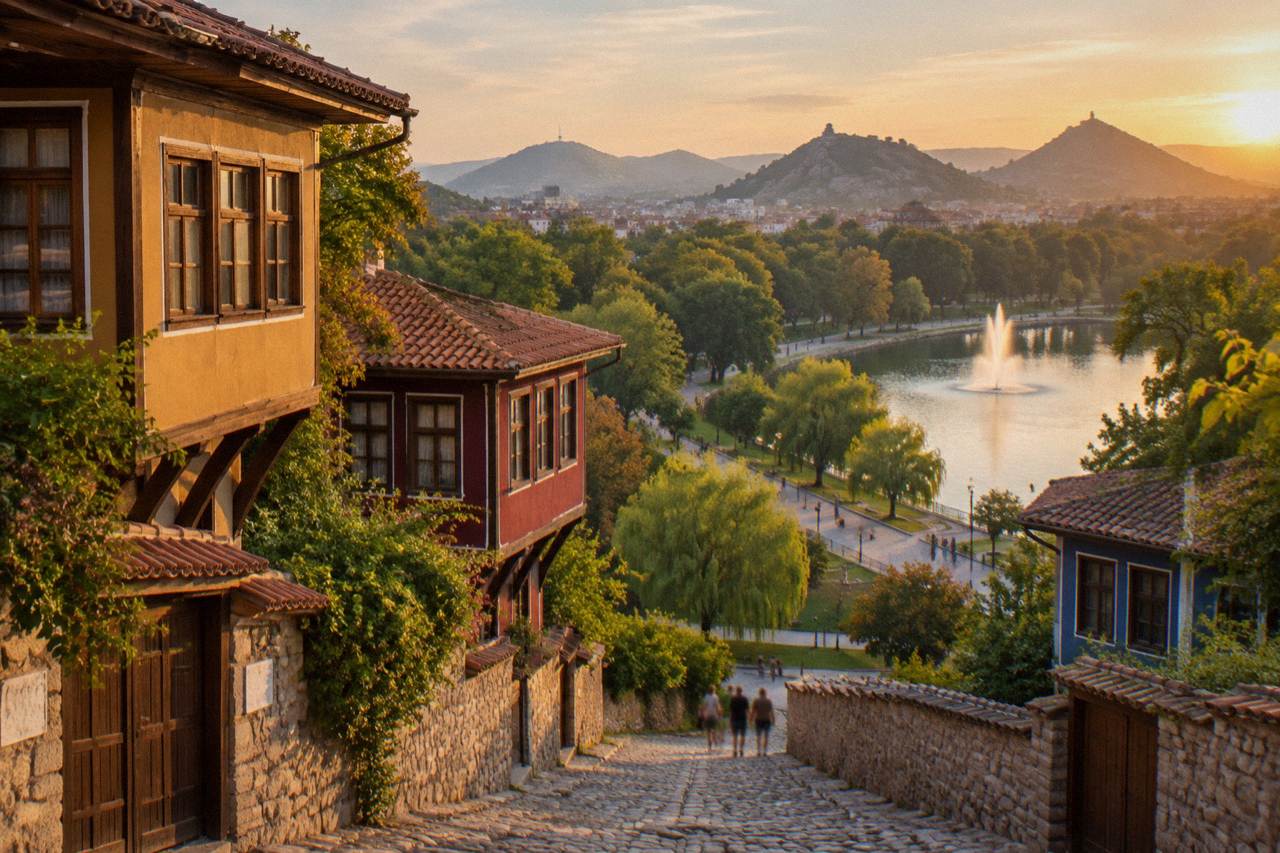
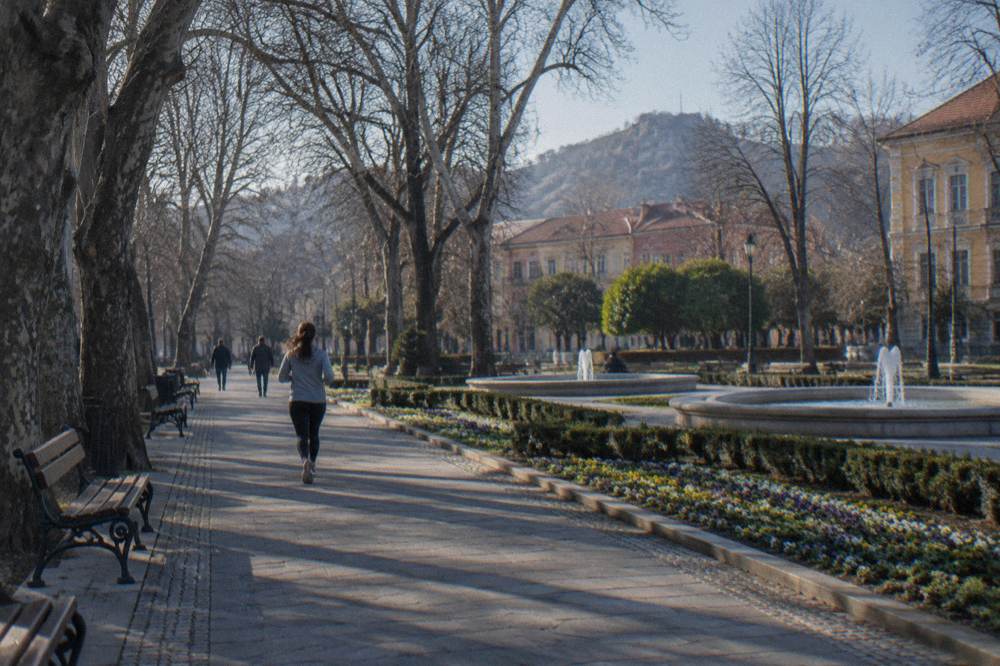
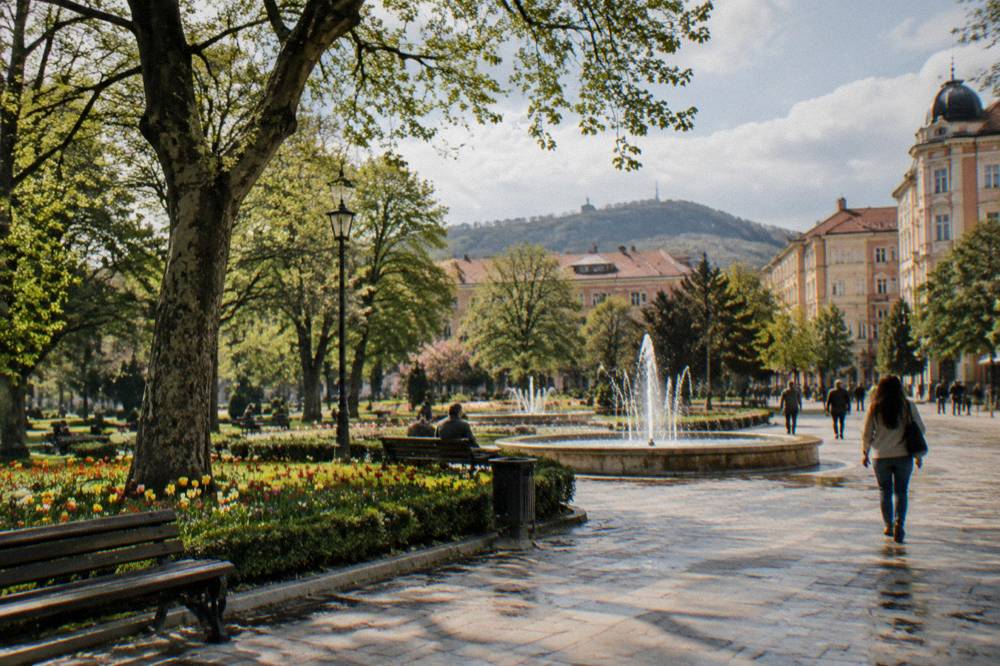
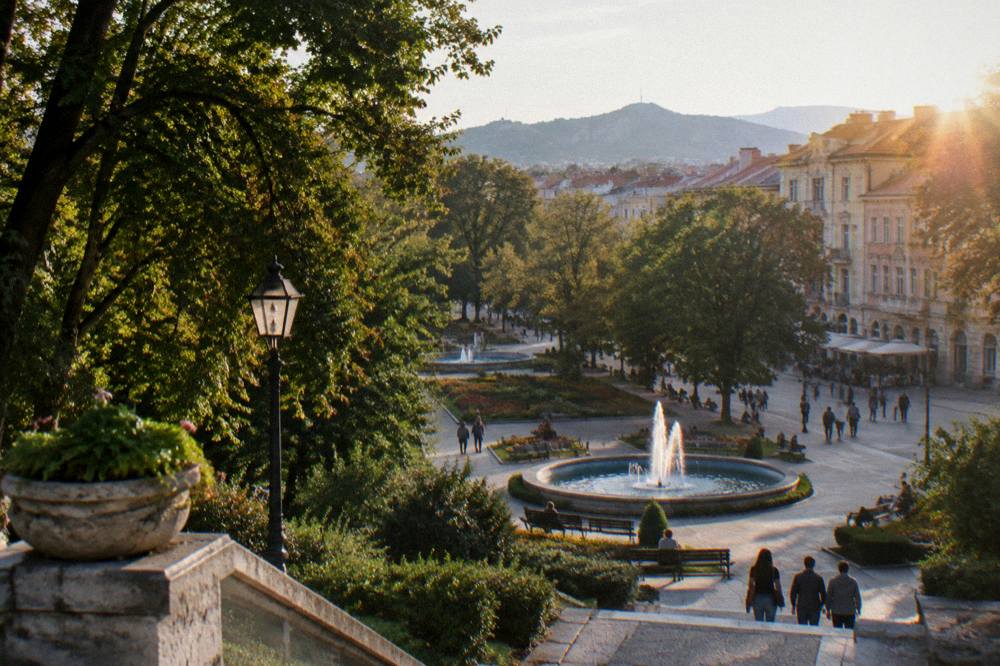
Tsar Simeon Garden is Plovdiv's central public park, the green hinge between the Main Street and the Central Square, best known for its singing fountains. This page lays out what the park is, what the municipal record says about the fountains, and how to plan a visit around it.
Short answer
Tsar Simeon Garden is a free public park in the center of Plovdiv, best known for its singing fountains on a lake at the edge of the Central Square. The park is open as a public space, the fountains run seasonally with a winter break, and the whole visit can be folded into a walk between the Roman Stadium, the Old Town and Kapana in a single afternoon.
Tsar Simeon Garden is the central public park of Plovdiv, the second-largest city of Bulgaria, an inland city built around six hills in the south of the country. The garden sits in the modern center, a short walk from the Main Street, the Roman Stadium and the Old Town, and its best-known feature is the lake with the singing fountains that gives the park its popular name. The garden is a public green space, free to enter at any hour, and the municipal record treats the fountains as a seasonal attraction with a maintenance calendar of its own.
The Plovdiv Travel Guide covers the rest of the city sight by sight, from the Ancient Theatre of Philippopolis to Kapana and the Old Town.
What Is Tsar Simeon Garden In Plovdiv?
Tsar Simeon Garden is Plovdiv's central public park, a free green space in the modern center of the city, laid out between the Main Street and the Central Square, and known locally for the lake with the singing fountains at its edge. The park is public ground with no ticket, no gate and no closing hour, and the municipal site groups it with the city's open, freely accessible spaces rather than with its ticketed museums.
The garden belongs to the layer of Plovdiv that the visitor crosses constantly without ever paying for it. The city's core is compact: the Main Street runs the length of the modern center, the Roman Stadium lies partly beneath it, and the Old Town climbs the three hills above. The garden is the green pause in that sequence, the place where the center opens out and the pace changes. Plovdiv is often described as one of the oldest continuously inhabited cities in Europe, with the first settlement on Nebet Tepe dated to the 4th millennium BC by the city's tourism site, but the garden belongs to the modern, planned city rather than to the ancient one.
The park's role in the city's public life is easiest to see in the municipal record. The city site reports that the garden and its lake are washed and cleaned weekly year-round, a maintenance routine it announced in 2026, and that the fountain lake has undergone major repairs in earlier municipal projects. The same record notes seasonal winterizing of the fountain installation in older posts, which matches what any visitor sees: the fountains are a fair-weather attraction, and the lake goes quiet in the cold months.
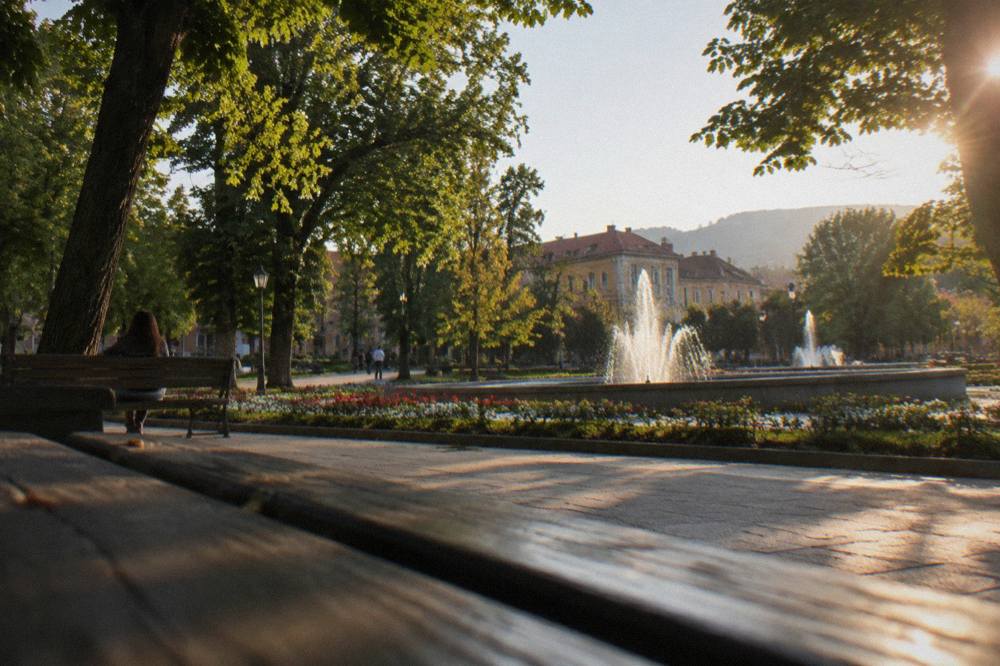
What the garden is not also matters. It is not a botanical garden with an entrance fee, and it is not part of the Old Plovdiv municipal institute, whose ticketed sites are the Ancient Theatre, the Small Basilica, the revival houses and the Bishop's Basilica. The garden costs nothing, sits open to the street, and works as a shortcut, a resting point and an evening destination all at once. For the structure of a full first visit, the one day in Plovdiv itinerary places it naturally at the end of a center-to-Old-Town loop.
What Are The Singing Fountains And When Do They Run?
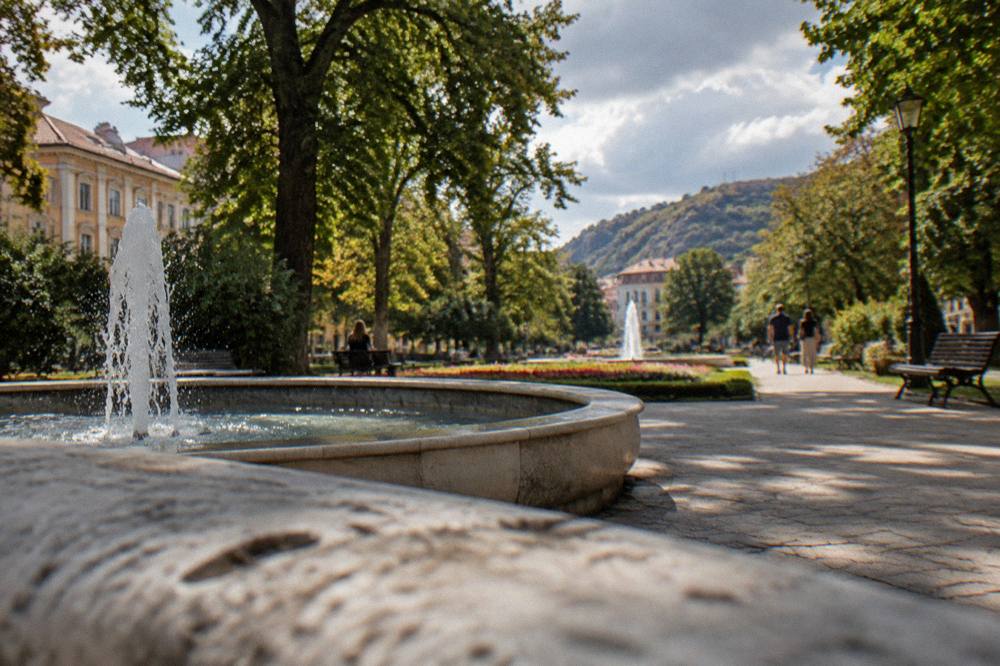
The singing fountains are a musical fountain installation on the lake in Tsar Simeon Garden, and they run seasonally: the municipal record notes a winterizing break in older posts and weekly cleaning year-round, with no fixed show schedule published in the municipal material. Visitors should treat the displays as a warm-season attraction and confirm show times locally, since the city publishes no standing timetable for them.
The name is literal. The fountains on the garden's lake are built as a display installation, and the lake itself is the visible part of a system the municipality has repaired and upgraded over the years. The city's own posts describe past major repair projects on the lake with the singing fountains, and a 2026 routine of weekly washing of the garden, which tells a visitor two things: the installation is actively maintained, and its operation is seasonal rather than year-round.
No published show schedule appears in the municipal material gathered for this page, so the honest advice is to confirm on the spot. The displays are a warm-season feature in practice, tied to the fountain season, and the winter months bring the winterizing the municipal posts describe. The climate explains the pattern: the ERA5 reanalysis for Plovdiv, 1991 to 2020, puts the mean daily high at 28.2 C in July and 28.6 C in August, against 5.9 C in January, so the fountain season and the comfortable walking season are the same season.
The garden also carries part of the city's event calendar. The Christmas in Plovdiv market used the Central Square and Tsar Simeon Garden for its 2025/26 edition, which ran 28 November 2025 to 4 January 2026, and the 2026/27 edition, billed as "Soul of Christmas", is set for 1 December 2026 to 7 January 2027 around Kapana and the Central Square areas. In the warm months the garden sits inside the footprint of the big open-air events: Kapana Fest ran its autumn 2026 edition over two weekends, 2 to 4 and 9 to 11 October, at the bridge over Gladstone Street and the Central Square, both a few minutes from the garden.
A walk with a guide is one way to see the garden in context, since the center's Roman layer sits within a few minutes of the lake. The audio-guided option below covers the Old Town and the Roman landmarks, and the garden is an easy final stop on the same route.
What Does It Cost To Visit The Garden In Plovdiv?
The garden itself costs nothing: it is a public park, free and open at all hours, with no ticket, no gate and no guided-tour requirement. Everything around it is priced separately, from the 3.58 euro single ticket at the Old Plovdiv sites to the 7.57 euro ticket at the Bishop's Basilica, and the paid sights are all optional add-ons around a free core.
This makes the garden one of the anchors of a cheap day in Plovdiv. The free layer of the center is thick: the Roman Stadium's sphendone is free to view, Nebet Tepe is a free open-air archaeological complex, Hisar Kapia is a public gate, Kapana is a free public district of narrow streets, and Bunardzhik hill with the Alyosha monument, unveiled in 1957, is open public ground. A full day can be built on these alone, and the free things to do in Plovdiv round them up in detail.
The paid layer, when it is wanted, is run by the Old Plovdiv municipal institute.
| Old Plovdiv ticket | Adult | Student | Family (parents with children 7 to 16) |
|---|---|---|---|
| Any one site, except the Bishop's Basilica | 3.58 EUR | 1.53 EUR | 7.16 EUR |
| Combined ticket, up to 5 sites (excludes the Small and Bishop's Basilicas) | 10.74 EUR | 4.09 EUR | 21.47 EUR |
| Bishop's Basilica of Philippopolis | 7.57 EUR | 3.58 EUR | 15.34 EUR |
| Roman Stadium 3D hall | 3.68 EUR | 1.23 EUR | listed on the ticket page |
Children under 7 and visitors with more than 50 percent disability enter the Old Plovdiv sites free, groups over 10 pay a reduced adult rate of 3.07 euro, and the first Thursday of the month is free for students and seniors at the Old Plovdiv sites, per the ticket page. The Regional History Museum is free the first Thursday of the month for everyone. The combined-ticket validity is not published, so confirm it at the counter rather than assuming.
For the practical costs of the rest of the day, crowd-reported data gives a planning range, and prices should be checked in the room rather than treated as fixed:
| Everyday item in Plovdiv | Typical range (crowd data, 2026) |
|---|---|
| Espresso or cappuccino | about 2.06 to 2.53 EUR |
| Domestic beer, 0.5 l draught | about 2.08 to 2.30 EUR |
| Mid-range meal for two, three courses | about 30 to 40 EUR |
| City bus single e-ticket | 0.50 EUR |
| Taxi start fare | about 1.11 to 1.13 EUR |
If a guided layer sounds better than a self-guided one, the audio-guided walk through the Old Town and the Roman landmarks is the natural companion to an afternoon that ends at the fountains: Check availability.
What Sits Near The Garden On A Plovdiv Walking Route?
The garden sits within a ten-minute walk of the Roman Stadium sphendone, the Central Square, the Dzhumaya Mosque, the Main Street and the foot of the Old Town, which makes it the natural midpoint of a walking loop rather than a separate destination. The paid sights nearest to it are the Ancient Theatre and the Bishop's Basilica, both uphill in the Old Town, and the free sights nearest to it are the stadium's sphendone and the Kapana district.
The center of Plovdiv is small enough that the garden works as a hinge. One direction leads down the Main Street, the pedestrian spine of the modern city, with the Roman Stadium's visible northern curve beside it: only the sphendone, the northern part, is accessible, unearthed in the 1970s, while the rest of the stadium lies beneath the street. The Roman Stadium page covers what can and cannot be seen.
A second direction leads uphill into the Old Town, past Hisar Kapia, the public gate that is open at all hours, toward the Ancient Theatre of Philippopolis, built in the 90s of the 1st century AD and described by the official page as 28 concentric rows of marble seats. The theatre is open daily, April to October 9:30 to 18:00 and November to March 9:00 to 17:30, with a lunch break at 12:30. A third direction leads into Kapana, whose name means "The Trap", a maze of narrow streets given over to workshops, bars and small stages, free and open to the street.
| Sight near the garden | Distance by foot | Cost |
|---|---|---|
| Roman Stadium sphendone | a few minutes on the Main Street | free to view |
| Dzhumaya Mosque | a few minutes, on the Main Street | free, modest dress, visits 6:00 to 23:00 |
| Hisar Kapia gate | about ten minutes uphill | free, open at all hours |
| Ancient Theatre of Philippopolis | about fifteen minutes uphill | 3.58 EUR single ticket |
| Bishop's Basilica | about fifteen minutes uphill | 7.57 EUR, priced separately |
| Kapana district | about ten minutes | free public streets |
The Dzhumaya Mosque deserves its own note. It is a working mosque, the second-largest in Bulgaria by built area at about 1,500 square meters, open to visits from 6:00 to 23:00 per the city's page, free, with modest dress expected and prayer times to be respected. No single construction year should be trusted: the city's own page says sources give years between the 14th and 16th centuries.
The hills complete the loop. Sahat Tepe, the clock hill, and the Danov Hill and Youth Hill pair sit across the center, all free public ground, and the sahat tepe and Danov Hill and Youth Hill pages walk them in detail. Bunardzhika, the Hill of the Liberators at 265 meters, carries the Alyosha monument and looks back over the whole route.
How Do The Seasons Change A Visit To The Garden?
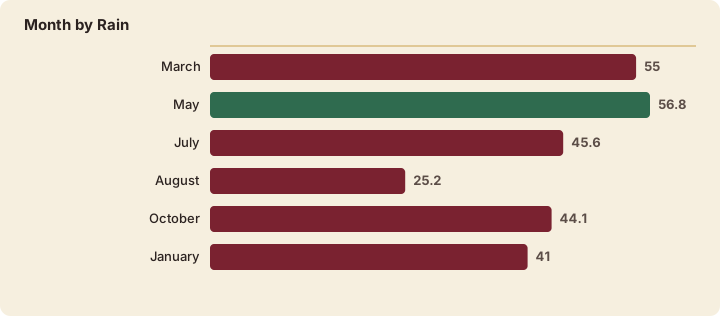
The garden changes character completely across the year: the fountains and the open-air life belong to the warm months, when the ERA5 reanalysis for Plovdiv, 1991 to 2020, puts the mean daily high at 21.9 C in May and 28.6 C in August, while winter brings the fountain winterizing, the Christmas market and mean highs of 5.9 C in January. Spring and autumn are the comfortable in-between, with March and May the rain months at 55.0 and 56.8 mm.
The seasonal logic of the garden follows the fountain season. In summer the park is an evening place: the displays run on the lake, the surrounding squares fill, and the Opera Open season puts the Ancient Theatre to work next door, 23 June to 9 September in 2026. The heat is real but not extreme, and the summer pages of this guide cover the whole warm-season program.
| Month | Mean daily high (ERA5 reanalysis, 1991-2020) | Mean daily low | Rain |
|---|---|---|---|
| March | 12.1 C | 2.1 C | 55.0 mm |
| May | 21.9 C | 11.5 C | 56.8 mm |
| July | 28.2 C | 17.9 C | 45.6 mm |
| August | 28.6 C | 18.1 C | 25.2 mm |
| October | 18.1 C | 8.8 C | 44.1 mm |
| January | 5.9 C | -2.6 C | 41.0 mm |
May carries the highest monthly rain total in the table at 56.8 mm and August the lowest at 25.2 mm, so late summer is the dependable fountain season and spring the greener but wetter one. Autumn belongs to Kapana Fest and the Old Town festival days: the "Revived Heritage" program ran 16 to 23 September 2026 with free events in the Old Town, and the Plovdiv Jazz Fest fall edition followed on 6 to 8 November 2026 at the Boris Hristov House of Culture.
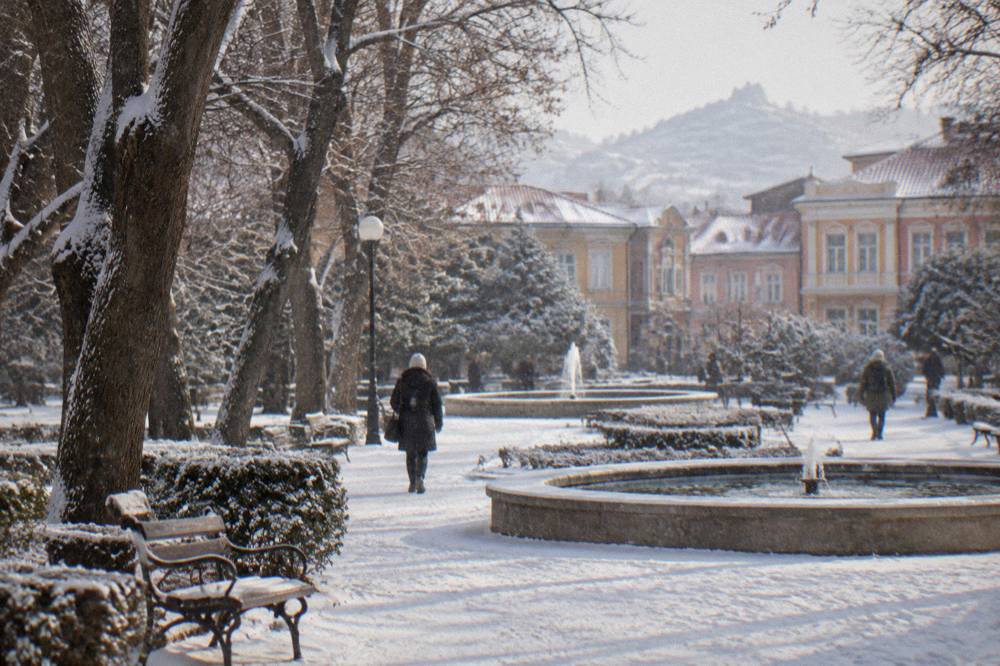
Winter turns the garden into the frame of the Christmas market. The 2025/26 edition ran 28 November 2025 to 4 January 2026 on the Central Square and in Tsar Simeon Garden, and the 2026/27 "Soul of Christmas" edition is set for 1 December 2026 to 7 January 2027 around Kapana and the Central Square areas. The fountains themselves are quiet in those months, but the park stays public ground, and the Plovdiv in winter coverage collects what the cold season holds.
How Do You Reach The Garden From Sofia Or Plovdiv Airport?
The garden sits in the pedestrian center of Plovdiv, reachable on foot from the railway and bus stations in about twenty minutes, or by a short taxi ride. Direct trains from Sofia take about 2 h 40 to 3 h 05, buses about 1 h 45 to 2 h 20, and Plovdiv Airport at Krumovo is about 12 to 14 km southeast of the center with a small, seasonal route list.
Arriving overland, the traveler lands at the central railway station and the Yug bus station, which stand side by side on Hristo Botev Boulevard. The center, the Main Street and the garden are a flat walk from there. The BDZ timetable shows direct fast trains from Sofia at several times a day, the fastest about 2 h 40, and trains routed via Karlovo take far longer, 4 h 50 to 5 h 50, so the direct services are the ones to book. The fare is not published as an official euro figure in the material gathered here, so check it on the BDZ timetable when booking.
| Route | Journey time | Notes |
|---|---|---|
| Sofia to Plovdiv, direct train | about 2 h 40 to 3 h 05 | several daily departures, fastest about 2 h 40 |
| Sofia to Plovdiv, train via Karlovo | 4 h 50 to 5 h 50 | avoid for a day trip |
| Sofia to Plovdiv, bus | about 1 h 45 to 2 h 20 | from Sofia Central Bus Station to Plovdiv Yug |
| Plovdiv Airport to center | about 12 to 14 km southeast | taxi about 13 to 20 EUR, bus about 20 to 35 minutes |
Plovdiv Airport's route list is small and seasonal: the airport's own flight search lists Belfast, Birmingham, Bratislava, London, Manchester, Milan and Tel Aviv, with Ryanair to Milan Malpensa and Wizz Air to Bratislava among the announced routes. Schedules change with the seasons, so the airline is the place to confirm. One local wrinkle matters for train travelers: the Plovdiv railway junction modernization, reported 85 percent complete in November 2025, is due to finish in 2026, and access around the central station can change while works run.
Inside the city the garden needs no transport at all, but the city bus e-ticket is 0.50 euro when a ride is wanted, and a taxi starts at about 1.11 euro per crowd-reported data. The getting around Plovdiv page covers the full local picture.
What Can Families Do Around The Garden In Plovdiv?
Families can treat the garden as the free core of a day that mixes fountains, park paths and the city's open-air sights, then add one or two ticketed stops at child-friendly prices: children under 7 enter the Old Plovdiv sites free, a family ticket for one site is 7.16 euro covering parents with children aged 7 to 16, and the stadium sphendone, Nebet Tepe and Kapana cost nothing at all.
The pricing structure is unusually kind to families. Under the Old Plovdiv list, the family ticket exists precisely for parents with children between 7 and 16, and the under-7s go free everywhere on the list. The Regional History Museum sells a family ticket at 6 euro for one site, and the Regional Archaeological Museum lists a family ticket at 7.67 euro. The free layer needs no tickets and no scheduling: the sphendone, the hills, the gates and the fountains themselves.
A workable family day starts at the garden, crosses to the Main Street and the stadium sphendone, climbs gently to Hisar Kapia and the Old Town lanes, and ends with the theatre if legs allow. The theatre's own hours run daily with a lunch break at 12:30, so an afternoon arrival fits. The Plovdiv with kids coverage expands this into a full plan.
Two museums within reach suit children on a rainy or hot hour. The Regional Archaeological Museum, closed Monday and open Tuesday to Sunday 10:00 to 18:00, renewed its permanent exhibition in November 2025 with about 150 new exhibits and a bilingual audio guide. The Regional Ethnographic Museum in the Kuyumdzhiev House, also closed Monday, shows the revival-era interior world of the city. Both are covered in the museums pages of this guide.
Food is the other family anchor. The food walk below is the guided version of a tasting route through the center, and the everyday costs are gentle: an espresso runs about 2 euro and a mid-range three-course meal for two about 30 to 40 euro, per crowd data. For the self-guided version, the what to eat in Plovdiv page starts with shopska salad, banitsa and kebapche.
When Is The Best Time Of Day To See The Fountains In Plovdiv?
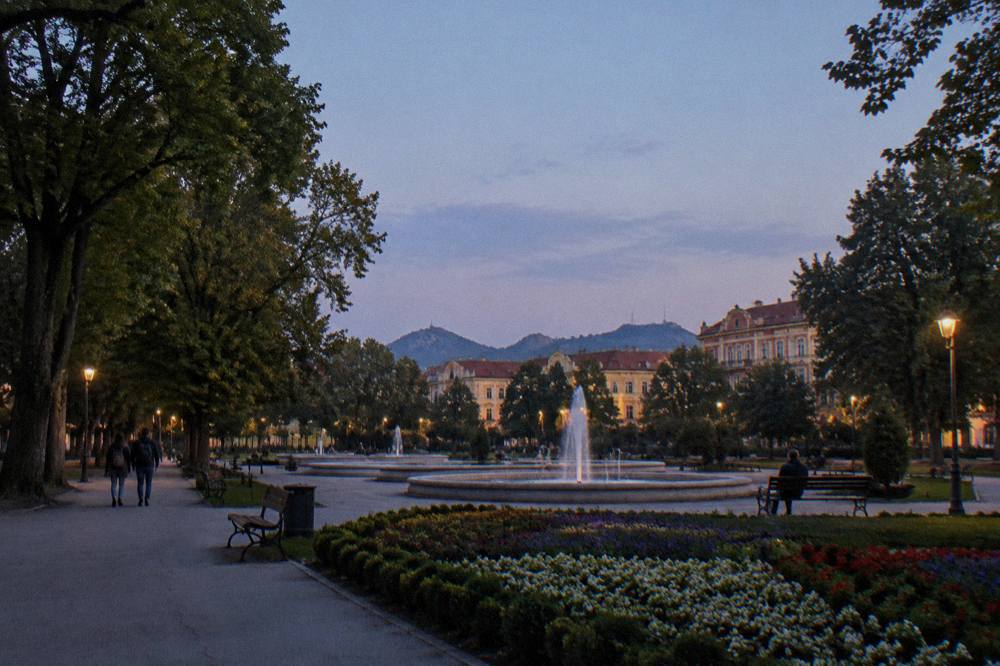
The fountains are an evening attraction in practice: the displays read best after dark in the warm season, and the municipal record gives no published show times, so the reliable plan is to spend the day on the surrounding sights and return to the garden in the evening, confirming display times locally on arrival. The garden itself is open as public space at all hours, so an evening visit costs nothing and needs no booking.
The rhythm of a Plovdiv evening supports this. The center empties of day-trippers in the late afternoon, the Main Street fills again after dinner, and the garden sits between the two. The ERA5 reanalysis for Plovdiv, 1991 to 2020, puts the mean daily low in July at 17.9 C, so summer evenings stay warm enough to sit outside, while January nights average -2.6 C, which explains the fountain winterizing on its own.
A guided stroll with a glass of local wine fits that rhythm. Book a sunset wine tasting tour here.
The practical plan writes itself. Morning at the Old Town and the Ancient Theatre before the heat, midday in Kapana or a museum, afternoon on the hills or at the Nebet Tepe complex, and the evening back at the garden. Nebet Tepe, free and open-air after its restoration project officially opened in March 2025, gives the sunset view over the city, and the walk down lands close to the garden.
And for a day beyond the city, the monastery route is the classic extension: Bachkovo Monastery, a working monastery with free entry, lies about 30 km away, with minibuses from the Rodopi station taking 35 to 45 minutes, and Asen's Fortress above Asenovgrad on the same road. The Bachkovo Monastery page covers the independent version.
Common Questions About The Tsar Simeon Garden In Plovdiv
Is Tsar Simeon Garden in Plovdiv free?
Yes. The garden is a public park with no ticket, no gate and no closing hour, and the singing fountains are viewed from public ground. The paid sights around it, such as the Ancient Theatre at 3.58 euro and the Bishop's Basilica at 7.57 euro, are separate and optional.
When do the singing fountains run in Plovdiv?
The fountains run seasonally, and the municipal record notes winterizing in older posts, so treat them as a warm-season attraction. No standing show schedule is published in the municipal material gathered here, so confirm display times locally on arrival.
How far is the garden from the Old Town of Plovdiv?
The garden sits in the modern center, about ten to fifteen minutes on foot from Hisar Kapia and the lower Old Town, and about fifteen minutes from the Ancient Theatre. The whole center-to-Old-Town loop is comfortably walkable.
Can you visit the garden in winter?
Yes, the park is public ground at all hours, and it frames the Christmas market: the 2025/26 edition ran 28 November 2025 to 4 January 2026 on the Central Square and in the garden. The fountain displays themselves are quiet in the cold months.
What else is there to do near the garden?
The Roman Stadium sphendone, the Dzhumaya Mosque, the Main Street, Kapana, Nebet Tepe and the Ancient Theatre all sit within a short walk, and the free sights outnumber the paid ones. The Regional Archaeological Museum and the Ethnographic Museum are also nearby, both closed on Monday.
Is the garden suitable for children?
Yes. It is free, open and central, children under 7 enter the Old Plovdiv sites free, and a family ticket for one site is 7.16 euro for parents with children aged 7 to 16, per the Old Plovdiv ticket page.
