Episcopal Basilica Of Philippopolis: The Floor Mosaics
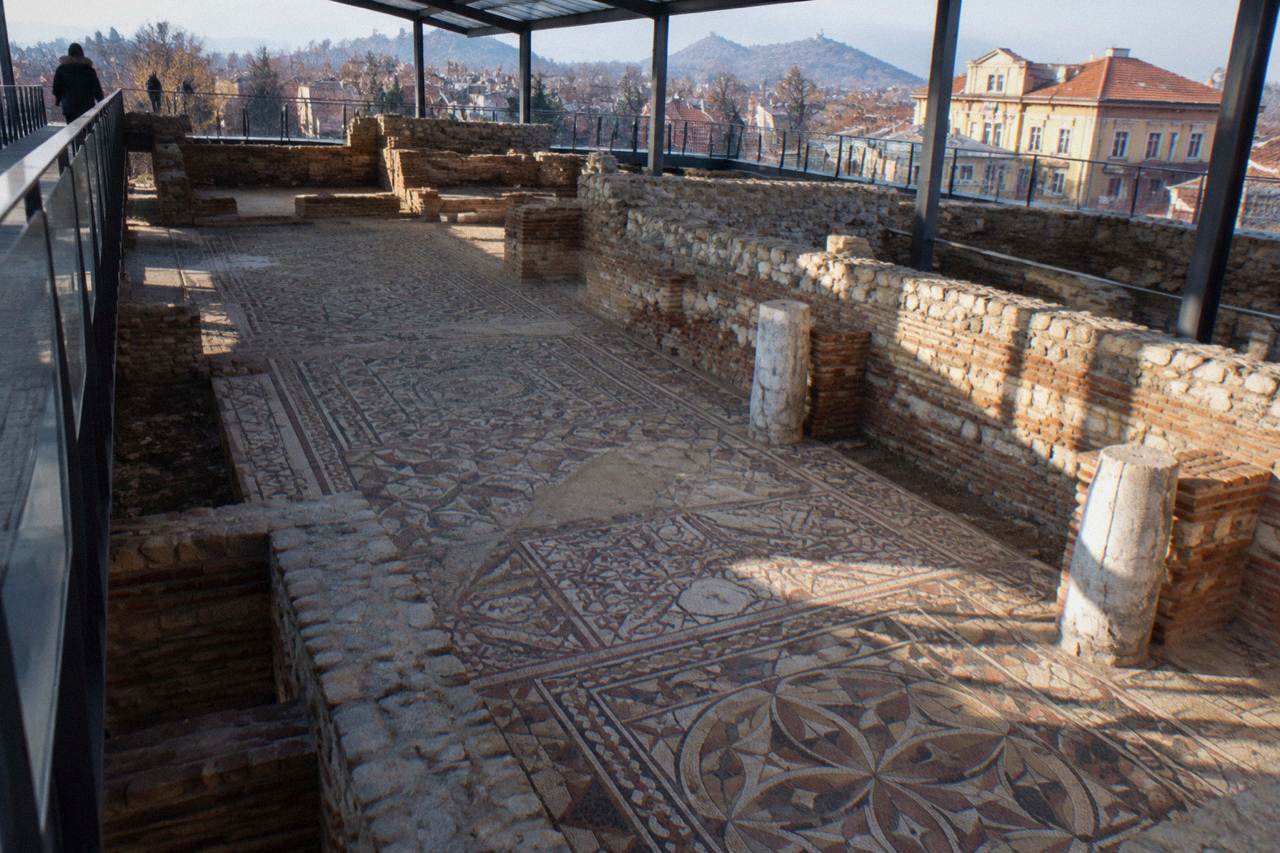
The Episcopal Basilica of Philippopolis in Plovdiv holds over 2,000 square metres of Roman floor mosaics across two layers, the largest concentration of its kind in Bulgaria, on a site in the city centre where a basilica has stood since late antiquity.
Short answer
The Episcopal (Bishop's) Basilica of Philippopolis in Plovdiv is open daily 9:00 to 18:00. An adult ticket costs 7.57 euro, with a student ticket at 3.58 euro, per the Old Plovdiv ticket page. The building measures about 83 m by 36 m and preserves two layers of floor mosaics covering over 2,000 sq m.
The Episcopal Basilica of Philippopolis in Plovdiv, southern Bulgaria, is the largest 4th to 6th century basilica in the country, about 83 m long and 36 m wide, and it preserves two layers of floor mosaics covering over 2,000 square metres. The Old Plovdiv ticket page prices an adult ticket at 7.57 euro, and the site opens every day from 9:00 to 18:00. This page lays out the ticket options, the hours, the mosaics themselves, and how the basilica fits into a day among Plovdiv's Roman remains.
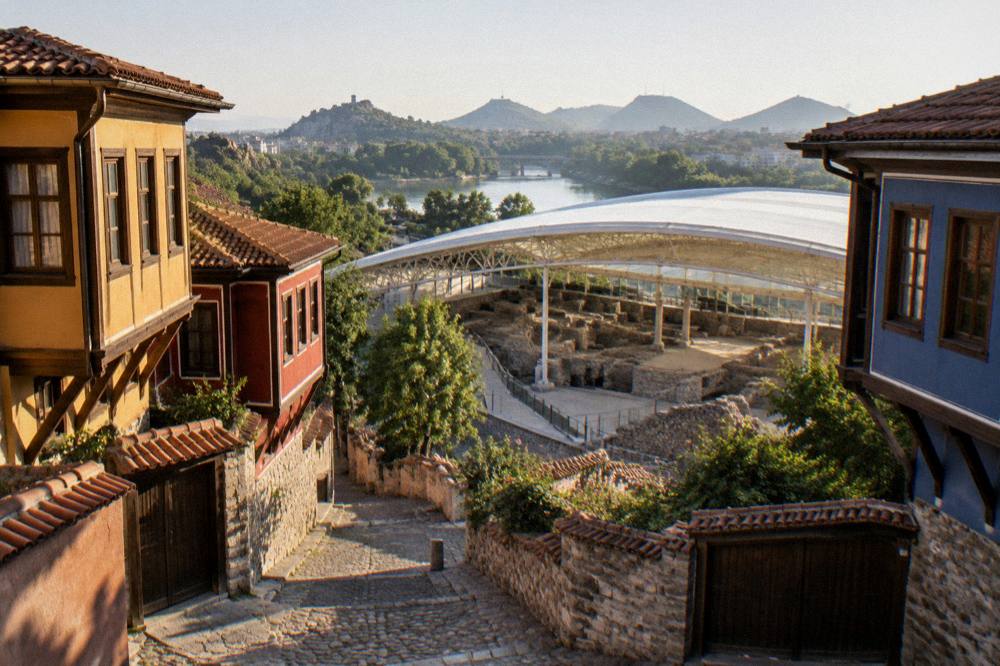
Plovdiv is an inland city built around six hills, and the basilica sits on the flat ground of the city centre, a few minutes on foot from the Main Street, the Roman Stadium and the entrance to the Old Town. It was European Capital of Culture in 2019, shared with Matera, and the basilica project, with its restored mosaics and raised visitor walkways, was one of the signature achievements of that period. The site is run by Old Plovdiv, the municipal institute that also operates the Ancient Theatre, the Small Basilica and the historic houses of the Old Town, so one ticketing system covers the lot.
What Is The Episcopal Basilica Of Philippopolis In Plovdiv?
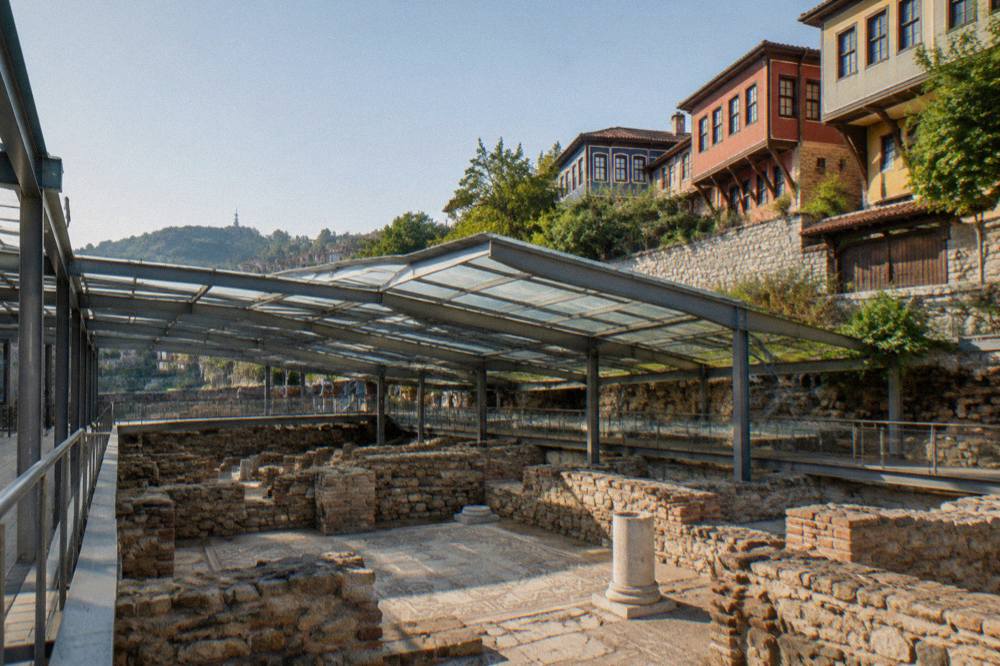
The Episcopal Basilica of Philippopolis, usually called the Bishop's Basilica, is a late antique cathedral complex in central Plovdiv, about 83 m long and 36 m wide, built in the 5th to 6th centuries on the site of an earlier church, and described by Old Plovdiv as the largest 4th to 6th century basilica in Bulgaria. Its floors carry two superimposed layers of mosaics covering over 2,000 sq m.
The basilica was a cathedral, the seat of a bishop, and its scale reflects the rank of Philippopolis in the late Roman world. The city had been a major urban centre since the 2nd century AD, when the Roman Stadium was built on the model of the stadium at Delphi, and by late antiquity it was an important Christian metropolis. The basilica stood at the heart of that, close to the forum and the commercial streets.
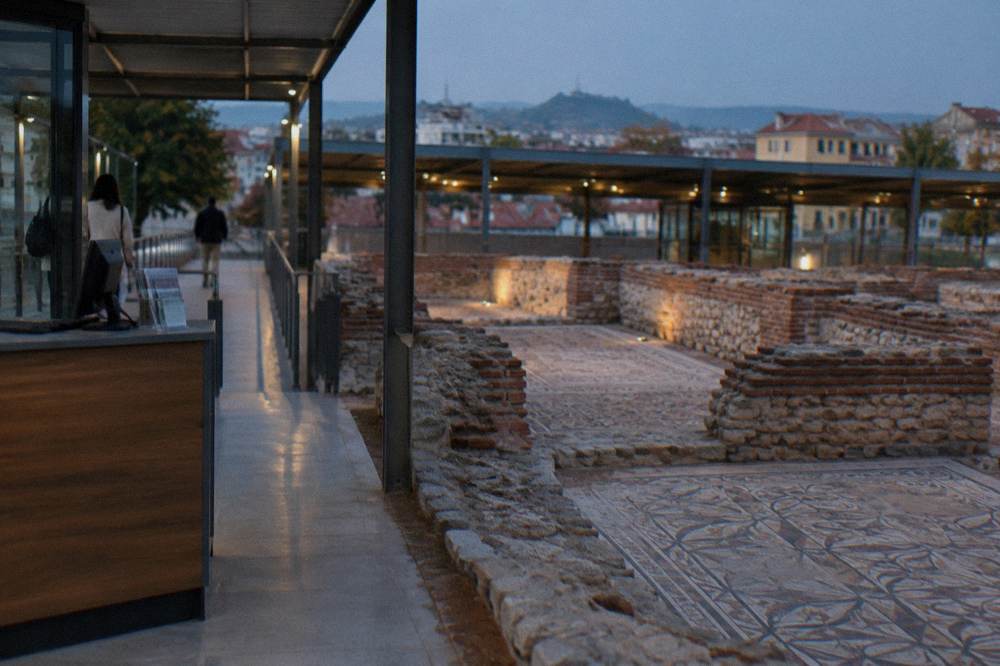
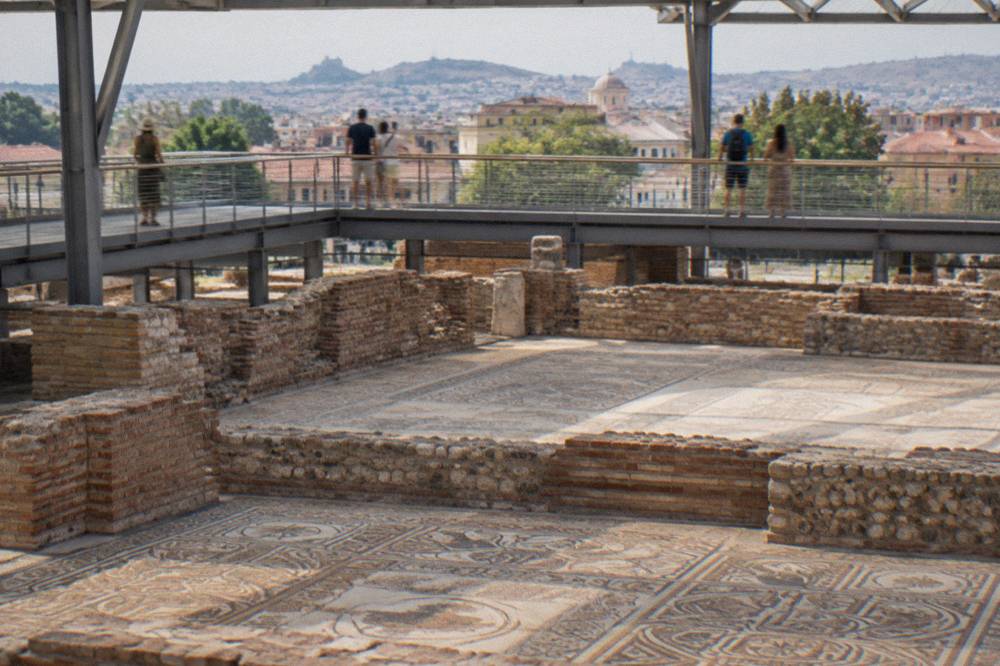
Excavation exposed the full plan: a broad atrium, a narthex, a nave flanked by aisles, and a bishop's residence attached to the complex. Walking the site today, on raised walkways that protect the floors, you read the building in plan view, which is the best way to take in mosaic carpets of this size. The mosaic layers themselves are described in detail further down this page.
The complex sits in the same quarter as the Small Basilica, a 5th to 6th century three-nave church with its own mosaic floors, and the Eirene building, whose mosaic gave the complex a second famous floor. Between them, this small corner of central Plovdiv holds one of the richest concentrations of early Christian floor decoration in the region. Visitors who want the wider Roman context can follow our guide to Roman Plovdiv, which strings the theatre, stadium, odeon, forum and basilicas into one route.
How Much Do Episcopal Basilica Tickets Cost In Plovdiv?
An adult ticket to the Bishop's Basilica costs 7.57 euro, a pupil or student ticket 3.58 euro, and a family ticket 15.34 euro, per the Old Plovdiv ticket page; children under 7 and visitors with more than 50% disability enter free, and groups over 10 pay 6.14 euro per adult. The basilica is priced separately from the one-site Old Plovdiv ticket.
The table below gathers the published prices.
| Ticket type | Price (euro) | Notes |
|---|---|---|
| Adult, Bishop's Basilica | 7.57 | Single site, per the Old Plovdiv ticket page |
| Pupil / student | 3.58 | Reduced rate |
| Family | 15.34 | Parents with children aged 7 to 16 |
| Group adult (over 10) | 6.14 | Group rate |
| Children under 7 | Free | Per the ticket page |
| Over 50% disability | Free | Per the ticket page |
The pricing structure matters for planning because the basilica is the most expensive single site on the Old Plovdiv list. A one-site ticket to any other Old Plovdiv site, the Ancient Theatre, the Small Basilica or houses such as Balabanov House, costs 3.58 euro for an adult, less than half the basilica's standalone price. The combined ticket for up to five Old Plovdiv sites costs 10.74 euro for an adult, but it excludes the Small Basilica and the Bishop's Basilica, so the basilica always carries its own separate charge.
One practical note: the first Thursday of the month is a free day for students and seniors at Old Plovdiv sites, and the Regional History Museum is free for everyone the first Thursday of the month. The municipal pages advise checking oldplovdiv.bg before a visit tied to a free day, since event closures can override them. The basilica also hosts temporary events, and on those days individual halls can close for a few hours; the ticket desk confirms on the spot.
If you would rather have someone else handle the route and the storytelling, guided options exist. The desk at the visitor centre runs its own guided tours, and several bookable walks cover the basilica as part of a wider Old Town circuit:
A guided walk is the only way to hear the excavation history narrated on site, and the listings above include a food-led option and a day trip for travellers using Plovdiv as a base for the Rhodopes.
What Can You See Inside The Episcopal Basilica And The Eirene Mosaic?
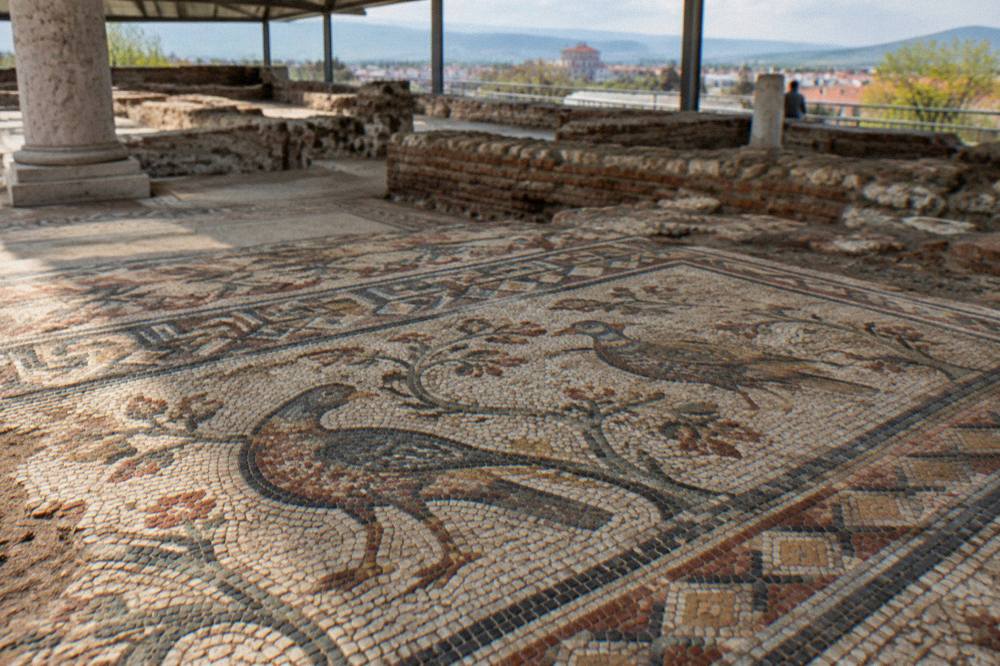
Inside the Bishop's Basilica you walk raised walkways over two superimposed mosaic floors covering more than 2,000 sq m, the lower layer with geometric and figural carpets from the 5th century and the upper layer from a later rebuilding, plus an atrium, a narthex, foundation walls and, nearby, the Eirene building mosaic with its donor inscription naming the woman Eirene.
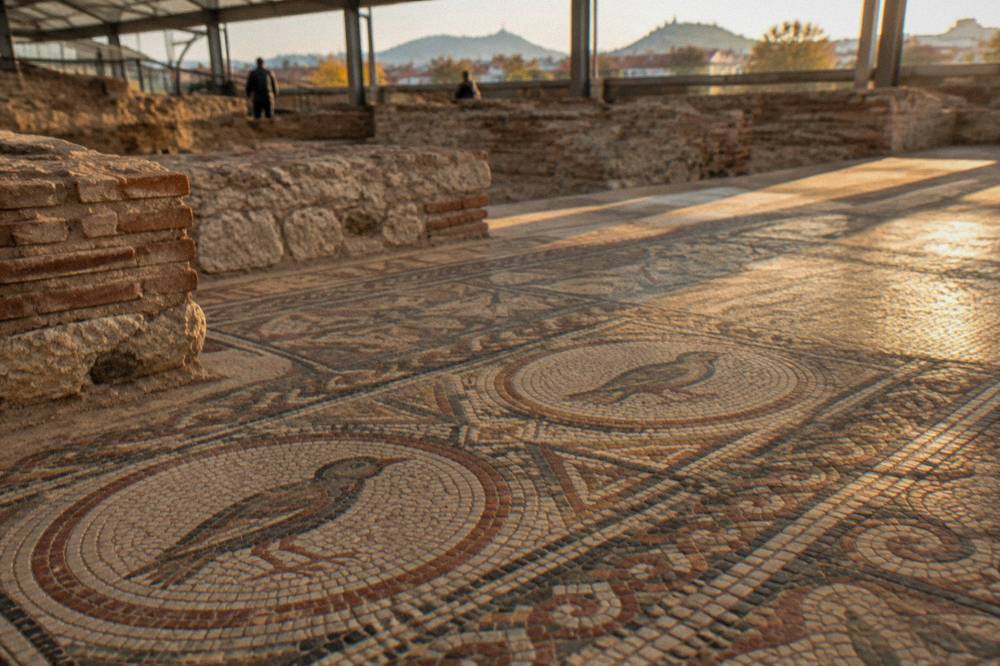
Two floors, one above the other, is the unusual part. When the early basilica was rebuilt, the builders laid a second mosaic floor directly over the first, and both survive. Conservation lifted sections of the upper floor so the earlier mosaics beneath can be seen through viewing panels, which is why the walkways matter: they let you read both layers without stepping on either.
| What you see | Where | Details |
|---|---|---|
| Upper mosaic layer | Nave, above the lower floors | Later rebuilding phase, partly lifted for viewing |
| Atrium and narthex | West end of the complex | Excavated and included in the visitor route |
| Bishop's residence | Attached to the basilica | Part of the late antique cathedral complex |
| Eirene building mosaic | Nearby building in the same complex | Floor mosaic with a donor inscription naming Eirene |
The figural decoration is the draw for mosaic fans: birds, animals, elaborate geometric frames and vignettes that once sat at the thresholds of the nave. The Eirene building, a separate structure in the same complex, carries a floor whose inscription names a female donor, Eirene, one of the few named individuals from late antique Philippopolis whose gift you can still stand above. The inscription is reproduced and explained on the interpretation panels along the walkway.
Interpretation inside is bilingual, and the route is linear, ending at the exit onto the street near the Small Basilica. Photography is allowed without flash. The raised walkways are the only permitted route, and they keep the floors untouched, which is the condition under which a working archaeological site like this stays open to the public year round.
For travellers who want the city's food culture and its archaeology in one afternoon, there is a tasting walk that pairs the centre's sights with local flavours, and the basilica quarter sits right on its route:
What Are The Basilica Opening Hours In Plovdiv?
The Bishop's Basilica is open daily from 9:00 to 18:00, year round, per the Old Plovdiv site page, and it is one of the few Plovdiv attractions with no closed day and no seasonal reduction. Other Old Plovdiv sites keep seasonal hours, which matters if you are combining visits in one day.
The basilica's daily schedule makes it the easiest major site to plan around. The Ancient Theatre, by contrast, runs 9:30 to 18:00 from April to October and 9:00 to 17:30 from November to March, with a lunch break from 12:30 to 13:00, and the Roman Stadium's paid halls follow the same seasonal pattern. The table below compares the published hours.
| Site | Hours | Closed | Lunch break |
|---|---|---|---|
| Bishop's Basilica | Daily 9:00 to 18:00 | None | Varies by season, check on site |
| Ancient Theatre | Apr to Oct 9:30 to 18:00; Nov to Mar 9:00 to 17:30 | None | 12:30 to 13:00 |
| Small Basilica | Follows Old Plovdiv seasonal hours | Event days only | 12:30 to 13:00 in season |
| Roman Stadium sphendone | Open-air viewing, free | None | Not applicable |
| Roman Stadium 3D hall | Apr to Oct 9:30 to 18:00; Nov to Mar 9:00 to 17:30 | None | 12:30 to 13:00 |
The practical reading of that table: start with whichever Old Plovdiv site has a lunch break, because the basilica's continuous daily hours absorb the middle of the day. A morning at the Ancient Theatre of Philippopolis, the lunch window at the basilica, and an afternoon walking the Old Town is a sequence the published hours support in every season.
To stay close to every site on this day's route, book a hotel here.
If you would like a guide to lead that exact kind of day, this Old Town walk with a rakia tasting finishes at a tasting table after the sights:
The booking page shows free cancellation, so the booking can be adjusted as plans firm up.
How Does The Episcopal Basilica Compare With Plovdiv's Other Roman Sites?
The Bishop's Basilica is Plovdiv's largest covered Roman site and its priciest single ticket at 7.57 euro, while the Ancient Theatre is the most complete ancient structure at 3.58 euro, the Roman Stadium's visible sphendone is free, and the Small Basilica costs 3.58 euro on the one-site ticket, so a full Roman Plovdiv day mixes free, mid-price and premium stops.
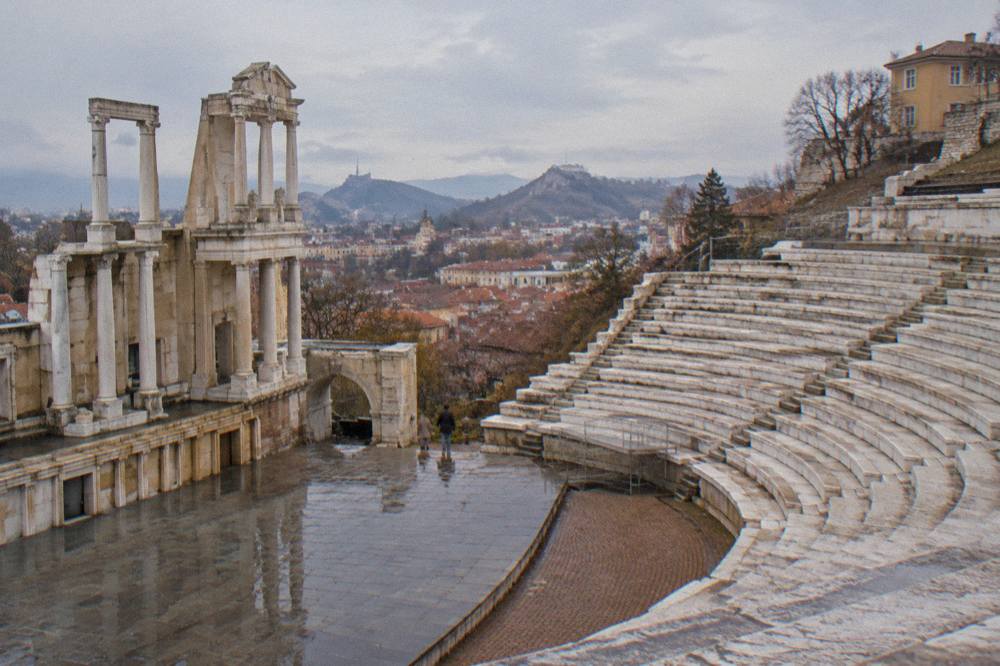
Each site answers a different question about the ancient city. The theatre, built in the 90s AD and described by the city tourism site as having 28 concentric rows of marble seats, shows Roman entertainment. The stadium, built in the 2nd century AD on the model of the stadium at Delphi and holding up to 30,000 spectators, survives mostly under the Main Street, with only the northern sphendone excavated. The basilicas show the late antique Christian city, and the odeon and forum fill in civic life.
| Site | Built | What survives | Adult ticket (euro) |
|---|---|---|---|
| Bishop's Basilica | 5th to 6th century | Full plan, two mosaic layers, over 2,000 sq m | 7.57 |
| Ancient Theatre | 90s AD | 28 concentric rows of marble seats, stage structures | 3.58 |
| Roman Stadium | 2nd century AD | Northern sphendone; the rest lies under the Main Street | Sphendone free; 3D hall 3.68 |
| Small Basilica | 5th to 6th century | Three-nave church with mosaic floors | 3.58 |
| Nebet Tepe | Settlement layers from antiquity | Open-air hilltop complex, fortification walls | Free |
A sensible ordering starts on the flat centre, the stadium and the basilicas, then climbs into the Old Town for the theatre and finishes on Nebet Tepe for the hilltop view, where the first settlement on the hill is dated to the 4th millennium BC by the city's tourism site. The whole circuit is walkable, and our self-guided walk of Plovdiv covers it step by step with timings.
One thing the basilica has that the others do not: shelter. The mosaics sit under a modern protective structure, which makes it the natural rainy-day anchor of any Plovdiv itinerary. The open-air theatre and Nebet Tepe offer no cover, so in changeable weather the basilica and the Roman Stadium halls carry the day.
How Old Is The Episcopal Basilica?
The Bishop's Basilica is a 5th to 6th century building, and it is described as the largest 4th to 6th century basilica in Bulgaria, about 83 m long and 36 m wide, with two layers of floor mosaics covering over 2,000 sq m; the city's tourism and municipal pages carry all of these figures, and no single foundation year is published.
The two-layer floor is the key to reading the site's chronology. An earlier church stood here, its mosaics laid in the first half of the building's life; the rebuilt basilica then received a second mosaic floor over the first. Conservation work exposed both, and the visible relationship between the two levels is what makes the interior more than a static display: you can see the earlier and later floors in the same field of view.
Plovdiv's late antique importance is the context. The city, often described as one of the oldest continuously inhabited cities in Europe, was a metropolitan see by this period, and a cathedral of this scale, with a bishop's residence attached, reflects that rank. The mosaic workshops that produced these floors worked in the traditions of the eastern Mediterranean, and the geometric frames and figural panels compare with floors known from across the late Roman Balkans.
For visitors building an itinerary around the deep past, there is a full-day option that takes in the monastery country south of the city as well, which pairs well with a basilica-centred stay:
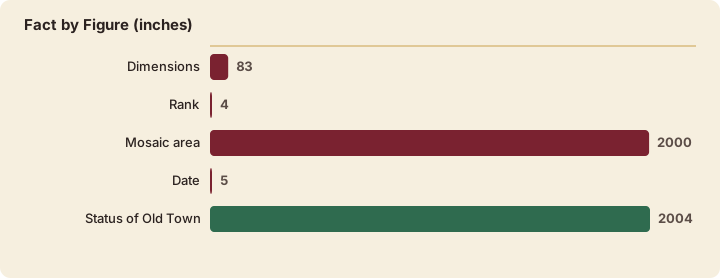
| Fact | Figure | Where it is published |
|---|---|---|
| Dimensions | About 83 m long, 36 m wide | oldplovdiv.bg site page |
| Rank | Largest 4th to 6th century basilica in Bulgaria | oldplovdiv.bg |
| Mosaic area | Two layers, over 2,000 sq m | oldplovdiv.bg |
| Date | 5th to 6th century | Municipal and tourism pages |
| Status of Old Town | Tentative List ("The Ancient Plovdiv", submitted 2004), not inscribed | UNESCO Tentative List |
That last row is worth stating plainly: Plovdiv Old Town is not a UNESCO World Heritage Site. "The Ancient Plovdiv" sits on Bulgaria's Tentative List, a waiting list for possible nomination, and has since 2004. The basilica is a star of that tentative bid, which is one reason the restoration was funded to museum standard.
Is The Episcopal Basilica Worth It For Families And Short Visits?
For families, the basilica works well because children under 7 enter free, the family ticket is 15.34 euro, the walkway route is short and stroller-friendly in dry weather, and the raised views over the mosaics hold a child's attention in a way few indoor sites in Plovdiv match; for a short visit, an hour is enough to walk the route and read the panels.
The site rewards a slow lap rather than a long stay. An hour covers the walkway, the viewing panels over the lower mosaics, the atrium and the Eirene building material, with time to read the main interpretation panels. Add another half hour if you plan to visit the Small Basilica afterwards, which is a short walk away on the same ticketing system at 3.58 euro on the one-site ticket.
| Visitor type | Suggested plan | Ticket cost (euro) |
|---|---|---|
| Family with young children | Basilica walkway plus free sphendone viewing | Family 15.34, under 7s free |
| Solo short visit | Basilica plus Small Basilica | 7.57 plus 3.58 |
| Roman Plovdiv day | Theatre, basilica, stadium sphendone, Nebet Tepe | 3.58 plus 7.57, sphendone free |
| Rainy day | Basilica, stadium 3D hall, Ethnographic Museum | 7.57 plus 3.68 plus about 3.07 |
Note that the Ethnographic Museum price of about 3.07 euro is a reported figure carried by the Bulgarian national news agency's coverage, and the museum closes on Mondays, so the rainy-day row applies Tuesday to Sunday. The Regional Archaeological Museum, a few streets away, renewed its permanent exhibition in November 2025 with about 150 new exhibits and a bilingual audio guide, and it also closes on Mondays; its ticket price is not published on the site's own page, so confirm at the desk.
For a one-day or two-day plan that slots the basilica into a full route, the desk's longer itineraries and the root things to do in Plovdiv page carry the sequencing. And for travellers who prefer a guide's voice over panels, the Old Town walk with a rakia tasting remains the natural pairing:
Common Questions About The Episcopal Basilica In Plovdiv
How much is the Episcopal Basilica in Plovdiv?
An adult ticket costs 7.57 euro, a pupil or student ticket 3.58 euro, and a family ticket 15.34 euro, per the Old Plovdiv ticket page. Children under 7 and visitors with more than 50% disability enter free, and groups over 10 pay 6.14 euro per adult.
What are the Episcopal Basilica opening hours?
The Bishop's Basilica is open daily from 9:00 to 18:00, year round, per the Old Plovdiv site page. It has no closed day, which makes it easier to plan around than the museums, several of which close on Mondays.
Is the Bishop's Basilica the same as the Small Basilica?
No. The Bishop's (Episcopal) Basilica is about 83 m by 36 m, the largest 4th to 6th century basilica in Bulgaria, with two mosaic layers over 2,000 sq m, and it is priced separately at 7.57 euro. The Small Basilica is a 5th to 6th century three-nave church with mosaic floors, covered by the standard one-site Old Plovdiv ticket at 3.58 euro.
Can you see the Eirene mosaic?
Yes, the Eirene building mosaic, with its donor inscription naming Eirene, is part of the same basilica complex and is included in the visitor route, with interpretation panels explaining the inscription along the raised walkway.
Is Plovdiv Old Town a UNESCO World Heritage Site?
No. "The Ancient Plovdiv" has been on Bulgaria's UNESCO Tentative List since 2004, which is a waiting list for possible nomination, not an inscription. The basilica's restoration is one of the showcase projects behind that tentative bid.
How long does a visit to the basilica take?
About an hour covers the raised walkway, the viewing panels over the lower mosaic layer, the atrium and the interpretation panels. Allow more time if you are combining the visit with the Small Basilica or the Roman Stadium halls on the same day.
