What Is The Prettiest City In Bulgaria?
Plovdiv, Bulgaria's second-largest city, makes the strongest case for the prettiest city in Bulgaria: six hills, a Roman theatre, Kapana and a restored Old Town. Here is the evidence.
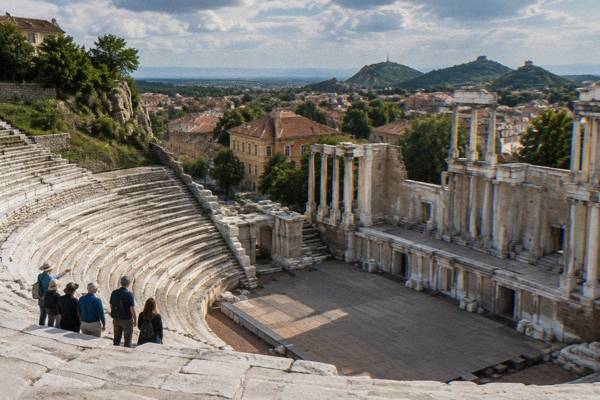
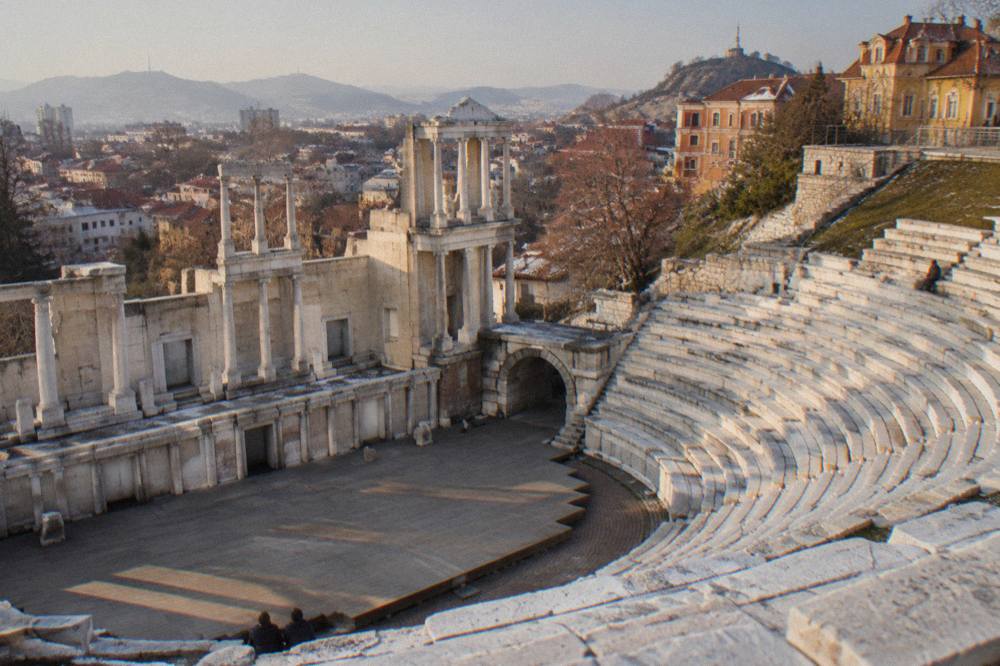
Prettiness is not a ranking any ministry publishes, so the honest answer has to be argued from what stands on the ground. Plovdiv, an inland city in southern Bulgaria built around six hills, makes the strongest case in the country: an Ancient Theatre of Philippopolis with 28 concentric rows of marble seats, a free open-air archaeological complex on Nebet Tepe, a maze-like creative quarter called Kapana, and a National Revival Old Town of pastel houses that Bulgaria has put forward, under the name "The Ancient Plovdiv", for possible UNESCO inscription. The city was European Capital of Culture in 2019, shared with Matera. No other Bulgarian city combines Roman architecture, hilltop views and a walkable historic core at this scale in one place.
What Is The Prettiest City In Bulgaria?
Plovdiv is the prettiest city in Bulgaria by the evidence this site can point to: a 1st-century Roman theatre with 28 concentric rows of marble seats, the free Nebet Tepe hilltop complex, the Kapana creative district, and a National Revival Old Town on Bulgaria's UNESCO Tentative List since 2004, all within walking distance in a city of six hills. The claim is a judgement, and other cities have partisans, but Plovdiv is the only Bulgarian city where Roman, medieval, Revival and modern layers sit this close together and this openly on display.
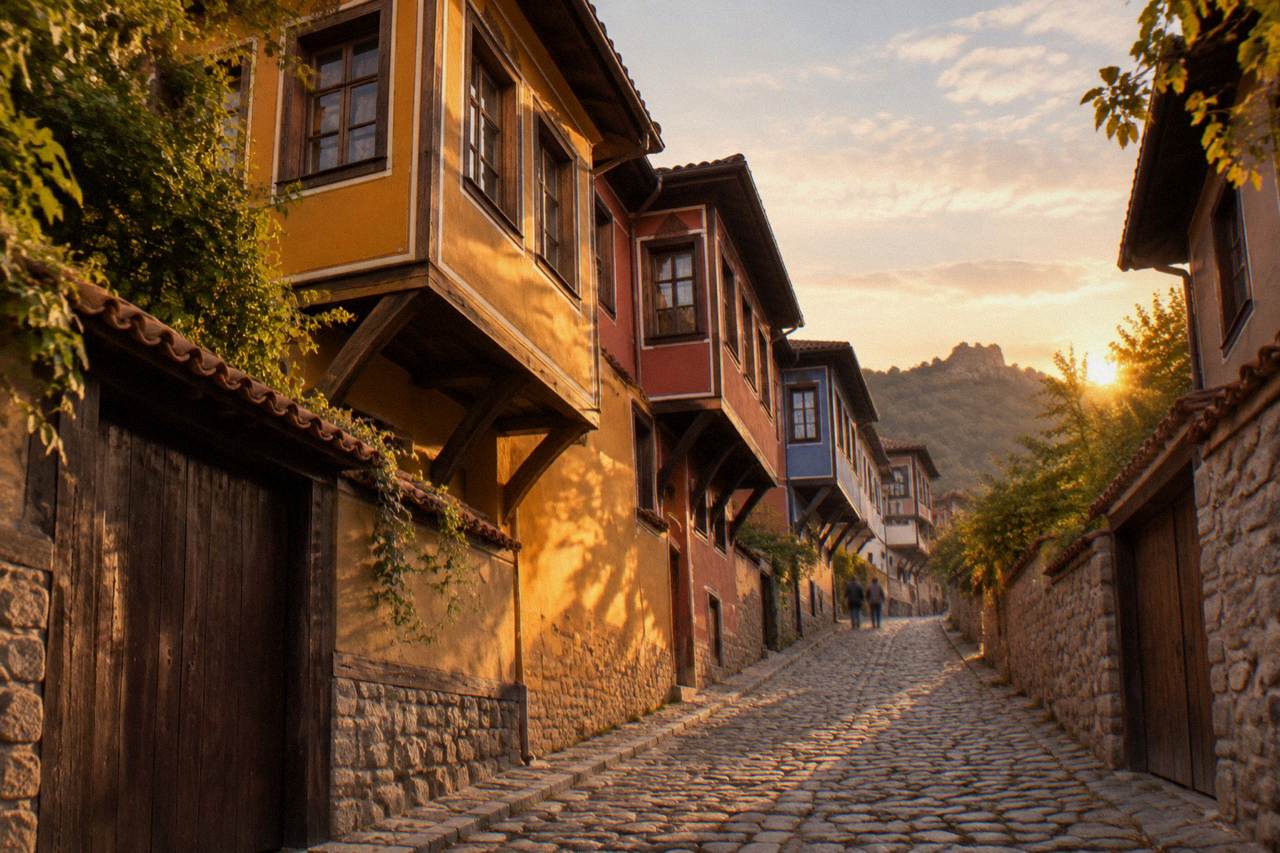
Beauty contests between cities collapse quickly into taste, so the useful question becomes: what can actually be shown? In Plovdiv's case, quite a lot. The city's tourism site describes the first settlement on Nebet Tepe as dating to the 4th millennium BC, which is why Plovdiv is often described as one of the oldest continuously inhabited cities in Europe. The Roman layer survives in the Ancient Theatre, the Roman Stadium's northern sphendone (the rest still lies under the Main Street), the Odeon and the Forum. On top of those sit the Dzhumaya Mosque, Hisar Kapia and the brightly painted merchant houses of the Old Town, museums in their own right, several open on the Old Plovdiv ticket.
For more on the city's claim to fame, see What Plovdiv Is Famous For, and for the counter-argument that keeps coming up, Is Plovdiv A Nicer City Than Sofia?.
Why Plovdiv Makes The Strongest Case
Plovdiv's case rests on density: the Ancient Theatre, the Roman Stadium sphendone, Nebet Tepe, Hisar Kapia, the Dzhumaya Mosque and the Revival houses of the Old Town all stand inside a compact historic centre that can be crossed on foot, and several of the headline sights are free to see, including Nebet Tepe, the sphendone and the public streets of Kapana. That combination of access and depth is unusual, and it is what turns a pretty day into a convincing argument.
The Ancient Theatre, built in the 90s of the 1st century AD, is the single most photographed structure in the city, and it still functions as a stage: the Opera Open festival ran there from 23 June to 9 September in 2026. Nebet Tepe, the hill where the settlement began, reopened in March 2025 after an EU-funded restoration and is free to enter with no set opening hours. Kapana, whose name means "The Trap", is a tangle of narrow streets given over to studios, galleries and small eateries, free and open like any public street.
The Old Town's houses are not wallpaper; they are ticketed museums. The Old Plovdiv price list sells entry to any one site (excluding the Bishop's Basilica) at 3.58 euro for an adult, and a combined ticket covering up to five sites at 10.74 euro. The Bishop's Basilica of Philippopolis, about 83 m long with floor mosaics covering over 2,000 sq m, is priced separately at 7.57 euro.
| Sight | Layer | What You See | Entry (euro) |
|---|---|---|---|
| Ancient Theatre of Philippopolis | Roman, 1st century AD | 28 rows of marble seats, working stage | 3.58 |
| Roman Stadium sphendone | Roman, 2nd century AD | Northern curve, 13 rows of seats | Free |
| Nebet Tepe | Thracian onward | Hilltop ruins, city views | Free |
| Bishop's Basilica | 4th to 6th century | Over 2,000 sq m of floor mosaics | 7.57 |
| Kapana | Ottoman onward | Maze of studios, galleries, streets | Free |
| Hisar Kapia | Medieval gateway | Stone gate in the Old Town walls | Free |
A guided walk is the efficient way to take this in, and the site's featured tour, a classic city walk of Plovdiv, covers the core with a local guide. Check availability
Where The Prettiness Is Concentrated In Plovdiv
The Old Town, the Three Hills (Nebet, Dzhambaz and Taksim Tepe), the Kapana district and the stretch of Main Street between the Roman Stadium and Central Square hold nearly everything a visitor photographs in Plovdiv, and all four connect in a single walk of roughly a couple of kilometres with no transport needed. The Old Town carries the Revival houses; the Three Hills carry the ruins and the views; Kapana carries the street life; Main Street carries the Roman remains buried beneath it.
The Old Town is the postcard. Balabanov House, Hindliyan House, Nedkovich House and Lamartine House line cobbled lanes above the city, and each is a museum on the one-site ticket. Below them, Hisar Kapia frames the view toward the Dzhumaya Mosque, and the Roman Stadium's sphendone opens out at the foot of Main Street. From Nebet Tepe the whole sequence is visible at once: red roofs, the plain of the Maritsa river, and the Rhodopes on the horizon. The municipal tourism site also points walkers to Sahat Tepe and the hills across the river, but the core circuit is Old Town, Three Hills, Kapana.
Planning the circuit is covered in detail on the itinerary pages of Plovdiv Travel Guide, and the question of how long to allow is answered in How Many Days In Plovdiv Bulgaria?
How Plovdiv Compares With Sofia, Veliko Tarnovo And Varna
No Bulgarian city has been officially crowned prettiest, and this site can only argue Plovdiv's side from what stands there: six hills, a functioning Roman theatre, a free hilltop archaeological complex and a Tentative-List Old Town. Sofia, Veliko Tarnovo and Varna each have partisans, but the comparison here is limited to what the Plovdiv record supports, plus the practical link that the BDZ timetable shows direct trains from Sofia taking about 2 h 40 to 3 h 05.
The fair way to frame it is by what a city asks of you. Plovdiv asks for almost nothing: the historic core is compact, the headline sights cluster within a walk, and the setting, a city folded around six hills above a river plain, gives views that flat cities cannot manufacture. Veliko Tarnovo is praised for its river gorge setting and Varna for the sea coast Plovdiv does not have, an honest difference rather than a defect. Sofia's case is metropolitan scale, and the two cities are close enough that the train between them is a normal day-trip distance, so a visitor does not have to choose one and abandon the other.
To wake up in the middle of it all, book a hotel in Plovdiv here.
Climate matters to how a city photographs, and the ERA5 reanalysis, 1991-2020 for the Plovdiv grid cell shows why the city wears well across seasons: a mean daily high of 28.6 C in August against 5.9 C in January, with monthly rainfall nowhere extreme (May at 56.8 mm, August at 25.2 mm). That is a continental profile with warm, mostly dry summers and cold winters that deliver the occasional snowfall on the Old Town roofs.
| Month | Mean Daily High (C) | Mean Daily Low (C) | Rain (mm) |
|---|---|---|---|
| January | 5.9 | -2.6 | 41.0 |
| April | 17.1 | 6.4 | 47.7 |
| July | 28.2 | 17.9 | 45.6 |
| August | 28.6 | 18.1 | 25.2 |
| October | 18.1 | 8.8 | 44.1 |
The figures above are modelled normals for the Plovdiv grid cell, ERA5 reanalysis, 1991-2020, not a station record, and they describe the climate that shapes the city's look rather than any single year.
When Plovdiv Is At Its Prettiest
Late spring (May and June) and early autumn (September and October) are when Plovdiv's streets, hills and Roman stones are at their most forgiving, with ERA5 reanalysis, 1991-2020 showing mean daily highs of 21.9 C in May, 23.8 C in September and 18.1 C in October, comfortable temperatures for the climb to Nebet Tepe and the long daylight walks the city rewards.
Summer belongs to the Ancient Theatre: Opera Open ran there from 23 June to 9 September in 2026, turning the monument into a working stage under the open sky. Autumn adds Kapana Fest, whose 2026 autumn edition ran across the first two weekends of October, and the Old Town festival days that ran 16 to 23 September in 2026. Winter has its own argument: the Christmas edition that ran from 28 November 2025 to 4 January 2026, with the 2026/27 season set for 1 December 2026 to 7 January 2027 across Kapana and Central Square. Each of these is an annual event, so confirm the latest dates before planning around one.
What To Build A Plovdiv Visit Around
A first visit built around the prettiest stretches of Plovdiv needs two full days: one for the Old Town, the Three Hills and the Roman remains in the centre, and one for a day trip into the countryside, most commonly Bachkovo Monastery and Asen's Fortress in the Rhodopes, which lie about 30 km from the city. Trying to compress it into a single rushed day undersells the point of the argument, which is that Plovdiv rewards slow looking.
Day-trip options widen the picture. A private Kazanlak and Rose Valley trip reaches the Thracian tombs and rose country, a private wine day in the Thracian Valley reaches cellars producing local reds such as Mavrud, and both return to the city the same evening. Inside the city, the food walks and the evening walks through Kapana cover the parts of the city that look best after dark. Whatever the choice, the practical pages on where Plovdiv sits on the map and on whether Plovdiv is worth visiting answer the questions that usually come next.
Common Questions About The Prettiest City In Bulgaria
What Is The Prettiest City In Bulgaria?
Plovdiv, on the evidence this site can point to: a Roman theatre with 28 rows of marble seats, the free Nebet Tepe complex, the Kapana district and a Tentative-List Old Town, all in a walkable city of six hills. Sofia, Veliko Tarnovo and Varna each have their advocates, but no official ranking exists.
Is Plovdiv Or Sofia Prettier?
This site can only argue Plovdiv's side, from its compact historic core and Roman remains. Sofia is the capital and larger by far, and the two are linked by direct trains of about 2 h 40 to 3 h 05, so both can be seen on one trip.
Is Plovdiv Old Town A UNESCO World Heritage Site?
No. "The Ancient Plovdiv" sits on Bulgaria's UNESCO Tentative List, submitted on 14 September 2004, which is a waiting list and not an inscription.
How Many Hills Does Plovdiv Have?
Six. There were seven until Markovo Tepe was partly quarried away in the 20th century, as the city's own relief page records.
When Is Plovdiv At Its Prettiest?
Late spring and early autumn, per the ERA5 reanalysis, 1991-2020 normals: mean daily highs of 21.9 C in May and 23.8 C in September. Summer adds opera in the Ancient Theatre, and winter adds the Christmas market in Kapana and Central Square.