Regional Ethnographic Museum In Kuyumdzhioglu House
The Regional Ethnographic Museum in Plovdiv occupies Kuyumdzhiev House, one of the large revival-era merchant houses on the Old Town hill, and its collections cover Bulgarian folk costume, textiles, crafts and town life. This guide sets out the reported opening hours, ticket options and what to expect inside.
Short answer
The Regional Ethnographic Museum in Plovdiv is housed in Kuyumdzhiev House in the Old Town. It is closed on Mondays and opens Tuesday to Sunday, 9:00 to 17:00 in winter and 9:00 to 18:00 in summer. The reported adult ticket is about 3 euro, and students and pensioners pay about 1 euro; confirm prices at the desk.
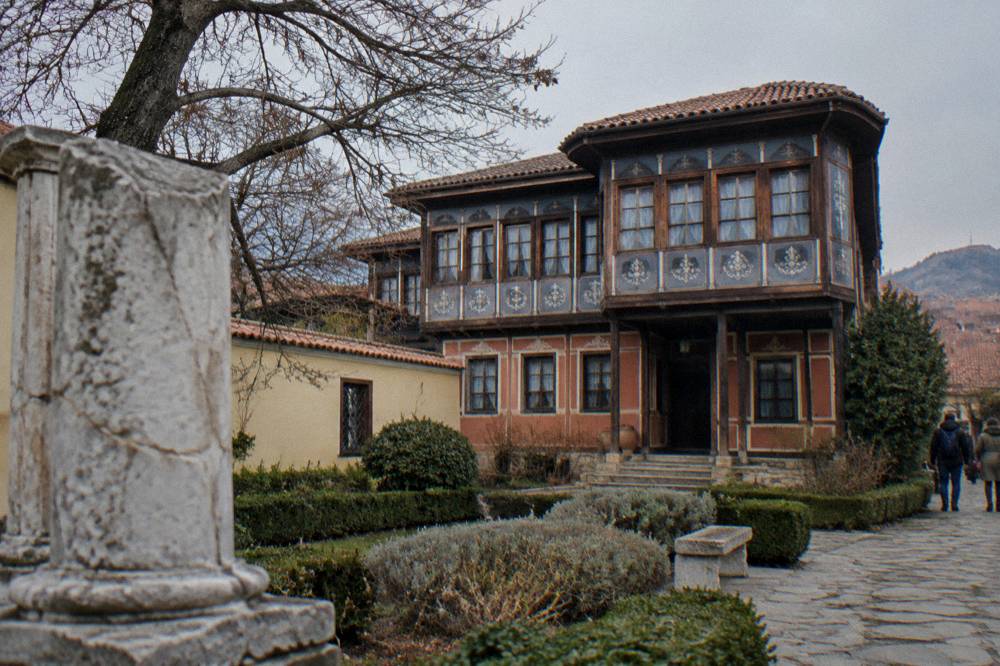
The Regional Ethnographic Museum in Plovdiv sits inside Kuyumdzhiev House, a large National Revival merchant residence on the Old Town hill, at 2 Dr Stoyan Chomakov Street. Plovdiv is Bulgaria's second-largest city, an inland city in southern Bulgaria built around six hills, and its Old Town is a dense cluster of revival-era houses, Roman ruins and cobbled lanes on the Three Hills. The museum holds the regional collection of folk culture: costumes, woven textiles, copperware, tools and room interiors that document how people in this part of the Thracian plain and the Rhodopes lived and worked in the centuries before industrialisation. It is one of the four or five museums a first-time visitor to the city typically weighs up, and unlike the Roman sites it is about the Bulgarian revival and rural life rather than antiquity. The municipal ticket list does not cover it, so its hours and prices need reading separately, which is what this guide does.
What Is The Regional Ethnographic Museum In Plovdiv?
The Regional Ethnographic Museum in Plovdiv is the regional folk-culture museum of the Plovdiv region, installed in Kuyumdzhiev House, a National Revival merchant house in the Old Town. Its collection covers traditional dress, woven textiles, metalwork, craft tools and furnished interiors. It is closed on Mondays and opens Tuesday to Sunday, with seasonal hours that shift between winter and summer. The museum answers a different question from the city's Roman monuments. Where the Ancient Theatre of Philippopolis shows the city as a Roman provincial capital, the Ethnographic Museum shows the countryside and the towns of the Bulgarian National Revival, the period when a merchant class grew wealthy enough in Plovdiv to build the very houses the Old Town is now famous for.
The building itself is half the reason to come. Kuyumdzhiev House belongs to the family of large symmetrical merchant houses that line the Old Town lanes, with painted reception rooms upstairs and a heavy stone-and-timber base below. The house museum format means the displays sit inside the architecture they describe: a loom or a bridal costume in a room that once held a merchant family's best furniture. That is a common pattern in Plovdiv. The Balabanov House, the Hindliyan House and the Lamartine House all work the same way, and several are on the Old Plovdiv ticket list, while the Ethnographic Museum is administered separately.
For planning purposes the museum functions as one node in an Old Town walk rather than a destination on its own. The lane system puts it within the same compact hill as Hisar Kapia, the Nebet Tepe archaeological complex and the Roman Stadium sphendone down on the flat. A realistic visit runs thirty minutes to an hour inside, longer if the costume and textile rooms catch your interest, and the surrounding lanes fill the rest of a morning. Plovdiv Travel Guide covers the whole hill in its Old Town itinerary pages, and this article stays on the museum itself: hours, tickets, the collections, and how it compares with the other museums in the city.
Where Is Kuyumdzhiev House In Plovdiv And How Do You Reach It?
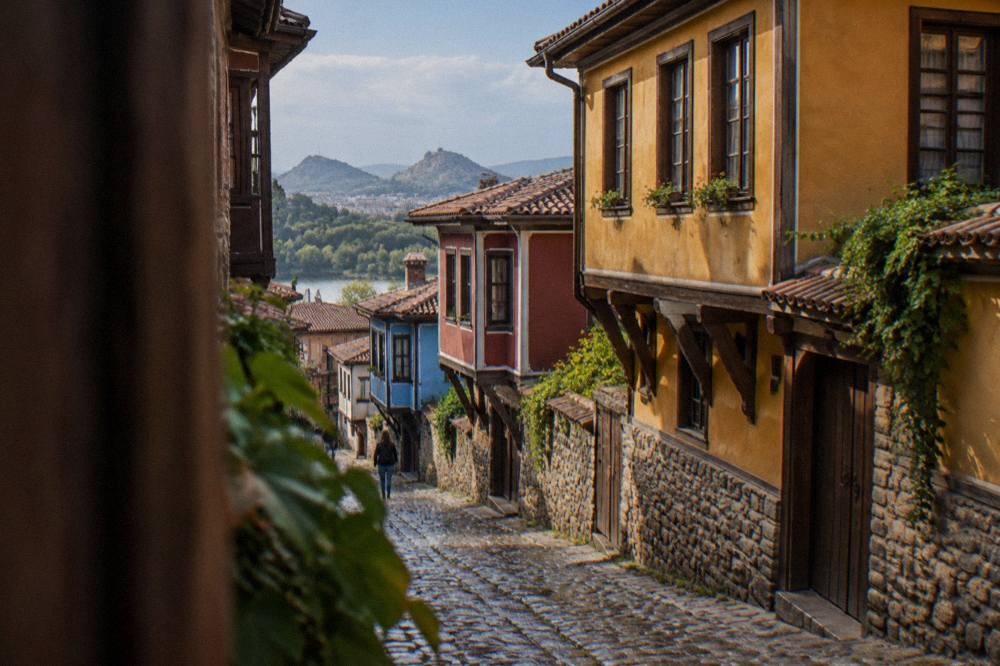
Kuyumdzhiev House stands at 2 Dr Stoyan Chomakov Street in Plovdiv's Old Town, on the Three Hills slope just above the modern center. From the Main Street and the Dzhumaya Mosque area the walk uphill to the museum is short, a few minutes of climbing lanes. The museum has no parking of its own, and buses serve the flat city center rather than the hill. The address matters because the Old Town is a hill quarter with steep cobbled streets, and the museum sits partway up, close to the other large house museums. Anyone arriving on foot from the center should head for Dzhumaya Mosque or the Roman Stadium sphendone as a landmark, then climb the lanes toward Hisar Kapia; the house museums cluster immediately above and around that gate.
Public transport reaches the edge of the hill rather than the hill itself. City buses in Plovdiv use an e-ticket costing 0.50 euro, and routes serve the flat streets around the center; the climb from any stop is on foot. Taxi fares are not published as an official tariff, so agree or check the meter. Visitors coming from Sofia by train arrive at the central railway station on Hristo Botev Boulevard, whose modernisation works were reported 85 percent complete in late 2025 and due to finish in 2026, which can mean access changes at the station itself. From the station the Old Town is a straightforward walk or a short taxi ride across the center.
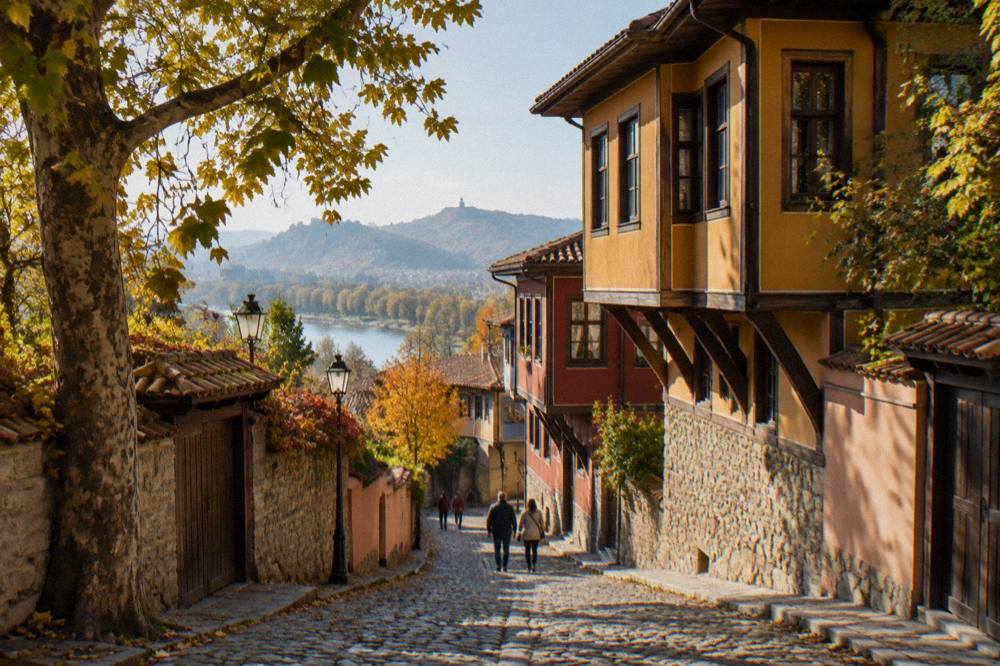
The walking logic of the hill rewards a plan. Coming up from Hisar Kapia you pass the house museums first; continuing uphill brings you to Nebet Tepe, free and open in daylight, with views over the plain. Coming down the other side drops you toward Kapana, the creative district whose name means "The Trap", a free maze of narrow streets with cafes and craft shops. The museum slots naturally into either direction, and the whole loop is walkable without transport once you are in the center. Comfortable shoes matter more than any timetable: the lanes are cobbled and the gradient is real.
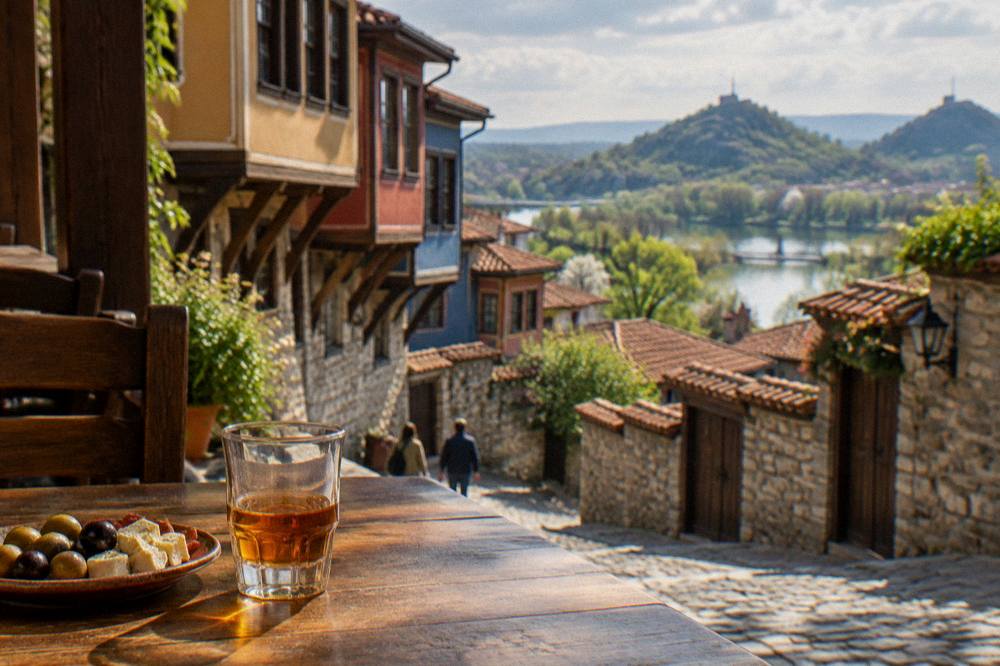
For readers weighing a guided option, a walking tour of the Old Town pairs directly with a museum visit, since guides cover the hill's houses and gates and leave you free to enter the museums at your own pace. One Old Town walking tour on this site adds a rakia tasting to the route, which is a fitting end to a morning of folk culture.
What Are The Opening Hours And Ticket Prices?
The Regional Ethnographic Museum in Plovdiv is closed on Mondays and open Tuesday to Sunday, 9:00 to 17:00 in winter (November to March) and 9:00 to 18:00 in summer (April to October), according to the museum's own visit page. The reported adult ticket is about 3 euro, with students and pensioners at about 1 euro; those prices are reported rather than published on an official tariff, so confirm at the desk. The hours are confirmed and stable; the prices come from secondary reporting and should be treated as a planning figure.
| Period | Days | Hours | Notes |
|---|---|---|---|
| April to October | Tuesday to Sunday | 9:00 to 18:00 | Closed Monday |
| November to March | Tuesday to Sunday | 9:00 to 17:00 | Closed Monday |
| First Thursday of the month | Thursday | Free entry for students and pensioners | Reported scheme, confirm locally |
Two practical consequences follow from the Monday closure. First, the museum cannot anchor a Monday itinerary, and the same applies to the Regional Archaeological Museum, which is also closed Monday, so anyone planning a Monday in Plovdiv should weight the day toward the Roman sites, the Tsar Simeon Garden and singing fountains or a day trip. Second, the museum sits outside the Old Plovdiv ticket system, so a combined ticket bought at the Ancient Theatre does not cover it. That division is worth understanding before you buy anything.
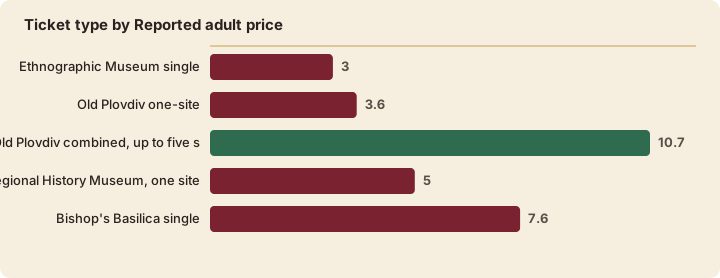
| Ticket type | What it covers | Reported adult price |
|---|---|---|
| Ethnographic Museum single | The museum only | About 3 euro, confirm at the desk |
| Old Plovdiv one-site | One site such as the Ancient Theatre or an Old Town house, except the Bishop's Basilica | 3.58 euro |
| Old Plovdiv combined, up to five sites | Five Old Plovdiv sites, excluding the Small and Bishop's Basilicas | 10.74 euro |
| Regional History Museum, one site | One of the history museum's sites | 5.00 euro |
| Bishop's Basilica single | The basilica and its mosaics only | 7.57 euro |
The pattern is simple: the Ethnographic Museum is one of the cheaper museum stops in the city, reported at around 3 euro, while the Old Plovdiv houses and the basilicas run on their own tariff. If your interest is folk costume and interiors, the Ethnographic Museum alone covers it. If your interest is the revival houses as architecture, the Old Plovdiv one-site or combined ticket is the better instrument, and the combined ticket's validity period is not stated in the official page text, so check at the point of sale. A short Old Town walk with a rakia tasting is bookable if you want the hill explained rather than just entered.
What Will You See Inside The Ethnographic Museum In Plovdiv?
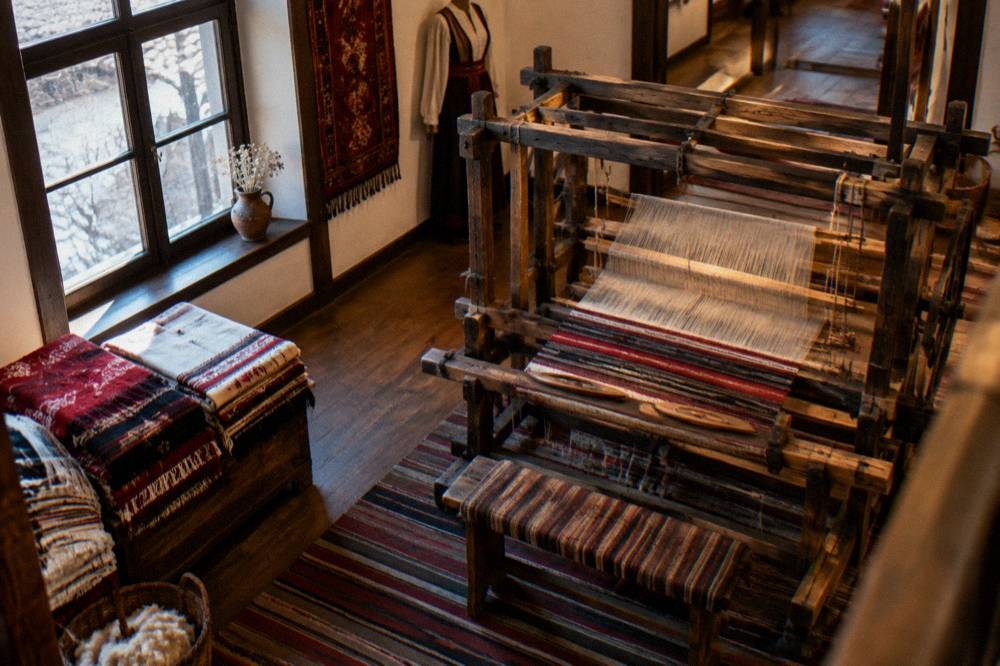
Inside the Regional Ethnographic Museum in Plovdiv the displays cover Bulgarian folk costume from the region, hand-loomed textiles and rugs, copper and metalwork, craft tools and reconstructed room interiors of the revival period. The house's own painted reception rooms form part of the exhibit, so the architecture and the collection are experienced together. The strength of a regional ethnographic collection is specificity: the costumes are not generic "Bulgarian dress" but pieces tied to villages and districts around Plovdiv, into the Rhodopes and across the Thracian plain. Embroidery patterns, belt weaves and the cut of a sleeve carried local identity, and the museum presents them as evidence of that system rather than as decoration.
Curious to try some of that folk dress yourself? Book a traditional costume photo experience here.
The textile rooms are usually what holds attention longest. Weaving was domestic industry across the region, and looms, combs, shuttles and the finished rugs and covers sit together, which makes the technical chain legible: wool, dye, loom, cloth. Costumes follow, arranged by type and district, with the heavy bridal and festival pieces that took months of work. The metalwork and craft displays document the town trades, coppersmiths, coopers and saddlers, that supplied both the city and the villages before factory goods replaced them. The copper trays and coffee sets connect directly to the coffee culture that still runs through Plovdiv's cafes and to the town's Ottoman-era commercial life.
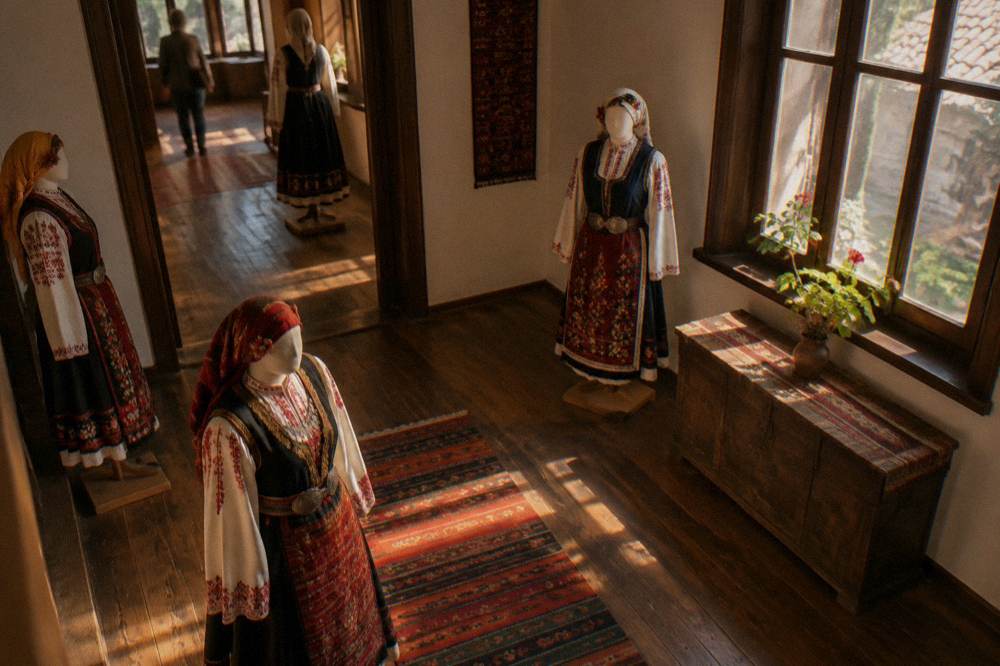
The interiors upstairs do double duty. A revival merchant house like this one was built around a formal reception floor, and the museum's furnished rooms show how that space was used: low divans along the walls, woven covers, a table set for coffee. Reading the house as an exhibit is exactly the same exercise you can repeat, with different tickets, at the Balabanov, Hindliyan and Nedkovich houses a few lanes away. The difference is focus. The Old Plovdiv houses present themselves as houses; the Ethnographic Museum presents the material culture of the whole region, with the house as its container.
Photography rules and guided-tour availability inside the museum are not published in the site's data, so ask at the desk. Allow half an hour if you skim and an hour if you read cases; the building is compact and the route is a loop through the floors. Visitors with limited mobility should expect stairs and cobbles, as in most of the Old Town, and plan accordingly.
How Does The Ethnographic Museum Compare With Plovdiv's Other Museums?
The Ethnographic Museum is Plovdiv's folk-culture museum, while the Regional Archaeological Museum covers antiquity from prehistory through the Roman period, the Regional History Museum runs several sites including the modern-history halls, and the Old Plovdiv houses are ticketed historic buildings rather than collection museums. All three museums close on Monday, and all three run a first-Thursday free scheme, at least in part. Choosing between them is a question of interest rather than quality. A visitor deep in Roman Plovdiv wants the Archaeological Museum, whose permanent exhibition was renewed in November 2025 with about 150 new exhibits and a bilingual audio guide. A visitor tracing the National Revival period wants the Ethnographic Museum. A visitor who just wants to walk through beautiful rooms wants the house museums on the Old Plovdiv ticket.
| Museum in Plovdiv | Subject | Closed | Hours (summer) | Ticket situation |
|---|---|---|---|---|
| Regional Ethnographic Museum | Folk costume, textiles, crafts, revival interiors | Monday | Tue to Sun, 9:00 to 18:00 | About 3 euro reported, confirm at desk |
| Regional Archaeological Museum | Archaeology, prehistory to Roman era | Monday | Tue to Sun, 10:00 to 18:00 | Price not published, confirm on site |
| Regional History Museum | History across several sites | Varies by site | Varies by site | 5 euro one site, 8 two, 10 three, 12 four |
| Old Plovdiv houses (Balabanov, Hindliyan, Nedkovich, Lamartine) | Revival architecture and interiors | Varies by house | Roughly daily or Tue to Sun | 3.58 euro per site, or combined 10.74 euro |
Note the asymmetries. The Archaeological Museum opens an hour later than the Ethnographic in summer, which matters if you are sequencing a morning. The History Museum's tiered ticket only pays off if you visit several of its sites, and its free first Thursday is confirmed on its own admission page; the equivalent first-Thursday free entry at Old Plovdiv sites applies to students and pensioners and is reported rather than printed on the tariff. The Ethnographic Museum's own price, as above, is reported rather than official. None of this is difficult, but it rewards a ten-minute plan the evening before. Everything else covered here is indexed on Plovdiv Travel Guide.
A second axis of comparison is the house itself. If you only have time for one revival interior and cost matters, the Ethnographic Museum delivers a genuine revival house plus a regional collection at a reported 3 euro. If architecture is the sole interest, the Old Plovdiv houses, especially the painted Hindliyan House, which local reporting says was set to open every day from autumn 2026, are the stronger draw. Plovdiv's Old Town rewards mixing: one museum, one or two houses, the Roman sites, and the open hilltop at Nebet Tepe.
What Else Is Within Walking Distance Of The Museum In Plovdiv?
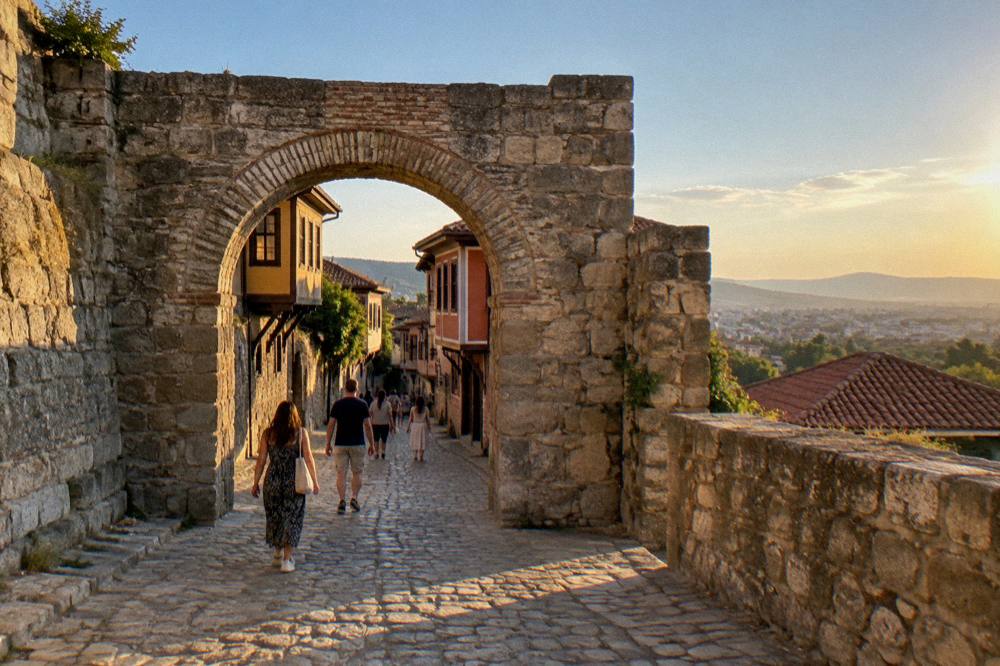
Around the Ethnographic Museum in Plovdiv's Old Town you can reach the Hisar Kapia gate, the Nebet Tepe archaeological complex, the Balabanov, Hindliyan, Nedkovich and Lamartine houses, the Ancient Theatre of Philippopolis and the Roman Stadium sphendone, all on foot, along with the Kapana creative district downhill. Nebet Tepe, Hisar Kapia and Kapana are free; the houses and Roman sites are ticketed under the Old Plovdiv list. This density is the practical argument for basing a day around the hill. Nothing on this list needs transport, and the sequence can be arranged as a loop: up one lane, along the ridge, down the other side.
| Sight near the museum | What it is | Entry |
|---|---|---|
| Hisar Kapia | Ottoman-era gate into the Old Town lanes | Free, public |
| Nebet Tepe | Open-air archaeological complex with hilltop views, free public access | Free |
| Balabanov House | Revival house museum on the Old Plovdiv ticket | 3.58 euro reported tariff |
| Hindliyan House | Painted revival house museum | 3.58 euro reported tariff |
| Lamartine House | Revival house linked to the French poet's stay | 3.58 euro reported tariff |
| Ancient Theatre of Philippopolis | Roman theatre with 28 concentric rows of marble seats | 3.58 euro reported tariff |
| Roman Stadium sphendone | The accessible northern curve of the stadium, in the open air | Free to view |
| Kapana | Creative district of narrow streets, shops and cafes | Free, public |
The free elements deserve emphasis. Nebet Tepe, the site of the earliest settlement on the hill, dated by the city's tourism site to the 4th millennium BC, was restored and officially reopened in March 2025 and remains free to walk, with no ticket and no closing time for general access. The stadium sphendone can be seen in the open air without paying; only the 3D projection hall and the eastern sector are ticketed. Hisar Kapia and Kapana are simply public space. A zero-spend day in the Old Town is entirely possible, with the museums as paid extras.
Downhill and across the center, other stops extend the walk if the day allows: the Sahat Tepe clock hill, the Danov Hill and Youth Hill pair on the other side of the city, the Georgiadi House in the Old Town, and the churches of Saints Constantine and Helena, Saint Marina and the Dormition Cathedral in the flat center. Those are spread across a wider radius and suit a second day. For a single day anchored on the Ethnographic Museum, the hill, the theatre and Kapana make a complete itinerary, and the one-day Plovdiv plan covers the full sequence.
When Is The Best Time To Visit The Ethnographic Museum In Plovdiv?
The best time to visit the Ethnographic Museum in Plovdiv is any month except a Monday, but spring and autumn combine comfortable walking weather with the museum's longer summer hours, since April to October keeps the 9:00 to 18:00 schedule. July and August bring the highest mean daily highs of the year in Plovdiv, 28.2 and 28.6 C respectively per the ERA5 reanalysis for 1991 to 2020, making an indoor museum a sensible midday stop. Winter visits work too, with hours from 9:00 to 17:00, though January's mean daily low of minus 2.6 C in the same reanalysis makes the cobbled lanes cold underfoot, and the Christmas market season from late November into early January adds a reason to be in the city anyway.
| Season | Museum hours | Mean daily high (ERA5 reanalysis, 1991 to 2020) | Notes for the Old Town |
|---|---|---|---|
| Spring (April to May) | 9:00 to 18:00 | 17.1 to 21.9 C | May is the month with the highest rainfall, 56.8 mm |
| Summer (June to August) | 9:00 to 18:00 | 25.9 to 28.6 C | Indoor stops are a good midday plan; August is the driest month at 25.2 mm |
| Autumn (September to October) | 9:00 to 18:00 until November, then 9:00 to 17:00 | 23.8 to 18.1 C | Kapana Fest ran two weekends in October 2026 |
| Winter (November to March) | 9:00 to 17:00 | 12.3 C down to 5.9 C | Christmas market ran to early January in 2026 |
Events can sharpen the timing. The Opera Open festival ran at the Ancient Theatre from 23 June to 9 September in 2026, and the Old Town festival days ran 16 to 23 September 2026, which puts more life in the lanes around the museum. Kapana Fest's autumn edition occupied the first two October weekends in 2026. These dates describe the latest editions; later editions are announced by the city's events calendar, so check before building a trip around one. The museum itself does not run on a festival clock: its calendar is just the Monday closure and the seasonal hour shift.
Time of day is the smaller lever. The museum's 9:00 opening makes it one of the earlier doors on the hill, while the Ancient Theatre and the Old Plovdiv houses open at 9:30 in the summer season, so starting at the Ethnographic Museum and moving to the ticketed houses afterwards sequences naturally. An early start also puts you on Nebet Tepe before the midday sun in summer, and in Kapana for lunch. The hill is small enough that the order matters less than the Monday rule.
What Should You Know Before Visiting Plovdiv's Ethnographic Museum?
Before visiting, know four things: the museum is closed on Mondays; its ticket is separate from the Old Plovdiv combined ticket; the reported price of about 3 euro is a secondary figure to confirm at the desk; and Bulgaria has used the euro since 1 January 2026, so old lev prices quoted in older guides and articles are obsolete. The museum sits on a steep cobbled hill, so footwear and mobility planning matter, and photography rules should be checked on arrival. Those five points prevent the common planning mistakes.
A few practical notes complete the picture. The emergency number in Bulgaria is 112, EU-wide and free. Plugs are type C and F at 230 volts. Bulgaria has been a full Schengen member since 1 January 2025, and citizens of the United States, the United Kingdom, Canada and Australia enter visa-free for 90 days in any 180-day period; the Entry/Exit System replaced passport stamping with biometric registration at external borders from 10 April 2026. A tourist tax may be charged by your accommodation, and its 2026 rate is not published as a single figure, so confirm at booking. None of this touches the museum visit directly, but it fills the edges of a trip plan.
For visitors pairing the museum with the region's folk culture beyond the city, two directions extend the theme. Wine has been made in the Thracian plain since antiquity, and a private tasting trip from Plovdiv into the Thracian Valley visits the wineries whose villages supplied the markets the museum's craft displays document. In the other direction, Koprivshtitsa, the revival-era mountain town, preserves the architecture of the same period as the Old Town houses, with six house museums on a combined ticket reported at about 10 euro; a full-day trip from Sofia combines both cities.
The Old Town walk with rakia tasting remains the closest pairing for the museum itself: the walk covers the hill and the houses, and the tasting connects to a drinks culture the museum's copper coffee sets hint at. Book the walk for the morning, spend the afternoon between the museum and Nebet Tepe, and let Kapana take the evening. Visitors staying several days will find the season-by-season guides on this site cover the rest of the city, from the Roman sites to the Rowing Canal.
For travellers arriving from Sofia for the day, the Ethnographic Museum fits comfortably in a day trip: direct trains take about 2 h 40 to 3 h 05, and a full-day guided trip with Koprivshtitsa on the return leg is another way to see both the city's folk side and the revival town in one outing.
Common Questions About The Ethnographic Museum In Plovdiv
Is the Ethnographic Museum in Plovdiv open on Mondays?
No. The museum is closed on Mondays and opens Tuesday to Sunday, 9:00 to 17:00 in winter (November to March) and 9:00 to 18:00 in summer (April to October), per its published hours. The Regional Archaeological Museum is also closed on Monday, so Mondays in Plovdiv suit the Roman sites and open-air areas better.
How much does the Ethnographic Museum in Plovdiv cost?
The reported adult ticket is about 3 euro, with students and pensioners at about 1 euro. Those figures come from secondary reporting rather than a published tariff, so confirm the price at the desk. Children up to 7 and visitors with over 50 percent disability have been reported to enter free, but check locally.
Is the Ethnographic Museum included in the Old Plovdiv combined ticket?
No. The combined ticket covers up to five Old Plovdiv sites, such as the Ancient Theatre and the Old Town houses, excluding the Small and Bishop's Basilicas, at 10.74 euro adult. The Ethnographic Museum is administered separately and needs its own ticket. The combined ticket's validity period is not stated on the official page, so ask where you buy it.
How long does a visit to the Ethnographic Museum take?
Half an hour for a quick pass and up to an hour for a careful one. The building is compact, and the route runs through the costume, textile and craft rooms and the furnished interiors. Allow extra time for the surrounding Old Town lanes, since the museum sits inside the densest sightseeing area in Plovdiv.
Is the Ethnographic Museum accessible for visitors with limited mobility?
The museum occupies a revival-era house on a steep cobbled hill, with stairs between floors and uneven surfaces on the approach lanes. No lift or accessibility details are published, so contact the museum ahead for current facilities and plan the uphill approach accordingly.
What is the best season to visit the Ethnographic Museum in Plovdiv?
Any season except a Monday closure works. Spring and autumn give comfortable walking weather with the museum's longer summer hours (April to October, 9:00 to 18:00). In July and August, with ERA5 reanalysis mean daily highs of 28.2 and 28.6 C for 1991 to 2020, the museum is a useful midday indoor stop on an Old Town circuit.