Plovdiv Photography: Viewpoints, Light And Quiet Corners
Plovdiv, in southern Bulgaria, is an inland city built around six hills, and almost every one of them doubles as a photo platform: here is where the frames are, when the light arrives, and which corners cost nothing.
Short answer
The strongest Plovdiv photography runs from Nebet Tepe's free hilltop at golden hour, down through the Ancient Theatre's 28 rows of marble seats, into the painted lanes of Kapana, with the Alyosha monument on Bunardzhik for the wide city shot.
Plovdiv sits in southern Bulgaria as an inland city of six hills, and that geography is the whole reason the city photographs so well: every climb ends in a panorama, every descent drops into Roman stone or revival-era lanes. The municipal tourism site describes the city as often listed among the oldest continuously inhabited cities in Europe, and the layers show in the frame: Thracian walls, a 1st century theatre, Ottoman domes, revival-era merchant houses in powder blues and ochres. This page is a shot list built from what the official pages publish, with the euro prices, the free corners and the seasonal light laid out so a camera bag can be packed around them. For the wider sightseeing picture, start with the things to do in Plovdiv overview and the Plovdiv walking tour guide.
Where Are The Best Photo Spots In Plovdiv?
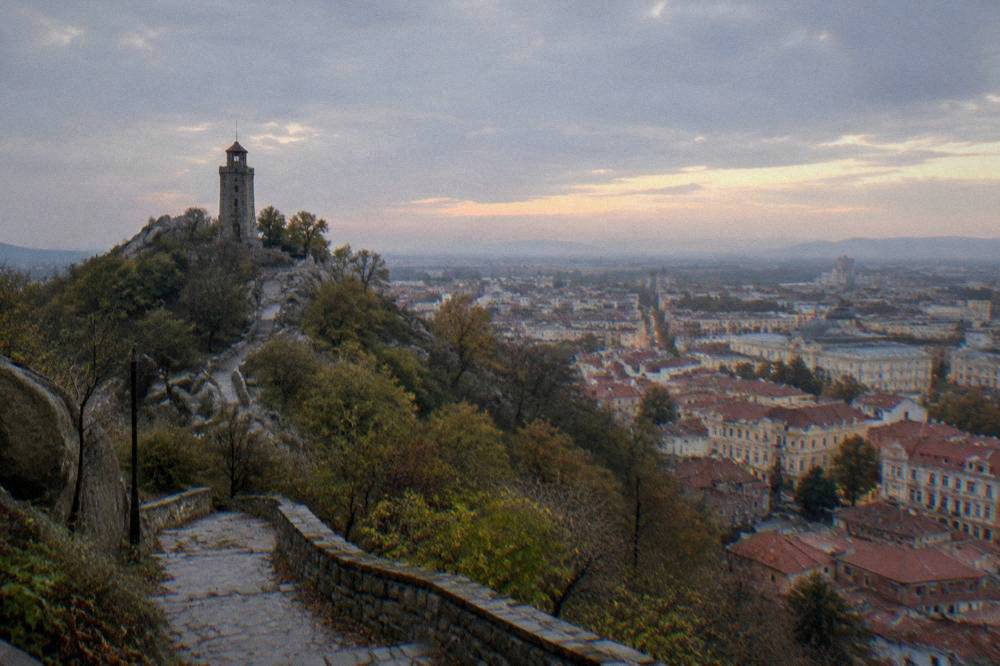
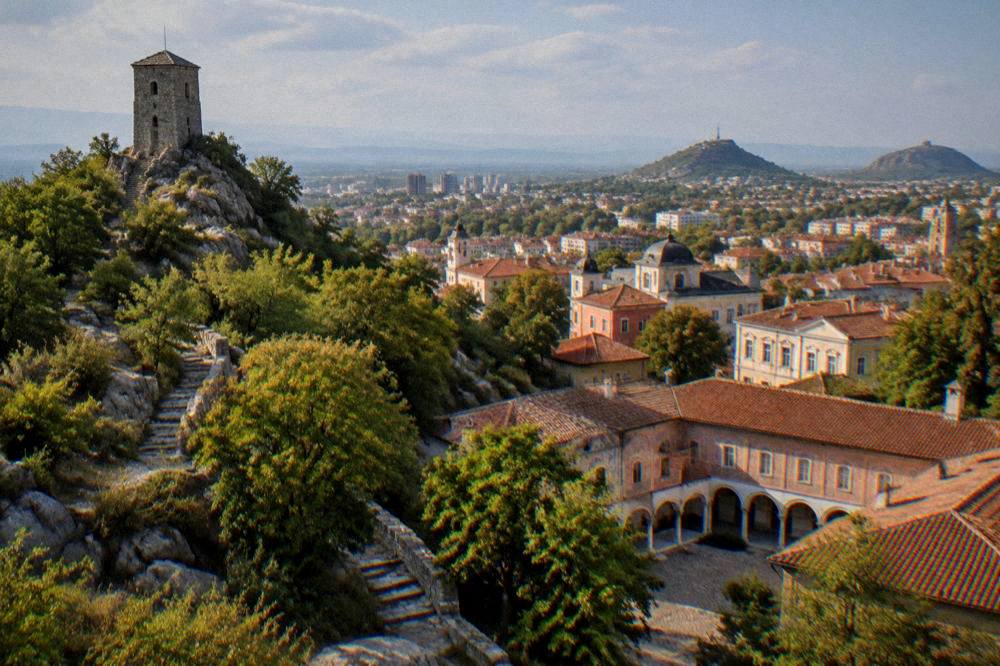
The core Plovdiv photography circuit is Nebet Tepe for the free hilltop panorama, the Ancient Theatre of Philippopolis for marble rows against the Rhodopes, Hisar Kapia for the stone gate, the painted lanes of Kapana, and the Alyosha monument on Bunardzhik for the wide city view, all walkable within a day. The city's official tourism site lists Nebet Tepe at 207 m as the spot where settlement began, and its open-air archaeological complex is free after the restoration project that opened in March 2025. The theatre, the stadium, the Old Town houses and the basilicas sit within fifteen minutes' walk of one another, which is why a single loop covers ruins, gates, hills and street art before the light changes.
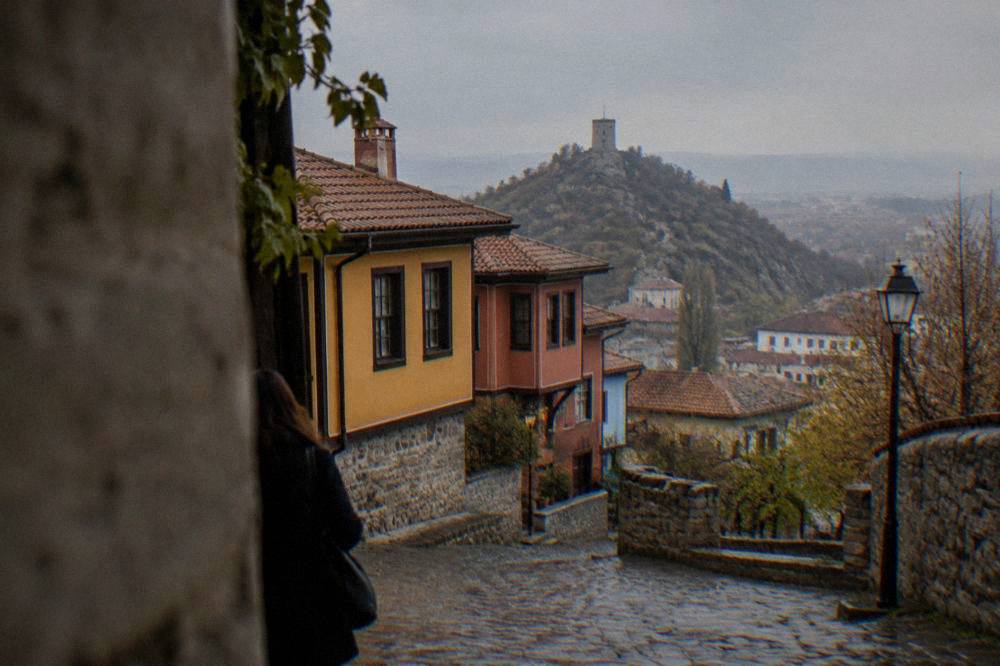
The circuit works in either direction. Climbing first, from the Three Hills up to Nebet Tepe, puts the panorama in afternoon light and the descent through Old Town lanes in shade, which suits detail work: doorways, ironwork, the cobble texture on Ulitsa Saborna. Reversed, the loop ends on the hill at dusk with the city lights coming on below.
What the official sources add is precision about access. The free corners, Nebet Tepe, Hisar Kapia, Kapana, the hills, cost nothing and hold no hours at all.
Which Plovdiv Viewpoint Should You Climb First?
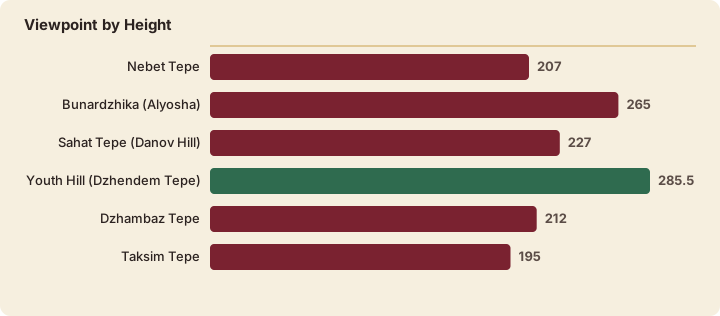
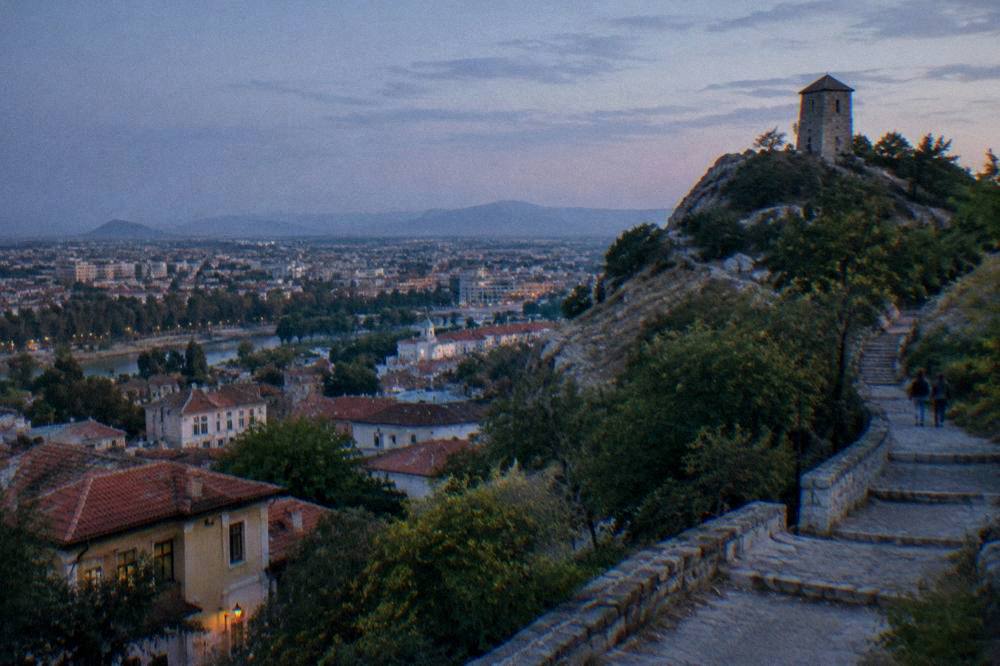
Nebet Tepe at 207 m is the first climb for Plovdiv photography, because it is free, open at all hours and looks straight across the Old Town roofs toward the Rhodopes, with Bunardzhik at 265 m and its 1957 Alyosha monument as the second climb for the wide multi-hill cityscape. The city's relief page gives every hill its height: Youth Hill 285.5 m, Bunardzhika 265 m, Danov Hill 227 m, Nebet Tepe 207 m, Dzhambaz Tepe 212 m, Taksim Tepe 195 m. Six hills remain; there were seven until Markovo Tepe was partly quarried away in the 1930s.
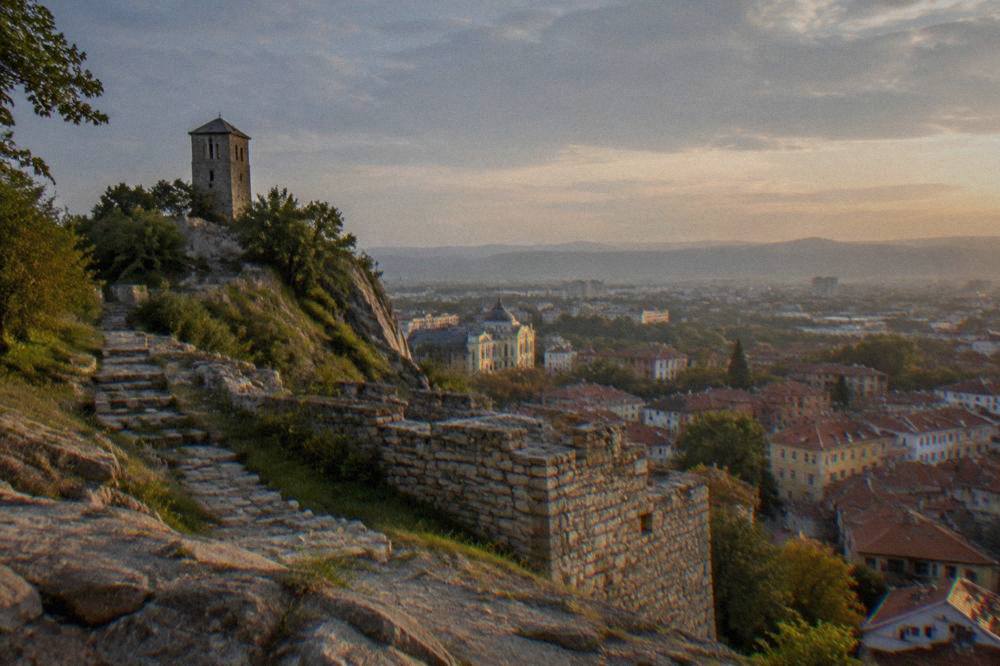
Nebet Tepe rewards the late climb. The restoration project that opened in March 2025 left the fortress walls socialised as an open-air complex, free and without set visiting hours, so the timing belongs entirely to the light. Sahat Tepe, Danov Hill, offers a different crop: the clock tower silhouette against the rooftops, closer to the centre than the western hills.
Bunardzhik is the panorama hill. The Alyosha monument was unveiled in 1957, and the figure stands about 11 m on a 6 m pedestal, tall enough to anchor a foreground while the plain and the other five hills fill the background. From here the city reads as a whole, which is the frame nowhere else in the centre gives.
| Viewpoint | Height | What The Frame Holds | Access |
|---|---|---|---|
| Nebet Tepe | 207 m | Old Town roofs, fortress walls, Rhodopes horizon | Free, no set hours |
| Bunardzhika (Alyosha) | 265 m | Wide six-hill cityscape, monument foreground | Free, open public hill |
| Sahat Tepe (Danov Hill) | 227 m | Clock tower, central rooftops | Free, public hill |
| Youth Hill (Dzhendem Tepe) | 285.5 m | The high ground of the six, distant city views | Free, public hill |
| Dzhambaz Tepe | 212 m | Old Town lanes from above, amphitheatre context | Free, public hill |
| Taksim Tepe | 195 m | Quiet residential slopes, few visitors | Free, public hill |
Heights from the city's own relief page at visitplovdiv.com. The two climbs that matter for a short visit are Nebet Tepe and Bunardzhik; the others suit a second day or a longer stay, and the free things to do in Plovdiv guide maps the hills against the other no-cost sights.
What Light Does Plovdiv Give Photographers Through The Year?
Plovdiv's modelled climate gives summer mean daily highs of 28.2 C in July and 28.6 C in August against 5.9 C in January, with May the month carrying the heaviest rain at 56.8 mm and August the least at 25.2 mm, per the ERA5 reanalysis 1991-2020, which points photographers at spring and autumn for balanced light and summer evenings for the theatre. The reanalysis is a modelled grid cell over the city, not a station record, and it smooths urban heat, so treat it as a planning normal rather than a forecast.
Spring and autumn give the longest useful days without the harsh overhead light of July and August. Winter compresses the day but adds a low sun that rakes across the Old Town facades for hours, and the white marble of the theatre holds whatever light the sky offers. Rain totals peak in May and March, both above 55 mm in the normals, so a cover for the camera matters more in those months than in August.
| Month | Mean Daily High | Mean Daily Low | Rain | Photo Note |
|---|---|---|---|---|
| January | 5.9 C | -2.6 C | 41.0 mm | Low sun rakes facades all afternoon |
| March | 12.1 C | 2.1 C | 55.0 mm | Second-wettest month, carry a cover |
| May | 21.9 C | 11.5 C | 56.8 mm | Wettest month in the normals |
| July | 28.2 C | 17.9 C | 45.6 mm | Shoot mornings and evenings |
| August | 28.6 C | 18.1 C | 25.2 mm | Driest month, theatre evenings |
| October | 18.1 C | 8.8 C | 44.1 mm | Warm light, festival-season streets |
The seasonal detail, month by month, sits in the Plovdiv weather guide and the best time to visit Plovdiv guide. An evening walk timed to the last hour of light is the single most productive slot in any season, and a guided city tour built around sunset pairs the loop with a tasting, a calm way to end a shooting day.
How Do You Photograph The Ancient Theatre And The Roman Stadium?
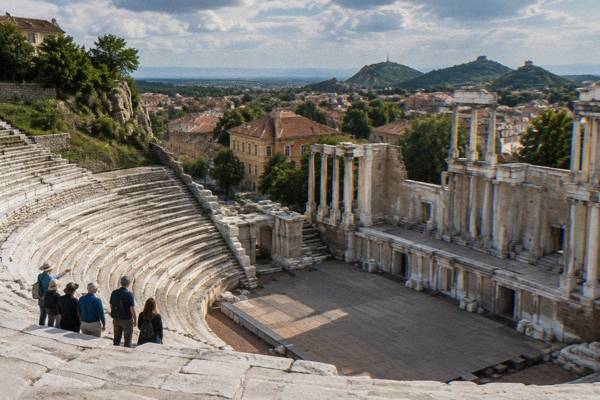
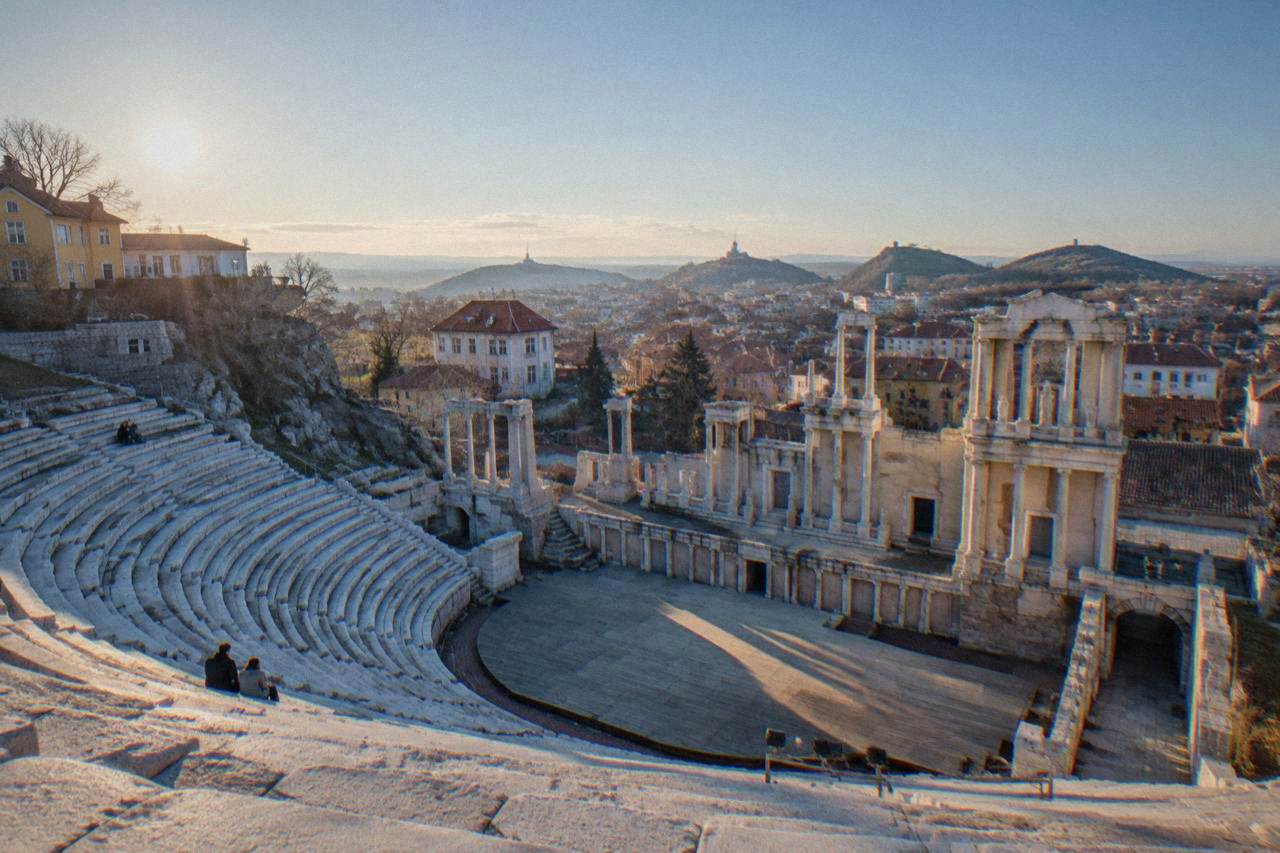
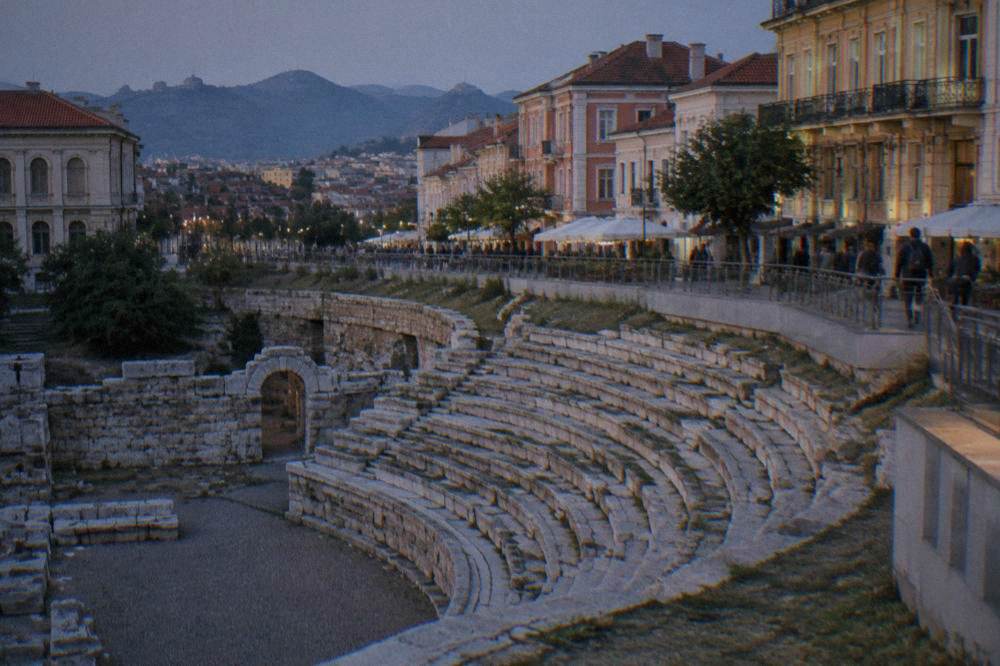
The Ancient Theatre of Philippopolis, built in the 90s of the 1st century AD and described on the official page as 28 concentric rows of marble seats, is Plovdiv's signature frame, open daily from 9:30 to 18:00 between April and October with a 3.58 euro single ticket, while the Roman Stadium's free sphendone below Main Street gives the second Roman frame with no ticket at all. The theatre sits on the hillside with the Rhodopes behind the stage building, a composition that works from the top row down and from the orchestra floor up.
Only the northern part of the stadium, the sphendone, is accessible, unearthed in the 1970s, with the rest lying under the modern Main Street. The official sight page says the stadium was built in the 2nd century AD on the model of the Stadium at Delphi and held up to 30,000 spectators, but the photographable portion is the curved northern end and the 3D projection hall beside it, where the adult ticket is 3.68 euro.
| Roman Site | Ticket (Euro) | Hours (Apr To Oct) | The Frame |
|---|---|---|---|
| Ancient Theatre | 3.58 adult, one-site | Daily 9:30 to 18:00, lunch 12:30 to 13:00 | Marble rows against the Rhodopes |
| Roman Stadium sphendone | Free | Open-air, unrestricted | Curved stone seats below street level |
| Stadium 3D hall | 3.68 adult | Daily 9:30 to 18:00, lunch 12:30 to 13:00 | Reconstructed interior on screen |
| Stadium Eastern sector + 3D | 5.11 adult combined | Daily 9:30 to 18:00 | Track surface and reconstruction |
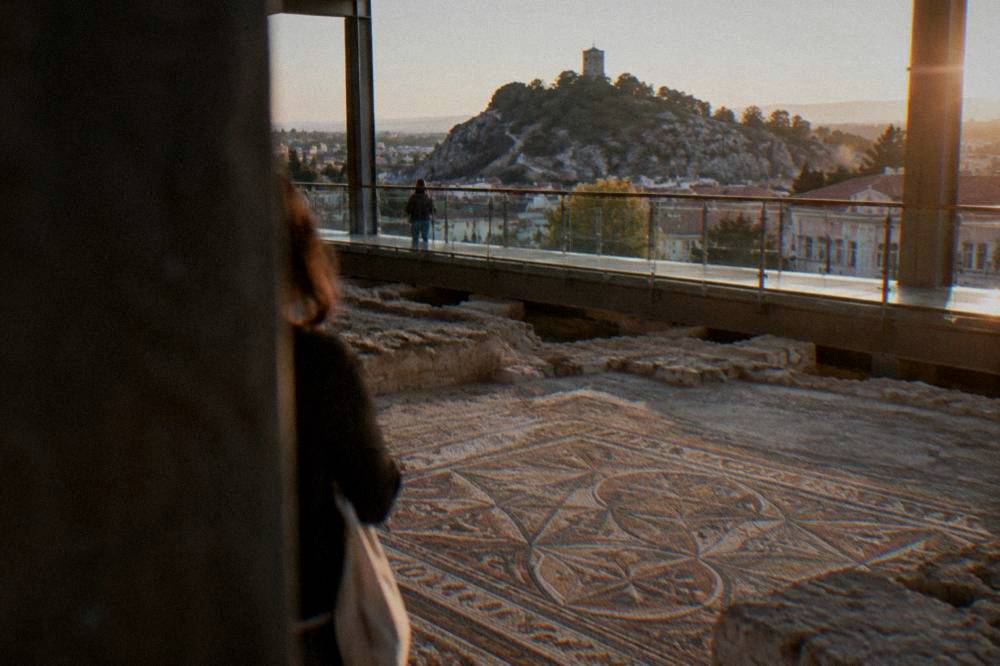
| Bishop's Basilica | 7.57 adult | Daily 9:00 to 18:00 | Floor mosaics, over 2,000 sq m |
| Small Basilica | 3.58 adult, one-site | Daily, seasonal hours | Early Christian mosaic floors |
The theatre also hosts Opera Open each summer, which ran 23 June to 9 September in 2026, and an event evening turns the monument into a lit stage, though access then belongs to ticket holders rather than photographers. The wider Roman layer, the odeon, the forum and the basilicas, is mapped in the Roman Plovdiv guide.
What Makes Kapana And The Old Town Lanes Good For Detail Shots?
Kapana, whose name the municipal tourism site translates as "The Trap" for its tangle of narrow streets, is Plovdiv's colour and street-art district, free and open at all hours, while the Old Town's revival houses, Balabanov, Hindliyan, Nedkovich and Lamartine, give the pastel facades, courtyards and cobbles that carry the quiet half of a Plovdiv photo set. The district is a grid that defeats straight lines on purpose: painted murals turn corners, doorways sit a frame off the lane, and the whole area works at any hour because it is public street.
To step into the frame in traditional dress, book a costume photo session here.
The Old Town houses are ticketed individually under the Old Plovdiv list at 3.58 euro for any single site, or covered by the 10.74 euro combined ticket for up to five sites. What the ticket buys, photographically, is interiors: carved ceilings, arranged rooms, stair halls that bounce window light. Hindliyan House moved to daily opening in a change reported in the autumn of 2026, so the days of the Monday gap in the lane circuit are narrowing, though the Ethnographic Museum in the Kuyumdzhiev House remains closed on Mondays. The wider set of guides lives on Plovdiv Travel Guide.
Hisar Kapia, the stone gate at the edge of the Old Town, needs no ticket and no hour. It frames whatever passes through it, and at dusk the lit gate against the deepening blue above it is one of the dependable frames of the centre. The Kapana guide and the Old Town guide carry the lane-by-lane detail.
Which Plovdiv Photo Spots Cost Nothing?
The free Plovdiv photography list is long: Nebet Tepe, all six hills, Hisar Kapia, the Kapana district, the Roman Stadium sphendone, the Dzhumaya Mosque exterior and interior outside prayer times, Main Street's full length, and Tsar Simeon Garden with its singing fountains, all public and all without a ticket. The mosque is a working building, the city's own page puts visits between 6:00 and 23:00, entry is free, and modest dress applies, shoulders and knees covered, shoes off inside. No construction year should be trusted for it: the city's page notes that differing years are given, so treat any single date with caution.
| Free Spot | The Frame | Any Restriction |
|---|---|---|
| Nebet Tepe | Fortress walls, city panorama | None, open-air |
| Hisar Kapia | Lit stone gate at dusk | None, public street |
| Kapana | Murals, doorways, café colour | None, public lanes |
| Stadium sphendone | Curved ancient seating | Open-air portion only |
| Dzhumaya Mosque | Minarets over the square, interior floor | Modest dress, avoid prayer times |
| Tsar Simeon Garden | Fountains, mature trees | Seasonal fountain shows |
| Main Street | Long pedestrian axis, hills at each end | None |
The free layer matters for pacing. A set built only on ticketed sites compresses the day around opening hours and lunch breaks, 12:30 to 13:00 at the theatre and stadium halls, while the free spots fill the gaps. The full no-cost picture, including the garden and the hills in detail, is in the free guide linked above.
What Should A Plovdiv Photo Plan Look Like By Season?
A Plovdiv photo plan keys to three seasonal moods: spring and autumn for long, angled light on the Old Town, summer for the theatre's Opera Open evenings and late sunsets, and winter for low sun on marble and empty cobbles, with May and March the two months where rain cover matters at 56.8 mm and 55.0 mm in the ERA5 1991-2020 normals. Summer mean highs of 28.2 C in July and 28.6 C in August push sensible shooting to the first and last three hours of the day.
| Season | Mean High (ERA5) | Light Character | What To Prioritise |
|---|---|---|---|
| Spring | 17.1 C April | Long angled light | Old Town facades, garden blooms |
| Summer | 28.2 C July, 28.6 C August | Hard midday, warm late evenings | Theatre evenings, dusk hills |
| Autumn | 18.1 C October | Low warm light, festival streets | Kapana colour, wide panoramas |
| Winter | 5.9 C January | Low sun all afternoon, quiet streets | Marble detail, fog-free hill views |
Festival dates reshape the street layer. Kapana Fest ran across the first two weekends of October in 2026, the jazz fest's fall edition ran 6 to 8 November 2026, and the Christmas programme ran into early January, all of them adding lights, stalls and crowds to otherwise quiet corners. The Plovdiv festivals and events guide collects the calendar, and the Plovdiv at night guide covers the after-dark layer.
How Far Can You Go For A Photo Day Trip From Plovdiv?
The strongest photo day trips from Plovdiv are Bachkovo Monastery, free to enter as a working monastery reached by minibus from the Rodopi bus station in 35 to 45 minutes, Asen's Fortress above Asenovgrad, and, deeper in the Rhodopes, the Wonderful Bridges and the Trigrad gorge caves, whose road distance makes a guided day the practical option. The minibus fare for the Bachkovo run is about 3.60 euro, and the monastery's painted refectory and courtyard are the region's richest interior frames outside the city.
Ticket prices for Asen's Fortress mix pre-euro figures, so confirm the current euro fee at the gate. The same caution applies to the Starosel Thracian complex, whose published adult figure predates the 1 January 2026 euro changeover. Koprivshtitsa, the revival-town day trip, publishes a combined ticket of about 10 euro for its six house museums.
For cave and gorge country, a day trip covers ground that public transport serves thinly, and the guided options bundle the driving with the timing. The Rhodopes in detail, gorge to gorge, are mapped in the Rhodopes day tour guide.
The city itself rewards the slower option too. An audio-guide walk through the Old Town and the Roman landmarks sets its own pace, which suits a photographer who stops every fifty metres, and the related tour below is that format.
Common Questions About Plovdiv Photography
Where is the best view over Plovdiv?
Nebet Tepe, at 207 m, is the classic free panorama over the Old Town roofs toward the Rhodopes, with restoration completed and opened in March 2025. Bunardzhik, at 265 m with the Alyosha monument unveiled in 1957, gives the wider six-hill cityscape.
Can you photograph inside the Ancient Theatre of Philippopolis?
Yes, with a ticket. The one-site ticket is 3.58 euro, the site is open daily, 9:30 to 18:00 from April to October and 9:00 to 17:30 from November to March, with a lunch break from 12:30 to 13:00. On Opera Open performance evenings access belongs to event ticket holders.
Is Plovdiv good for street photography?
Kapana, whose name the municipal tourism site translates as "The Trap", is a dense maze of narrow streets with murals, café fronts and artisan shopfronts, free and open at all hours. Main Street and the market squares add the pedestrian flow.
What camera gear suits Plovdiv?
A standard zoom covers the Old Town lanes, while a wide lens earns its place at the theatre, the sphendone and Hisar Kapia, where the working distance is short. The hills involve cobbled climbs, so weight matters more than focal length range.
When is golden hour in Plovdiv?
In winter the low sun rakes the facades for a long stretch of the afternoon.
Do the Plovdiv photo spots charge entry?
Many do not: the hills, Hisar Kapia, Kapana, the stadium sphendone and the mosque are free. The Old Plovdiv sites charge 3.58 euro for a single site, 10.74 euro for a combined ticket of up to five, and the Bishop's Basilica is priced separately at 7.57 euro.
The frames that define Plovdiv are all within one walkable core: a free hilltop, a marble theatre, a stone gate and a painted maze, with six hills standing behind them whenever the composition needs a horizon.