Georgiadi House And The Museum Of The Bulgarian Revival In Plovdiv
Georgiadi House stands in Plovdiv's Old Town as one of the revival-era houses on the Old Plovdiv ticket list, holding displays on the Bulgarian National Revival.
Short answer
Georgiadi House is a revival-era house museum in Plovdiv's Old Town, covered by the Old Plovdiv one-site ticket at 3.58 euro for adults and 1.53 euro for students, with a combined ticket covering up to five sites at 10.74 euro.
Georgiadi House is one of the revival-era house museums of Plovdiv, the inland city in southern Bulgaria built around six hills that served as European Capital of Culture in 2019, shared with Matera. The whole quarter is run as a single museum system by the Old Plovdiv municipal institute, which publishes one price list covering the Ancient Theatre, the Small Basilica and a string of historic houses, Georgiadi House among them.
That single price list matters more here than at a typical sight. Buy one ticket and you see one Old Plovdiv site; buy the combined ticket and you can visit up to five, which changes how a morning in the Old Town is planned. Where a detail, such as the validity period of the combined ticket, is not published, it says so plainly and tells you to confirm at the gate.
What Is Georgiadi House In Plovdiv?
Georgiadi House is a historic revival-era house museum inside Plovdiv's Old Town, run under the Old Plovdiv municipal institute and covered by its shared one-site ticket of 3.58 euro for adults and the multi-site combined ticket of 10.74 euro.
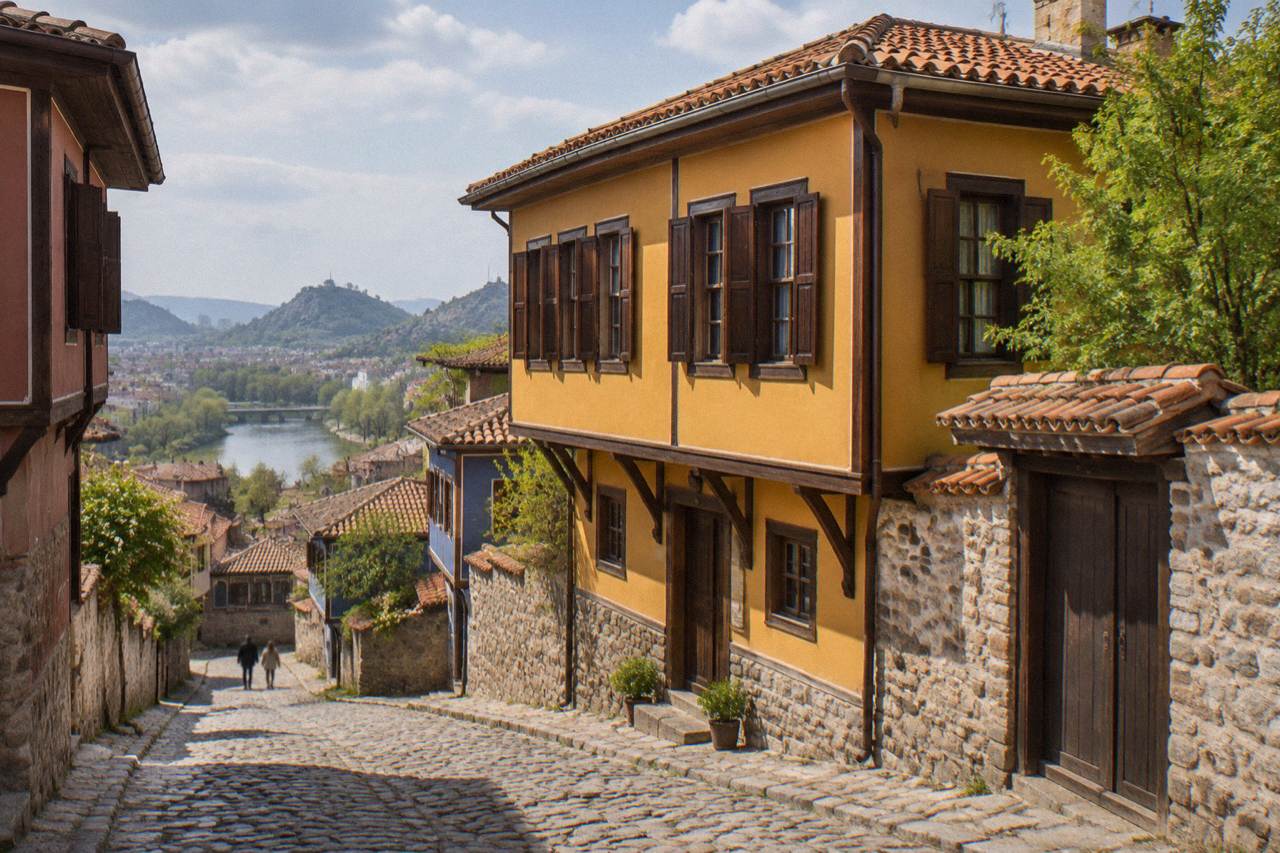
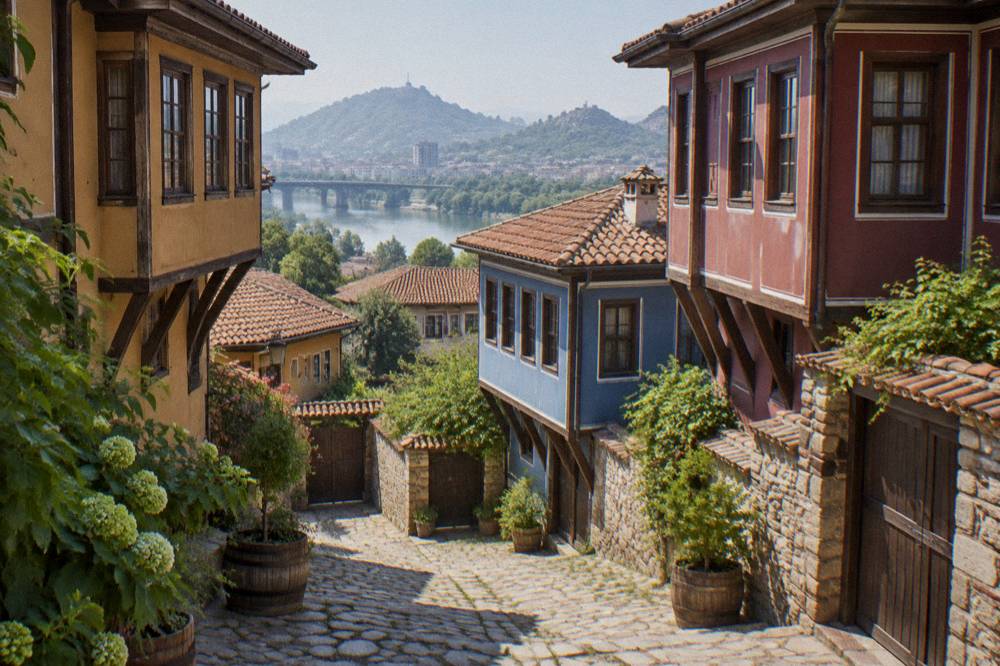
Plovdiv's Old Town is unusual among European old quarters in that its domestic architecture, not its churches, is the headline. These buildings combine a heavy stone base with an overhanging upper storey of timber and bay windows, a silhouette that has become the visual shorthand for the whole city. The municipal tourism site presents the Old Town, under the name "The Ancient Plovdiv", on Bulgaria's Tentative List for UNESCO inscription, submitted on 14 September 2004; it is a waiting list entry, not a World Heritage inscription, and it is worth being precise about that distinction.
Within that collection of houses, Georgiadi House is presented as one of the museum houses with a Revival-period focus. The Old Plovdiv price list groups it with the other named houses, so planning a visit is really planning a circuit: the houses sit within a few minutes' walk of one another on streets that climb between the Ancient Theatre and Nebet Tepe. For background on the era the houses represent, the site's Plovdiv history guide traces the city from its first settlement on Nebet Tepe, dated by the city's tourism site to the 4th millennium BC, through Philippopolis, the Roman name still attached to the Ancient Theatre, to the Revival quarter that stands today.
The city around the house rewards context. Plovdiv is Bulgaria's second-largest city, with a population of 333,994 as of 31 December 2025 according to the National Statistical Institute figure cited by citypopulation.de, and it is often described as one of the oldest continuously inhabited cities in Europe. It has no sea coast; the nearest dramatic landscape is the Rhodopes to the south. Six hills remain inside the city, there were seven until Markovo Tepe was partly quarried away, and the Old Town spreads over three of them. Everything a visitor comes to see sits compactly on and around those hills.
Where Is Georgiadi House And How Do You Reach It In Plovdiv?
Georgiadi House stands inside the Old Town of Plovdiv, the pedestrian hill quarter on the three central hills, reached on foot from the Main Street pedestrian axis in a short climb of a few minutes from the city centre. The Old Town is walkable in its entirety, cars are largely absent from its lanes, and the house sits within the same small circuit as the Ancient Theatre, Nebet Tepe and the other revival houses on the Old Plovdiv ticket.
The practical geography is simple. Plovdiv's centre is organised around a long pedestrian Main Street that runs from the Central Square, where the Roman Stadium sphendone lies exposed beside it, up toward the Old Town. Streets peel off the top end of Main Street and climb into the revival quarter, where the surface becomes cobbles and the lanes narrow. Hisar Kapia, the old gate that survives as a freestanding landmark at the edge of the quarter, is the traditional entry point, and from there the lanes fan out toward the theatre, the houses and Nebet Tepe. The Old Town area guide covers this layout in more detail.
There is no special transport question for the house itself, because there is no driving to it: the quarter is a walking district. What matters is reaching the city, and for that the two facts that shape every Plovdiv trip are these. Direct trains from Sofia take about 2 h 40 to 3 h 05, per the BDZ timetable, with services via Karlovo taking far longer, so check the destination of the train before boarding. Plovdiv's own airport at Krumovo has a small route list, London, Milan, Bratislava, Birmingham, Manchester, Belfast and Tel Aviv among the destinations in the airport's own flight search, and most international travellers still arrive through Sofia.
Once in the centre, everything is on foot. A guided walk is one way to absorb the quarter's layers quickly, and the Plovdiv guided walking tour covers the Old Town and the Roman landmarks with a guide; Check availability on the operator's live listing if that suits your pace. Walking independently works just as well, since the quarter is small and the ticket offices are staffed.
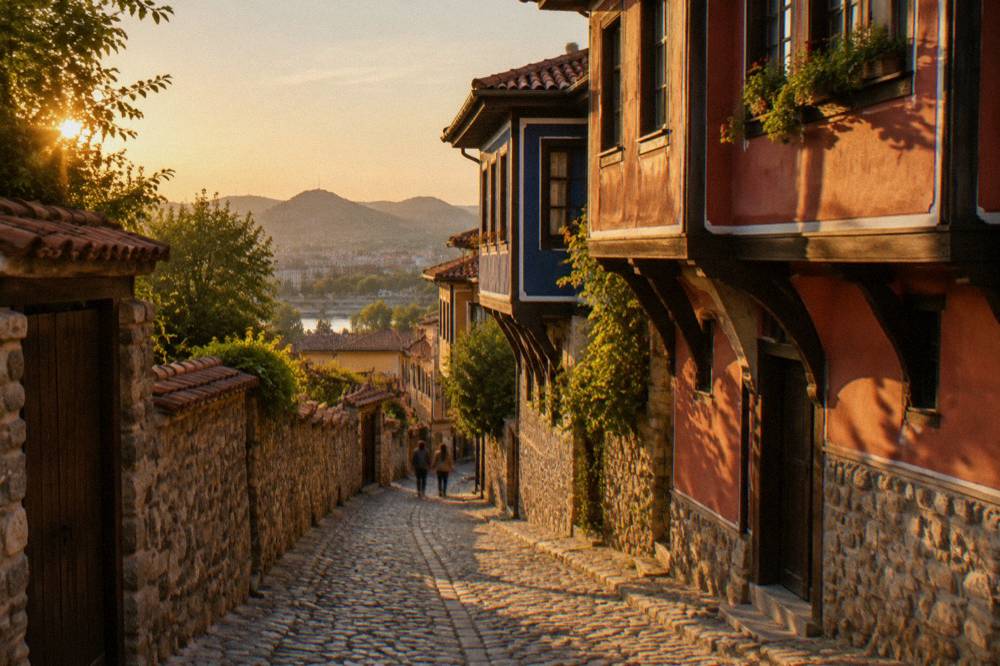
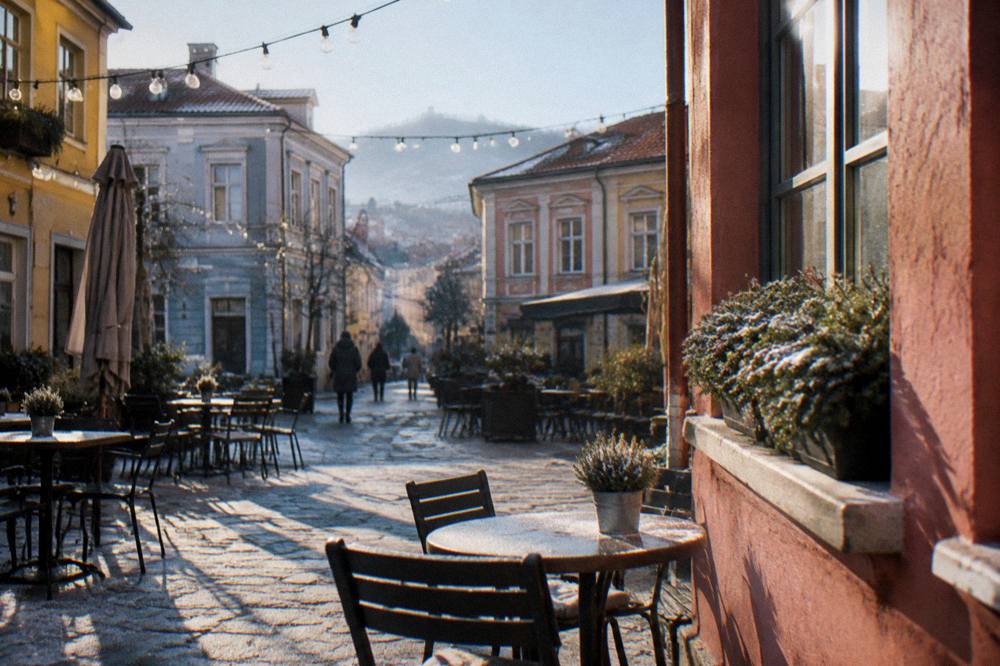
Between visits, the streets themselves are the attraction. Kapana, the creative district whose name means "The Trap" in a reference to its maze of narrow streets, sits just downhill from Hisar Kapia and is free and open at all hours, filled with studios, cafes and small venues. The contrast is the point: the Old Town is the museum piece, Kapana is the living workshop. Both fit into the same afternoon without transport.
What Does Georgiadi House Cost To Visit In Plovdiv?
A single adult ticket to any one Old Plovdiv site, Georgiadi House included, is 3.58 euro, with pupils and students at 1.53 euro, a family ticket at 7.16 euro and free entry for children aged 7 and under and visitors with more than 50 percent disability, per the Old Plovdiv ticket page. The combined ticket covering up to five Old Plovdiv sites costs 10.74 euro for adults, 4.09 euro for students and 21.47 euro for families.
| Ticket | Adult | Pupil / Student | Family |
|---|---|---|---|
| One Old Plovdiv site (incl. Georgiadi House) | 3.58 euro | 1.53 euro | 7.16 euro |
| Combined, up to 5 sites (excl. Small and Bishop's Basilicas) | 10.74 euro | 4.09 euro | 21.47 euro |
| Group rate, over 10 people, one site | 3.07 euro | N/A | N/A |
| Children 7 and under, over 50% disability | Free | Free | Free |
Two cautions sit alongside that table. The published validity period of the combined ticket is not published, so do not rely on a figure you may have read elsewhere; confirm it at the ticket office when you buy. And the Bishop's Basilica of Philippopolis is priced separately from the list above, at 7.57 euro adult, because it is a distinct monument with its own visitor operation, daily 9:00 to 18:00, about 83 m long and 36 m wide with two layers of floor mosaics covering over 2,000 sq m, the largest basilica of the 4th to 6th centuries in Bulgaria per oldplovdiv.bg.
The combined ticket changes the arithmetic of a visit. Three one-site tickets bought separately cost more than the five-site combined ticket, so anyone planning to see the Ancient Theatre plus two or three houses, Georgiadi House among them, comes out ahead with the combination. Anyone seeing a single sight buys the single ticket. Students get the same benefit at a lower level, and the first Thursday of the month brings free entry for students and seniors at Old Plovdiv sites per the same listings, so a budget itinerary can be built around that day.
Nearby state museums run on separate lists. The Regional History Museum charges 5 euro for one site, 8 for two, 10 for three and 12 for four, with free entry the first Thursday of the month. The Regional Archaeological Museum at Saedinenie Square 1 is closed Monday and open Tuesday to Sunday 10:00 to 18:00, and it renewed its permanent exhibition in November 2025 with about 150 new exhibits and a bilingual audio guide; its ticket price is not published, so confirm on arrival. The Ethnographic Museum, the Kuyumdzhiev House at the top of the Old Town, is also closed Monday.
What Can You See Inside Georgiadi House In Plovdiv?
Inside, Georgiadi House presents period interiors and displays tied to the Bulgarian National Revival, the revival era whose merchant wealth built the Old Town, in the setting of a revival-era house with its characteristic stone base, overhanging upper floors and painted reception rooms. The Old Plovdiv institute presents the house as part of the same circuit as Balabanov House, Hindliyan House, Nedkovich House and Lamartine House, each with its own focus within the Revival story.
The houses of the quarter differ enough that seeing several is not repetition. Balabanov House is known for its grand reception hall and its use as a concert venue, a house in the symmetrical townhouse manner of the period's wealthiest builders; the site's Balabanov House page covers it in detail. Hindliyan House, across a shared courtyard from Balabanov, is the richly decorated one, with painted walls and ceilings in the style of the era's interior fashion, and reports from the autumn of 2026 say it moved to opening every day.
| Old Plovdiv House | Character | Ticket list |
|---|---|---|
| Georgiadi House | Revival-period displays and period interiors | One-site / combined |
| Balabanov House | Grand reception hall, concert use | One-site / combined |
| Hindliyan House | Painted walls and ceilings, decorative interiors | One-site / combined |
| Nedkovich House | Revival-era domestic interior | One-site / combined |
| Lamartine House | Named for the French poet's stay | One-site / combined |
| Ethnographic Museum (Kuyumdzhiev House) | Regional costumes and crafts, separate museum | Own price list |
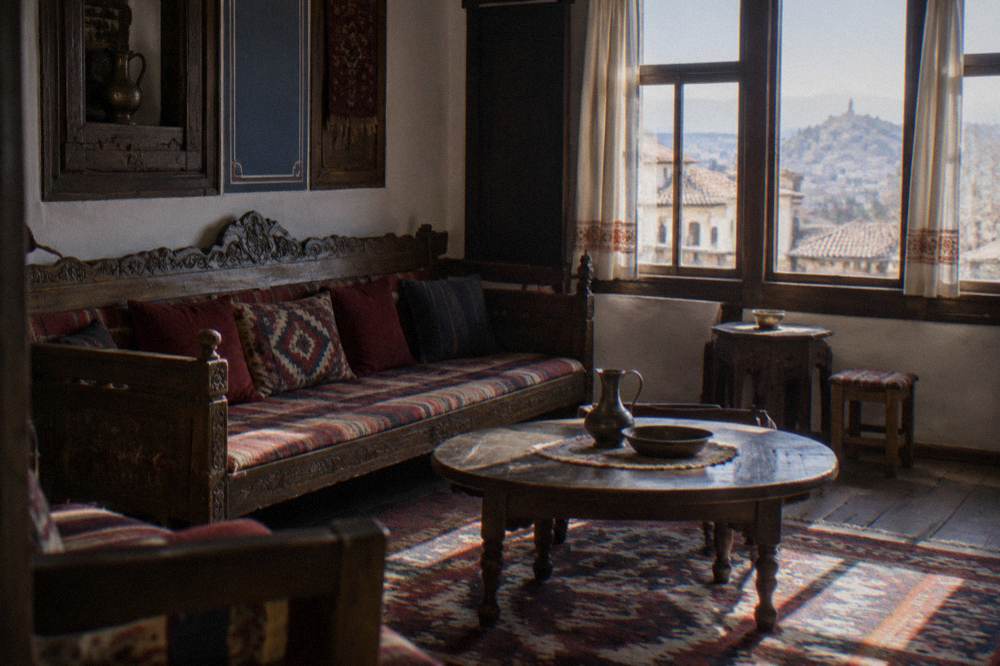
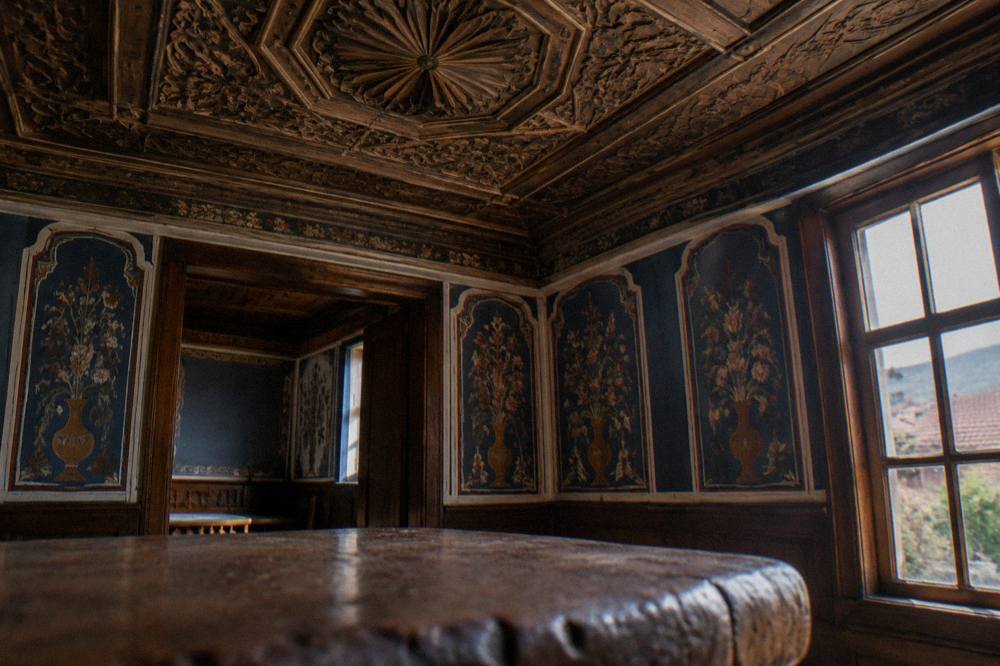
The interiors these houses share have a recognisable grammar. Reception rooms sit behind rows of windows on the street facade, ceilings carry carved wood, and the raised seating alcove, the divan running along the walls, was where households received guests. The Old Town's domestic world is deliberately preserved in that state, and the museums' role, as the Old Plovdiv institute presents it, is to keep the interiors intact rather than to rebuild them as modern galleries. Expect furnished rooms, display cases and period detail rather than interactive screens; the one high-technology exhibit in the quarter is the Roman Stadium's 3D projection hall, priced separately at 3.68 euro.
A word on what the houses do not offer. There is no Plovdiv city card covering the museums; none exists, and any product sold as one should be checked against the official price list. There are no published crowd figures or timed-entry slots for the house museums; tickets are bought at the gates. Opening patterns vary slightly between the houses, some close on Sunday or Monday while others open daily, so a visit planned around one specific house should confirm that house's days at the ticket office or on the institute's listings.
When Is Georgiadi House Open In Plovdiv?
Old Plovdiv sites, the Ancient Theatre, the basilica sites and the historic houses, run a two-season pattern, April to October roughly 9:00 or 9:30 to 18:00 and November to March 9:00 to 17:30, with a lunch break typically 12:30 to 13:00, though individual houses vary their closing days and the ticket office confirms each.
The Ancient Theatre's published hours are the clearest model: April to October daily 9:30 to 18:00, November to March daily 9:00 to 17:30, closed no days.
The pattern exists because the houses are staffed individually rather than as one gate. The Ethnographic Museum is closed Monday, opening Tuesday to Sunday 9:00 to 18:00 in summer and 9:00 to 17:00 in winter. The Regional Archaeological Museum is closed Monday, Tuesday to Sunday 10:00 to 18:00. Hindliyan House, by contrast, was reported in the autumn of 2026 as moving to daily opening. The safe planning assumption is that a Monday visit narrows your options in Plovdiv generally, and that any single house's days should be confirmed before you build a tight itinerary around it. The full index of guides sits on Plovdiv Travel Guide.
| Site | Summer pattern | Winter pattern | Closed |
|---|---|---|---|
| Old Plovdiv houses (general) | ~9:00/9:30–18:00 | ~9:00–17:30 | Varies by house |
| Ancient Theatre | 9:30–18:00 | 9:00–17:30 | None |
| Bishop's Basilica | 9:00–18:00 | 9:00–18:00 | None |
| Ethnographic Museum | 9:00–18:00 | 9:00–17:00 | Monday |
| Regional Archaeological Museum | 10:00–18:00 | 10:00–18:00 | Monday |
The lunch break deserves a line of its own, because it catches out tight schedules. A 12:30 to 13:00 closure at the Ancient Theatre and several other sites means a midday arrival can meet a shut door for half an hour. The break is short enough to plan around, and Kapana's cafes sit close enough to fill it, but a visitor sprinting between sights on a half-day stop should sequence the houses for the morning and the open-air monuments, Nebet Tepe, Hisar Kapia, the stadium sphendone, which have no ticketed hours at all, for the early afternoon.
When Is The Best Time Of Year To Visit Georgiadi House In Plovdiv?
The most comfortable months for Plovdiv's Old Town are late April to June and September to October, when the ERA5 reanalysis, 1991-2020, shows mean daily highs of 17.1 to 21.9 C in spring and 18.1 to 23.8 C in early autumn, against 28.6 C in August and 5.9 C in January, and the houses, being unheated and un-air-conditioned period buildings, are best visited in mild weather rather than at either seasonal extreme.
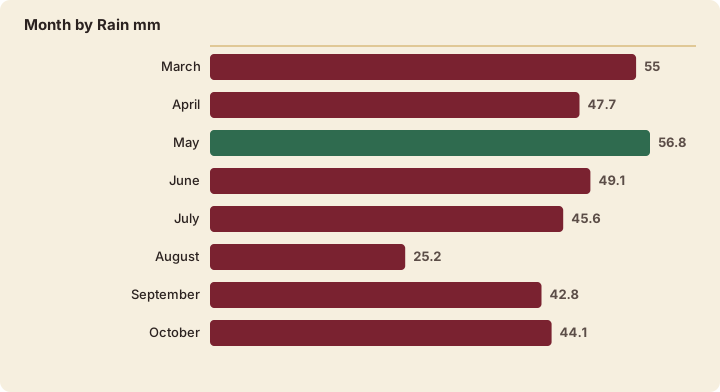
The climate table below is drawn from modelled normals for the grid cell near the Old Town, and it should be read as a planning range, not a forecast. Reanalysis smooths extremes in both directions, so a July afternoon on the cobbles can feel well above the monthly mean, and a January visit can meet snow; the site's winter pages cover that case. Rain is fairly evenly spread, with May the higher month at 56.8 mm and August the lower at 25.2 mm, so no month is defined by rain.
| Month | Mean high C | Mean low C | Rain mm |
|---|---|---|---|
| March | 12.1 | 2.1 | 55.0 |
| April | 17.1 | 6.4 | 47.7 |
| May | 21.9 | 11.5 | 56.8 |
| June | 25.9 | 15.4 | 49.1 |
| July | 28.2 | 17.9 | 45.6 |
| August | 28.6 | 18.1 | 25.2 |
| September | 23.8 | 13.8 | 42.8 |
| October | 18.1 | 8.8 | 44.1 |
Two seasonal arguments are worth weighing. Summer brings the Opera Open festival at the Ancient Theatre, which ran 23 June to 9 September in 2026, and the evenings in the theatre are the city's flagship cultural experience; but the midday heat sits squarely on the Old Town's stone, so summer visitors should tour the houses in the morning. Autumn brings Kapana Fest, whose 2026 autumn edition ran across two October weekends, and milder walking weather, and it is the season the climate figures favour for long days on the hills.
Winter has its own draw. Christmas in Plovdiv ran 28 November 2025 to 4 January 2026, with the 2026/27 edition, billed as the Soul of Christmas, announced for 1 December 2026 to 7 January 2027 across Kapana and Central Square. The house museums keep winter hours, the crowds thin, and January's mean low of -2.6 C is manageable with the right layers, though the houses themselves are not heated to modern comfort standards.
What Else Sits Around Georgiadi House In Plovdiv?
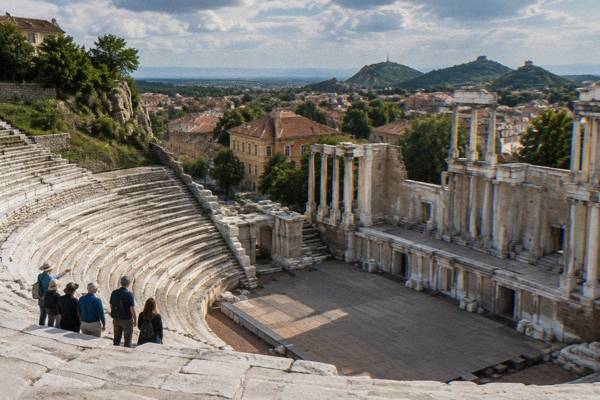
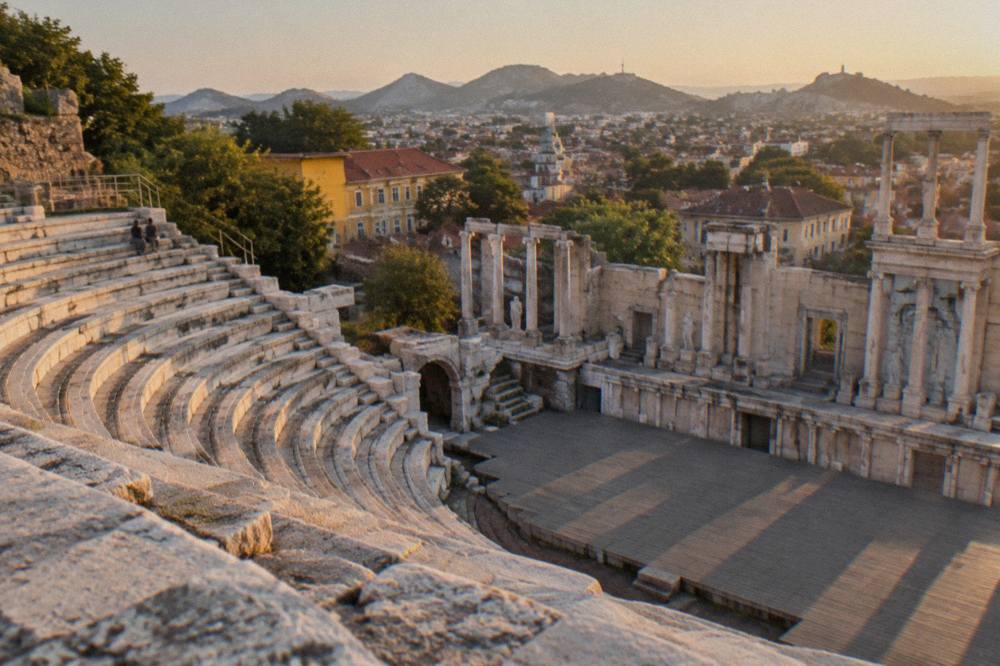
The Old Town packs the Ancient Theatre of Philippopolis, Nebet Tepe, Hisar Kapia, Dzhumaya Mosque and the Roman Stadium sphendone into the same walkable quarter as the house museums, with the theatre, built in the 90s AD with 28 concentric rows of marble seats, a few minutes' climb away and Nebet Tepe, free and open at all hours, directly above the houses. Everything on this list needs no transport once you are in the centre.
The theatre is the quarter's fixed star. Built in the 90s of the 1st century AD and described by the official page through its 28 concentric rows of marble seats rather than a capacity figure, it still hosts performances, and its viewing rows are included on the one-site ticket. Below the Old Town, at the foot of Main Street, the Roman Stadium's northern curve, the sphendone, lies open and free in the air, with the 3D projection hall beside it at 3.68 euro; only the northern part is excavated, the rest sleeps under the modern street, unearthed in the 1970s.
| Sight Near Georgiadi House | What It Is | Cost |
|---|---|---|
| Ancient Theatre | 1st century AD theatre, 28 rows of marble seats | One-site ticket, 3.58 euro |
| Nebet Tepe | Open-air hill complex, first settlement site | Free |
| Hisar Kapia | Surviving old gate at the quarter's edge | Free |
| Roman Stadium sphendone | Exposed northern curve of a 2nd century stadium | Free |
| Dzhumaya Mosque | Working mosque, about 1,500 sq m, free entry | Free |
| Kapana | Creative district, "The Trap" of narrow streets | Free |
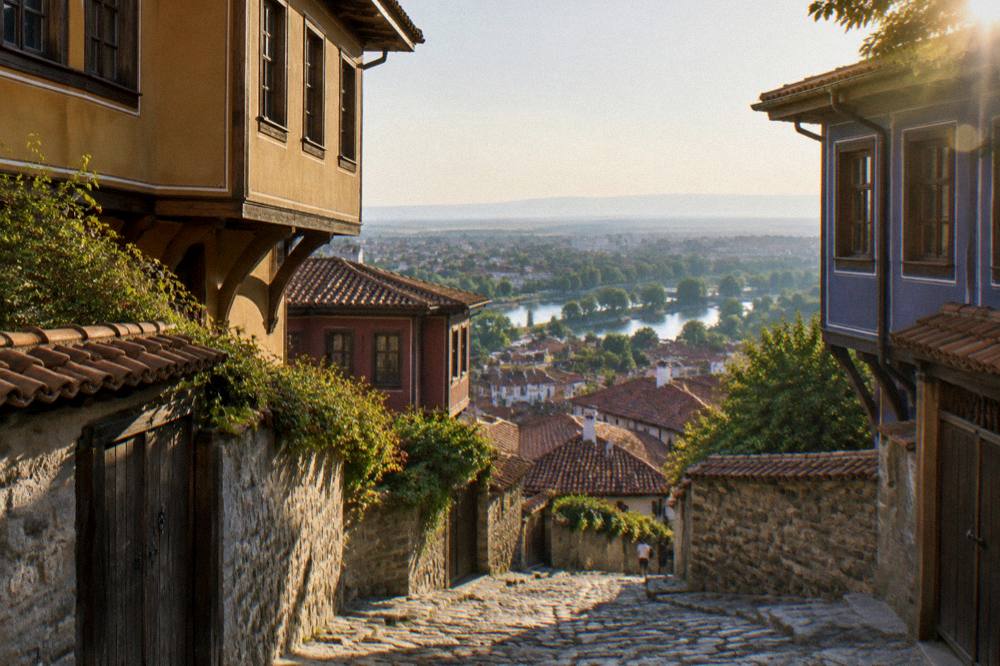
Nebet Tepe rewards the climb with the widest view over the plain and, per the city's tourism site, holds the earliest settlement traces in Plovdiv, dated to the 4th millennium BC. Dzhumaya Mosque, on the square beside Main Street, is a working mosque, the second-largest in Bulgaria by built area at about 1,500 sq m, free to visit outside prayer times with modest dress and shoes off; no single construction year is published, sources give years between the 14th and 16th centuries. The Dzhumaya Mosque page and the Nebet Tepe page cover both in depth.
For a fuller route through all of it, the site's things to do in Plovdiv collection and the Ancient Theatre page give the longer circuit, and a themed walk such as the one on the site's Old Town audio guide adds narration where the houses' own labels are sparse.
How Does Georgiadi House Fit Into A Day In Plovdiv?
A workable day pairs the house museums with the Ancient Theatre in the morning, uses the 12:30 lunch break for Kapana, then spends the early afternoon on the free open-air sights, the sphendone, Hisar Kapia and Nebet Tepe, finishing on a hill at sunset; the combined ticket covers the morning block, and the afternoon block costs nothing, so the whole day needs one ticket purchase and comfortable shoes.
The sequencing follows from the hours, not from taste. Ticketed sites open around 9:00 or 9:30 and take a lunch break at 12:30, so the morning is the window for Georgiadi House and its neighbours. The Ancient Theatre's rows are quickest to absorb, the houses reward slower looking, and two or three houses plus the theatre is a full morning at a reasonable pace. Kapana, five minutes downhill, absorbs the lunch hour. The free monuments have no hours at all, which makes them the natural afternoon, and Nebet Tepe's terraces face the plain for the evening light.
Travellers with more than a day can push outward. The Rhodopes begin at the city's southern edge, and day trips toward Bachkovo Monastery, which is free to enter as a working monastery, and Asen's Fortress run year-round from the Rodopi bus station or on organised tours. A day trip that pairs the Thracian heritage at Starosel with the murals of Staro Zhelezare is one of the options in the selection below.
Food fits the same geography. The traditional dishes of the region, shopska salad, kavarma, kebapche and tarator, appear on menus across the centre, and the site's Bulgarian food guide covers what to look for; a tasting walk through the centre is another way to meet the same cuisine, and the selection above includes one. Wine from the Thracian Valley, the Mavrud and Rubin reds grown in the hills south of the city, turns up on Kapana's lists, and the Bulgarian wine guide explains the labels.
Common Questions About Georgiadi House In Plovdiv
Is Georgiadi House included in the Old Plovdiv combined ticket?
Yes. The combined ticket covers up to five Old Plovdiv sites, the historic houses among them, at 10.74 euro for adults and 4.09 euro for students, while excluding the Small Basilica and the Bishop's Basilica. Its validity period is not published on the ticket page, so confirm it at the ticket office.
How much is a single ticket to Georgiadi House in Plovdiv?
A single adult ticket to any one Old Plovdiv site is 3.58 euro, with pupils and students at 1.53 euro and a family ticket at 7.16 euro, per the Old Plovdiv ticket page. Children aged 7 and under and visitors with more than 50 percent disability enter free.
When is Georgiadi House open?
Old Plovdiv houses generally follow a two-season pattern, about 9:00 or 9:30 to 18:00 from April to October and 9:00 to 17:30 from November to March, with a lunch break around 12:30 to 13:00. Individual houses vary their closing days, so confirm the house's own days before a tight itinerary.
Can you buy tickets in advance for Georgiadi House?
The Old Plovdiv sites sell tickets at the gates, and no city card or bundled pass covering them exists. Free entry applies the first Thursday of the month for students and seniors at Old Plovdiv sites per the listings.
Is Georgiadi House the same as the Ethnographic Museum in Plovdiv?
No. The Ethnographic Museum is the Kuyumdzhiev House, a separate museum at the top of the Old Town with its own price list and a Monday closing. Georgiadi House is one of the revival houses on the shared Old Plovdiv ticket list.
How long does a visit to Georgiadi House take?
A single house visit is a short stop on an Old Town circuit; most of a morning goes to the combination of two or three houses plus the Ancient Theatre on the combined ticket. The rest of the quarter, its lanes, viewpoints and free monuments, fills the remainder of the day at no cost.
Georgiadi House earns its place on that ticket as one room in a much larger house: the story of Plovdiv's Revival quarter, read best house by house, on streets that have changed less than almost anywhere else in the city, with a ticket system that makes seeing all of it the cheaper option.