Plovdiv History: Thracians, Romans, Ottomans And The Revival
Plovdiv, in southern Bulgaria, is often described as one of the oldest continuously inhabited cities in Europe, and the layers under its six hills run from a Thracian hillfort, through Roman Philippopolis and Ottoman Filibe, to the Revival houses of the Old Town.
Short answer
Plovdiv's first settlement on Nebet Tepe is dated to the 4th millennium BC by the city's tourism site. Romans built the Theatre and the Stadium, Byzantine builders raised the basilicas, Ottoman rule shaped the town for five centuries, and the National Revival produced the Old Town houses visitors see today.
Plovdiv, in southern Bulgaria, is an inland city built around six hills, and it is often described as one of the oldest continuously inhabited cities in Europe. The official city tourism site dates the first settlement on Nebet Tepe to the 4th millennium BC, and everything that came after, Thracian, Macedonian, Roman, Byzantine, Ottoman and Bulgarian, left something standing within about two kilometres of that hill. This page walks the full timeline, naming what each era built and what a visitor can still see, with every figure drawn from the city's own published sources. The story is easier to follow on foot: the things to see across Plovdiv cluster tightly around the Old Town, and this Plovdiv Travel Guide page supplies the history behind them.
Why Is Plovdiv Described As One Of The Oldest Continuously Inhabited Cities In Europe?
Plovdiv is often described as one of the oldest continuously inhabited cities in Europe, and the official city tourism site dates the first settlement on Nebet Tepe to the 4th millennium BC. The city makes no single "oldest" ranking against any other city, and neither does this page; the claim is one of continuous habitation, not a title.
Continuity is the word that matters. Plenty of European places have older archaeological traces, but settlement on Plovdiv's hills did not stop. The city's tourism site traces the development of the ancient city from the Thracian settlement on Nebet Tepe onward, through every conqueror that arrived, and the sequence of names it carried is itself a timeline: Evmolpias and Philippopolis in antiquity, Trimontium under Rome, Pulpudeva, Puldin and Filibe in between, and Plovdiv today. Each name belongs to a chapter below.
The hills set the stage. There were seven until the 1930s, when Markovo Tepe was partly quarried away; six remain, and three of them, Nebet Tepe, Dzhambaz Tepe and Taksim Tepe, form the Three Hills around which the Old Town grew. Nebet Tepe itself is now a free, open-air archaeological complex after a restoration project officially opened in March 2025, so the starting point of the whole story can be walked at no cost at any hour. The free things to do in Plovdiv guide lists it among the city's free sights.
Who Lived In Plovdiv Before The Romans?
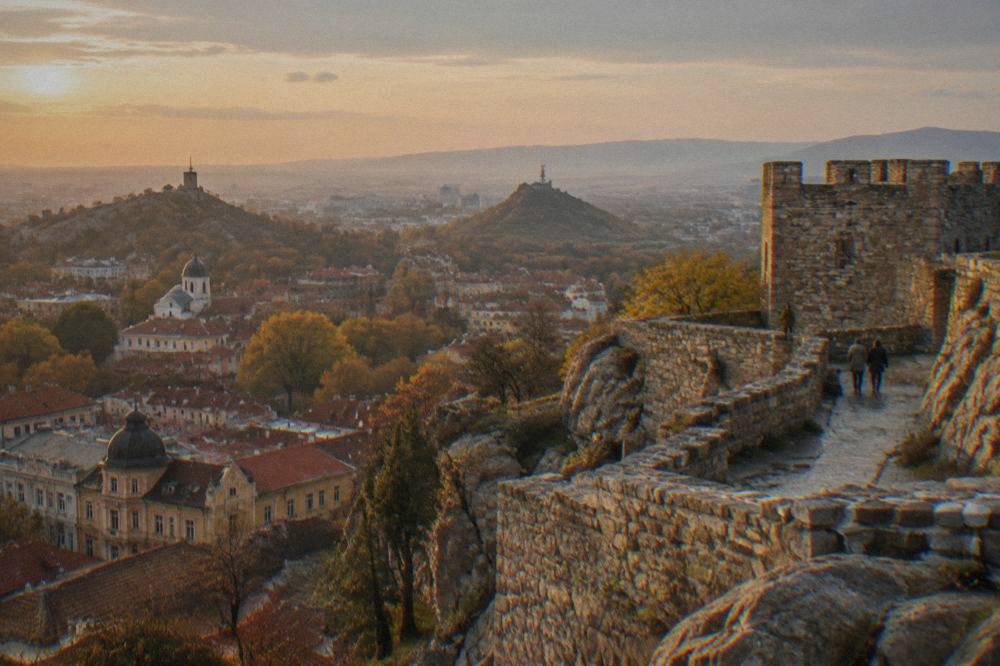
Before the Romans, the hills were a Thracian settlement: the city's tourism site traces the first settlement on Nebet Tepe to the 4th millennium BC and the development of the ancient town from a Thracian hillfort that Greek sources later called Evmolpias.
The Thracian layer is the least visible and the most consequential. Nebet Tepe's position, 207 m above the plain, made it a natural fortress, and the fortress walls that stand there today were rebuilt and reused by every later ruler, Thracian, Macedonian, Roman and Byzantine, which is exactly why archaeologists read the hill as a layered archive rather than a single monument. The Thracian world around Plovdiv also left tombs and temple complexes in the region, and the Thracian cult complex at Starosel, reachable on a day trip from the city, is the largest of its kind; its full guide covers what is known and what a visit involves.
Philip II's conquest fixed the city's name. The Roman era kept Philippopolis, adding Trimontium, "city of the three hills", as a second name, and both appear on coins and inscriptions found in the city. The historical names the city's tourism site lists, Kendrissos, Evmolpias, Philippopolis, Trimontium, Ulpia, Flavia Julia, Pulpudeva, Puldin, Plapdiv, Ploudin, Filibe and Plovdiv, map cleanly onto the political history below.
| Era | Ruler or culture | Name used | What remains visible today |
|---|---|---|---|
| 4th millennium BC onward | Thracian settlement | Evmolpias (later Greek name) | Nebet Tepe fortress layers |
| 4th to 6th century | Early Byzantine | Puldin / Pulpudeva | Bishop's Basilica, Small Basilica, fortress walls |
| Modern era | Bulgaria | Plovdiv | Revival houses, 2019 Capital of Culture legacy |
The Roman layer is where the city's history becomes a walkable open-air museum, and a guided route through those streets explains what the stones alone do not. A themed heritage walk such as the Jewish Walking Tour of Plovdiv covers one specific thread of the post-Roman story, the Jewish quarter and community history around the Ancient Theatre, and pairs well with the general Roman route below.
What Did The Romans Build In Philippopolis?
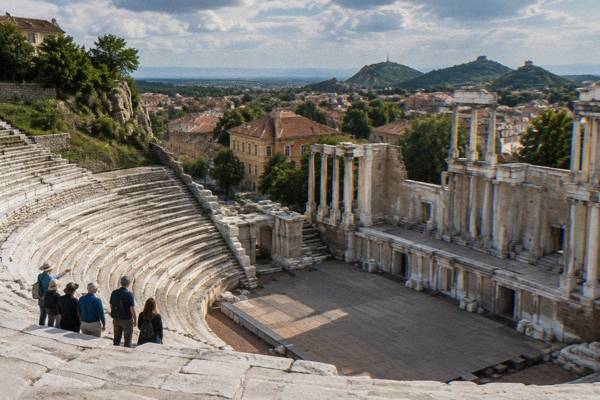
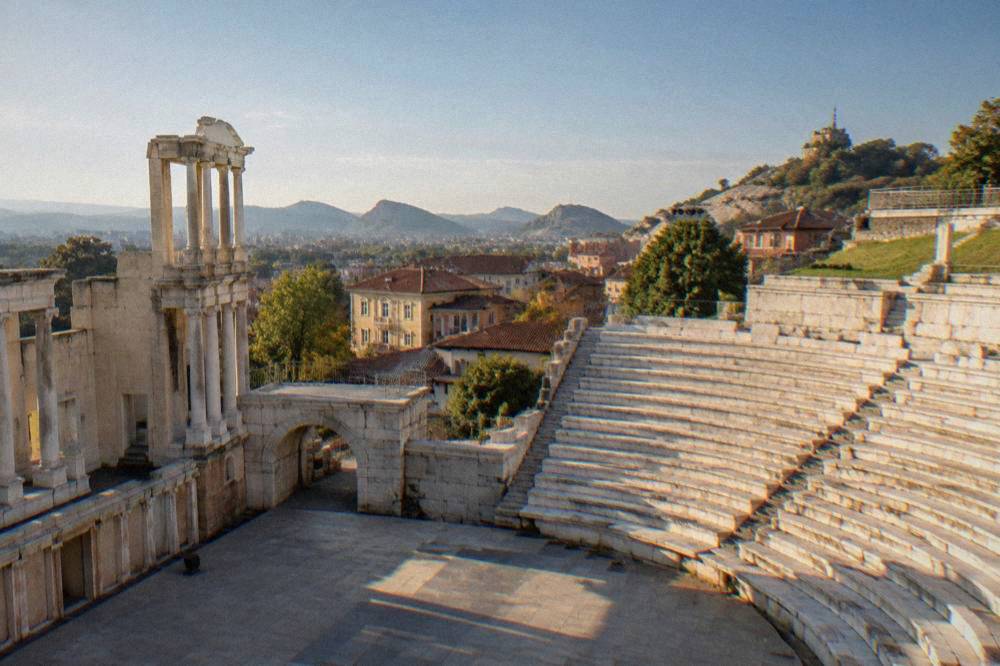
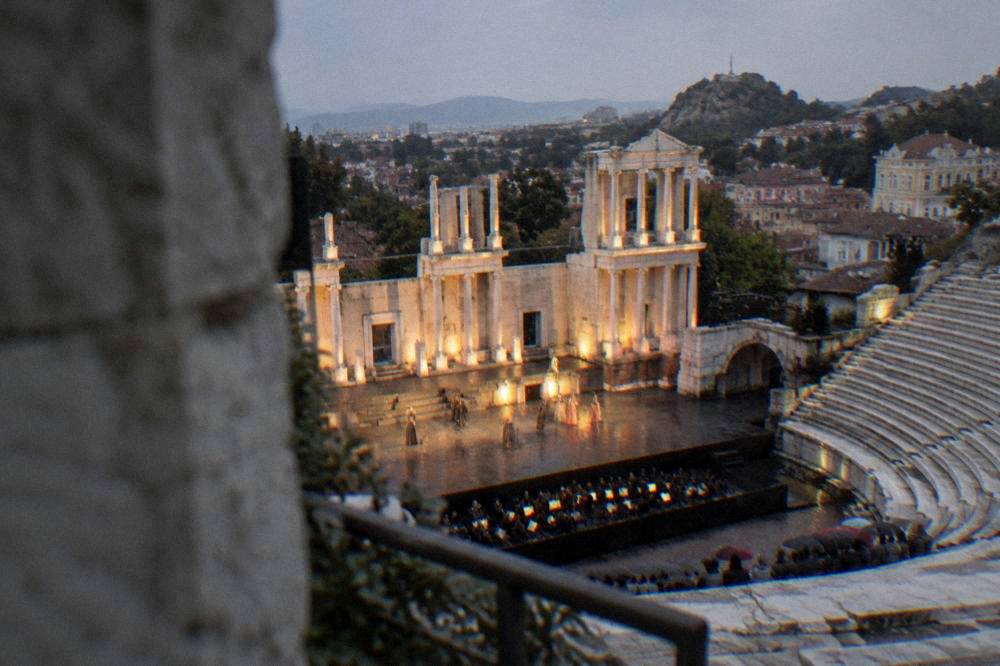
Roman Philippopolis, which Thrace's incorporation into the empire turned into a major provincial city, left Plovdiv its three great public monuments: the Ancient Theatre built in the 90s AD with 28 concentric rows of marble seats, the Roman Stadium built in the 2nd century AD on the model of the stadium at Delphi, which held up to 30,000 spectators, and the Roman Forum with its Odeon. All four can be visited on foot within the modern centre.
The Ancient Theatre is the headline. It was built in the 90s of the 1st century AD, sits on the slope of the Three Hills facing the plain, and its 28 concentric rows of marble seats are the figure the official page gives; no seat-capacity number belongs on this page. Tickets are sold by the Old Plovdiv municipal institute: an adult one-site ticket costs €3.58, a pupil or student ticket €1.53, and entry is free for children under 7. The Roman Plovdiv guide unpacks the whole Roman itinerary.
The Roman Stadium is the paradox of the set. Built in the 2nd century AD and able to hold up to 30,000 spectators along its track, it lies mostly under the modern Main Street: only the northern curved end, the sphendone, unearthed in the 1970s, is accessible today, so the idea that it is fully excavated is simply wrong. The sphendone is free to view, and a 3D projection hall beside it reconstructs the rest; the Roman Stadium guide gives hours and ticket combinations.
| Roman monument | Built | Key figure | Ticket situation |
|---|---|---|---|
| Ancient Theatre of Philippopolis | 90s of the 1st century AD | 28 concentric rows of marble seats | Old Plovdiv one-site ticket, adult €3.58 |
| Roman Stadium | 2nd century AD | Up to 30,000 spectators | Sphendone free; 3D hall adult €3.68 |
| Roman Odeon | Roman era, restored | Small covered theatre | Old Plovdiv one-site ticket applies |
| Roman Forum | Roman era | Public square complex | Outdoor remains, public space |
| Bishop's Basilica (post-Roman, 4th to 6th century) | Early Byzantine | Over 2,000 sq m of floor mosaics | Priced separately, adult €7.57 |
The four Roman-era sites sit inside a fifteen-minute walk of each other, which is why so much of the Old Town itinerary is effectively a Roman tour with a modern city attached.
What Happened To Plovdiv After Rome Fell?
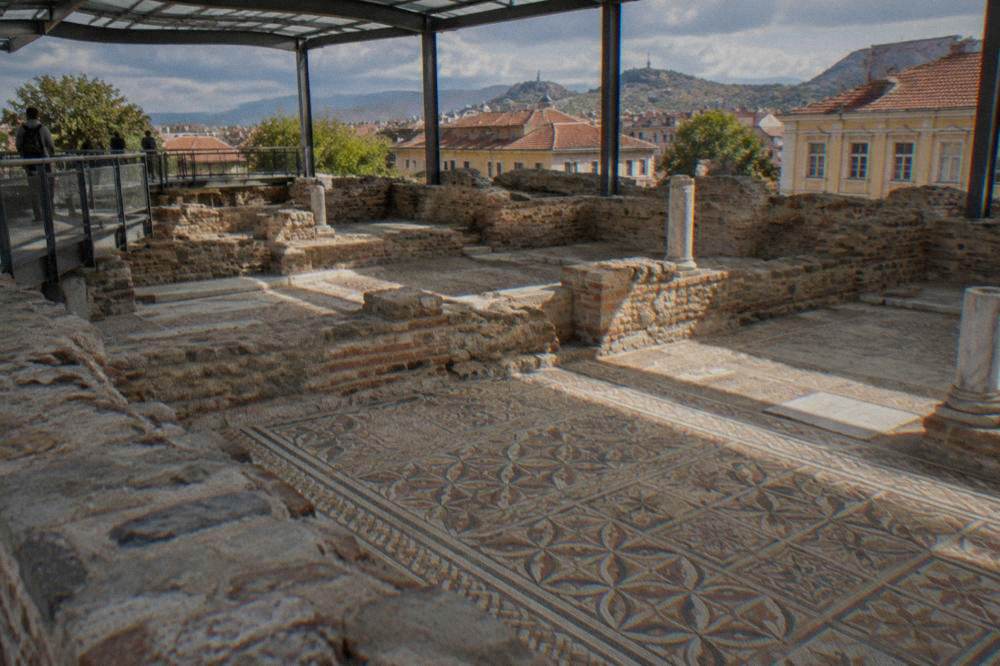
After the Roman period Plovdiv passed between Byzantium and Bulgaria repeatedly, and its most durable monuments from those centuries are Christian: the Bishop's Basilica, about 83 m long and 36 m wide, the largest 4th to 6th century basilica in Bulgaria with two layers of floor mosaics covering over 2,000 sq m, and the 5th to 6th century Small Basilica with its mosaic floors. Both are open daily and both are priced on the Old Plovdiv ticket list.
The Bishop's Basilica, next to the modern Central Square, is the largest 4th to 6th century basilica in Bulgaria, about 83 m long and 36 m wide, with two layers of floor mosaics amounting to over 2,000 sq m; after a long restoration it now operates with a visitor centre, open daily 9:00 to 18:00 year round, adult ticket €7.57. The Small Basilica, a three-nave 5th to 6th century church with mosaic floors, is covered by the ordinary one-site ticket.
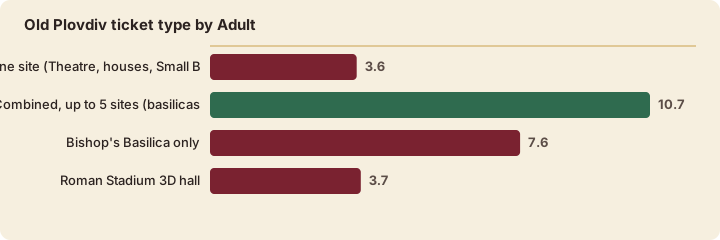
A combined ticket covering up to five Old Plovdiv sites, excluding the two basilicas, costs €10.74 for adults, but its validity period is not stated on the official ticket page, so check at the desk.
| Old Plovdiv ticket type | Adult | Student / pupil | Family (parents with children 7 to 16) |
|---|---|---|---|
| One site (Theatre, houses, Small Basilica) | €3.58 | €1.53 | €7.16 |
| Combined, up to 5 sites (basilicas excluded) | €10.74 | €4.09 | €21.47 |
| Bishop's Basilica only | €7.57 | €3.58 | €15.34 |
| Roman Stadium 3D hall | €3.68 | €1.23 | not listed |
The practical detail that surprises readers is the free-day rule: Old Plovdiv sites admit students and seniors free on the first Thursday of the month, and the Regional History Museum is free for everyone that day. Museum days matter in the other direction too: the Regional Archaeological Museum is closed Monday, as is the Ethnographic Museum, whose Kuyumdzhiev House holds the Revival costume collection described below.
What Did Ottoman Rule Leave Behind In Plovdiv?
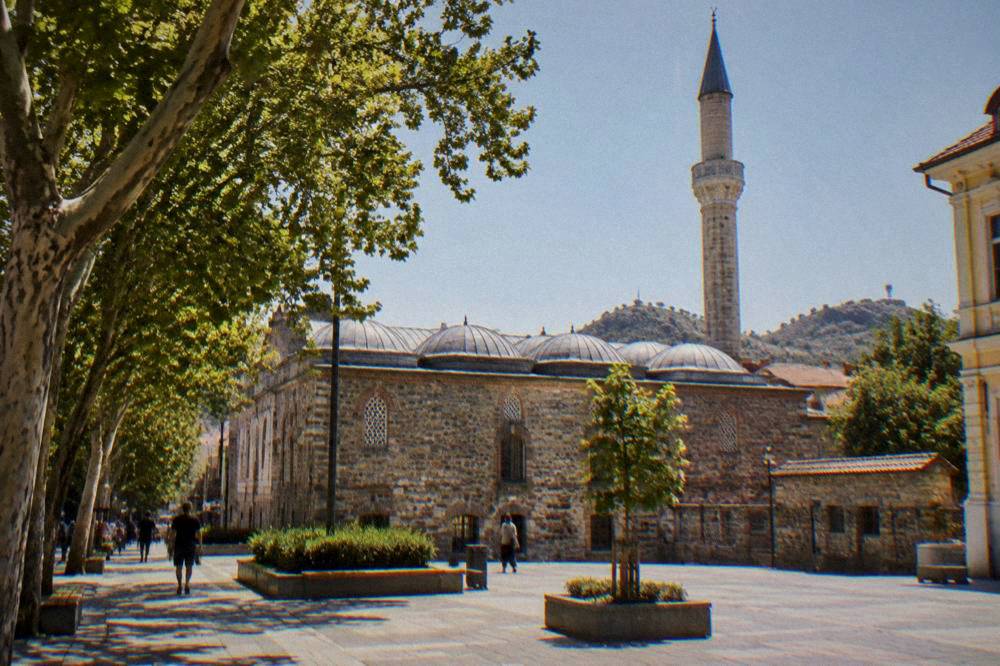
Ottoman rule, which lasted for about five centuries, made Plovdiv into Filibe, a provincial centre whose most visible legacy today is the Dzhumaya Mosque in the city centre, a working mosque described by the city's own page as the second-largest in Bulgaria by built area at about 1,500 sq m. No single construction year can be given: the city's page states that sources place its building between the 14th and 16th centuries.
That date range is not scholarly vagueness for the sake of it; the city's own listing declines to pick one year, and this page follows it. The mosque stands on the square where the Roman Stadium's track once ran, which makes it the clearest single illustration of how Plovdiv's eras stack: a Roman sports ground, an Ottoman religious building and a modern pedestrian shopping street, all in one frame. Entry is free, opening for visits runs 6:00 to 23:00, and the standard rules of a working mosque apply: modest dress, shoulders and knees covered, shoes off, and visits avoided around prayer times. The Dzhumaya Mosque guide covers etiquette in full.
Ottoman Plovdiv was also a trade city, and that shape determined what came next. Caravan routes, bazaars and artisan quarters, including the tangle of streets now called Kapana, "The Trap", grew up between the Three Hills and the Maritsa river.
What Was The Bulgarian National Revival In Plovdiv?
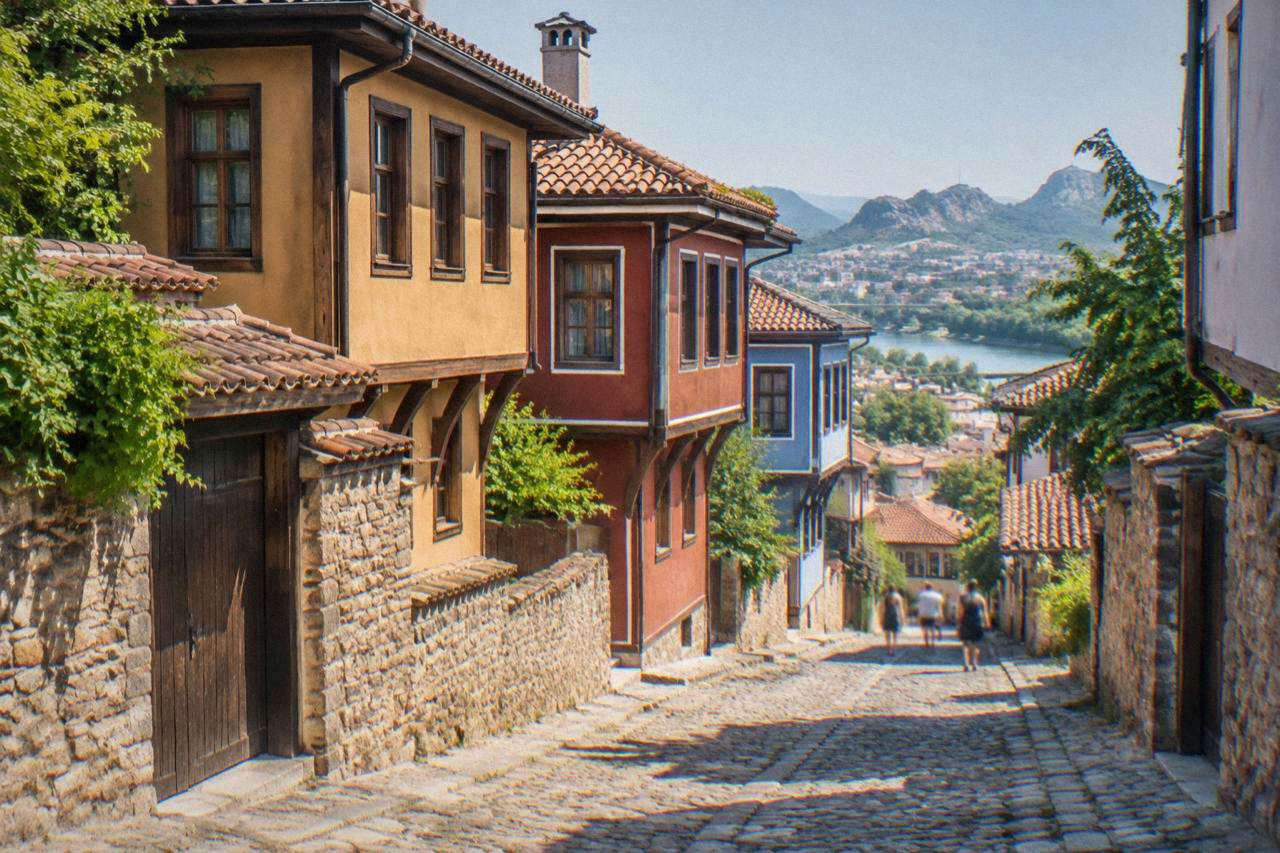
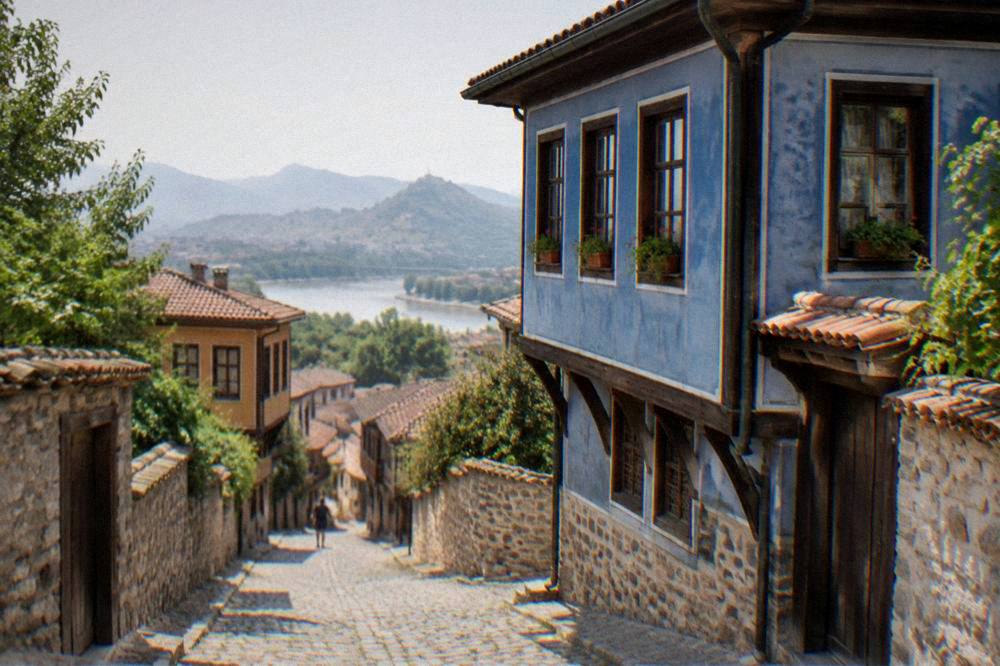
The Bulgarian National Revival, the cultural and economic renaissance that preceded independence, produced the Plovdiv Old Town: the fortified merchant houses of the Revival decades, including Balabanov, Hindliyan, Nedkovich and Lamartine houses, built by Bulgarian traders . These houses are the core of "The Ancient Plovdiv", the ensemble Bulgaria placed on its UNESCO Tentative List in 2004, and several are open as museums under the Old Plovdiv ticket system.
The houses were built when Filibe's Bulgarian merchant class controlled trade routes and spent its money on display, schools and churches, and the conflict that followed, church independence from the Greek patriarchate and then the April Uprising, is the political half of the Revival. Plovdiv was liberated from Ottoman rule, then served as capital of Eastern Rumelia before joining the Bulgarian principate, events commemorated in the European Capital of Culture legacy that the city carried much later, in 2019, shared with Matera.
A note on UNESCO, because the internet gets it wrong constantly: Plovdiv's Old Town is not a World Heritage Site. "The Ancient Plovdiv" sits on Bulgaria's Tentative List, submitted on 14 September 2004, which is a waiting list and not an inscription. The houses are protected nationally and administered by the Old Plovdiv municipal institute, whatever the tentative status does next.
| Revival house / museum | What it shows | Ticket |
|---|---|---|
| Balabanov House | Reconstructed merchant mansion, concert venue | One-site ticket, adult €3.58 |
| Hindliyan House | Wall paintings and period interiors | One-site ticket |
| Nedkovich House | Revival-era townhouse, facade and interiors | One-site ticket |
| Lamartine House | Memorial to the French poet Alphonse de Lamartine | One-site ticket |
| Regional Ethnographic Museum (Kuyumdzhiev House) | Revival costumes, crafts, interiors | About €3.07 adult, closed Monday |
The Ethnographic Museum is the interpretive key to all of them: its collections put the houses' objects, costumes and tools in context, and its own building is one of the grandest Revival houses in the city. The Balabanov House page and the Georgiadi House page describe the two most visited interiors individually.
How Did Plovdiv Become The City Visitors See Today?
Modern Plovdiv, Bulgaria's second-largest city with a population of 333,994 as of 31 December 2025 per the National Statistical Institute, grew as an industrial and fair city through the 20th century, regained its Old Town as a protected conservation area under the socialist period, and re-entered the European cultural map as European Capital of Culture 2019, shared with Matera, an event that funded the restoration of the basilicas and Nebet Tepe.
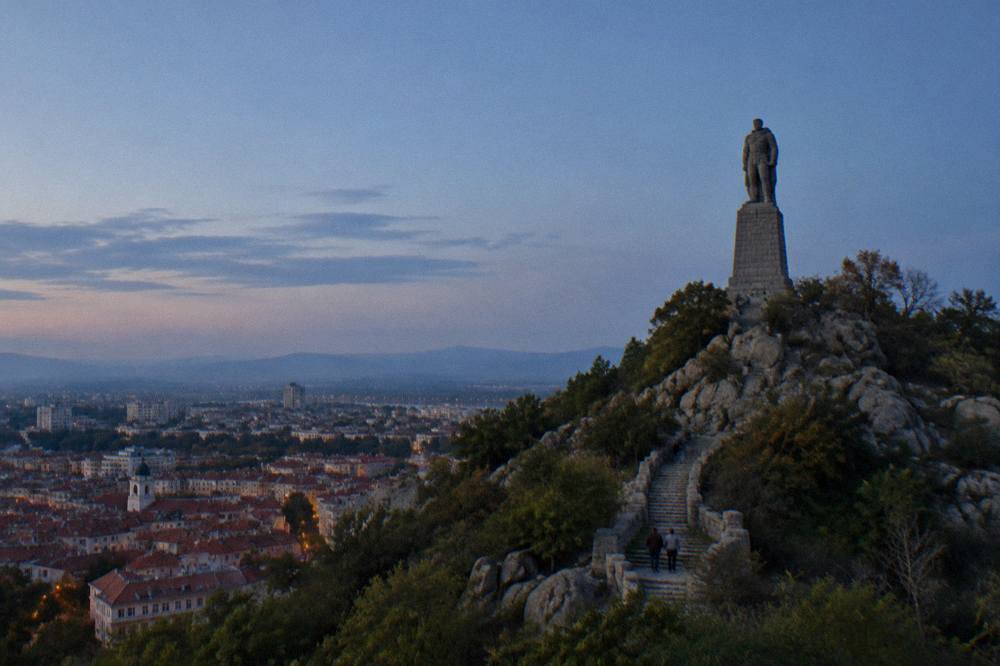
The 20th century reshaped the city twice. First came industry and the trade fairs of the International Fair Plovdiv, whose spring editions still anchor the city calendar, with Agra and Vinaria running 17 to 21 February in 2026. Then came the socialist period, which built the wide boulevards and panel suburbs, preserved the Alyosha monument, unveiled in 1957, on Bunardzhik hill, and, decisively for today's visitor, designated the Old Town a protected conservation area, which is why the Revival houses survived at all.
The decades after the fall of socialism delivered the projects a visitor now benefits from. The Bishop's Basilica mosaics were excavated, conserved and opened with a visitor centre; Nebet Tepe's restoration under the EU-funded fortress-walls project opened in March 2025; the Regional Archaeological Museum renewed its permanent exhibition in November 2025 with about 150 new exhibits and a bilingual audio guide; and the 2019 Capital of Culture year, shared with Matera, left the city a denser festival calendar, from Opera Open in the Ancient Theatre to Kapana Fest, whose autumn 2026 edition ran 2 to 4 and 9 to 11 October. The festivals guide tracks what runs when.
Practical Plovdiv has changed too, and recent changes matter to planning. Arrivals run through Sofia, with direct BDZ trains taking about 2 h 40 to 3 h 05, or through the small Plovdiv Airport at Krumovo; the Sofia to Plovdiv guide covers the rail options and the getting around guide the local ones.
| Year | Event in Plovdiv's modern history |
|---|---|
| 1957 | Alyosha monument unveiled on Bunardzhik |
| 2019 | European Capital of Culture, shared with Matera |
| November 2025 | Regional Archaeological Museum's renewed permanent exhibition opens |
| March 2025 | Nebet Tepe restoration officially opened |
| 1 January 2025 | Bulgaria becomes a full Schengen member |
| 1 January 2026 | Bulgaria adopts the euro |
Which Historic Sites Should A First-Time Visitor Prioritise?
A first visit to Plovdiv should prioritise four historic sights, the Ancient Theatre, the Roman Stadium sphendone, the Bishop's Basilica mosaics and one Revival house museum, all within a fifteen-minute walk of each other, plus Nebet Tepe for free and the Dzhumaya Mosque square for the layering of eras; the total ticket cost for that set is under €20 per adult at the prices published on the Old Plovdiv list.
Two full days is the comfortable pace. Day one covers the Roman and early Christian core on the flat: the Stadium under the Main Street, the Forum and Odeon, the Bishop's and Small Basilicas, ending with Opera Open or a concert in the Ancient Theatre if the calendar allows. Day two climbs the Three Hills: Nebet Tepe first thing, then the Revival houses and the Ethnographic Museum, down through Hisar Kapia into Kapana for the evening. The itinerary pages break this down by length, and the where to stay guide explains why the Old Town and Kapana edges put all of it on foot.
Readers who want the history explained rather than read from plaques have three thematic options on this site: the Jewish heritage walk through the quarter by the Ancient Theatre, the food and culture walk that connects Revival-era cuisine to the modern Kapana table, and the Starosel and Staro Zhelezare trip that pushes the timeline back before Philip II into the Thracian heartland. The Roman Plovdiv guide does the deepest single-era dive for independent walkers.
Common Questions About Plovdiv History
Is Plovdiv the oldest city in Europe?
No such ranking can be stated. Plovdiv is often described as one of the oldest continuously inhabited cities in Europe, and its tourism site dates the first settlement on Nebet Tepe to the 4th millennium BC, but no comparison against other cities can be stated.
Is Plovdiv Old Town a UNESCO World Heritage Site?
No. "The Ancient Plovdiv" sits on Bulgaria's UNESCO Tentative List, submitted on 14 September 2004, which is a waiting list and not an inscription.
What does the name Philippopolis mean?
The Romans kept the name alongside Trimontium, "city of the three hills".
When was the Dzhumaya Mosque built?
No single year is printed by the city: its own page states that sources give construction dates between the 14th and 16th centuries. The mosque is free to visit outside prayer times, with modest dress required.
How much of the Roman Stadium can you see?
Only the northern part, the sphendone, is accessible, unearthed in the 1970s; the rest of the stadium, built in the 2nd century AD for up to 30,000 spectators, lies under the modern Main Street.
The history of Plovdiv is not a museum behind glass; it is a functioning city where a Thracian hillfort, a Roman theatre, an early Christian basilica, an Ottoman mosque and a Revival mansion stand within sight of one another, and every ticket in the tables above puts a visitor inside one of those layers rather than outside it.