Bulgarian Phrases For Plovdiv: Hello, Thank You And Nodding
Plovdiv, in southern Bulgaria, is a city where the street signs, menus and museum labels run in Cyrillic, and a handful of spoken Bulgarian phrases opens more doors than a phrasebook app. This guide covers the words worth memorising, the nodding habit that reverses everything, and what English a visitor can realistically expect.
Short answer
Learn zdravey (hello), blagodarya (thank you), molya (please), and da and ne for yes and no, and know that many Bulgarians shake the head for yes and nod for no. English is common in Plovdiv's tourist core, scarcer in shops and buses. Cyrillic is helpful for reading street signs and menus but not required for a short visit.
Plovdiv, Bulgaria's second-largest city, sits on six hills in the south of the country, and nearly everything written on its walls, from the street signs in Kapana to the menu boards on Main Street, uses the Cyrillic alphabet. Bulgarian is the official language, and it is a Slavic language written in Cyrillic script, which surprises first-time visitors more than anything else about the practical side of the city. A short list of spoken phrases, together with an understanding of the local head shake, covers an enormous share of everyday interactions, and this guide sets out exactly which words earn their place in your memory and which can stay in the phone.
The language question in Plovdiv has two layers. One is what to say: the greetings, politeness words and menu vocabulary that make transactions smoother. The other is what you will hear and read: how much English exists in the tourist core, how far Cyrillic literacy stretches a visit, and why the answer to "do you speak English" is usually a shrug followed by fluent English anyway. Both layers are covered below, with pronunciation rendered in a simple Latin approximation, because Bulgarian stress and the Cyrillic alphabet deserve a short honest briefing rather than a pretend course.
What Are The Most Useful Bulgarian Phrases For Plovdiv?
The ten phrases that carry a Plovdiv trip are zdravey (hello), dobur den (good day), blagodarya (thank you), molya (please and you're welcome), da (yes), ne (no), izvinete (excuse me), kolko struva (how much does it cost), govorite li angliyski (do you speak English), and dovizhdane (goodbye). Bulgarian is written in Cyrillic, so the same words appear on signs as здравей, благодаря, моля, да and не, and recognising both forms is what turns a phrase list into a working tool on the street.
Start with greetings, because they set the tone of every interaction. Zdravey (здравей) is the informal hello, and zdraveyte (здравейте) is the plural or polite form, used with strangers, staff and anyone older. Dobur den (добър ден), good day, is the safe default in shops and museums, and dobro utro (добро утро) and dobur vecher (добър вечер) cover morning and evening. Dovizhdane (довиждане) closes the exchange politely.
Politeness words do heavy lifting in Bulgarian, and two of them cover nearly everything. Blagodarya (благодаря) is thank you, and molya (моля) means please, you're welcome and here you are, depending on context. Izvinete (извинете) is excuse me or sorry, the word for working past someone on a crowded Main Street or getting a server's attention. Leka nosht (лека нощ), good night, is a friendly close at a restaurant or hotel desk.
| Bulgarian (Cyrillic) | Latin form | Meaning | Where it fits in Plovdiv |
|---|---|---|---|
| здравей / здравейте | zdravey / zdraveyte | hello (informal / polite) | entering a shop in Kapana |
| добър ден | dobur den | good day | museums, ticket desks |
| благодаря | blagodarya | thank you | everywhere |
| моля | molya | please, you're welcome | receiving change, a coffee |
| извинете | izvinete | excuse me, sorry | crowded Main Street |
| да / не | da / ne | yes / no | answering any question |
| колко струва | kolko struva | how much does it cost | markets, stalls |
| говорите ли английски? | govorite li angliyski? | do you speak English? | hotels, restaurants |
| довиждане | dovizhdane | goodbye | leaving a café or shop |
Numbers matter for shopping and buses, and Bulgarian numerals are mercifully familiar once spoken. Edno, dve, tri, chetiri, pet (1 to 5) and deset (10), dvadeset (20), sto (100) handle prices in euro, the currency since 1 January 2026.
Pronunciation has one rule worth more than the rest: Bulgarian stress moves between words and is not marked in writing, so a word learned with the wrong stress will still usually be understood, but listening matters more than perfect speaking. The letter ж sounds like the s in measure, ч like ch, ш like sh, and the combination ь shapes soft consonants. Nobody expects a visitor to master this, and effort is met with warmth far beyond its accuracy, a pattern consistent across the region rather than a measured local statistic.
Do Bulgarians Really Shake Their Head For Yes In Plovdiv?
Yes, the reversed head gesture is real and current in Plovdiv: many Bulgarians indicate yes by a single shake of the head from side to side and no by a brief nod or a tilt, the opposite of the gesture used in Western Europe and North America. The habit is fading among younger people and in tourist-facing roles, but it survives in shops, markets and taxis, so when a spoken answer is ambiguous, listen for the word da (yes) or ne (no) rather than trusting the head.
The gesture is called the Bulgarian nod, and it has a folk explanation repeated across the country: the story goes that Ottoman soldiers would force villagers to nod assent, and Bulgarians reversed the motion to say yes while technically not nodding. The story is folklore, not documented history, so treat it as a legend told rather than a fact cited. What is verifiable is the gesture itself, and visitors notice it within days, often after a confusing exchange in a bakery.
The practical defence is simple. Pair every question with a spoken word: da ili ne, yes or no, forces a verbal answer. When asking a shopkeeper whether a card payment works, or a server whether a dish contains something, listen for the word rather than watching the head. In reverse, a visitor's own Western nod can cause confusion, and saying da or ne aloud while nodding resolves it instantly, because the spoken word overrides the gesture in both directions.
Gesture use varies in ways worth naming plainly. A side-to-side shake that means no at home often means yes here; an up-and-down nod that means yes at home often means no here; a brief tilt of the head back can be a casual no or simply a greeting; and raised eyebrows with a nod usually signal confirmation or interest. The safest single habit is verbal confirmation, repeated once, for anything that matters: a bus destination, a bill, an allergy, a closing time. The table below is a planning aid, not a rulebook, since gesture use varies by person, age and setting, and in Plovdiv's Old Town ticket desks and tour-facing businesses staff typically calibrate to visitors.
For travellers who want language and history together, a themed walk is an efficient compromise. The Jewish heritage walking tour of Plovdiv traces a specific community's story through the city, and guides on such walks interpret inscriptions, street names and archive material that a phrase list cannot unlock; Check availability if that angle appeals. Tip-based city walks also run locally, and the arrangement with those is always to confirm the meeting point and the tipping custom with the guide directly.
How Much Cyrillic Do You Need To Read In Plovdiv?
Reading Cyrillic is genuinely useful in Plovdiv but not required for a short visit: street signs, bus destinations, shop signs and some menus appear in Cyrillic only, while the Old Town museum signage, major attractions and hotel fronts carry English translations. Learning the alphabet takes an hour or two with a transliteration chart, and the highest-value letters to recognise are П (P), Р (R), Н (N), С (S), В (V) and У (U), because their Latin look-alikes map to different sounds and cause the classic misreadings.
The trap letters deserve their own short list. The Cyrillic Н is the Latin N sound, the Cyrillic Р is the Latin R, the Cyrillic С is the Latin S, and the Cyrillic В is the Latin V. A sign reading РЕСТОРАНТ therefore reads restaurant, and ЦИРК is circus. Once those six letters are fixed, most shopfronts and street names become decodable with a phone dictionary, and place names in Plovdiv reward the effort: Капана is Kapana, ул. Цар Борис III is Tsar Boris III Street, and Й on a menu is part of a vowel sound, not a stray accent.
| Cyrillic letter | Sounds like | Common trap? | Example you'll see in Plovdiv |
|---|---|---|---|
| Н | N | yes, looks like H | ПЛОВДИВ (Plovdiv) |
| Р | R | yes, looks like P | РЕСТОРАНТ (restaurant) |
| С | S | yes, looks like C | КАПАНА street signs |
| В | V | yes, looks like B | ВХОД (entrance) |
| У | U | mild | ИЗХОД (exit) |
| К | K | no | КАФЕ (café) |
| М | M | no | МЕНЮ (menu) |
| Х | H (as in loch) | yes, looks like X | ХЛЯБ (bread) |
Practical reading targets, in order of value: ВХОД and ИЗХОД (entrance and exit) at museums and the train station, ОТВОРЕНО and ЗАТВОРЕНО (open and closed) on shop doors, МЕНЮ posted outside restaurants, and the bus destination display on the front of city buses, which often shows the terminus in Cyrillic only. Free public spaces in Plovdiv, including Kapana and Nebet Tepe, carry no signage obligations at all, and the major sights covered in the site's guide to free things to do in Plovdiv need no reading whatsoever.
Menus reward a small food vocabulary. Many restaurants in the centre print English menus on request, but smaller kitchens in Kapana and the neighbourhoods may not, and dishes like shopska salad, banitsa, kavarma and kebapche are described in detail in the site's Bulgarian food guide. Recognising месо (meat), пиле (chicken), сирене (white cheese), супа (soup) and салата (salad) covers half of any menu, and the rest of the what to eat in Plovdiv guide handles the translation work for you.
Can You Get By With English In Plovdiv?
English works comfortably across Plovdiv's tourist core: hotels, museums, ticket desks, restaurants on Main Street and the Old Town, and tour operators overwhelmingly serve visitors in English, and younger staff switch to it unprompted. Coverage thins in local shops, suburban buses, markets and among older residents, where gesture, a translation app and the phrases above carry the exchange. A visitor who speaks neither Bulgarian nor English will find the task harder, since English is the city's main shared second language rather than one option among several.
No percentage or ranking of English proficiency is claimed here. What can be said is structural: Plovdiv was a European Capital of Culture in 2019, shared with Matera, and the tourism infrastructure built around that year, from museum interpretation to guiding services, operates in English as standard. The municipal Old Plovdiv institution maintains an English ticket page, and the city's tourism site publishes in English, which reflects where the visitor economy expects its audience to come from.
Where English thins out, two tools work. First, a translation app with camera mode decodes Cyrillic menus and signs instantly. Second, politeness in Bulgarian opens cooperative English: a dobur den followed by govorite li angliyski reliably produces a switch, because the question shows effort and the answer is usually yes in the centre.
| Situation | English likelihood | Backup that works |
|---|---|---|
| Hotel reception | high | none needed |
| Old Town museum ticket desk | high | signage in English |
| Main Street restaurant | high | English menus on request |
| Kapana café or bar | high | translation app |
| City bus | low | destination in Cyrillic, e-ticket |
| Neighbourhood shop | low | molya, blagodarya, card payment |
| Taxi | mixed | written address, meter |
Bulgarian is a Slavic language, which gives visitors who know Russian, Serbian, Macedonian or another Slavic language a large head start in vocabulary, though false friends exist and Bulgarian grammar has its own shape, including the loss of noun cases that makes its structure simpler than Russian for basic sentences. Speakers of those languages will read Cyrillic already, and much of the surrounding signage becomes transparent. For everyone else, the honest summary is that Plovdiv is one of the easier cities in the region for an English-only visit, provided the bus and the small shop are approached with the ten phrases from the first section.
What Should You Say In Restaurants, Shops And Taxis In Plovdiv?
In restaurants, say zdravey or dobur den on entry, molya when ordering, blagodarya when served, and smetkata or just the international signal for the bill; in shops, greet on entry and thank on exit; in taxis, confirm the destination aloud and confirm the meter or the agreed fare before moving. Tipping is reported at around 10 percent in restaurants for good service or a rounded-up bill, a crowd-reported norm rather than an official rule, and the single European emergency number is 112.
Restaurant vocabulary earns its keep beyond politeness. The bill is smetkata (сметката), water is voda (вода), still or sparkling asked as gazirana or negazirana, beer is bira (бира), and wine is vino (вино), with the wider world of local bottles covered in the site's Bulgarian wine guide. A useful sentence is edno cafe, molya, one coffee, please, and coffee culture in Plovdiv is substantial enough to have its own café guide. For allergies or diet, the cleanest path is a translation app sentence shown to the server, spoken attempts included, since precision matters more than accent here.
In practice the pattern is consistent: greet on entry rather than in silence, place molya between items when ordering rather than pointing only, ask for smetkata rather than leaving money without asking, greet with zdraveyte in shops rather than grabbing and going, and in taxis confirm the destination and the meter aloud rather than accepting an unnamed corner pickup. At museum desks a dobur den before switching to English reads better than assuming English immediately. The wider set of guides lives on Plovdiv Travel Guide.
| Setting | Say this | Avoid this |
|---|---|---|
| Restaurant entry | dobur den | silence on entry |
| Ordering | molya between items | pointing only |
| Asking for the bill | smetkata, molya | leaving money without asking |
| Shop entry | zdraveyte | grabbing and going |
| Taxi | confirm destination and meter aloud | unnamed street corners |
| Museum desk | dobur den, then English | assuming English immediately |
For taxis, the practical language is procedural rather than conversational. Confirm the destination by name and street, ask da li raboti li broyach, does the meter run, or simply point at it, and agree before the car moves. The fare question is covered properly in the site's getting around Plovdiv guide. For a fuller grounding in how the city fits together, from the train station to the money and currency basics, the site's practical guides continue where this phrase list stops.
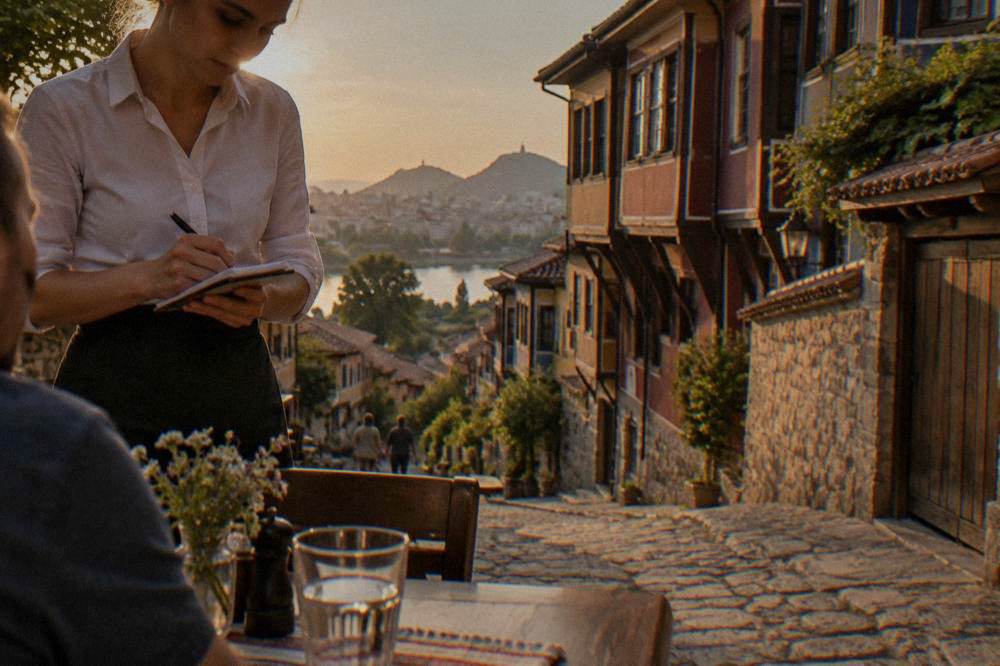
Which Bulgarian Words Appear On Plovdiv Street Signs And Museum Labels?
The words to recognise on Plovdiv signage are ulitsa (street), bulvard (boulevard), ploshtad (square), vhod (entrance), izhod (exit), otvoreno (open), zatvoreno (closed), and the site names Starinat Plovdiv for Old Plovdiv, Antichen Teatar for the Ancient Theatre and Rimski Stadion for the Roman Stadium. Museum labels at the major sights carry English translations, but directional signage inside stations, parks and car parks is often Cyrillic only.
The vocabulary of direction is small and fixed. Ulitsa (улица) abbreviates to ул. on maps and addresses, as in ул. Цар Ив. Асен II, the street that climbs into the Old Town. Bulvard (булевард) marks the wide central arteries, including Hristo Botev Boulevard where the railway and Yug bus stations sit side by side. Ploshtad (площад) is square, the word that precedes Central Square and Saedinenie Square in addresses. Recognising these three words turns an address string into a navigable instruction, and the site's guide to getting to Plovdiv covers the arrival end of that navigation.
| Bulgarian | Latin | Meaning | Where you'll read it |
|---|---|---|---|
| улица / ул. | ulitsa / ul. | street | addresses, maps |
| булевард / бул. | bulvard / bul. | boulevard | Hristo Botev, central arteries |
| площад / пл. | ploshtad / pl. | square | Central Square, Saedinenie |
| вход | vhod | entrance | museums, stations |
| изход | izhod | exit | stations, car parks |
| отворено | otvoreno | open | shop doors |
| затворено | zatvoreno | closed | shop doors |
| бесплатен | bezplaten | free | Nebet Tepe, sphendone viewing |
Site names deserve a warning about spelling, because the Latin forms used across this site are fixed: Nebet Tepe, Dzhumaya Mosque, Hisar Kapia, Kapana. Transliteration from Cyrillic varies between English and other systems, so a map app may offer a different Latin spelling than a museum label, and both point at the same place. The Dzhumaya Mosque, a working mosque, appears as Джумая джамия in Cyrillic, and no single construction date should be attached to it, since accounts differ on the matter.
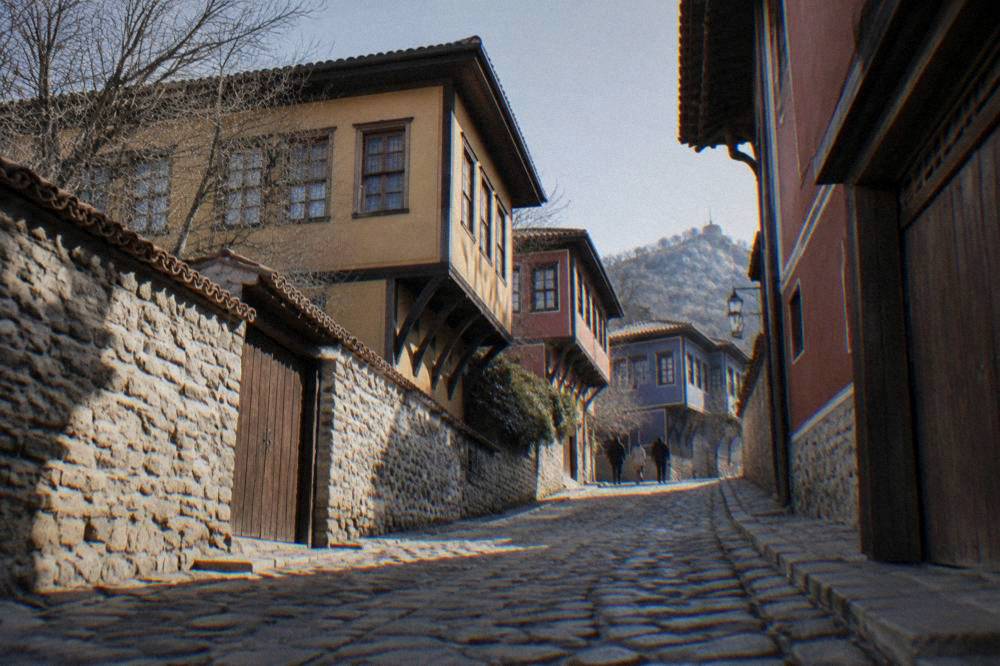
How Do You Pronounce Bulgarian Place Names Around Plovdiv?
Plovdiv is pronounced PLOV-div, with the stress on the first syllable, and the surrounding names follow the same pattern of de-emphasised endings: Kapana is ka-PA-na, Nebet Tepe is NE-bet TE-pe, Bachkovo is bach-KO-vo, and Asenovgrad is a-sen-Ov-grad. Two letters shape the sound of local names: the Cyrillic ж as in measure, and the combination ьо which softens the preceding consonant into a yo sound, as in Rhodope village names.
Place names outside the city appear on buses, tours and road signs, and hearing them beats reading them. Asen's Fortress is Asenova krepost, and the fortress town is Asenovgrad. Koprivshtitsa, the Revival-era town visited on several day trips from the site's roster, is ko-priv-SHTI-tsa, four syllables with the stress on the third. Bachkovo Monastery keeps the stress on the second syllable. Smolyan, deep in the Rhodopes, is SMO-lyan. The Rhodopes themselves are RHO-do-pes in English, ro-DOP-i in Bulgarian, and both are heard locally.
| Place | Latin spelling | Say it roughly as | Notes |
|---|---|---|---|
| Plovdiv | Plovdiv | PLOV-div | stress first syllable |
| Kapana | Kapana | ka-PA-na | the Trap district |
| Nebet Tepe | Nebet Tepe | NE-bet TE-pe | Old Town hill |
| Hisar Kapia | Hisar Kapia | hi-SAR ka-PI-a | the gate |
| Bachkovo | Bachkovo | bach-KO-vo | monastery town |
| Asenovgrad | Asenovgrad | a-sen-Ov-grad | fortress base |
| Koprivshtitsa | Koprivshtitsa | ko-priv-SHTI-tsa | day-trip town |
| Smolyan | Smolyan | SMO-lyan | Rhodopes town |
Day trips multiply the language question, because rural sites have less English than the city. Trips to Asen's Fortress and Bachkovo Monastery from the site's day-trip roster include transport and guiding, which removes the language burden entirely, and the monastery itself is free to enter, per the listing. For independent travel into the Rhodopes, buses leave from the Rodopi bus station and destinations are displayed in Cyrillic, so the reading skills from the previous section become genuinely operational rather than decorative.
Is Bulgarian Hard To Learn Before A Trip To Plovdiv?
Bulgarian is a moderately difficult language for English speakers, mainly because of Cyrillic script, movable stress and a rich verb system, but the survival tier needed for a Plovdiv trip is small: the alphabet takes an evening, the ten core phrases take a commute, and the restaurant and signage vocabulary above covers the rest. Bulgarian grammar is simpler than most Slavic languages in one way, having dropped noun cases, so words do not change form by grammatical role as they do in Russian or Polish.
Set expectations by tier. Tier one, the greetings and politeness words, is two hours of spaced repetition and pays back immediately in shops. Tier two, the signage and menu vocabulary, is recognition only, not recall, and a phone screenshot of the tables above serves as well as memory. Tier three, forming sentences, is where difficulty rises sharply, and no short trip justifies it; a translation app is faster, more accurate and more polite to the listener than a broken sentence attempted at counter speed.
Resources are plentiful and free. Language apps cover Bulgarian, the alphabet specifically is taught in dozens of short videos, and the Cyrillic chart approach in this guide, six trap letters first, matches how the reading skill actually consolidates. What no app teaches is the reversed head shake, which is why it sits at the top of this article's practical advice: it is the one Bulgarian habit that is invisible in every textbook and obvious within an hour of arriving in the city.
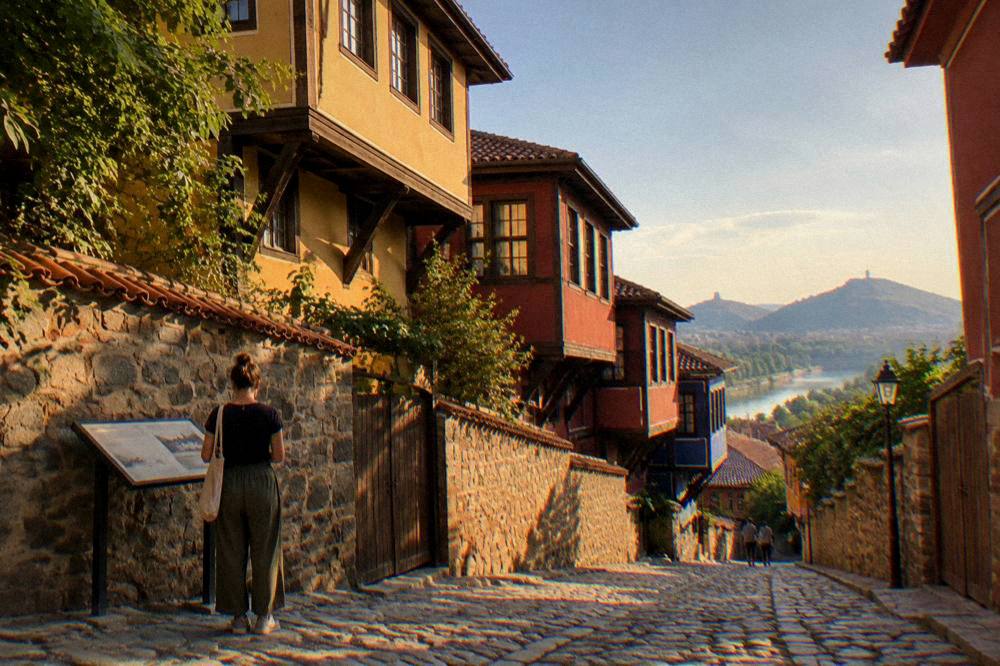
What Politeness Rules Matter Beyond Words In Plovdiv?
The non-verbal rules that matter in Plovdiv are greeting shop staff on entry, using polite forms with strangers and elders, covering shoulders and knees when entering the Dzhumaya Mosque or any working church, and confirming verbally whenever a nod or shake carries the answer. Bulgaria is a full Schengen member since 1 January 2025, and biometric registration under the Entry/Exit System replaced passport stamps at external borders as of 10 April 2026, which simplifies arrival courtesy considerably.
Greeting on entry is the rule visitors break most often, usually by accident. In a Bulgarian shop, a bakery or a small gallery, silence on entry reads as coldness, and zdraveyte or dobur den costs nothing. The same word on exit, with blagodarya, closes the loop. In churches, dress modestly and keep voices low; at the Dzhumaya Mosque, a working mosque open to visitors, shoulders and knees covered, shoes off, and avoid prayer times, especially the midday Friday prayer. These are behavioural rules reported by visitor guides rather than codified regulations, so follow on-site instructions where posted.
| Context | The rule | The phrase that helps |
|---|---|---|
| Any shop on entry | greet staff | zdraveyte |
| Church or mosque | modest dress, quiet | no phrase needed |
| Someone elderly | use polite forms | zdraveyte, not zdravey |
| Receiving something | accept with a nod and thanks | blagodarya |
| Unclear answer | confirm verbally | da ili ne? |
| Emergency | call the EU-wide number | 112 |
The Schengen and currency facts simplify the practical layer of politeness, because fewer transactions need negotiation. The remaining friction points are exactly where the phrases in this guide sit: buses, small shops, taxis and rural day trips.
Which Guided Tours In Plovdiv Help If You Speak No Bulgarian?
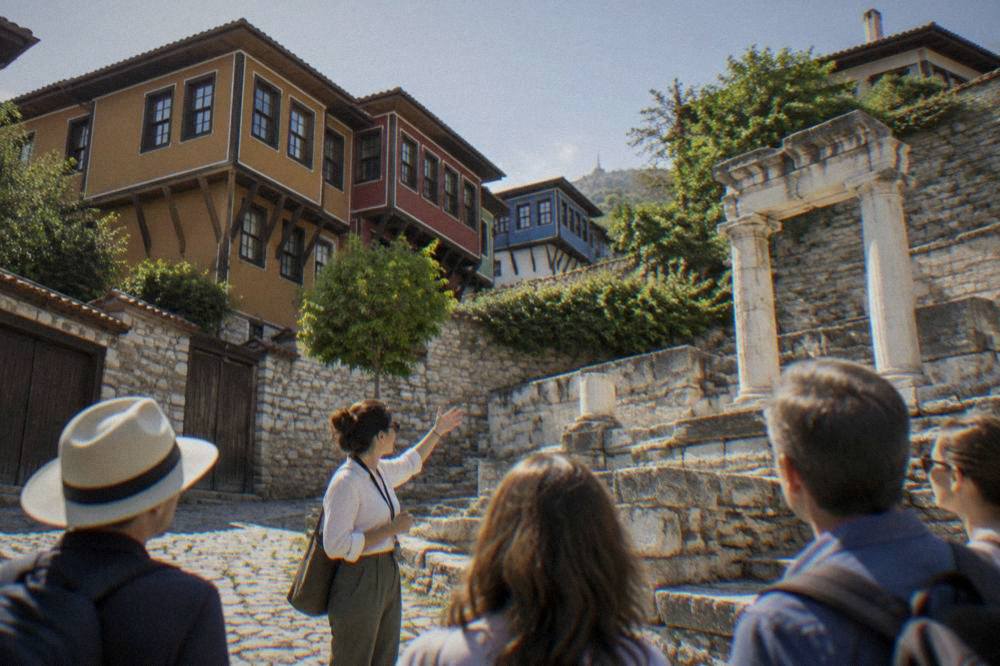
Guided tours solve the language problem entirely in Plovdiv, because guides operate in English as standard across the city's walking tours, food walks and day trips, translating signage, menus and museum labels as part of the service; the practical choice is between a general city walk, a themed walk such as the Jewish heritage tour, and a day trip beyond the city where rural sites have the least English of anywhere in the region. Booking through the operator's live listing shows the language options before payment.
The thematic walks deserve a note. The Jewish walking tour of Plovdiv moves through a district whose inscriptions and archive material are inaccessible without a guide, and the same logic applies to Roman Plovdiv, where Latin and Greek epigraphy sits on the stones of the Ancient Theatre and the Forum. A general introduction is covered in the site's Plovdiv walking tour guide, and the practical planning layer, from where to stay to the best time to visit, sits elsewhere on this site.
For day trips, language matters most at the edges of the region. A trip to the Buzludzha monument and the Museum of Aviation covers sites where signage is thin and interpretation is largely Bulgarian, which is precisely where a guided option earns its place over an independent drive. In the other direction, monastery visits at Bachkovo are walkable independently with English signage limited but the site free to enter, per the listing, while the Thracian valley wineries and fortress sites reward either a guided tour or a confident driver with a translation app. Whatever the choice, the ten phrases from the top of this article, and one hour with the Cyrillic alphabet, remain the highest-return language investment a Plovdiv trip offers.
Common Questions About Bulgarian Phrases In Plovdiv
Do I need to speak Bulgarian in Plovdiv?
No. English is standard in hotels, museums, restaurants and tour operations in the tourist core, and card payment plus translation apps cover most remaining gaps. A handful of phrases, hello, thank you, please and yes and no, is appreciated but not required.
Is English widely spoken in Plovdiv?
English is the main shared second language in the city's visitor economy, and coverage is strong across hotels, the Old Town sights and central restaurants. It thins in local shops, on city buses and among older residents, so keep a translation app for those settings.
What does Kapana mean?
Kapana means "The Trap", a name the municipal tourism site explains through the district's maze of narrow streets. It is a free, open creative district of galleries, cafés and workshops.
Why do Bulgarians shake their head for yes?
Many Bulgarians indicate yes with a side-to-side head shake and no with a nod, the reverse of Western habit. A folk legend attributes it to Ottoman-era defiance, but that story is folklore, not documented history. When in doubt, listen for da or ne rather than watching the head.
How hard is the Cyrillic alphabet to learn for Plovdiv?
The alphabet takes an hour or two with a chart, and six letters cause the classic misreadings: Н is N, Р is R, С is S, В is V. Recognising entrance, exit, open and closed signs covers most practical signage needs on a short visit.
How do you say thank you in Bulgarian?
Blagodarya (благодаря). Molya (моля) means please and you're welcome, and pairing the two covers polite exchanges in shops and restaurants across Plovdiv.