Plovdiv In One Day: Old Town, Kapana And The Hills
Plovdiv, in southern Bulgaria, is an inland city built around six hills, and one well-planned day covers the Old Town, the Roman Stadium, Kapana and a sunset viewpoint, with the euro prices and opening hours that matter.
Short answer
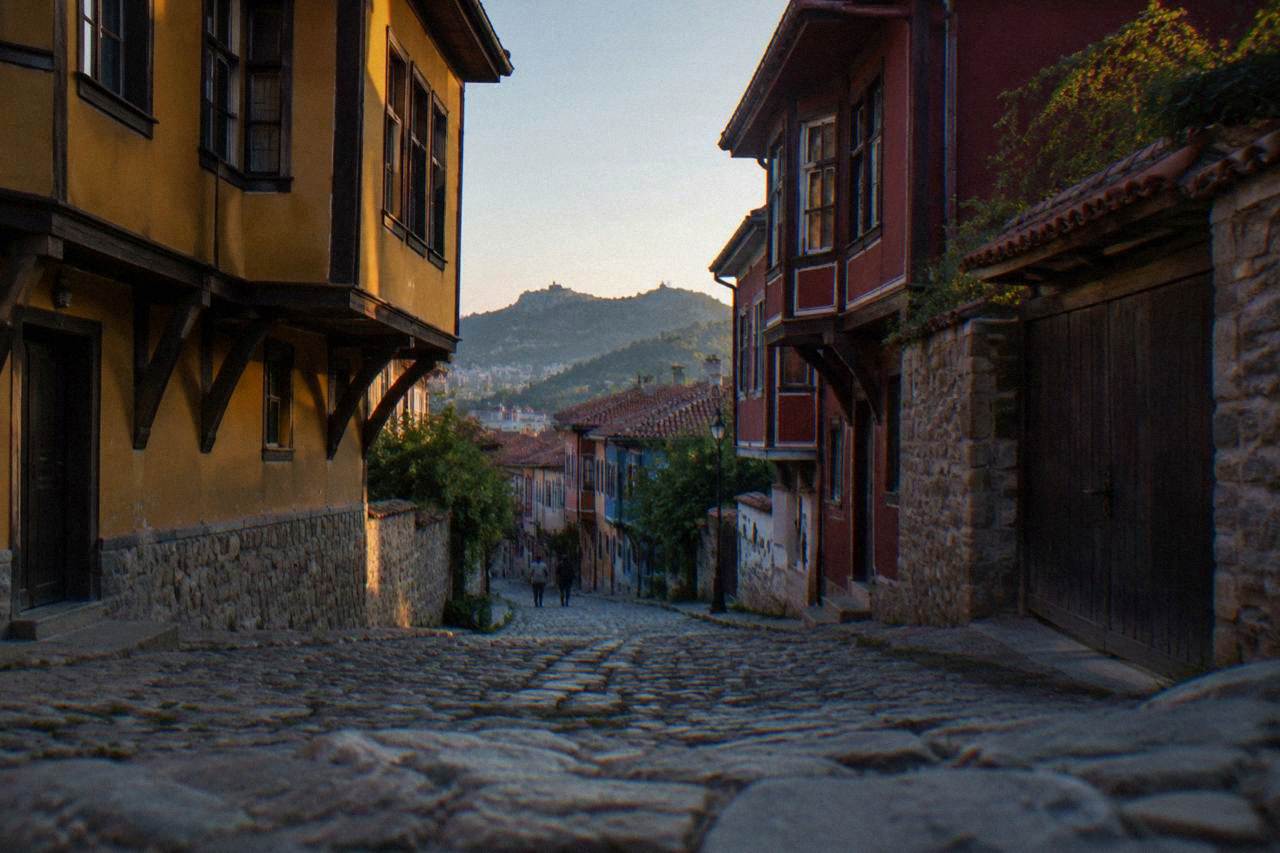
Yes. One day in Plovdiv covers the Ancient Theatre, the Old Town houses, the Roman Stadium sphendone, Kapana and Nebet Tepe, because the core is walkable and the main sites sit within roughly twenty minutes on foot of each other.
Plovdiv, in southern Bulgaria, is an inland city with no sea coast, built around six hills and often described as one of the oldest continuously inhabited cities in Europe. Its core is compact: the Old Town, the Roman remains, the Kapana creative district and the Three Hills viewpoints all sit within a walkable band a few streets wide. That compactness is what makes a one-day visit work. The city's tourism site dates the first settlement on Nebet Tepe to the 4th millennium BC, and almost everything worth scheduling in a single day sits on or beside that same hill. Note one thing before planning: Plovdiv Old Town is not a UNESCO World Heritage Site; "The Ancient Plovdiv" has been on Bulgaria's Tentative List since 2004, which is a waiting list, not an inscription.
Can You Really See Plovdiv In One Day?
Yes, one day is enough to see the essential Plovdiv: the Ancient Theatre of Philippopolis, one or two Old Town house museums, the Roman Stadium sphendone, the Kapana district and the Nebet Tepe viewpoint all fit into a single walking day, because the historic core is small, largely pedestrian and free to wander between the ticketed sites. A second day adds depth, museums and a day trip into the Rhodopes or the Thracian Valley, but the headline sights cluster tightly around the Three Hills. The itinerary below sequences them from morning to night so nothing backtracks.
The shape of the day is simple. Mornings belong to the Old Town, where the ticketed houses and the Ancient Theatre open from 9:00 or 9:30 depending on season. Midday drops down to Main Street and the Roman Stadium, then into Kapana for lunch and the afternoon. Late afternoon climbs to Nebet Tepe for the view, and the evening returns to Kapana or the city centre for dinner. Everything in that list is within walking distance of everything else.
A few practical anchors hold the day together. The city bus e-ticket is 0.50 euro. Plovdiv is Bulgaria's second-largest city, with a population of 333,994 as of 31 December 2025 according to the National Statistical Institute, yet the visitor core feels like a town. That contrast, big-city services under a small-town walking scale, is exactly why a single day delivers so much.
| Time block | Where | Ticket needed |
|---|---|---|
| Morning, 9:00 to 12:00 | Old Town: Ancient Theatre, one house museum | Yes, per site |
| Midday, 12:00 to 14:00 | Main Street, Roman Stadium sphendone, lunch | No for the sphendone |
| Afternoon, 14:00 to 17:00 | Kapana district, coffee, galleries | No, open streets |
| Late afternoon | Nebet Tepe viewpoint | No, free |
| Evening | Kapana or centre for dinner | No |
If your day starts in Sofia, direct trains take about 2 h 40 to 3 h 05, so an early departure still lands you in Plovdiv by mid-morning. Trains routed via Karlovo take far longer and are worth avoiding on a one-day schedule. The full Sofia to Plovdiv picture covers that leg in more detail.
Where Should The Morning Go In Plovdiv?
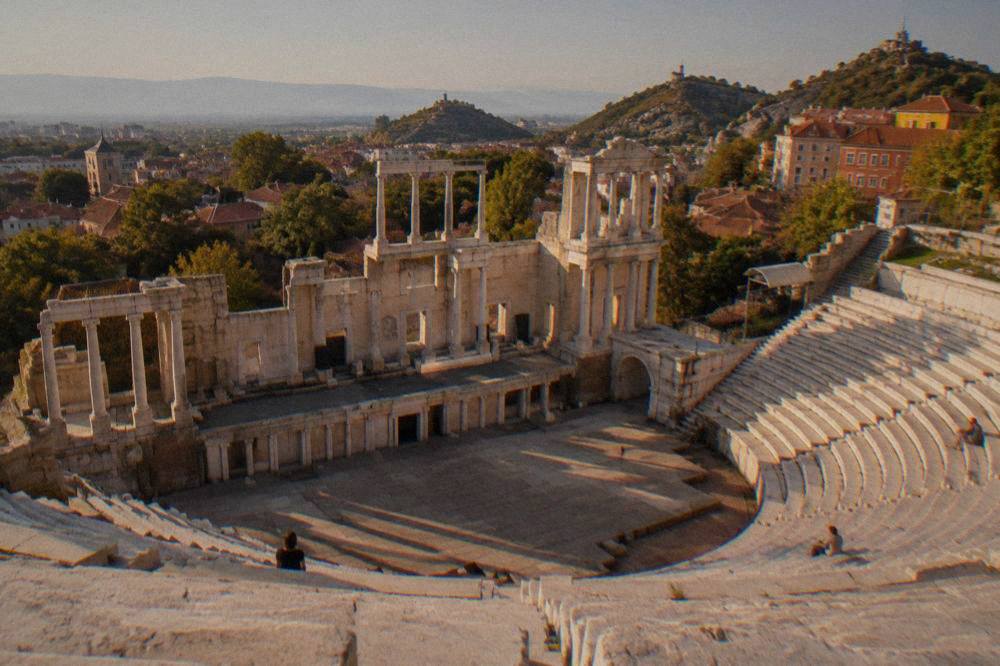
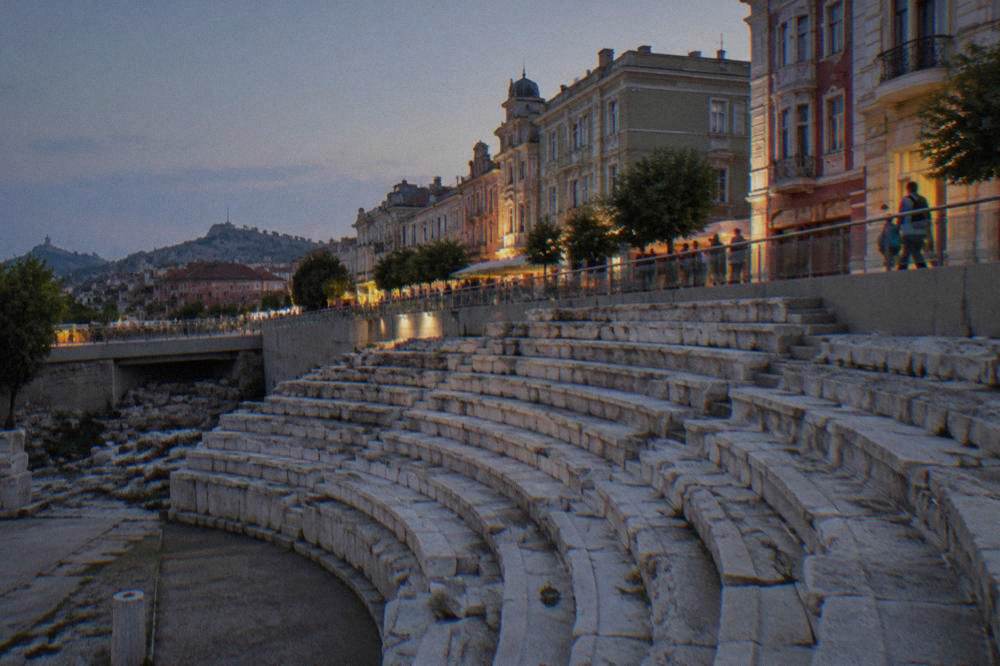
The morning belongs to the Old Town: start at the Ancient Theatre of Philippopolis when it opens, then walk one or two of the Revival-era house museums such as Balabanov or Hindliyan House, all before the midday heat or the lunch-break closure at 12:30 that the Old Plovdiv ticket page lists for its sites. The Ancient Theatre is the anchor. Built in the 90s of the 1st century AD, it holds 28 concentric rows of marble seats, and it still hosts performances: Opera Open ran there from 23 June to 9 September in 2026.
Hours follow a two-season pattern that the Old Plovdiv ticket page sets for its sites. From April to October the Theatre opens daily 9:30 to 18:00; from November to March it opens 9:00 to 17:30. There is a lunch break from 12:30 to 13:00 at the ticketed sites, which matters if you are squeezing several into one morning. The Theatre has no closure announced for 2025 or 2026, and it operates daily year round.
Ticketing is straightforward but has one trap. Any single Old Plovdiv site except the Bishop's Basilica costs 3.58 euro for an adult, with students at 1.53 euro and a family ticket at 7.16 euro. A combined ticket covering up to five sites costs 10.74 euro for an adult. The Bishop's Basilica is priced separately, at 7.57 euro, because it is run on its own list. The combined ticket's validity period is not published, so confirm it at the desk before relying on it for a second day.
| Old Plovdiv ticket | Adult | Student | Family |
|---|---|---|---|
| Any one site, except Bishop's Basilica | 3.58 euro | 1.53 euro | 7.16 euro |
| Combined, up to 5 sites | 10.74 euro | 4.09 euro | 21.47 euro |
| Bishop's Basilica, separate | 7.57 euro | 3.58 euro | 15.34 euro |
| Roman Stadium 3D hall | 3.68 euro | 1.23 euro | not listed |
| Stadium eastern sector plus 3D | 5.11 euro | 2.05 euro | not listed |
For a one-day visit, the honest arithmetic is this: if you plan two sites or fewer, buy singles; at three or more, the combined ticket wins, provided none of them is a basilica. Children under 7 enter free, and visitors with more than 50% disability enter free as well. Students and seniors get free entry on the first Thursday of the month, per the listing.
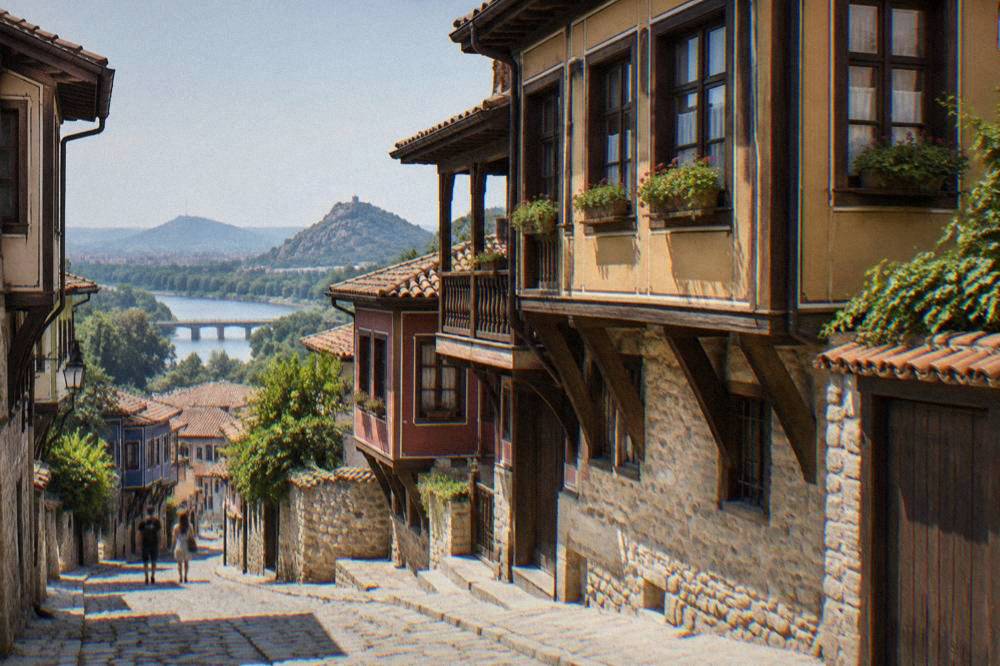
Between the Theatre and the houses, the Old Town streets themselves cost nothing and carry much of the atmosphere. Hisar Kapia, the old gate, is a public landmark with no ticket and no closing time, and it makes a natural pivot between the Old Town ridge and the streets below.
How Do You Handle Midday On Main Street And The Roman Stadium?
Drop down from the Old Town to Main Street around noon: the Roman Stadium's northern end, the sphendone, is free to view in the open air, so midday is the right time for it, followed by lunch in Kapana two blocks west, with no ticket and no schedule pressure until the afternoon. The Stadium was built in the 2nd century AD on the model of the Stadium at Delphi and held up to 30,000 spectators, but only its northern part is accessible today. The rest lies beneath the modern Main Street.
That buried geometry surprises people. You walk into a shopping street, and below one of the storefronts sit thirteen rows of ancient seating, unearthed in the 1970s. The sphendone viewing is free. The paid options are the 3D projection hall, at 3.68 euro for an adult, and the separate eastern sector, with a combined eastern-sector-plus-3D ticket at 5.11 euro. For a one-day visit short on time, the free sphendone view plus a few minutes at the 3D hall is a reasonable split, and skipping the paid options entirely is defensible if the morning ran long.
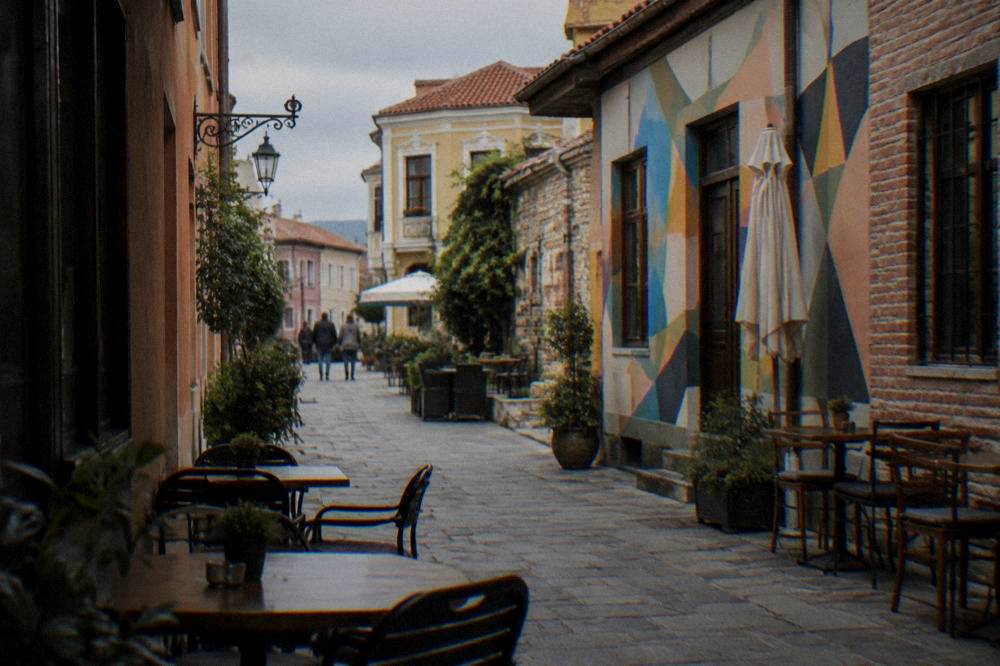
Lunch follows naturally. Kapana, whose name means "The Trap", is a maze of narrow streets that became the city's creative district, and its streets are free and open to the public. No specific Kapana bar, cafe or shop had its hours or prices confirmed, so treat the district as a wander rather than a checklist: the streets, the murals and the small galleries are the substance. The Kapana area guide maps the geography if you want to plan the loop before you arrive.
The Dzhumaya Mosque sits on the edge of this zone, on the square where Main Street meets the Old Town slope. It is a working mosque, free to visit, open 6:00 to 23:00 per the city's own page, with modest dress expected and prayer times to avoid. No single construction date can be stated: the mosque's origins remain a matter of disagreement.
| Roman Stadium option | What it is | Adult price |
|---|---|---|
| Sphendone viewing | Open-air northern curve, 13 rows of seats | Free |
| 3D projection hall | Indoor reconstruction show | 3.68 euro |
| Eastern sector | Separate excavated seating area | 3.58 euro |
| Eastern sector plus 3D | Both paid options together | 5.11 euro |
One scheduling note: the 3D hall keeps the same seasonal hours and the same 12:30 to 13:00 lunch break as the other Old Plovdiv sites, so it closes for that half hour too. Plan lunch in Kapana across that window rather than standing at a shuttered desk.
Why Is Kapana The Right Place For The Afternoon In Plovdiv?
Kapana earns the afternoon because it is the one part of central Plovdiv built for slow time: a tangle of pedestrian lanes, free to enter at any hour, where galleries, studios and cafes replace monuments, so it absorbs the post-lunch hours that a schedule of ruins cannot, and its festivals fill the same streets several weekends a year. The name itself, "The Trap", refers to the maze-like narrow streets in which newcomers lose their bearings, and the district has been the city's creative quarter since its redevelopment around the 2019 European Capital of Culture year, which Plovdiv shared with Matera.
Give the afternoon a loose structure. Coffee first, then the street art: the district and the surrounding blocks carry a dense concentration of murals, and the street art guide lists where the notable walls cluster. After that, wander without a map for an hour; that is the activity Kapana was made for. The Sunday artisan market that operates in the district on weekend afternoons, roughly 10:00 to 18:00 per secondary listings, is worth a look if your one day falls on a Saturday or Sunday, though market details should be confirmed locally.
Kapana Fest gives the district its calendar anchors. The autumn 2026 edition ran across two weekends, 2 to 4 and 9 to 11 October, at the bridge over Gladstone Street and Central Square. If your one-day visit collides with a festival weekend, the streets will be fuller and better; if not, the district functions normally every day. There is no ticket and no opening time for Kapana itself, only for individual businesses, whose hours are not confirmed here.
For a rest mid-afternoon, Tsar Simeon Garden sits a short walk east of Kapana, and its singing fountains are a free public feature of the park. In 2026 the municipality's own announcements describe routine weekly washing and maintenance of the fountain lake, with no major works affecting visitors.
Where Do You Watch Sunset In Plovdiv?
Climb Nebet Tepe for sunset: it is the free, open-air archaeological complex at the top of the Old Town ridge, the spot where the city's tourism site places the first settlement in the 4th millennium BC, and after a restoration completed and officially opened in March 2025 it has unrestricted public access with no ticket and no closing time. The view from the top takes in the Three Hills group, the plain of the Maritsa river and the sprawl of the modern city, which is the visual summary a one-day visitor wants before dinner.
Nebet Tepe stands 207 m high, one of the six surviving hills. The restoration project, EU-funded under the name "Along the Fortress Walls of Philippopolis", finished with the site's official opening in March 2025, and local reporting since describes free access without fixed opening hours, with guided tours available at limited times through the museum. For a sunset visit, go up on your own.
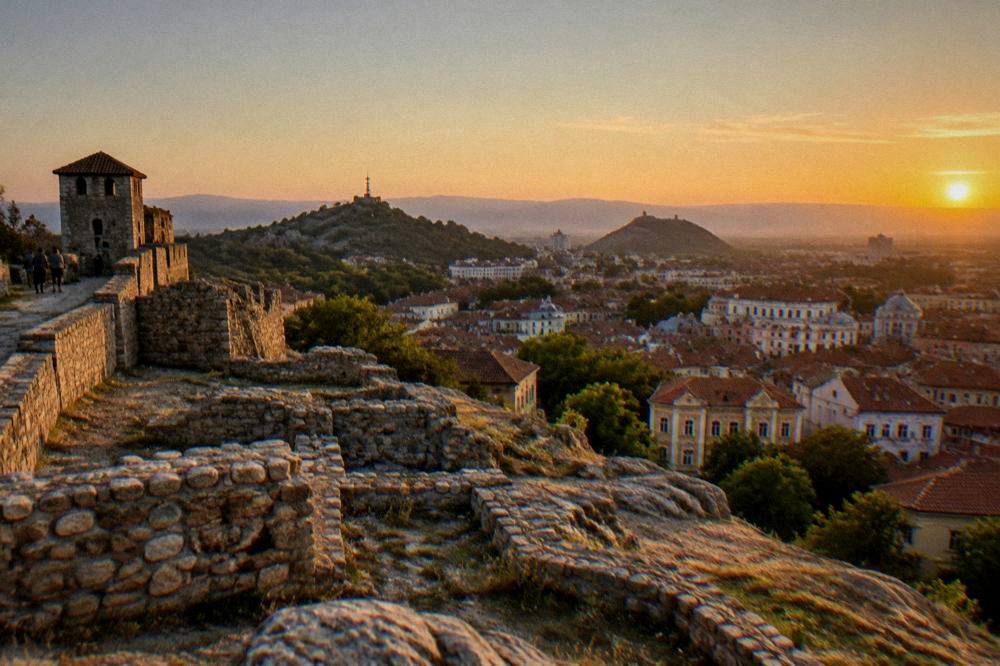
The hill inventory matters because guides repeat a wrong number. There were seven hills until the 20th century, when Markovo Tepe was partly destroyed by quarrying; six remain. The Three Hills area guide covers how Nebet Tepe, Dzhambaz Tepe and Taksim Tepe connect into one walkable ridge.
| Plovdiv hill | Height | Ticket |
|---|---|---|
| Youth Hill, Dzhendem Tepe | 285.5 m | Free public space |
| Hill of the Liberators, Bunardzhika | 265 m | Free public space |
| Danov Hill, Sahat Tepe | 227 m | Free public space |
| Nebet Tepe | 207 m | Free, open access |
| Dzhambaz Tepe | 212 m | Free public space |
| Taksim Tepe | 195 m | Free public space |
If you have energy left, the Hill of the Liberators, Bunardzhika, carries the Alyosha monument, unveiled in 1957, on its top. It is free and open at all hours, and the city views from its slopes are a quieter alternative to Nebet Tepe. Timing sunset needs no more than the season: ERA5 reanalysis, 1991-2020, puts the mean daily high at 28.6 C in August and 5.9 C in January, so summer evenings linger and winter ones demand a coat.
What About Dinner And The Evening In Plovdiv?
Return to Kapana or the city centre for dinner: Bulgarian kitchens run late into the evening, the pedestrian centre stays lively after dark, and a one-day visit can end with shopska salad, kavarma or grilled kebapche and a glass of local wine, at crowd-reported prices of around 2 euro for an espresso or a half-litre of draught beer. The evening is also when the city's performance calendar shows up: the Ancient Theatre stages concerts through the summer, and the autumn brings the Plovdiv Jazz Fest, which ran 6 to 8 November in 2026 at the Boris Hristov House of Culture.
Food planning is easiest without a named-restaurant checklist, since no individual Plovdiv restaurant had its hours or prices confirmed. Build the meal from the canon instead: shopska salad, banitsa, kavarma, kebapche and tarator are the standard set, and the Bulgarian food pages on this site describe each. Crowd-data figures from Numbeo, quoted as approximations and not official prices, put a mid-range three-course dinner for two at roughly 30 to 40 euro. Tipping follows the local norm of around 10% in restaurants for good service, or simply rounding up.
To sample those dishes with a guide instead, book a Bulgarian food and culture tour here.
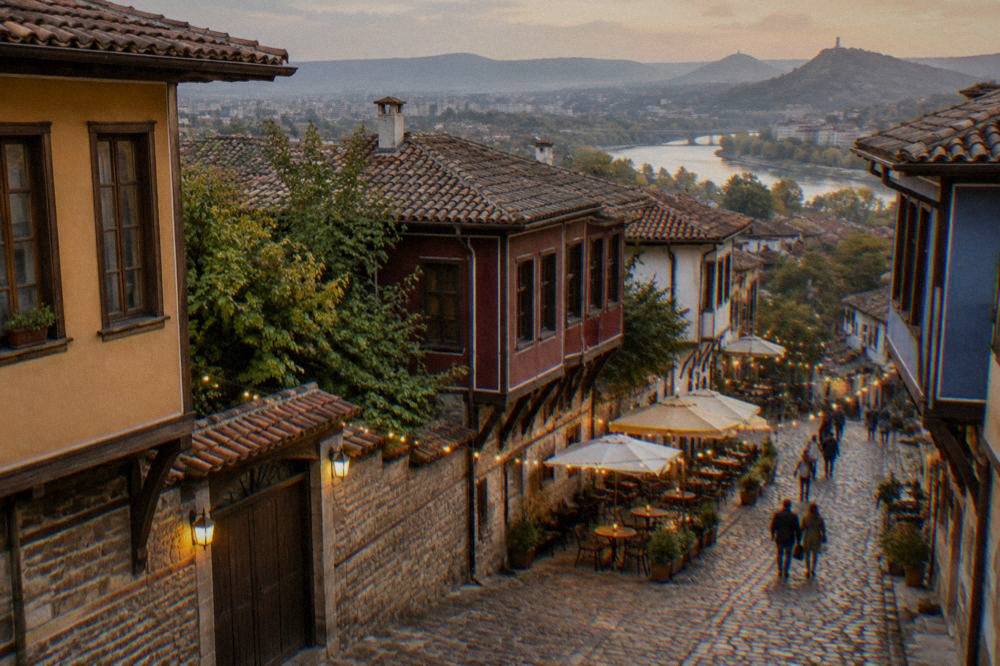
After dinner the options split by taste. The nightlife guide and the Plovdiv at night page cover the bars and the lit-up monuments; alternatively, an evening walk back up toward Hisar Kapia shows the Old Town walls under floodlight, free and uncrowded. In late November and December the Christmas market changes the equation: the 2026/27 edition, billed as "Soul of Christmas", is listed for 1 December 2026 to 7 January 2027 across Kapana and Central Square, so a winter one-day visit can end there instead.
A practical word on money and connectivity for the evening, and the day generally. Bulgaria adopted the euro on 1 January 2026 and dual circulation ended on 31 January 2026, so euros are the currency, period. Confirm any accommodation tax directly at booking. Emergency services run on 112, the standard EU number.
What If One Day In Plovdiv Turns Into Two?
If a second day appears, spend it out of the city: Bachkovo Monastery lies about 30 km away with free entry and minibuses from the Rodopi station taking 35 to 45 minutes, while the Thracian Valley wineries and the Rhodopes sit within an hour, so day two converts from a walking day into a day trip. The two-day itinerary sequences exactly that split, and the wider Bulgaria itinerary shows where Plovdiv fits in a national route.
The day-trip menu from Plovdiv is unusually rich for a city this size. Bachkovo Monastery is a working monastery with free entry. Asen's Fortress near Asenovgrad charges a small entry fee whose current euro figure is unclear, so check at the gate. Koprivshtitsa, the Revival-era town, sells a combined ticket for its six house museums at about 10 euro. The Rhodopes, Wonderful Bridges and the caves around Trigrad are farther but reachable, and the Rhodopes day tour covers the logistics.
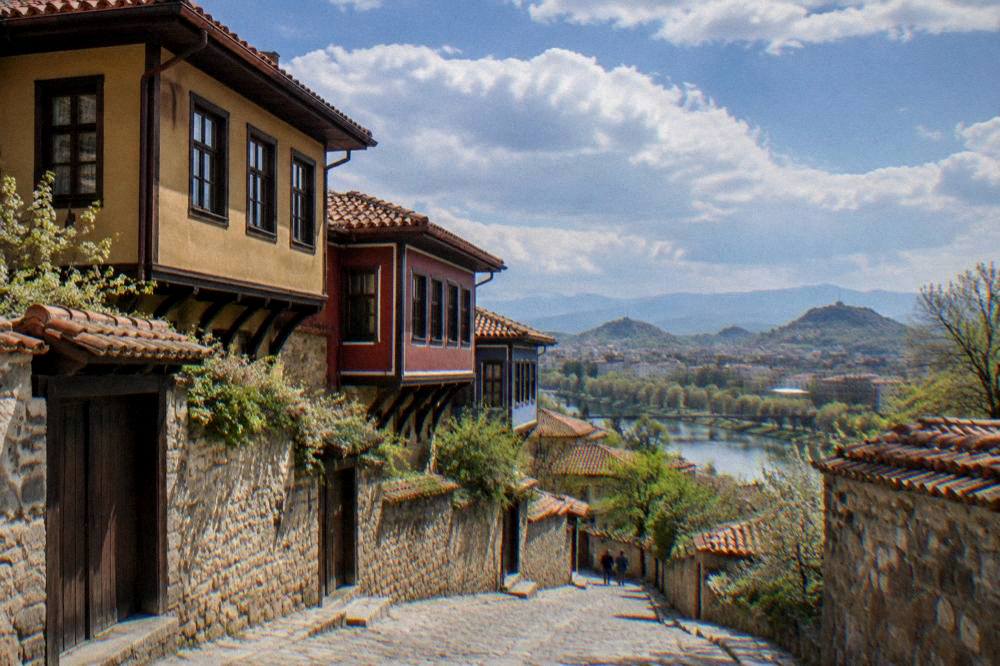
Weather reshapes the plan more than anything else. On a wet day, swap the hills for the museums: the Regional Ethnographic Museum in the Kuyumdzhiev House is closed Mondays and charges about 3.07 euro per the latest reports; the Regional History Museum's sites are free on the first Thursday of the month; the Regional Archaeological Museum, closed Mondays, renewed its permanent exhibition in November 2025 with about 150 new exhibits and a bilingual audio guide. The rainy-day itinerary rebuilds the full day around them.
| Day-trip destination | Distance or access | Entry |
|---|---|---|
| Bachkovo Monastery | About 30 km; minibus from Rodopi station, 35 to 45 min | Free |
| Asen's Fortress | Near Asenovgrad, via the same corridor | Small fee, confirm at the gate |
| Koprivshtitsa | House-museum town, reached by road | Combined ticket about 10 euro |
| Rhodopes, Wonderful Bridges | South by road or organised tour | Varies, confirm locally |
| Thracian Valley wineries | Estates 15 to 45 min from the city | Tastings vary, book ahead |
For travellers who want a guided frame around the city itself, guided walking options exist alongside tip-based walks that run locally; for the tip-based ones, confirm arrangements directly with the guide, as no platform listing is endorsed here. And if the whole day must be run from Sofia because you sleep there, a Sofia connection with the first train out and the last train back covers the same core, tightly.
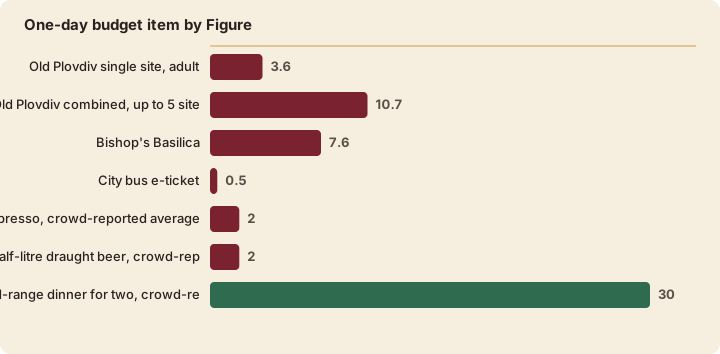
| One-day budget item | Figure |
|---|---|
| Old Plovdiv single site, adult | 3.58 euro |
| Old Plovdiv combined, up to 5 sites | 10.74 euro |
| Bishop's Basilica | 7.57 euro |
| City bus e-ticket | 0.50 euro |
| Espresso, crowd-reported average | About 2 euro |
| Half-litre draught beer, crowd-reported | About 2 euro |
| Mid-range dinner for two, crowd-reported | About 30 to 40 euro |
One day in Plovdiv, done in this order, ends with the sunset from Nebet Tepe and dinner in Kapana, having spent less on tickets than a single museum costs in many European capitals. The Plovdiv Travel Guide homepage collects the full sight list for whenever the second day arrives.
Common Questions About Plovdiv In One Day
Can you see Plovdiv in one day?
Yes. The Ancient Theatre, one or two Old Town house museums, the Roman Stadium sphendone, Kapana and Nebet Tepe fit into one walking day, because all of them sit within the compact historic core.
How much do the main Plovdiv sights cost?
A single Old Plovdiv site costs 3.58 euro for an adult, the combined ticket for up to five sites is 10.74 euro, and the Bishop's Basilica is priced separately at 7.57 euro, per the official Old Plovdiv ticket list. Nebet Tepe, the sphendone, Kapana and Hisar Kapia are free.
What is the best order for one day in Plovdiv?
Old Town and the Ancient Theatre in the morning before the 12:30 lunch break, Main Street and the Roman Stadium at midday, Kapana for lunch and the afternoon, Nebet Tepe for sunset, then dinner back in Kapana or the centre.
Is Plovdiv Old Town a UNESCO site?
No. "The Ancient Plovdiv" has been on Bulgaria's UNESCO Tentative List since 14 September 2004, which is a waiting list and not an inscription.
Can you visit Plovdiv as a day trip from Sofia?
Yes. Direct trains take about 2 h 40 to 3 h 05 each way, so an early start gives you most of a day in the city. Trains routed via Karlovo take far longer and should be avoided on a tight schedule.
