Plovdiv Itinerary: One, Two Or Three Days At A Glance
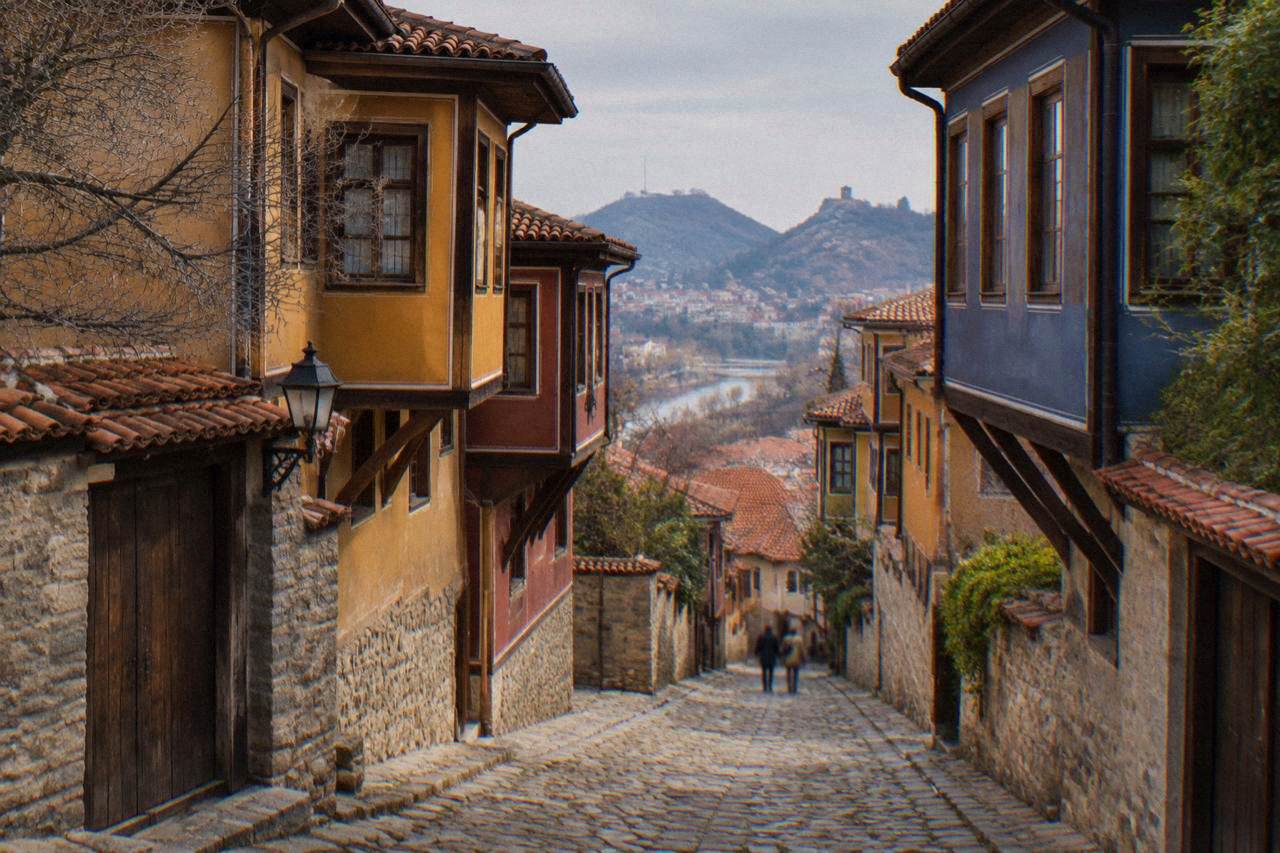
Plovdiv, in southern Bulgaria, packs its Roman ruins, revival-era Old Town and Kapana creative district into a walkable centre, which makes it one of the easier European cities to plan by day count.
Short answer
One day covers the Ancient Theatre, Nebet Tepe, Kapana and the Roman Stadium sphendone. Two days add the Bishop's Basilica mosaics, the Ethnographic Museum and a hill or two. Three days add a Rhodope foothills day trip to Bachkovo Monastery and Asen's Fortress, about 30 km south.
Plovdiv, in southern Bulgaria, is an inland city built around six hills, and its sightseeing core is compact enough that the difference between one day and three is not distance but depth. The Old Town, the Roman sites and the Kapana creative district sit within a fifteen-minute walk of one another, and the classic day trip into the Rhodope foothills starts from a bus station on the edge of the centre. This Plovdiv itinerary lays out what fits realistically into one, two or three days, using the ticket prices and hours the Old Plovdiv institute and the city's own tourism pages publish, and it flags the few figures no official source confirms.
How Many Days Do You Need In Plovdiv?
One day is enough for the core: the Ancient Theatre of Philippopolis, Nebet Tepe, Hisar Kapia, the Roman Stadium sphendone and a wander through Kapana all sit within walking distance of each other, and the single-site Old Plovdiv ticket costs 3.58 euro. Two days let you add the Bishop's Basilica mosaics, the Ethnographic Museum and a relaxed evening. A third day opens the Rhodope foothills: Bachkovo Monastery lies about 30 km away, with minibuses from the Rodopi station taking 35 to 45 minutes.
The honest answer depends on what kind of trip you want. A city break built around Roman ruins and restaurant evenings works in two days without rushing. Add a third day only if the monastery-and-fortress route into the Rhodopes appeals, because that is the one excursion from here that is genuinely popular. The dedicated How Many Days In Plovdiv Bulgaria answer page breaks the trade-offs down further, and the site's one day, two day and three day pages carry hour-by-hour detail for each length.
What Does A One Day Plovdiv Itinerary Look Like?
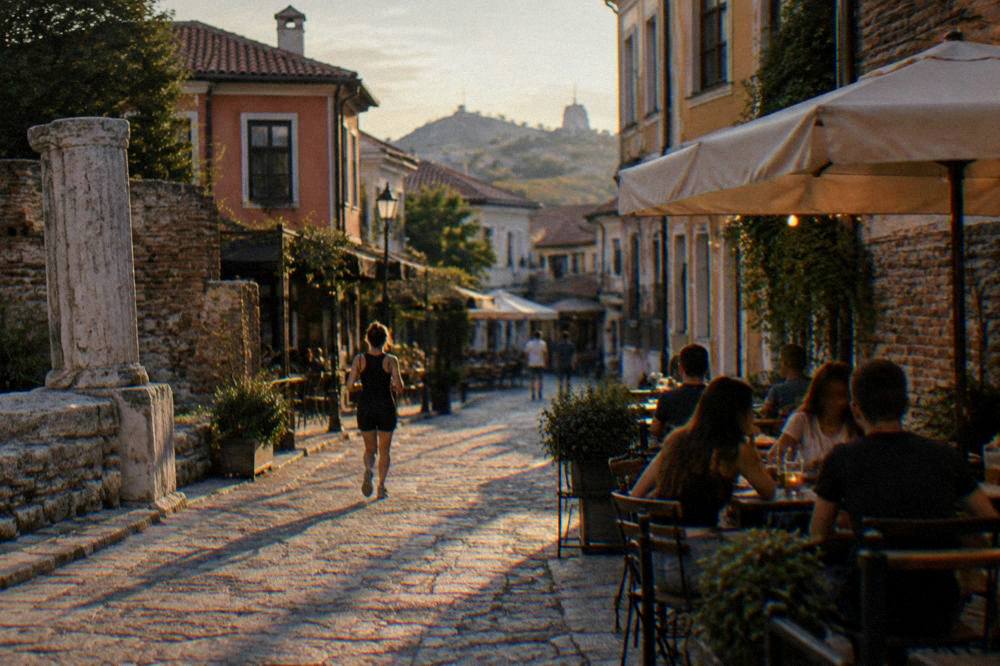
Start at the Roman Stadium sphendone, which is free to view, then walk the length of Main Street to Dzhumaya Mosque, climb into the Old Town for the Ancient Theatre (one-site ticket 3.58 euro), Nebet Tepe (free) and Hisar Kapia, and finish the evening in Kapana, whose name means The Trap, a maze of narrow streets that costs nothing to enter. That single loop is the whole core of Plovdiv and it fits one day comfortably.
Morning belongs to the archaeology. The Roman Stadium was built in the 2nd century AD on the model of the stadium at Delphi and held up to 30,000 spectators, but only its northern curve, the sphendone, is visible today; the rest lies under the modern Main Street. The viewing area is free, and a 3D projection hall beside it charges 3.68 euro if you want the reconstruction show.
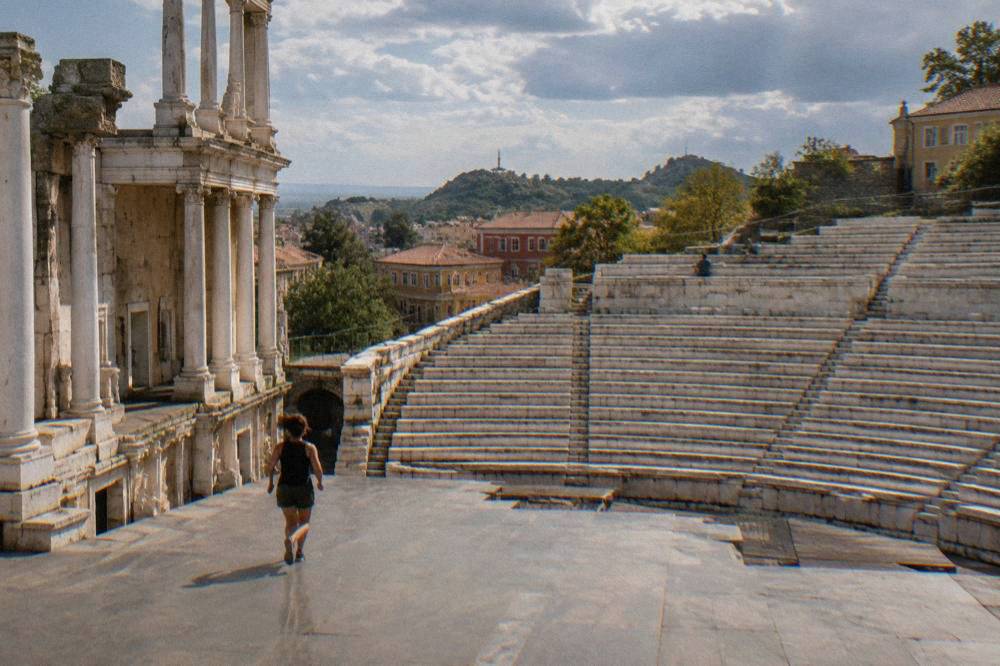
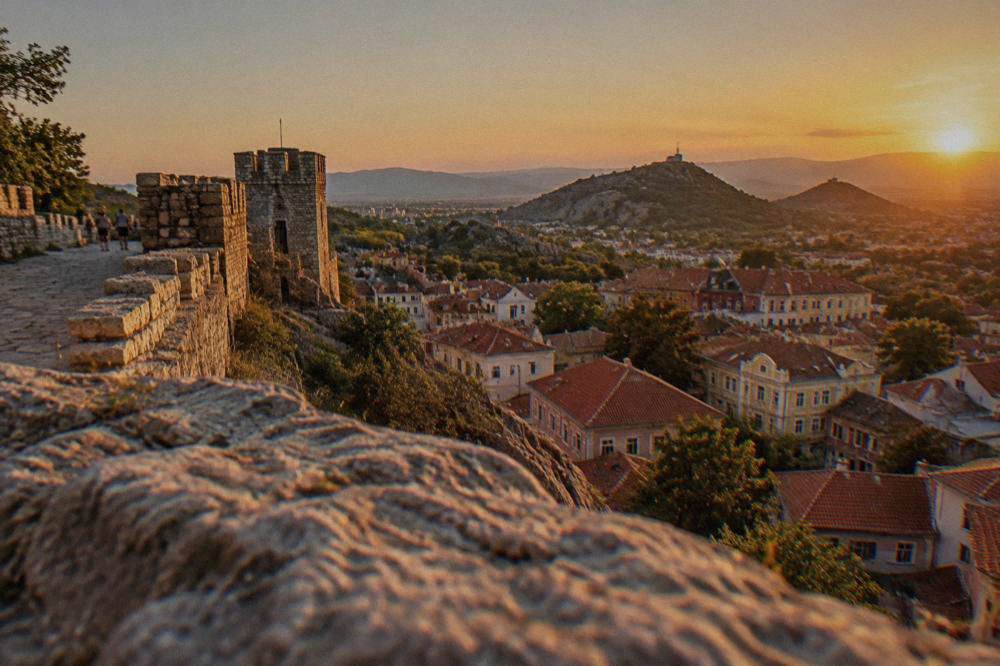
Afternoon moves uphill. The Ancient Theatre of Philippopolis, built in the 90s of the 1st century AD, keeps 28 concentric rows of marble seats and still hosts performances, including the Opera Open festival that ran 23 June to 9 September in 2026. From the theatre the lanes bend past Hisar Kapia, the old gate, up to Nebet Tepe, where the city's tourism site dates the first settlement to the 4th millennium BC. The terrace view over the Lower Town is the standard closing shot of any Plovdiv day.
Evening is Kapana. The district is a set of free, open public streets, and the city listings show it hosting regular events: the autumn Kapana Fest ran two weekends, 2 to 4 and 9 to 11 October 2026. If you would rather have a guide for the core loop, the site's Plovdiv walking tour options cover exactly this ground.
What Does A Two Day Plovdiv Itinerary Add?
Day two adds the Bishop's Basilica of Philippopolis (7.57 euro, daily 9:00 to 18:00), whose floor mosaics cover over 2,000 square metres, plus the Small Basilica on the one-site ticket, the Regional Ethnographic Museum in the Kuyumdzhiev House (about 3.07 euro, closed Monday) and at least one of the six hills, most easily Bunardzhik with the Alyosha monument, which is free and open at all hours.
The basilicas are the reason to stay a second day. The Bishop's Basilica, about 83 m long and 36 m wide, is the largest 4th to 6th century basilica in Bulgaria, and its two layers of floor mosaics are what you come to see; the Eirene mosaic and Episcopal Basilica page covers the detail. The Small Basilica, a 5th to 6th century three-nave building, sits on the standard one-site Old Plovdiv ticket.
The Old Town houses fill the afternoon. Balabanov House and Hindliyan House are the usual picks, and a September 2026 report noted Hindliyan House moving to daily opening. The Ethnographic Museum itself is closed on Monday, which matters for planning: the Regional Archaeological Museum is also closed Monday, so a Monday arrival squeezes day two.
For travellers who prefer a guided spine to the second day, a city tour with a sunset wine tasting is one of the few evening options in the roster that pairs the Old Town walk with a local tasting, and the private bike tour covers the same centre on two wheels for a faster loop.
What Does A Three Day Plovdiv Itinerary Add?
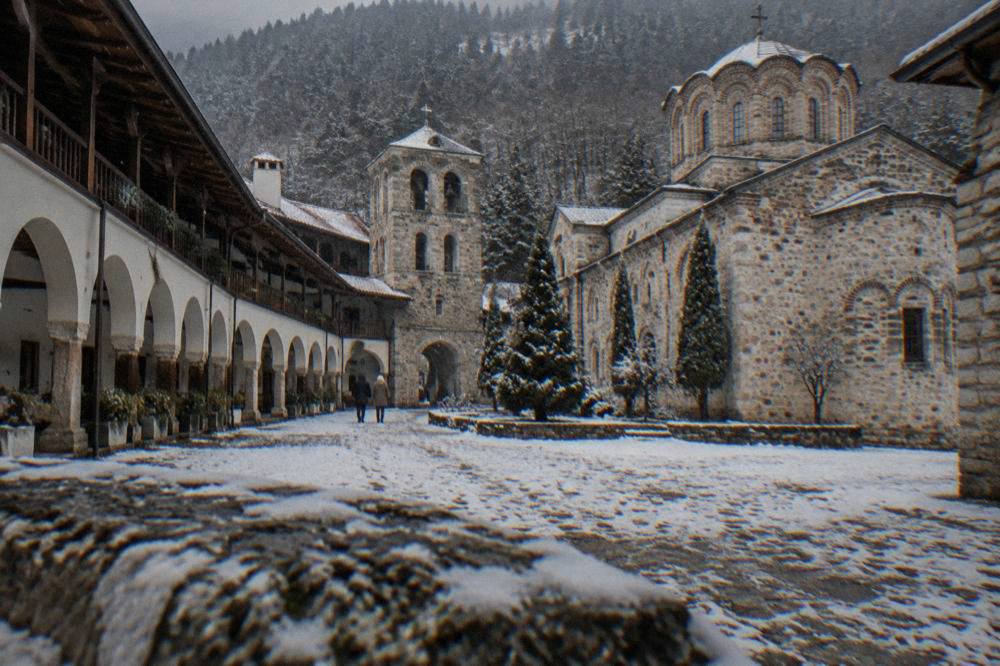
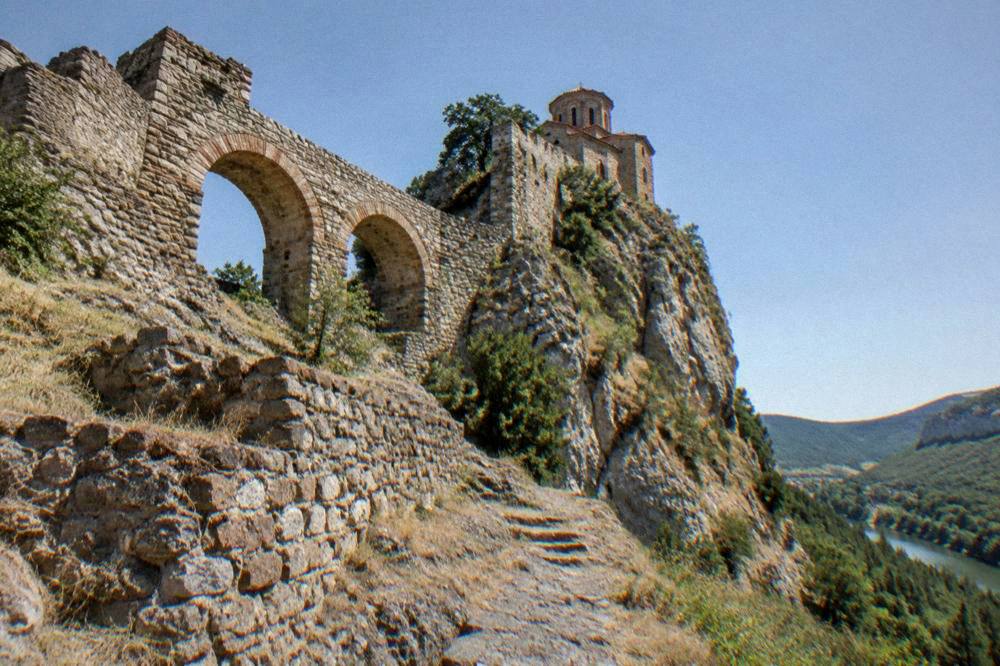
Day three belongs to the Rhodope foothills: Bachkovo Monastery, about 30 km from Plovdiv, is free to enter and reachable by minibus from the Rodopi station in 35 to 45 minutes, and Asen's Fortress near Asenovgrad sits on the same road south. The monastery is a working religious house, and the fortress charges a small entry fee whose current figure no official source publishes, so confirm on arrival.
Rather not deal with the minibus? Book a monastery and fortress tour here.
This is the one excursion the day-trip roster leans on heavily, and with good reason. Bachkovo is among the most visited monasteries in Bulgaria, and the combined monastery-plus-fortress route is exactly what the featured option on this page covers: Check availability for the small-group version, or read the fuller comparison on the site's Bachkovo Monastery and Asen's Fortress pages. Doing it independently by minibus is equally workable if you prefer your own pace.
If hills rather than monasteries appeal on day three, the Three Hills group and the garden squares fill a slower day, and the Rhodopes day tour from Plovdiv overview lists what lies further south. Drivers can bolt day three onto a longer route with the site's Bulgaria road trip and Sofia Plovdiv Rila itinerary plans.
What Do The Plovdiv Tickets Actually Cost?
The Old Plovdiv ticket page prices any one site, except the Bishop's Basilica, at 3.58 euro for adults and 1.53 euro for students, with the five-site combined ticket at 10.74 euro, the Bishop's Basilica separately at 7.57 euro, and children under 7 free; Nebet Tepe, the stadium sphendone, Kapana and Hisar Kapia cost nothing at all.
| Site | Adult price | Notes |
|---|---|---|
| Any one Old Plovdiv site (theatre, Small Basilica, revival houses) | 3.58 EUR | Student 1.53 EUR; family 7.16 EUR |
| Old Plovdiv combined ticket, up to 5 sites | 10.74 EUR | Excludes Small Basilica and Bishop's Basilica; validity not stated on the page, confirm at the desk |
| Bishop's Basilica | 7.57 EUR | Daily 9:00 to 18:00; over 2,000 sq m of mosaics |
| Roman Stadium 3D hall | 3.68 EUR | Sphendone viewing itself is free |
| Stadium eastern sector + 3D combined | 5.11 EUR | Per the ticket page |
| Regional History Museum, one site | 5.00 EUR | Free first Thursday of the month |
| Ethnographic Museum | about 3.07 EUR | Closed Monday; figure is a reported one, confirm at the desk |
| Nebet Tepe, Kapana, Hisar Kapia, Alyosha hill | free | Open public spaces |
Two planning details from the ticket page are easy to miss. Groups of more than 10 pay a reduced adult rate of 3.07 euro per site, and students and seniors get free entry at Old Plovdiv sites on the first Thursday of the month. Lunch breaks, typically 12:30 to 13:00, apply at several sites in both summer and winter seasons, so late-morning arrivals should plan around them rather than against them.
When Should You Walk This Plovdiv Itinerary?
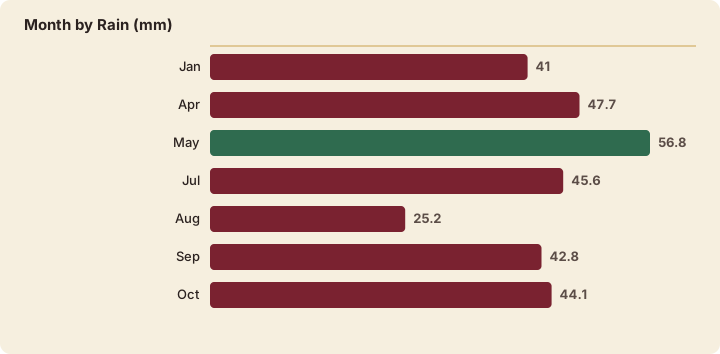
The ERA5 reanalysis, 1991-2020, puts Plovdiv's mean daily high at 28.6 C in August and 5.9 C in January, with May the wettest month at 56.8 mm of rain and August the driest at 25.2 mm, so spring and autumn give the most comfortable walking weather for an itinerary built on cobblestones and hills.
The itinerary above is a walking itinerary. That argues for April, May, September or October, when the hills are climbable without heat and the theatre's daytime hours (9:30 to 18:00 from April to October) are in force. Winter sightseeing still works: the theatre shortens to 9:00 to 17:30 from November to March, and the Christmas event in Plovdiv ran 28 November 2025 to 4 January 2026 in its last edition, with the 2026/27 edition announced for 1 December 2026 to 7 January 2027.
| Month | Mean daily high (C) | Mean daily low (C) | Rain (mm) |
|---|---|---|---|
| Jan | 5.9 | -2.6 | 41.0 |
| Apr | 17.1 | 6.4 | 47.7 |
| May | 21.9 | 11.5 | 56.8 |
| Jul | 28.2 | 17.9 | 45.6 |
| Aug | 28.6 | 18.1 | 25.2 |
| Sep | 23.8 | 13.8 | 42.8 |
| Oct | 18.1 | 8.8 | 44.1 |
The figures are modelled normals from a reanalysis grid cell, not a station record, and reanalysis smooths urban heat, so treat them as planning ranges rather than forecasts. If rain arrives mid-trip, the site's Plovdiv in the rain and Plovdiv in autumn pages reroute the same days indoors.
Where Should You Stay To Follow This Plovdiv Itinerary?
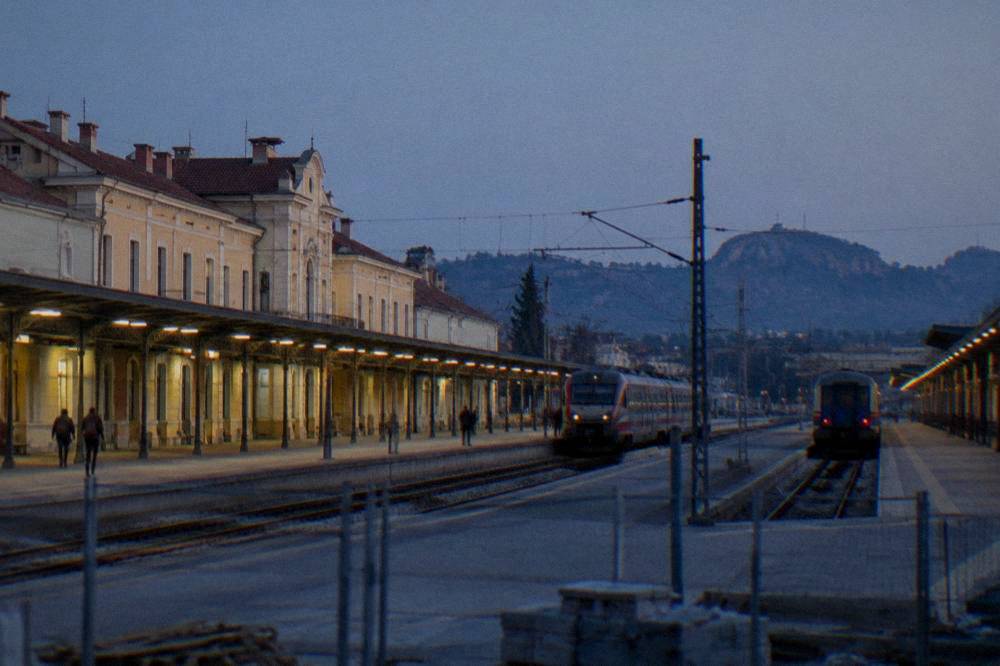
The Old Town and the blocks immediately around Kapana and Main Street put every stop in the one-day loop within a short walk, which is the whole point of a compact itinerary; the central railway station and the Yug bus station sit side by side on Hristo Botev Boulevard, so arrival days need no taxi. A tourist tax is charged per night by accommodation, but its 2026 euro rate is not published on the municipal pages, so confirm at booking.
Location beats amenities here. The one-day loop spans roughly the Roman Stadium in the north to Nebet Tepe in the south, all on foot, and the three-day version only leaves the centre by minibus or tour vehicle from the Rodopi station. Staying anywhere inside that triangle keeps each morning car-free. The site's where to stay in Plovdiv guide maps the neighbourhoods in detail, and the getting around Plovdiv page covers the 0.50 euro e-ticket for any bus hops.
How Do You Get To Plovdiv To Start The Itinerary?
Direct BDZ trains from Sofia take about 2 h 40 to 3 h 05 for the fastest services, while trains routed via Karlovo take far longer, and buses run about 1 h 45 to 2 h 20; Plovdiv Airport at Krumovo has a small route list that includes London, Milan Malpensa, Bratislava, Birmingham and Manchester, mostly seasonal.
The train is the standard arrival from the capital, and the timetable page shows several direct departures a day. The railway junction around Plovdiv's central station has been under a modernisation programme reported 85 percent complete in November 2025, due to finish in 2026, so expect some access changes around the station itself. The Sofia to Plovdiv and Plovdiv airport pages carry the detail, including the airport route caveats: Ryanair's Milan Malpensa service and Wizz Air's Bratislava service were announced as new routes, and the airport's own flight search is the place to confirm what runs on your dates.
Which Day Trips Fit Around This Plovdiv Itinerary?
Bachkovo Monastery and Asen's Fortress are the standard southward day trip, about 30 km away by minibus in 35 to 45 minutes; Koprivshtitsa's six house museums sell a combined ticket of about 10 euro; and the Starosel Thracian complex lies in the same direction, so check the price on arrival. No other day-trip price could be confirmed.
| Day trip | Distance and transport | Entry | What it is |
|---|---|---|---|
| Bachkovo Monastery | about 30 km; minibus from Rodopi station, 35 to 45 min | free | Working monastery, most-visited in the region |
| Asen's Fortress | near Asenovgrad, same road south | small fee, figure unconfirmed | Medieval fortress above the Chepelarska valley |
| Koprivshtitsa | reachable by train or tour | six houses combined about 10 EUR | National-revival town of house museums |
| Starosel Thracian complex | pre-euro ticket figure only | confirm on arrival | Thracian cult temple with columns |
| Wonderful Bridges, Rhodopes | bus or tour from Plovdiv | confirm locally | Rock arches in the western Rhodopes |
The monastery-and-fortress pairing is the trip the tour roster reflects most heavily, and the small-group option featured here handles both plus pickup: Check availability if you want it organised. The Plovdiv and the Rhodopes itinerary stretches the same idea across several days.
What Should You Not Miss Whatever Your Day Count?
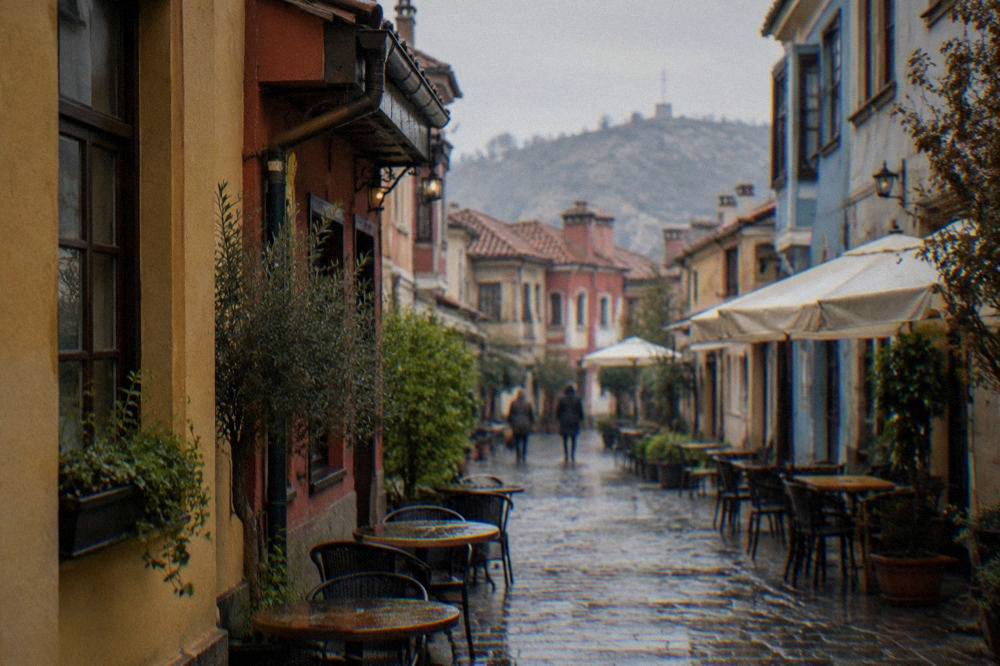
Three free sights anchor any version of this itinerary: Nebet Tepe, the settlement hill the city dates to the 4th millennium BC, reopened after conservation in March 2025; the Roman Stadium sphendone, the visible northern curve of a 30,000-spectator arena; and Kapana, The Trap, whose maze of narrow streets hosts the Kapana Fest and the Christmas programme. Everything else on the ticket list is an add-on to those.
A common shortcut is to treat the Old Town as the whole city. It is not. The main street and the centre carry their own sights, the Dzhumaya Mosque, free to visit outside prayer times with modest dress, stands at the heart of them, and the hills give the city its shape: there were seven until Markovo Tepe was partly quarried away in the 1930s, leaving six. Plovdiv is not a UNESCO World Heritage Site; "The Ancient Plovdiv" has sat on Bulgaria's Tentative List since 2004, which is a waiting list rather than an inscription.
How Do You Compress This Plovdiv Itinerary Into A Short Trip?
Cut the museums before you cut the hills: on a tight schedule, the one-site Ancient Theatre ticket, the free sphendone, Nebet Tepe and an evening in Kapana preserve the essential Plovdiv, while the Ethnographic Museum, the Regional History Museum and the second basilica are the pieces that reward a second day rather than demand one. Monday is the worst arrival day, since the Ethnographic and Archaeological museums both close then.
| If you have | Keep | Drop without regret |
|---|---|---|
| Half a day | Ancient Theatre, Nebet Tepe, Kapana | All museums, all day trips |
| One day | Add sphendone, Hisar Kapia, Dzhumaya Mosque | Bishop's Basilica interior, hills beyond Nebet Tepe |
| Two days | Add both basilicas, Ethnographic Museum, one hill | Day trips |
| Three days | Add Bachkovo and Asen's Fortress | Nothing core; extend with the Rhodopes |
For a first visit of any length, the Plovdiv self-guided walk page turns the one-day loop into turn-by-turn directions, and the root things to do in Plovdiv page is the full index of everything the itinerary above compresses. This Plovdiv Travel Guide page is the day-count overview; the linked pages carry the hour-by-hour versions.
Common Questions About The Plovdiv Itinerary
Can you see Plovdiv in one day?
Yes. The core loop, the Ancient Theatre, Nebet Tepe, Hisar Kapia, the Roman Stadium sphendone and Kapana, is walkable in a day, and the one-site Old Plovdiv ticket is 3.58 euro.
Is two days in Plovdiv enough?
Two days cover the core loop plus the Bishop's Basilica mosaics, the Small Basilica, the Ethnographic Museum and one or two hills, without rushing. A third day is only needed for the Rhodope foothills day trip.
What is the best day trip from Plovdiv?
Bachkovo Monastery, free to enter and about 30 km away with minibuses taking 35 to 45 minutes, paired with Asen's Fortress on the same road south, is the excursion the tour roster centres on.
Is the Plovdiv Old Town a UNESCO site?
No. "The Ancient Plovdiv" has been on Bulgaria's UNESCO Tentative List since 2004, which is a waiting list, not a World Heritage inscription.
Does Bulgaria use the euro in Plovdiv?
Yes, Bulgaria has used the euro since 1 January 2026. Some official price lists still print both currencies; the euro figure is the one to use.
What is free in Plovdiv?
Nebet Tepe, the Roman Stadium sphendone viewing area, Kapana, Hisar Kapia and the Bunardzhik hill with the Alyosha monument all cost nothing, and students and seniors get free Old Plovdiv entry on the first Thursday of the month.
Whichever day count you choose, book the monastery day trip and the theatre hours around your arrival day, and the rest of this itinerary will fall into place on foot.
