Plovdiv With Kids: Easy Wins In The Old Town
Plovdiv, in southern Bulgaria, is a compact hill city of Roman ruins and car-free lanes, and it works surprisingly well with children: here is what to see, what each site costs in euro, and how to pace the day.
Short answer
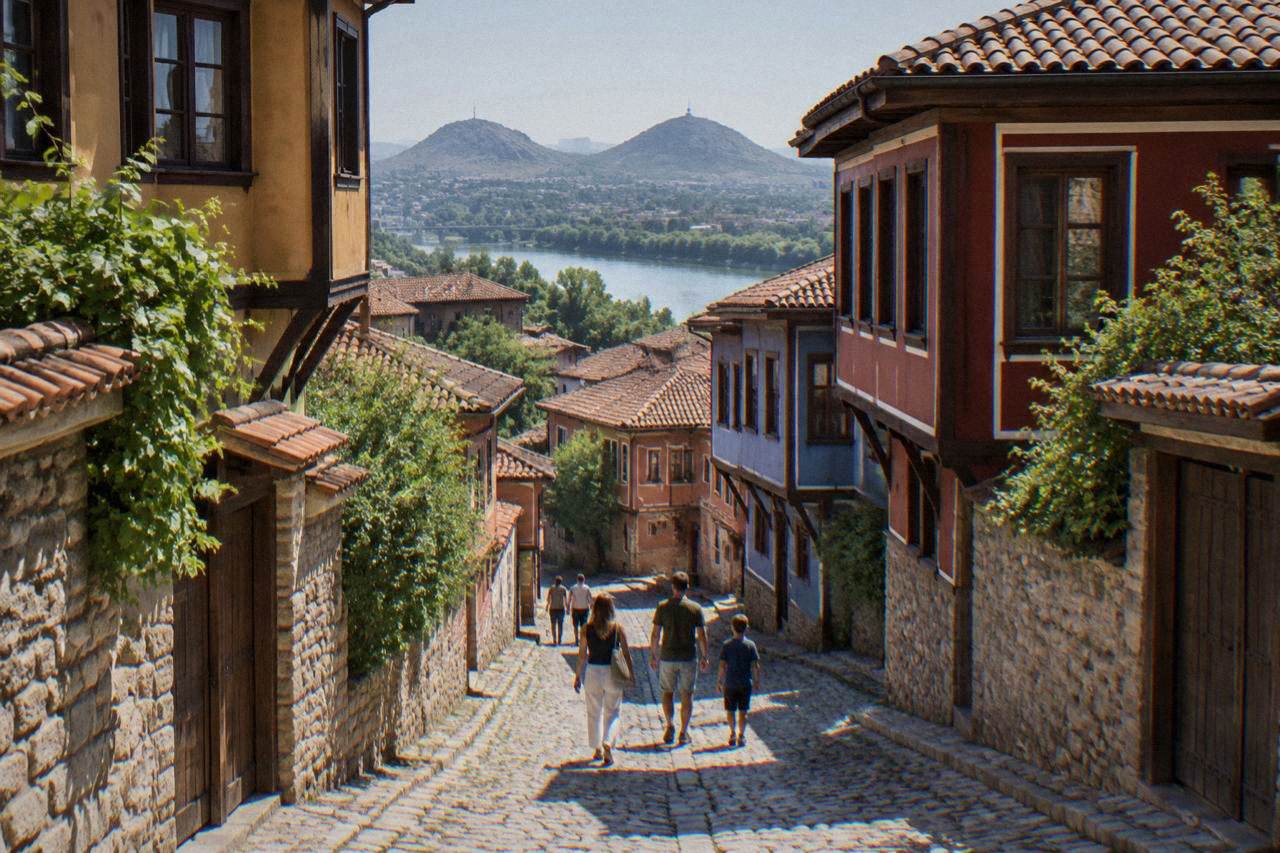
Plovdiv with kids works best as a walking city: the Ancient Theatre, the free Nebet Tepe hill, Kapana's lanes and Tsar Simeon Garden are all within a short walk of each other, single Old Plovdiv site tickets cost 3.58 euro for adults with children under 7 free, and the city bus e-ticket is 0.50 euro.
Plovdiv, in southern Bulgaria, is an inland city built around six hills, and almost everything a family needs sits inside one walkable rectangle between the Old Town and the city centre. The Roman ruins are open-air and climbable within the rules, the main street is fully pedestrian, and the two big family stops that cost nothing, Nebet Tepe and the Kapana creative district, sit five minutes apart. The municipal Old Plovdiv price list prices a single site at 3.58 euro for adults with children aged 7 and under free, which makes a half day of history far cheaper than equivalent city breaks in western Europe. This guide lays out what to see in what order, what each ticket costs in euro, and where the practical traps are, from Monday museum closures to cobbles and pushchairs.
Is Plovdiv Good To Visit With Kids?
Yes, Plovdiv suits families well for a short city break, because the core sights are close together, largely car-free and mostly open-air: the Ancient Theatre, the Roman Stadium sphendone, Nebet Tepe, Kapana and the pedestrian Main Street form one continuous walking loop, the city bus e-ticket costs 0.50 euro, and children under 7 enter Old Plovdiv sites free. The Old Town's cobbles and slopes are the one physical drawback, described in general terms on every guide to the area, so a carrier beats a pushchair on the hill lanes.
The city's shape does a lot of the work. Plovdiv is Bulgaria's second-largest city, with a population of 333,994 at the end of 2025 according to the National Statistical Institute, but the visitor core is a fraction of that. The Three Hills, the Old Town, the Main Street and the centre stack north to south in a line a family can walk end to end without crossing traffic for long stretches. The municipal tourism material presents the city as often described as one of the oldest continuously inhabited cities in Europe, which for children translates into layers they can see: a Roman theatre on one hill, a medieval gate below it, revival-era houses in between.
Plovdiv was European Capital of Culture in 2019, shared with Matera in Italy, and that year left the city with a stock of restored buildings and public spaces, including the Bishop's Basilica visitor infrastructure. For a fuller rundown of the city's sights in their own right, the site's root guide to things to do in Plovdiv covers the whole roster; this page keeps the family lens.
What Are The Best Things To See In Plovdiv With Children?
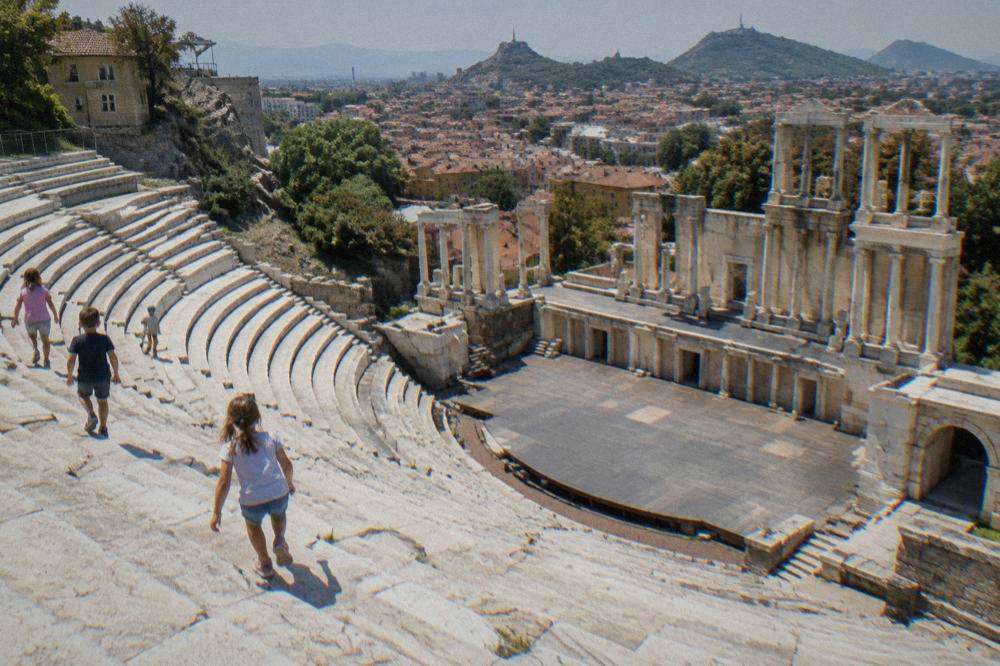
The five reliable wins with children are the Ancient Theatre of Philippopolis, the free Nebet Tepe archaeological hill, the Roman Stadium sphendone on the Main Street, the Kapana creative district, and Tsar Simeon Garden with its singing fountains: three of the five are free, the theatre costs 3.58 euro per adult with under-7s free, and all five sit within one walking loop. Each one gives children something to do rather than something to look at, which is the difference between a good family stop and a failed one.
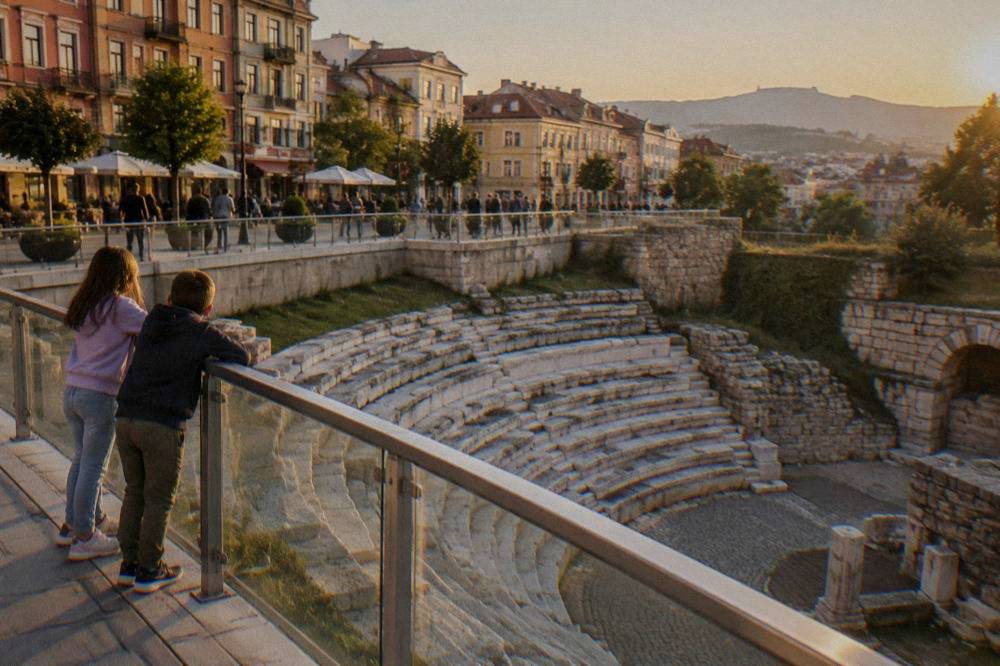
The Ancient Theatre is the anchor. It was built in the 90s of the 1st century AD and has 28 concentric rows of marble seats, and children take to the seating as a natural amphitheatre of steps. The theatre is open daily, April to October 9:30 to 18:00 and November to March 9:00 to 17:30, with a lunch break from 12:30 to 13:00, so time an arrival around that gap. The theatre still hosts performances, with Opera Open running 23 June to 9 September in 2026, and an evening performance is a memorable way for older children to see the space in use. The site's own page is covered in detail at the Ancient Theatre of Philippopolis.
Nebet Tepe, one of the Three Hills, is free and open at all hours since its restoration project was completed and officially opened in March 2025. The city's tourism site dates the first settlement on the hill to the 4th millennium BC. There are walls, views over the plain and enough loose geography for children to burn energy on; the guided-tour hours quoted for the site apply to organised visits, while general access is unrestricted. Kapana, whose name means "The Trap" in a maze of narrow streets, is free, open and full of small squares; the autumn Kapana Fest ran two weekends in October 2026, and the Sunday artisan market activity around the district is worth confirming locally.
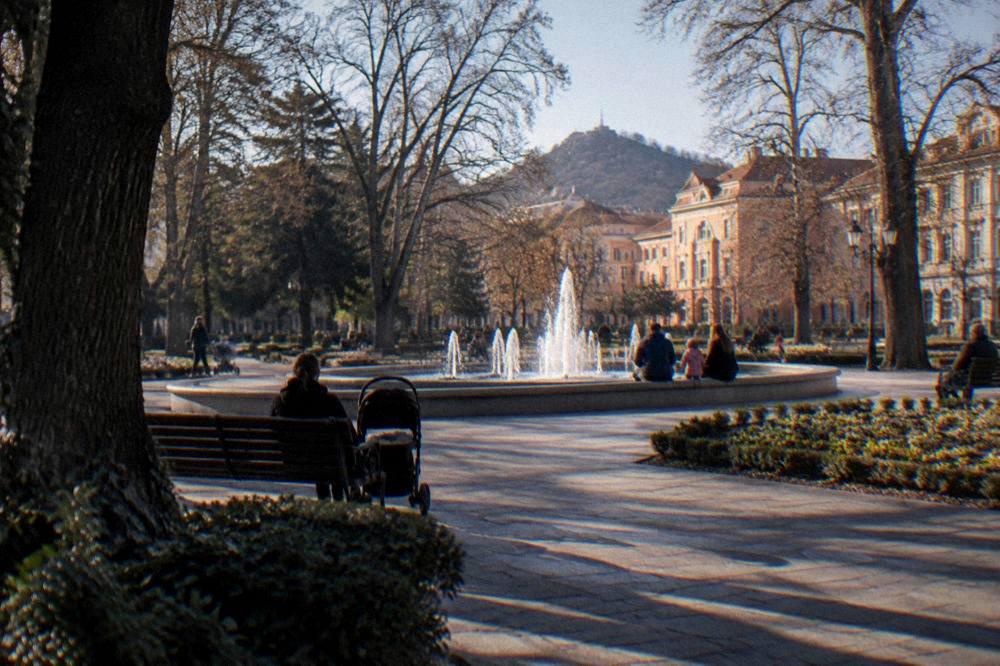
The Roman Stadium's northern curve, the sphendone, is free to view from the Main Street level, and only the northern part is accessible because the rest of the monument still lies under the modern street. Tsar Simeon Garden and its singing fountains are public, free and a standard evening gathering point. For a fuller walk through these sights in sequence, the site's Plovdiv walking tour page lays out the route.
Between the theatre and Kapana sit Hisar Kapia, the medieval gate that is open at all hours, and the back lanes of the Old Town themselves. A family circuit that starts at the theatre, drops through Hisar Kapia into Kapana, and returns along the Main Street past the sphendone takes in every free headline stop without a single ticket.
What Do Plovdiv Tickets Cost For A Family?
A single Old Plovdiv site costs 3.58 euro per adult, pupils and students pay 1.53 euro, children aged 7 and under are free, a family ticket for parents with children aged 7 to 16 costs 7.16 euro, and a combined ticket covering up to five sites costs 10.74 euro for adults, all per the official Old Plovdiv price list. The Bishop's Basilica is priced separately at 7.57 euro for adults and is not covered by the standard combined ticket, which also excludes the Small Basilica.
The family ticket is the number to look at first, because for two adults and one child aged 7 to 16 it undercuts two adult singles. The combined ticket covers up to five sites but its validity period is not stated on the official page, so plan to use it within a single visit rather than banking it for a second day. Groups of more than 10 pay 3.07 euro per adult, which applies to organised groups rather than families.
| Ticket | Adult | Pupil / Student | Family (parents + children 7 to 16) | Child 7 and under |
|---|---|---|---|---|
| Any one Old Plovdiv site (except Bishop's Basilica) | 3.58 euro | 1.53 euro | 7.16 euro | Free |
| Combined, up to 5 sites | 10.74 euro | 4.09 euro | 21.47 euro | Free |
| Bishop's Basilica, single | 7.57 euro | 3.58 euro | 15.34 euro | Free |
| Roman Stadium 3D hall | 3.68 euro | 1.23 euro | not listed | Free |
Source of the first three rows: the Old Plovdiv municipal ticket page. The first Thursday of the month is free for students and seniors at Old Plovdiv sites, and the Regional History Museum is free for everyone the first Thursday of the month, which is worth building a calendar around for a tight budget.
The museums have their own prices. The Regional History Museum charges 5.00 euro for one site, 8 euro for two and 10 euro for three, with students at 2 euro and a family one-site ticket at 6 euro. The Regional Ethnographic Museum, in the Kuyumdzhiev House, is closed on Monday, opens 9:00 to 18:00 in summer and 9:00 to 17:00 in winter, and its adult price is reported at about 3.07 euro, a figure to confirm on arrival. The Regional Archaeological Museum's ticket price is not published on its official page, so confirm locally; it is closed Monday and open Tuesday to Sunday 10:00 to 18:00, and its renewed permanent exhibition opened in November 2025.
| Museum | Closed | Hours | Child note |
|---|---|---|---|
| Regional History Museum | first Thursday free | varies by site | student 2 euro, family ticket exists |
| Regional Ethnographic Museum | Monday | 9:00 to 18:00 summer, 9:00 to 17:00 winter | confirm child rate on arrival |
| Regional Archaeological Museum | Monday | Tue to Sun 10:00 to 18:00 | price not published, confirm locally |
A guided walk is one way to hold children's attention across these sites, and the related tour on this page, an Old Town and Roman Theatre walking option, covers exactly the stretch a family walks anyway; Check availability if that suits your pace.
Is The Old Town Manageable With A Pushchair?
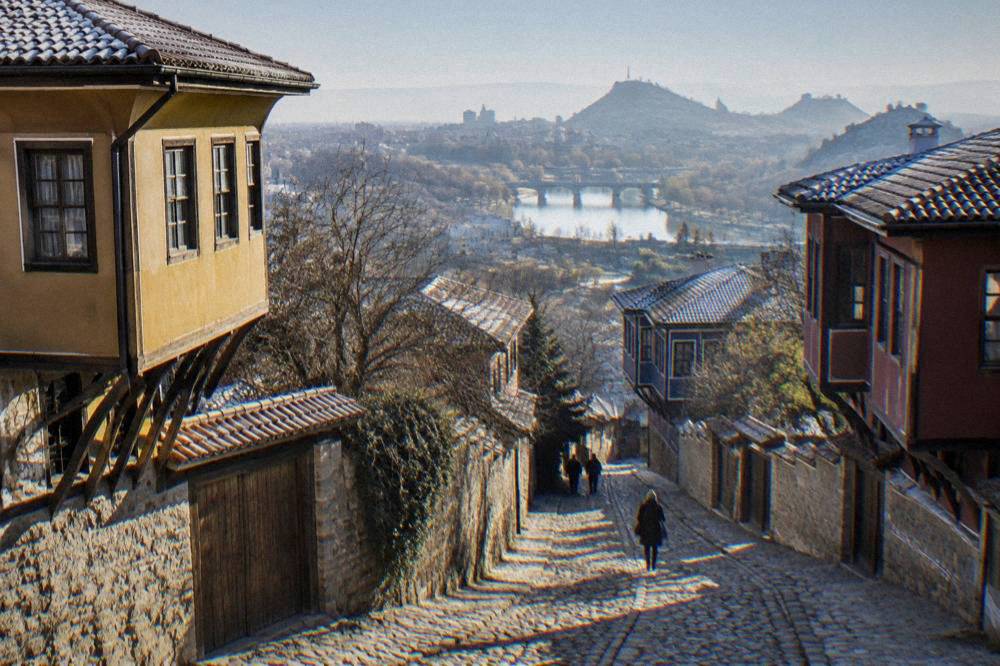
The Old Town is cobbled and steep in stretches, with no gradient figures published, so a baby carrier is more practical than a pushchair on the hill lanes, while the lower route along the Main Street, the Roman Stadium sphendone and Tsar Simeon Garden is flat and fully pedestrian. Families who keep to the lower city can move entirely on smooth paving; the theatre, Nebet Tepe and the revival-house lanes are where wheels struggle.
The practical split is simple. Everything above Hisar Kapia climbs: the theatre sits high on one of the Three Hills, Nebet Tepe is a hill by definition, and the streets between Balabanov, Hindliyan and Nedkovich houses are pitched cobbles. Everything below it, the Main Street, the stadium sphendone, the garden and the centre, is flat. A day that does the hills in the morning with a carrier and the flat city after lunch spreads the effort sensibly.
The revival houses reward the climb if children have patience for interiors. Balabanov House, Hindliyan House, Nedkovich House and Lamartine House all take the one-site Old Plovdiv ticket, and Hindliyan House moved to daily opening in an autumn 2026 report. Their painted rooms and courtyards are compact, which suits short attention spans better than a large museum. The site has dedicated pages for Hisar Kapia and Hindliyan House with the details.
How Many Days Do Families Need In Plovdiv?
Two days is the comfortable family length: day one for the Old Town loop, the theatre, Nebet Tepe and Kapana, and day two for the flat centre, a museum or two and the Bishop's Basilica mosaics, with a day trip to Bachkovo Monastery or the Rhodopes as an optional third day. One day works for the headline loop alone, and the pacing question is covered in depth on the site's Plovdiv in one day itinerary.
The two-day rhythm suits children because the mornings hold the climbing and the afternoons hold food and open space. Lunch in the middle is not a compromise in Plovdiv, it is an attraction in itself; the city's food pages cover what to eat in Plovdiv and the wider Bulgarian food repertoire, and a food walk is one of the few tour types that children experience as a treat rather than a lesson.
For the third day, the classic family excursion runs south to Bachkovo Monastery, about 30 km from Plovdiv with minibuses from the Rodopi bus station taking 35 to 45 minutes, and the monastery is free to enter as a working monastery. Asen's Fortress sits above Asenovgrad on the same road; its admission figure is unclear in current sources, so confirm on arrival. The Bachkovo Monastery and Rhodopes pages carry the detail, and a guided option covers the same ground:
When Should A Family Visit Plovdiv?
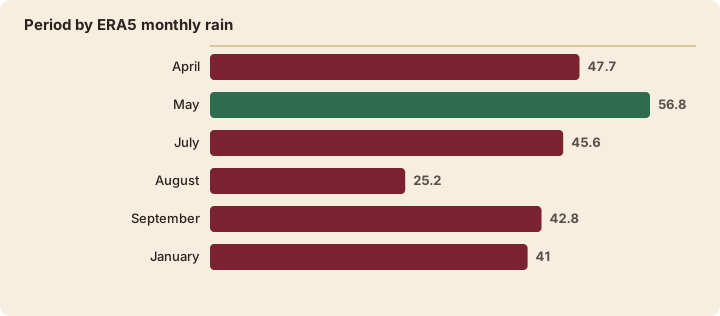
Late April to June and September to early October give families the best balance: ERA5 reanalysis, 1991-2020 puts the mean daily high at 17.1 C in April, 21.9 C in May and 23.8 C in September, against 28.6 C in August and 5.9 C in January, so spring and early autumn avoid both the summer heat on the exposed hills and the winter ice on the cobbles. The schedule of events also matters: Opera Open at the Ancient Theatre ran 23 June to 9 September in 2026, and the Christmas market ran from 1 December 2026 into January 2027 in the latest edition.
Rain is not the deciding factor, since the annual total across the monthly normals is 536.6 mm spread fairly evenly, but May carries the highest monthly total at 56.8 mm and August the lowest at 25.2 mm. The seasonal trade-offs, month by month, are laid out on the site's best time to visit Plovdiv and Plovdiv weather pages.
| Period | ERA5 mean daily high | ERA5 monthly rain | Family read |
|---|---|---|---|
| April | 17.1 C | 47.7 mm | comfortable climbing weather |
| May | 21.9 C | 56.8 mm | warm, highest rain total of the year |
| July | 28.2 C | 45.6 mm | exposed hills get hot at midday |
| August | 28.6 C | 25.2 mm | driest month, warmest mean high |
| September | 23.8 C | 42.8 mm | back to comfortable |
| January | 5.9 C | 41.0 mm | mean low -2.6 C, icy cobbles possible |
Winter has its own case: the Christmas market's 2026/27 edition, "The Soul of Christmas", ran 1 December 2026 to 7 January 2027 across Kapana and Central Square, and the city's squares and Roman ruins in artificial light are the winter evening draw. Opening times at outdoor sites shorten in winter, with the theatre moving to 9:00 to 17:30 from November.
How Does A Family Get To Plovdiv And Around?
Most international families arrive via Sofia and take a direct BDZ train, about 2 h 40 to 3 h 05, or a bus, about 1 h 45 to 2 h 20, while Plovdiv Airport at Krumovo has a small route list including London, Milan Malpensa and Bratislava; inside the city the bus e-ticket costs 0.50 euro and the core sights are walkable. The full arrival options are on the site's pages for Sofia to Plovdiv, Plovdiv Airport and how to get to Plovdiv.
One warning worth repeating: the Plovdiv railway junction modernisation is due to finish in 2026, so access around the central station can change during works. Families with luggage should budget extra time there and check the current layout on arrival. The station sits next to the Yug bus station on Hristo Botev Boulevard, which keeps connections simple; the Plovdiv train station page covers the detail.
Inside the city, walking covers the visitor core. Where a bus is needed, the e-ticket is 0.50 euro; a 1 euro paper ticket from the driver was a 2026 proposal only, not adopted at the time of check, so confirm the fare arrangements on the spot. Car hire is reasonable if a Rhodopes day is planned, and the getting around Plovdiv and Plovdiv car rental pages carry the options. Parking rules and tariffs are not stated here; the Plovdiv parking page addresses the topic with the same caution.
Where Should A Family Stay In Plovdiv?
The central area between the Old Town, Kapana and the Main Street puts every family sight within a short walk, and the choice is between the cobbled Old Town itself for atmosphere or the flat centre for pushchairs and restaurants; no hotel rate is published on this site, so compare prices at booking. The neighbourhood-by-neighbourhood breakdown, including which districts are flat and which sit on the hills, is on the where to stay in Plovdiv page.
The practical hierarchy for families runs centre first, Old Town second, hills last. The centre keeps restaurants, the garden and the stadium sphendone level and close; the Old Town trades convenience for revival-house streetscapes; anything up the hills adds a climb to every return trip. A tourist tax may be charged by the accommodation, and its exact 2026 euro rate is not published here, so confirm at booking.
What Should Children Eat In Plovdiv?
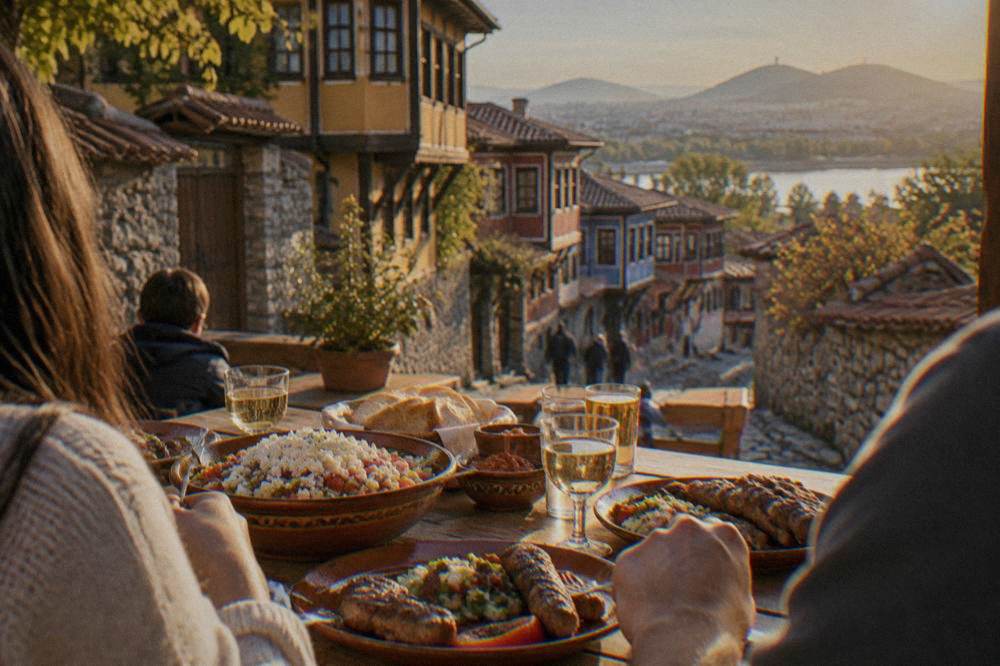
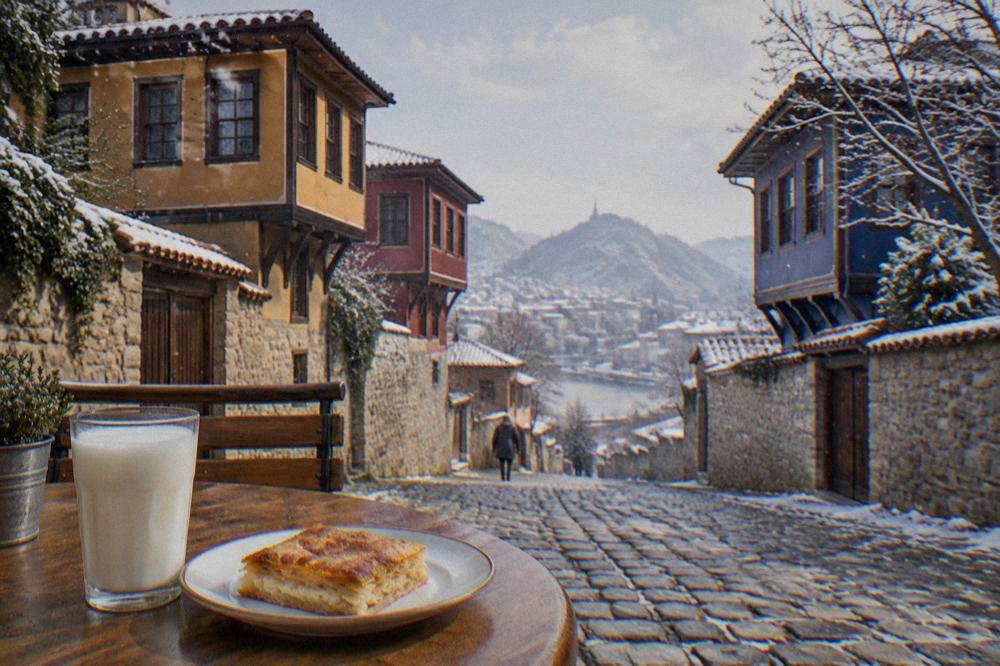
The dishes children reliably take to are banitsa, the cheese filo pastry sold as a breakfast staple, shopska salad with its sirene cheese, kebapche and kyufte grilled mince, tarator cold yogurt soup in summer, and kavarma clay-pot stew, with an espresso around 2 euro and a 0.5 l draught beer around 2 euro for the adults, per crowd-reported 2026 price data. Nothing on the standard menu is aggressively spiced, and the pastry-and-grill core of Bulgarian food suits cautious young eaters.
Food is the easiest part of a Plovdiv trip. A mid-range three-course meal for two runs about 30 to 40 euro in the crowd-reported averages, and the restaurant landscape is covered on the best restaurants in Plovdiv page. Tipping runs to about 10 per cent in restaurants for good service, common but not mandatory.
| Dish | What it is | Child appeal |
|---|---|---|
| Banitsa | cheese filo pastry, breakfast staple | high, familiar format |
| Shopska salad | tomatoes, cucumbers, peppers, sirene cheese | high in summer |
| Kebapche / kyufte | grilled minced meat | high |
| Tarator | cold yogurt and cucumber soup | medium, seasonal |
| Kavarma | clay-pot meat and vegetable stew | medium-high |
For families who want the food explained rather than just eaten, a guided food walk turns a meal into the afternoon's activity:
What Are The Free Things To Do In Plovdiv With Kids?
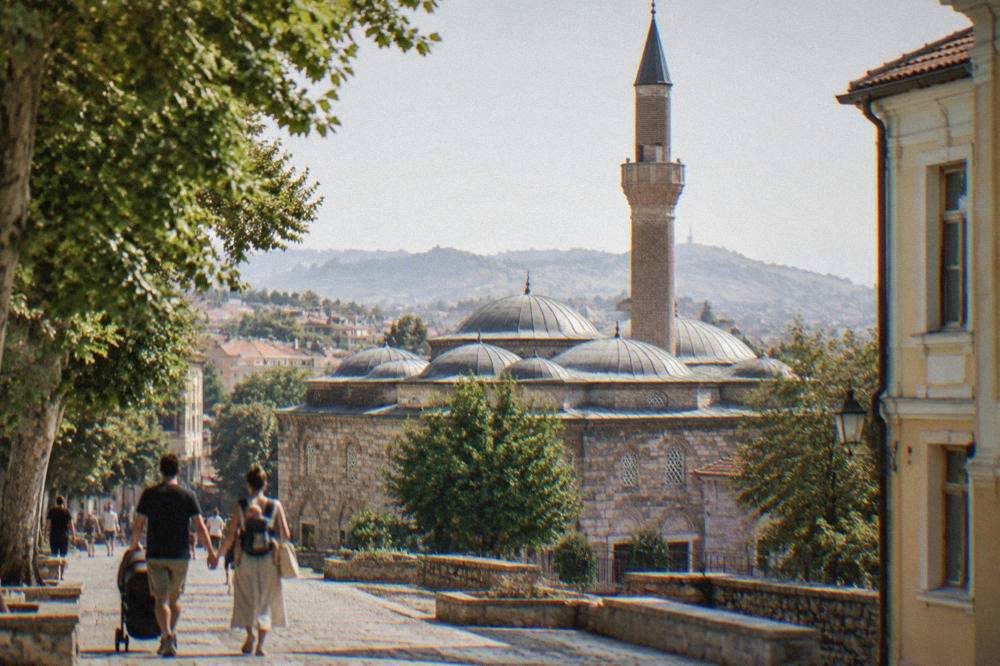
The free family stops are Nebet Tepe, the Roman Stadium sphendone, Kapana's street-art lanes, Hisar Kapia, Tsar Simeon Garden and the singing fountains, the pedestrian Main Street, and the Dzhumaya Mosque outside prayer times, which opens to visitors 6:00 to 23:00 with modest dress required. Between free hills, free ruins and free public space, a family can fill a full day in Plovdiv without buying a single ticket.
The balance of a budget trip looks like this: mornings on the free open-air sites, one paid site per day at 3.58 euro per adult, the first Thursday of the month for the Regional History Museum's free day, and lunch from the street-food end of the menu. The Dzhumaya Mosque, the second-largest in Bulgaria by built area at about 1,500 sq m, asks for shoulders and knees covered, shoes off and a headscarf for women, and Friday midday prayer is the time to avoid.
Common Questions About Plovdiv With Kids
Is Plovdiv good with kids?
Yes. The core sights are close together, largely car-free and mostly open-air, children under 7 enter Old Plovdiv sites free, and the flat Main Street, garden and Kapana lanes balance the cobbled hills.
How much do tickets cost for children in Plovdiv?
Children aged 7 and under enter Old Plovdiv sites free, pupils and students pay 1.53 euro at a single site, a family ticket for parents with children aged 7 to 16 costs 7.16 euro, and the combined five-site adult ticket is 10.74 euro, per the official Old Plovdiv price list.
Is the Old Town pushchair-friendly?
Only in part. The lower loop along the Main Street and past the sphendone is flat and pedestrian, while the theatre, Nebet Tepe and the revival-house lanes are cobbled and steep, so a baby carrier is the practical choice for the hills.
What is free in Plovdiv for families?
Nebet Tepe, the Roman Stadium sphendone, Kapana, Hisar Kapia, Tsar Simeon Garden with its singing fountains, the pedestrian Main Street and the Dzhumaya Mosque outside prayer times are all free to enter.
How many days should a family spend in Plovdiv?
Two days covers the Old Town loop plus the flat centre and museums comfortably, with an optional third day for Bachkovo Monastery and the Rhodopes.
When is the best time to visit Plovdiv with children?
Late April to June and September to early October, when ERA5 reanalysis 1991-2020 normals put mean daily highs between 17.1 C and 23.8 C, avoiding the 28.6 C August heat on the exposed hills and the January mean low of -2.6 C.
The short version for families: Plovdiv is a walking city that rewards a slow loop, a carrier instead of a pushchair on the hills, one paid site a day, and the free hills, lanes and fountains filling every gap. More of the site's planning material, from the Plovdiv Travel Guide homepage to the itineraries and day-trip pages, is built around exactly that pace.
