Karshiyaka: Street Art And The Other Side Of The River
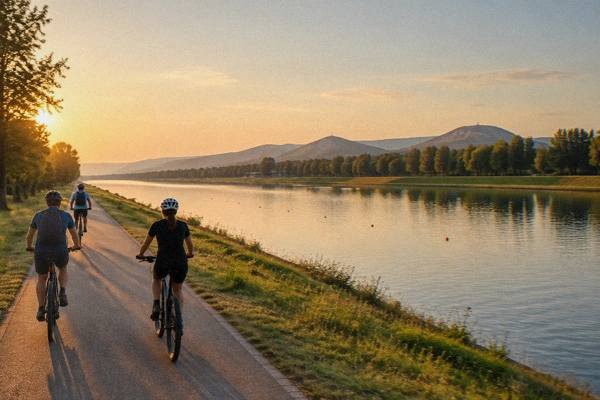
Karshiyaka is the stretch of Plovdiv on the north bank of the Maritsa, directly opposite the city center, and it rewards a slow walk with river views, painted walls and a calmer pace than the Old Town.
Short answer
Karshiyaka sits across the Maritsa from central Plovdiv. Cross on foot from the center, walk the riverbank and the back streets, look back at the six hills, then loop over a bridge. Half a day is enough, and it pairs well with Kapana or the Old Town on the same day.
Karshiyaka is the district of Plovdiv, in southern Bulgaria, that faces the city center from the north bank of the Maritsa river. Plovdiv is an inland city built around six hills, with no sea coast, and Karshiyaka is where you go to see those hills as a skyline rather than from inside them. The name is used loosely by locals for the whole opposite bank, and the walk across, along and back is one of the free pleasures of a city where the river has always divided the Roman-era core on the south side from the quieter ground to the north. Nothing here needs a ticket. The district's streets are public and open, the riverbank path is free, and the views back toward the Three Hills and the Old Town are the reason to make the crossing.
What Is Karshiyaka In Plovdiv?
Karshiyaka is the collective name for the neighbourhoods on the north bank of the Maritsa in Plovdiv, facing the historic center, which sits on the south bank among the hills. The river is the city's oldest boundary, and the district across it is flat, residential and free to wander, with no ticketed attraction anywhere in it. On the south side stand the Three Hills, Nebet Tepe, Dzhambaz Tepe and Taksim Tepe, with the Old Town above and the Roman sites below. On the north side the ground is flatter, the streets are wider and the building stock mixes 20th-century apartment blocks with older houses. The district has no single ticketed attraction and no gate: it is a residential quarter with a riverfront, and its appeal is the walk itself, the painted walls on its underpasses and side streets, and the uninterrupted view of the center from the opposite bank.
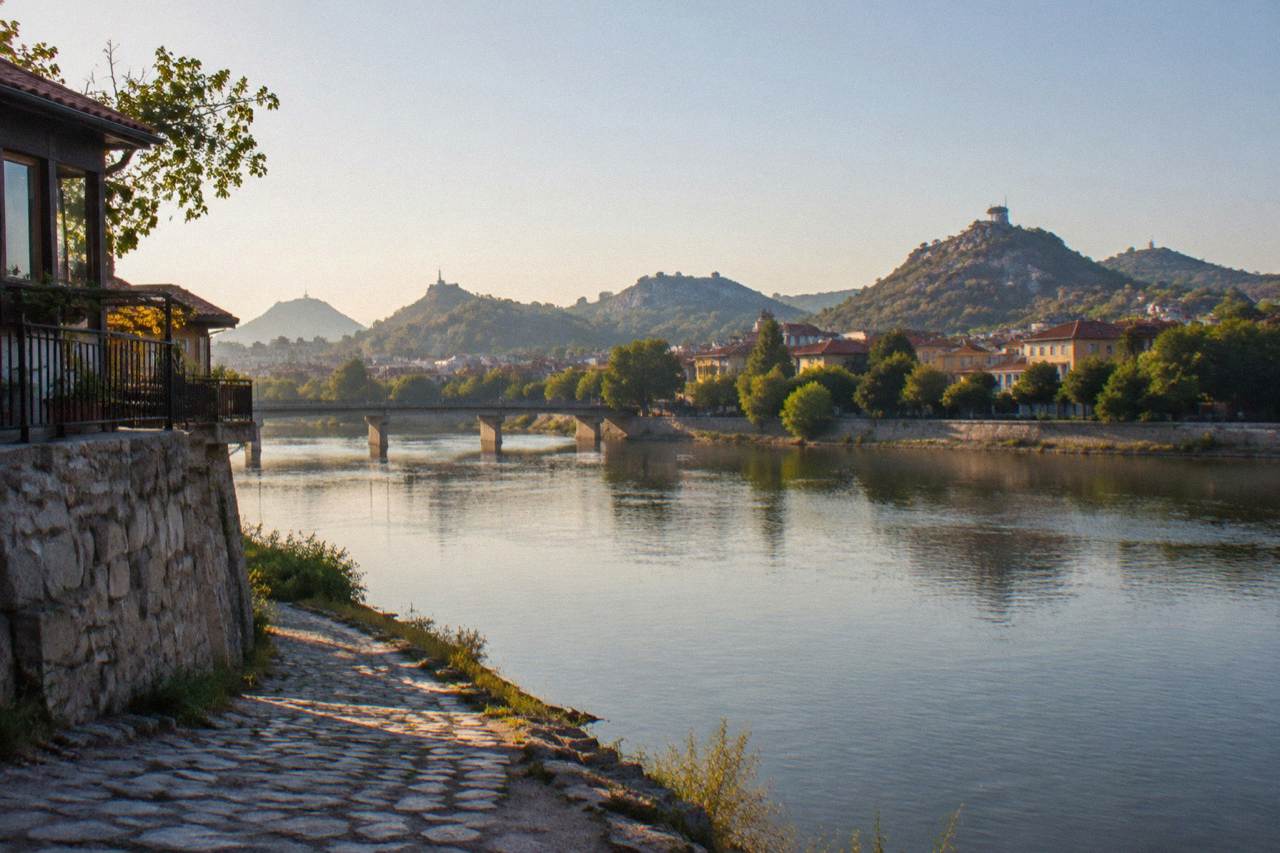
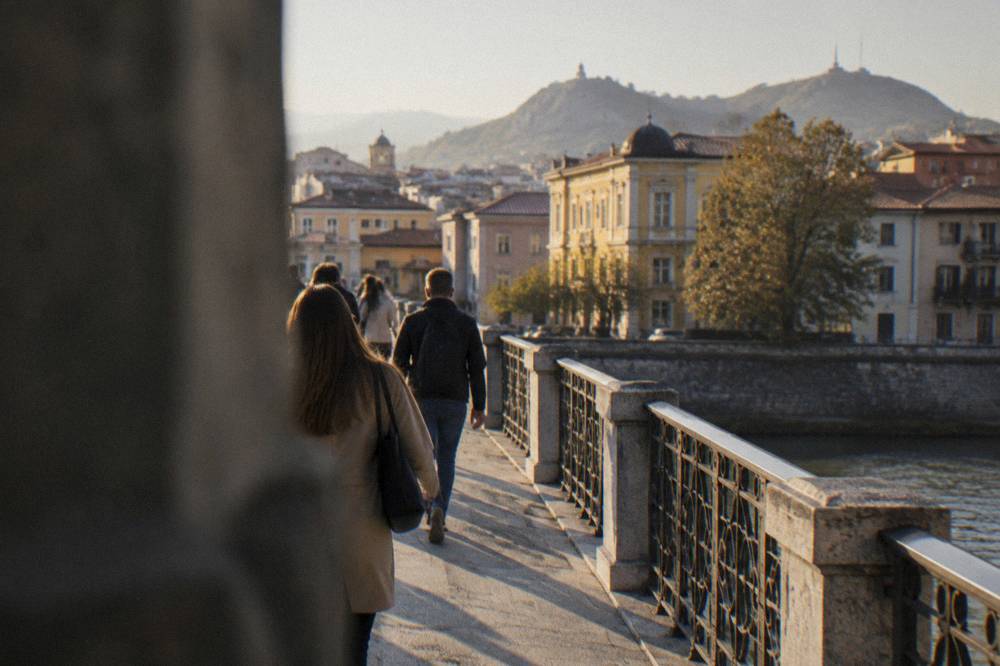
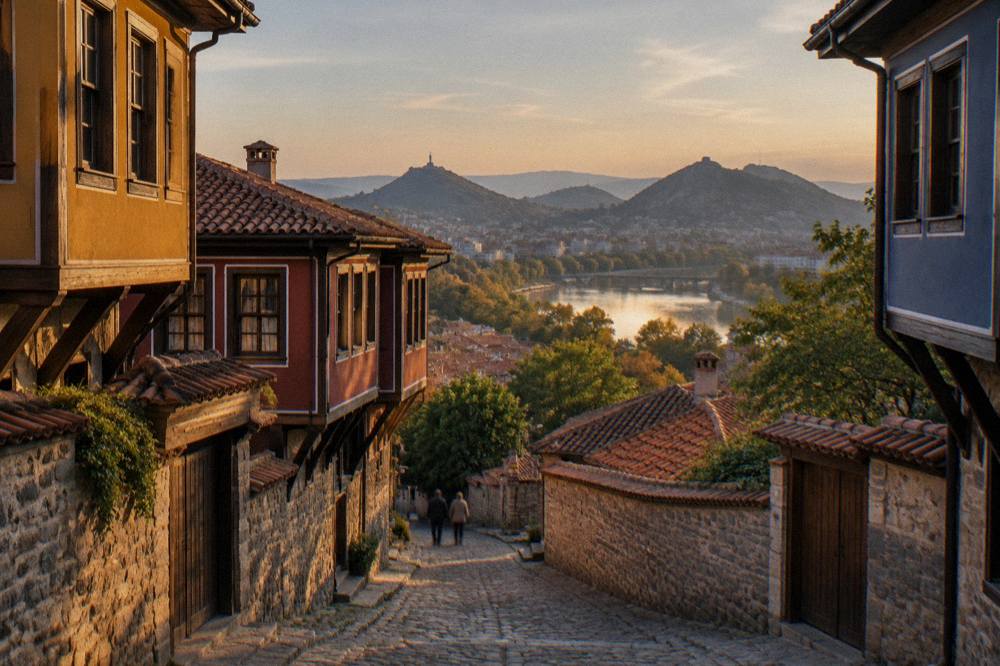
The view works in both directions, which is the point. From the center, Karshiyaka is the low skyline beyond the water. From Karshiyaka, Plovdiv presents itself as it does in photographs: the hills stacked one behind another, the Alyosha monument standing on Bunardzhik hill to the southwest, and the Old Town's roofs climbing toward Nebet Tepe at 207 m. The heights of the six hills, published by the city's tourism site, give the panorama its shape: Youth Hill at 285.5 m is the high point, with the Hill of the Liberators at 265 m, Danov Hill at 227 m, Nebet Tepe at 207 m, Dzhambaz Tepe at 212 m and Taksim Tepe at 195 m.
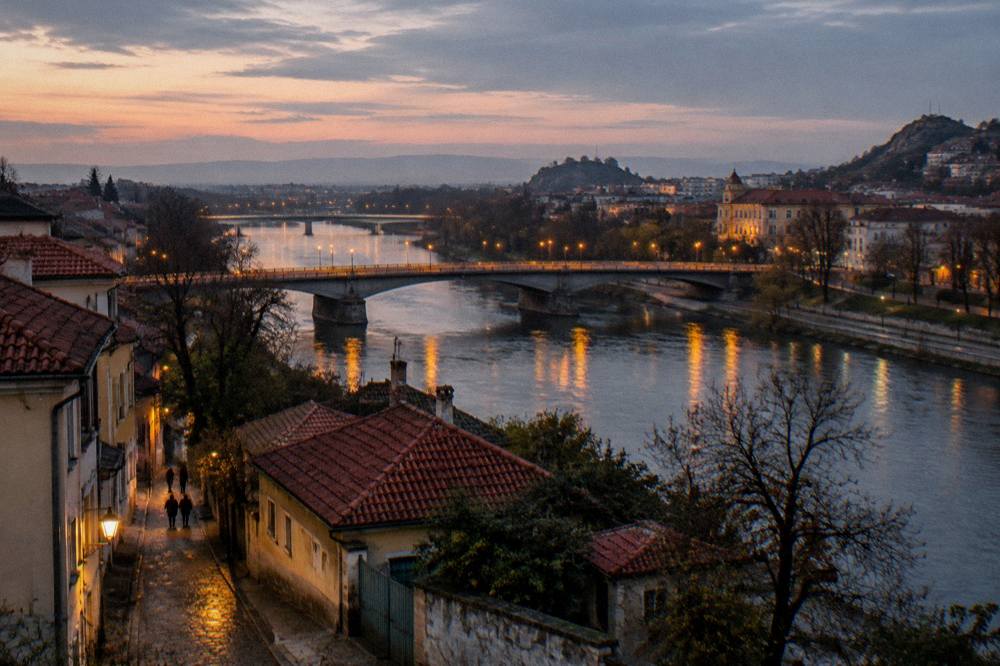
A note on expectations, because guidebooks sometimes oversell the district. Karshiyaka is not a museum quarter and it is not Kapana, the maze of narrow streets whose name means "The Trap" and which became the city's creative district. It is a lived-in part of town. That is exactly why photographers and walkers cross the river: the light on the water in the late afternoon, the reflections, and the sight of the whole historic core lined up across the Maritsa.
How Do You Cross From Central Plovdiv To Karshiyaka?
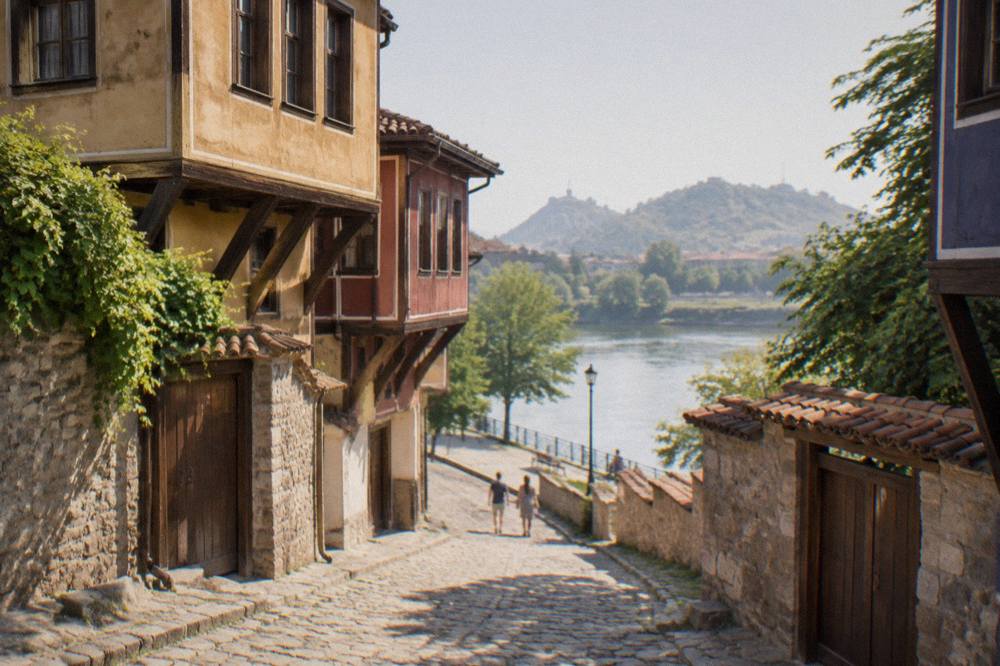
You cross the Maritsa on foot over one of the road and footbridges that link central Plovdiv to Karshiyaka, a walk of a few minutes from the end of Main Street, with no ticket, no fare and no restriction on hours, and the riverbank path on the far side continues the walk along the water. The center's pedestrian spine, Main Street and the center, runs down to the river, and the bridges sit within easy reach of it. Once over, the riverbank path runs along the water and the district's grid of streets opens behind it. The whole crossing-and-return loop can be done at any pace, and in summer the bank is where the city goes to escape the heat of the stone streets.
The practical detail worth knowing before you set out is what the walk gives you on each leg. The table below lays out the geography of the crossing, drawing on the figures the city publishes about the hills you will be looking at.
| Leg of the walk | What you cross or see | Figure |
|---|---|---|
| Center to riverbank | End of Main Street, the Roman-era core behind you | No ticket needed, public streets |
| Bridge crossing | The Maritsa, Plovdiv's dividing river | Open at all hours |
| North bank path | Riverfront walk facing the Three Hills | Free, public |
| View southwest | Alyosha monument on Bunardzhik (Hill of the Liberators) | Unveiled 1957, hill 265 m |
| View south | Old Town climbing to Nebet Tepe | Nebet Tepe 207 m |
| View west | Youth Hill, the high ground of the six | 285.5 m |
Orientation on the far bank is simple because the hills do the work. Keep the river on one side and the skyline on the other, wander a few blocks inland for the street art, then return to the water and cross back at a different bridge so the return view is fresh. The Alyosha monument makes a useful compass: it stands on the Hill of the Liberators, unveiled in 1957, and it is visible from much of the north bank.
A guided walk is one way to anchor the day. The city's classic guided walking tours cover the center's landmarks, the Ancient Theatre of Philippopolis, the Roman Stadium and the Old Town lanes, and a local guide can point out the best bridge and hour for the Karshiyaka view before you go on your own. The site's tour pages list what each walk covers.
What To See On The Karshiyaka Side Of Plovdiv?
The Karshiyaka side of Plovdiv offers three things: the riverbank walk with its panorama of the six hills, the street art on walls and underpasses inland of the bank, and the everyday architecture of a district that tourists usually only photograph from the center. None of it is ticketed. The district's open-air character means a visit costs nothing but time, and the only planning decision is which direction to loop and how far inland to stray before turning back to the water.
Start on the bank and work inward. The riverfront gives the long view of the Three Hills, the group on which the ancient city grew, with the Old Town's revival-period houses stacked above the trees. The city's tourism site dates the first settlement on Nebet Tepe to the 4th millennium BC, and Plovdiv is often described as one of the oldest continuously inhabited cities in Europe; from the north bank you can see the whole of that ancient ground in one frame. The Nebet Tepe complex itself, free and open following the restoration completed in 2025, sits at the top of the view.
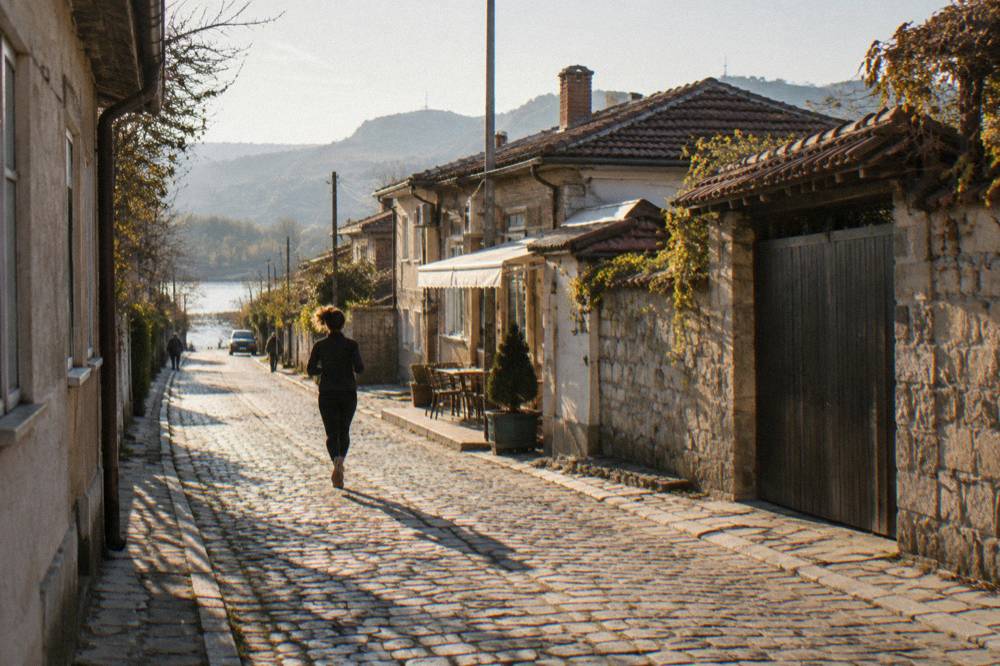
Inland from the bank, the district's walls carry much of the mural work that has spread across Plovdiv since the city's year as European Capital of Culture in 2019, an honour it shared with Matera in Italy. The site's dedicated Plovdiv street art guide covers where the painted walls cluster citywide. On the Karshiyaka side the murals sit among ordinary blocks and passageways rather than in a curated district, so the pleasure is discovery: a wall here, a bridge pier there, a painted transformer box on a corner. No gallery or wall on this side had its hours or address confirmed for this page, so treat the hunt as open-ended rather than a checklist.
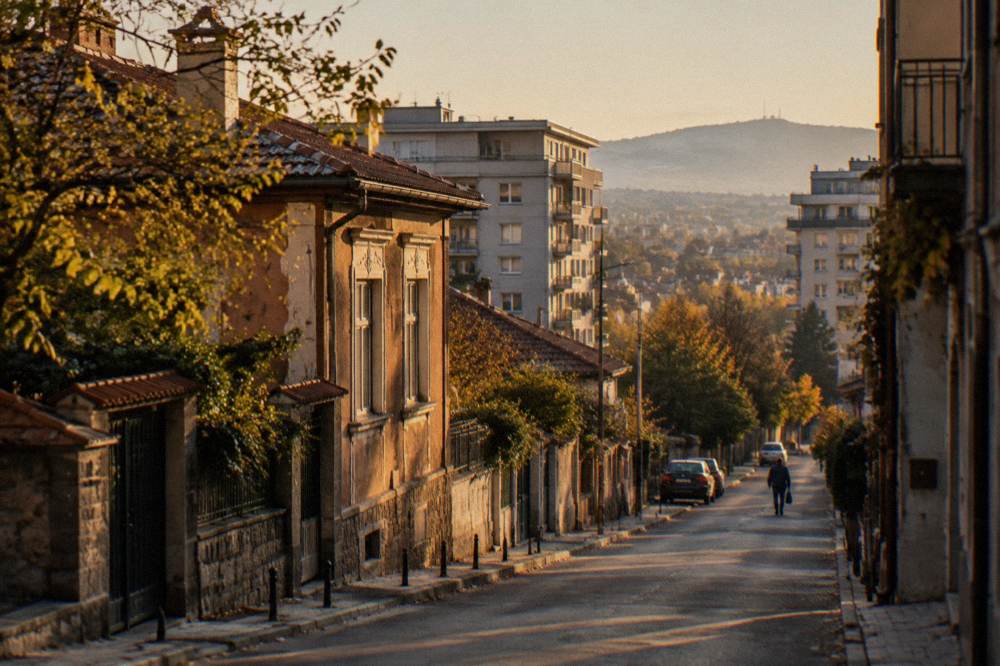
The third layer is architectural. Karshiyaka's streets hold interwar houses, mid-century blocks and newer construction side by side, a counterpoint to the National Revival houses of the Old Town. Photographers use this contrast deliberately: shoot the Revival-era past from the modern present, across the water that separates them.
| What you are looking at | Where it is | Cost | Notes |
|---|---|---|---|
| Panorama of the Three Hills | North bank riverfront | Free | Best light late afternoon |
| Alyosha monument on the skyline | Hill of the Liberators, southwest | Free to view | Unveiled 1957 |
| Street art walls and underpasses | Inland blocks off the bank | Free | Locations shift, no fixed map |
| Old Town skyline | Across the river, south | Paid sites inside | One-site Old Plovdiv ticket 3.58 euro |
| Kapana creative district | South bank near the center | Free streets | Name means "The Trap" |
A short food walk is a good bridge between the two banks. One city-centre option covers tastings across the center and runs about an hour, long enough to anchor a morning before you cross the river.
How Does Karshiyaka Fit A Day In Plovdiv?
Karshiyaka fits a Plovdiv day as the mid-afternoon or early-evening segment: two to three hours to cross, walk the bank, hunt the murals and return, slotted after the Old Town and before dinner in Kapana or the center. The district needs no advance planning, no tickets and no reservations, which makes it the flexible piece of any itinerary. If the morning went long in the Ethnographic Museum or a house museum such as Balabanov House, Karshiyaka shrinks to a single bridge loop; if the day is wide open, it stretches into a slow riverside wander.
The site's ready-made itineraries show where the crossing slots in. The one day in Plovdiv plan front-loads the ancient sites, the theatre, the stadium, the forum ground, and leaves the late afternoon loose, which is exactly the Karshiyaka window. The two day version can give the north bank its own half day, paired with the Dzhumaya Mosque and the lower Main Street on the way to the bridge.
For a sense of how the pieces divide, the table below breaks a full day into segments and what each one costs at the municipal ticket prices published by Old Plovdiv, in euro. The rest of the planning pages sit on Plovdiv Travel Guide.
| Day segment | Where | Ticket situation |
|---|---|---|
| Morning, ancient core | Ancient Theatre, one-site | 3.58 euro adult |
| Morning, Roman Stadium | Sphendone open-air part | Free |
| Midday, lunch | Kapana or Main Street | Pay as you eat |
| Afternoon, Old Town houses | Balabanov, Nedkovich or similar | 3.58 euro per site |
| Late afternoon, Karshiyaka | Bridges and north bank | Free |
| Evening, dinner | Kapana or center | Pay as you eat |
The Old Plovdiv price list also carries a combined ticket covering up to five sites, at 10.74 euro for an adult, excluding the basilicas, if the house-museum count rises during the day. The Bishop's Basilica is priced separately at 7.57 euro. Prices are those printed by the municipal institute; students, families and groups pay less across the list.
If the itinerary stretches beyond the city, the north-bank walk still holds its place. Longer Bulgaria itineraries that pass through Plovdiv often give the city a single afternoon, and the river crossing is the cheapest way to see the whole historic skyline when time is short.
Where Do You Eat And Drink Near Karshiyaka In Plovdiv?
The eating and drinking near Karshiyaka happens back across the river in Plovdiv's center and Kapana, because the north bank itself is primarily residential, with the riverside and the bridges returning you to the densest choice of cafes, bars and kitchens within a short walk. The creative district's free public streets hold the cluster of small kitchens and bars, and the Main Street carries the chain and cafe layer between the river and the Roman sites.
For self-catering and snacking, the site's Plovdiv street food guide covers the dishes to look for: banitsa for breakfast, kebapche from grills, shopska salad wherever tomatoes are in season. Crowd-reported price data for the city puts an espresso or cappuccino at roughly 2 to 2.5 euro and a half-litre of draught beer at around 2 euro, figures to treat as planning ranges rather than promises.
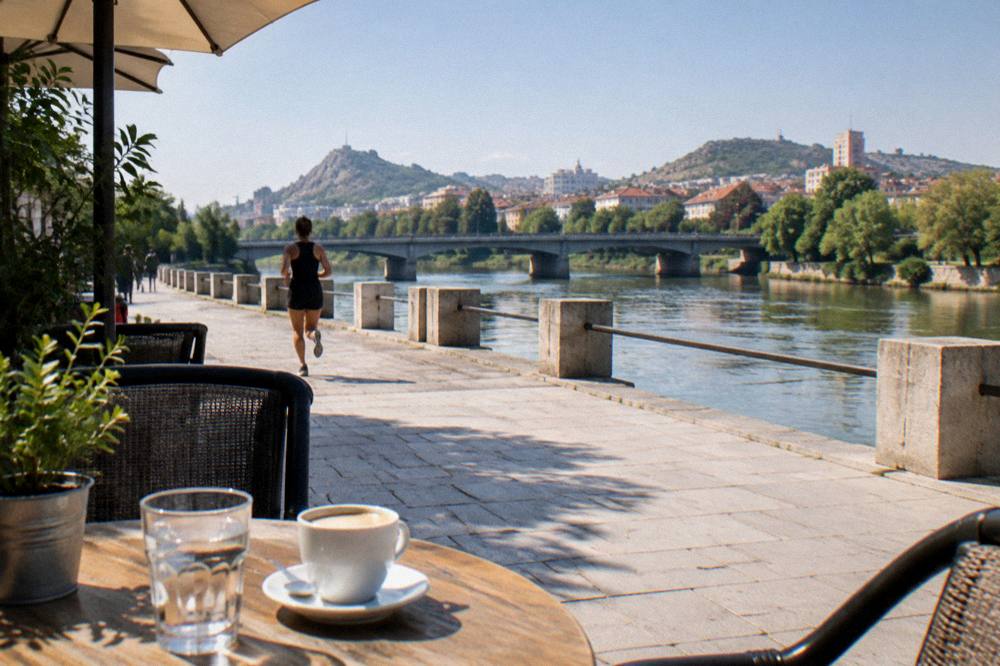
A practical rhythm for the evening: cross to Karshiyaka in the last hour of good light, walk the bank west, re-cross at a different bridge, then eat on the south side. In the warmer months this lines up with the opera and concert season at the Ancient Theatre, which ran from 23 June to 9 September in 2026, so a river walk can end with an open-air performance in a Roman building.
When Is The Best Time To Walk Karshiyaka In Plovdiv?
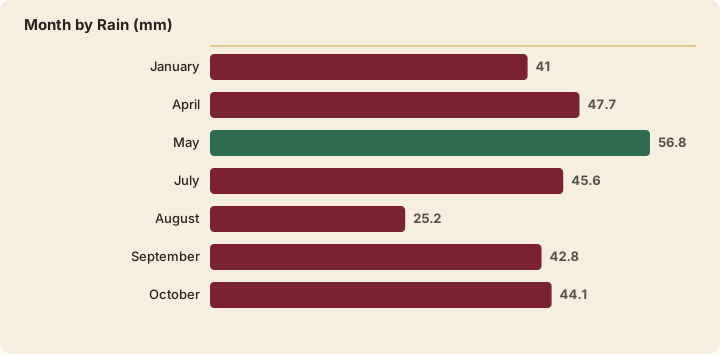
The best months to walk Karshiyaka in Plovdiv are April to June and September to October, when the ERA5 reanalysis 1991-2020 normals show mean daily highs between about 17 and 26 C and rainfall that stays moderate, and the best hour on any day is late afternoon into evening for the light on the river and the skyline. The city's climate is continental, with cold winters and warm summers. July and August bring mean daily highs of 28.2 C and 28.6 C respectively, and while August is the month with the least rain in the normals, 25.2 mm, midday heat on unshaded riverbank asphalt is a real consideration. January's mean daily low of minus 2.6 C makes the winter walk a different proposition: shorter, colder, and occasionally under snow.
| Month | Mean daily high (C) | Mean daily low (C) | Rain (mm) |
|---|---|---|---|
| January | 5.9 | -2.6 | 41.0 |
| April | 17.1 | 6.4 | 47.7 |
| May | 21.9 | 11.5 | 56.8 |
| July | 28.2 | 17.9 | 45.6 |
| August | 28.6 | 18.1 | 25.2 |
| September | 23.8 | 13.8 | 42.8 |
| October | 18.1 | 8.8 | 44.1 |
May, at 56.8 mm, carries the largest rain total in the normals, so spring walkers should keep that in proportion: it is still a walking city in May.
Seasonal events shape the timing too. The autumn Kapana Fest ran across two October weekends in 2026, 2 to 4 and 9 to 11 October, and the Jazz Fest fall edition followed on 6 to 8 November. A Karshiyaka afternoon slots neatly alongside either. In winter, the Christmas market, whose 2026/27 edition is billed to run 1 December 2026 to 7 January 2027 in the Kapana and Central Square areas, gives the short winter days a center of gravity back on the south bank, a bridge away from the north.
Is Karshiyaka In Plovdiv Worth The Walk?
Karshiyaka is worth the walk for any visitor to Plovdiv with two spare hours, because it is a good place to see the city's six-hill skyline whole, it costs nothing, and it balances a day otherwise spent among ticketed Roman and Revival-era sites on the south bank. The district asks nothing of you: no entry fee, no schedule, no dress code beyond comfortable shoes. What it returns is the view that made Plovdiv a European Capital of Culture in 2019 and a place on every Bulgaria route since, seen from the quiet side of the river.
Weigh it honestly against the alternatives. If your time in the city is a single stop on a day trip circuit, the Old Town and the theatre come first. If you have a full day or more, the crossing is the natural decompression after the ticket queues, and it pairs with the free sights, the stadium sphendone, Nebet Tepe, Hisar Kapia, that cost nothing either. A longer itinerary that continues north or east through the country can absorb Karshiyaka without rearranging anything.
For travelers who want a guide's eye on the skyline before walking it alone, a small-group city walk covers the center's highlights.
One planning note to carry with you. Beyond the river, Plovdiv's bigger excursions run south and west: the fortress-and-monastery circuits into the Rhodopes and the Thracian Valley. The full-day option below covers the Buzludzha monument, the Rose Valley and the Thracian kings' tombs in one loop for the day after the city is done.
Common Questions About Karshiyaka In Plovdiv
Is Karshiyaka in Plovdiv free to visit?
Yes. The district is residential and its streets, riverbank path and bridges are public and open at all hours, with no ticket, gate or closing time. The sights you view from the north bank, the hills, the Old Town skyline and the Alyosha monument, cost nothing to look at.
How long does a Karshiyaka walk in Plovdiv take?
Plan on two to three hours for a loop that crosses one bridge, follows the riverbank, wanders a few inland blocks for the street art and returns over another bridge. A shortened version, straight across and back along the water, takes under an hour.
Where is the best view of Plovdiv from Karshiyaka?
From the north-bank riverfront looking south, where the Three Hills, Nebet Tepe, Dzhambaz Tepe and Taksim Tepe, line up with the Old Town above them and the Alyosha monument on the Hill of the Liberators to the southwest. Late afternoon light is the strongest on the skyline.
Is Karshiyaka the same as Kapana in Plovdiv?
No. Kapana, whose name means "The Trap", is the maze of narrow streets on the south bank near the center that became the city's creative district. Karshiyaka is the north-bank district across the Maritsa. The two pair well on one day, Kapana for eating, Karshiyaka for the view.
Can you see street art in Karshiyaka in Plovdiv?
Yes, murals and painted surfaces sit on walls, underpasses and building ends inland of the riverbank. The work is spread among ordinary streets rather than gathered in one square, and no wall or location on that side had its details confirmed for this page, so treat it as an open-ended walk rather than a fixed route.
When should you walk Karshiyaka in Plovdiv?
On any day, late afternoon into evening gives the best light on the river and the hills opposite.